
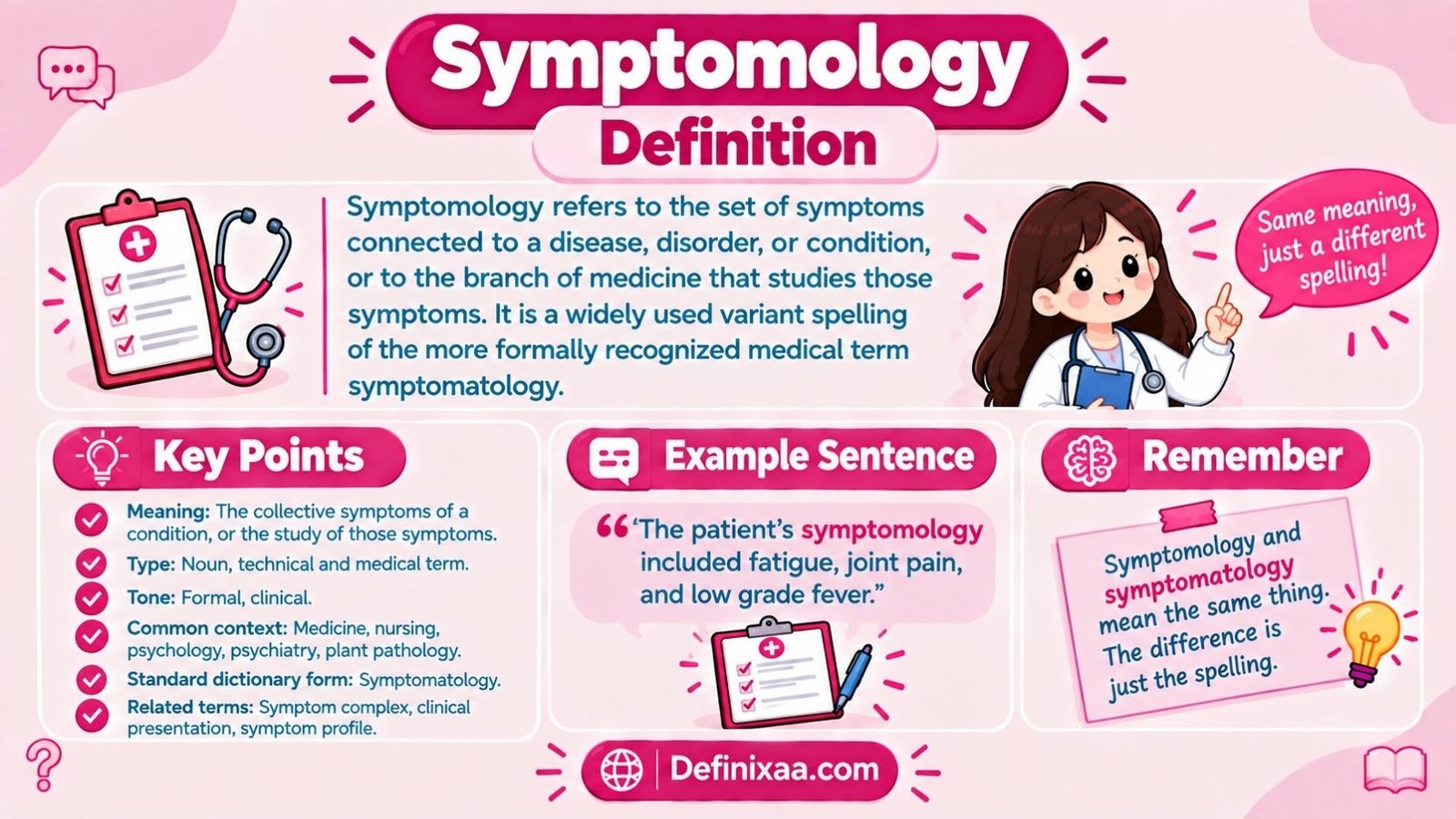
Symptomology refers to the set of symptoms connected to a disease, disorder, or condition, or to the branch of medicine that studies those symptoms. It is a widely used variant spelling of the more formally recognized medical term symptomatology. Both words point to the same idea: the pattern of signs a condition produces and what that pattern tells a clinician.
Note: Standard dictionaries such as Merriam Webster and Dictionary.com list symptomatology as the primary headword. These major dictionaries do not treat symptomology as a separate, distinct entry, but it appears constantly in medical writing, nursing coursework, and everyday health conversation as an accepted informal spelling.
At A Glance
| Detail | Information |
| Meaning | The collective symptoms of a condition, or the study of those symptoms |
| Type | Noun, technical and medical term |
| Tone | Formal, clinical |
| Common context | Medicine, nursing, psychology, psychiatry, plant pathology |
| Standard dictionary form | Symptomatology |
| Related terms | Symptom complex, clinical presentation, symptom profile |
Read More: Ocher Definition
So, What Does Symptomology Actually Mean?
At its core, symptomology describes two closely related things.
First, it can mean the full collection of symptoms that a particular illness, disorder, or condition produces. A clinician might say a patient’s symptomology includes fatigue, joint pain, and low grade fever.
Second, it can mean the branch of medical science devoted to studying symptoms themselves, including how they develop, how they cluster together, and what they reveal about an underlying cause.
Both meanings trace back to the same root idea. Symptoms are evidence. Symptomology is the organized effort to read that evidence accurately.
Is Symptomology A Word?
Yes, in practical terms it functions as a real word. It is used constantly in clinical notes, nursing textbooks, research writing, and casual health discussions across the United States.
However, there is a nuance worth understanding.
- Major dictionaries, including Merriam Webster and Dictionary.com, formally define symptomatology, not symptomology, as the standard headword.
- Symptomology is widely treated as a variant spelling that developed through common usage, likely influenced by the pattern of other “ology” words such as pathology, radiology, and dermatology.
- Style guides in academic and medical publishing generally favor symptomatology for formal writing, such as journal articles, official documentation, and textbooks.
Tip: If you are writing something formal, such as a research paper, clinical report, or academic assignment, symptomatology is the safer, dictionary-supported choice. If you are writing casually or speaking with colleagues, symptomology is understood everywhere and rarely causes confusion.
Symptomology Versus Symptomatology: Is There A Real Difference?
This is one of the most common points of confusion, so it deserves a direct answer.
There is no meaningful difference in meaning between symptomology and symptomatology. They refer to the same concept. The difference is almost entirely one of spelling convention and formality, not definition.
| Term | Meaning | Typical Use | Key Difference |
| Symptomatology | The symptom complex of a disease, or the branch of medicine concerned with symptoms | Medical journals, textbooks, formal clinical documentation | Recognized as the standard dictionary headword |
| Symptomology | The same core meaning, used as a common variant | Everyday clinical conversation, informal writing, some coursework materials | Widely used but not the primary dictionary entry |
Before you use either word, remember this: they are functionally interchangeable in meaning. The real decision is about register. Formal writing leans toward symptomatology. Everyday clinical speech very often uses symptomology, and listeners rarely notice or mind the difference.
Symptomology Definition In A Medical Context
In medicine, symptomology, or symptomatology, refers to the specific pattern of symptoms a patient presents with, and how that pattern helps guide diagnosis.
A physician evaluating a patient does not look at symptoms in isolation. They look at the symptomology as a whole picture. For example, a cluster of fever, cough, and fatigue points toward a different diagnostic path than a cluster of joint pain, rash, and sensitivity to sunlight.
Medical symptomology can include:
- Physical symptoms the patient reports, such as pain, nausea, or dizziness
- Observable signs a clinician detects, such as swelling or abnormal heart rate
- The timing and progression of symptoms over hours, days, or months
- How symptoms respond to treatment or environmental changes
Note: In strict clinical usage, symptoms are subjective experiences reported by the patient, while signs are objective findings observed by a clinician. Symptomology often refers primarily to the symptom side of that pairing, though in casual use people sometimes blend the two.
Read More: Feed Definition
Symptomology Definition In Nursing
Nursing programs use symptomology extensively, and it appears often enough in coursework that students specifically search for how it applies to their field.
For nurses, understanding a patient’s symptomology means being able to:
- Recognize which symptoms are typical for a diagnosed condition
- Identify new or worsening symptoms that may signal a complication
- Communicate symptom patterns clearly to physicians and care teams
- Document symptom changes accurately over the course of care
A nursing instructor might ask a student to describe the symptomology of congestive heart failure, meaning the student should list and explain the typical symptoms, such as shortness of breath, swelling in the legs, and fatigue, along with how these symptoms tend to develop and progress.
Tip: In nursing education, precision matters more than which spelling you choose. Instructors are generally far more concerned with whether the symptom pattern is described accurately than whether you wrote symptomology or symptomatology.
Symptomology Definition In Psychology
In psychology and psychiatry, symptomology refers to the set of behavioral, emotional, or cognitive symptoms associated with a mental health condition.
For example, the symptomology of generalized anxiety disorder typically includes persistent worry, restlessness, difficulty concentrating, and sleep disturbance. The symptomology of major depressive disorder typically includes persistent low mood, loss of interest in activities, changes in appetite, and fatigue.
Mental health symptomology is often more complex to evaluate than physical symptomology because:
- Symptoms can overlap significantly across different conditions
- Symptoms are frequently self-reported and can vary in how clearly a person can describe them
- Cultural background and personal history can shape how symptoms present
- Severity and duration matter heavily in distinguishing a clinical condition from normal emotional experience
Clinicians use structured diagnostic tools, along with careful observation of symptomology over time, to reach an accurate diagnosis rather than relying on a single symptom in isolation.
Symptomology Definition In Plant Pathology
Symptomology is not limited to human medicine. In plant pathology, it refers to the branch of the field concerned with symptoms plants display in response to disease, pests, or environmental stress, as well as the symptom pattern itself.
Plant pathologists use symptomology as a key diagnostic tool because many issues share overlapping symptoms. Wilting, for example, can result from fungal infection, bacterial disease, root damage, or simple lack of water. Careful attention to the full symptom pattern, not just one isolated sign, helps identify the true cause.
Common categories of plant symptomology include:
- Discoloration, such as yellowing or browning of leaves
- Necrosis, meaning the death of plant tissue, often appearing as spots or blighted areas
- Wilting, caused by disrupted water movement within the plant
- Abnormal growth, such as stunting, galls, or distorted leaves and stems
- Systemic versus localized symptoms, depending on whether the entire plant is affected or only a specific area
Plant pathologists typically distinguish symptoms, which are the plant’s own visible reactions, from signs, which are physical evidence of the pathogen itself, such as fungal spores or mildew. Symptomology focuses primarily on the plant’s reaction rather than the pathogen’s visible presence.
What Does Symptomology Look Like In A Sentence?
Seeing the word in context often clarifies meaning faster than any definition alone.
- Clinical setting: The attending physician reviewed the patient’s symptomology before ordering additional bloodwork.
- Nursing coursework: Students were asked to compare the symptomology of type one and type two diabetes.
- Psychology context: Her symptomology aligned closely with the diagnostic criteria for panic disorder.
- Academic writing: The study tracked changes in patient symptomology across a twelve week treatment period.
- Plant pathology: The leaf symptomology, including yellowing and curling, pointed toward a nutrient deficiency rather than infection.
- Everyday professional conversation: The two conditions have very similar symptomology, which is why early diagnosis can be difficult.
What Are Some Synonyms For Symptomatology?
While no word is a perfect one to one replacement, several terms overlap closely in meaning depending on context.
- Symptom complex: the full set of symptoms associated with a condition
- Clinical presentation: how a condition manifests in a specific patient
- Symptom profile: the pattern or combination of symptoms observed
- Symptom pattern: a more casual way to describe the same idea
- Clinical picture: a broader term covering symptoms, signs, and overall presentation
Note: These terms are related, not identical. Clinical presentation, for instance, often includes signs and test findings in addition to symptoms, while symptomology tends to focus specifically on the symptoms themselves.
Where Do People Often Get This Word Wrong?
A few common misunderstandings show up repeatedly in searches and casual usage.
- Assuming symptomology and symptomatology are different concepts. They are not. The core meaning is shared.
- Treating symptomology as strictly informal or incorrect. While dictionaries favor symptomatology, symptomology is not slang. It is a recognized variant used throughout professional medical writing and speech.
- Confusing symptoms with signs. Symptomology generally centers on symptoms, which are experienced or reported, rather than signs, which are objectively observed.
- Assuming the term only applies to human medicine. As shown in plant pathology, the concept extends naturally to any field where researchers study patterns of disease expression.
Is Symptomology Appropriate To Use?
Yes, in most professional and academic settings, symptomology is entirely appropriate and easily understood.
- It is acceptable in spoken clinical communication among healthcare professionals.
- It is commonly used in coursework, lecture material, and informal academic writing.
- It may be considered less ideal in highly formal writing, such as peer reviewed journal submissions or official medical documentation, where symptomatology is the more traditionally expected spelling.
If you are ever unsure which version to use, consider your audience. Writing for a professor, journal, or formal report favors symptomatology. Writing or speaking in a general clinical, nursing, or everyday professional context, symptomology works just as well and is instantly understood.
Read More: Enticing Definition
Symptomology In Real Use: How Professionals Actually Talk About It
Beyond formal definitions, the word does real work in daily professional life.
Doctors use it to summarize a patient’s overall condition quickly during rounds or handoffs. Instead of listing every individual complaint, a clinician might simply say the patient’s symptomology is consistent with a particular diagnosis, condensing a complex picture into one useful reference point.
Nursing students encounter it constantly while learning to differentiate similar conditions. Comparing the symptomology of two diseases side by side is a standard learning exercise because many illnesses share overlapping symptoms but differ in subtle, important ways.
In mental health settings, symptomology often becomes the foundation for diagnostic conversations, since psychological conditions are identified primarily through reported and observed symptom patterns rather than lab tests.
In agricultural and plant science settings, the word supports practical decision making. Correctly identifying symptomology, such as leaf pattern or wilting type, can be the difference between treating a curable nutrient issue and losing a crop to an untreated infection.
Frequently Asked Questions
What does symptomology mean in simple terms?
It means the group of symptoms linked to a condition, or the study of those symptoms. It helps professionals understand and diagnose what is happening.
Is symptomology the same as symptomatology?
Yes, they share the same core meaning. Symptomatology is the term found in standard dictionaries, while symptomology is a widely used variant spelling.
Is symptomology a real medical word?
It functions as a real, widely used word in medicine, nursing, and psychology, even though major dictionaries list symptomatology as the primary form.
What is the difference between a symptom and symptomology?
A symptom is one individual sign of a condition. Symptomology is the complete pattern or collection of symptoms considered together.
How is symptomology used in nursing?
Nurses use it to describe the typical symptom pattern of a diagnosed condition and to track changes in a patient’s symptoms over time.
Can symptomology apply outside of human medicine?
Yes, plant pathology uses the same concept to describe and study the symptoms plants display in response to disease or stress.
Which spelling should I use in academic writing?
Symptomatology is generally preferred in formal academic and clinical writing, since it matches standard dictionary entries and typical journal style.
What is a synonym for symptomatology?
Common alternatives include symptom complex, clinical presentation, and symptom profile, though each carries slightly different shades of meaning.
Why do symptoms matter more than a single symptom?
Looking at the full symptomology, rather than one isolated symptom, helps professionals distinguish between conditions that may share individual symptoms but differ overall.
Is symptomology used in psychology as well as medicine?
Yes, psychologists and psychiatrists use it regularly to describe the emotional, behavioral, and cognitive symptoms associated with mental health conditions.
The Simple Takeaway
Symptomology describes the full set of symptoms tied to a condition, or the study of those symptoms, and it functions essentially the same as symptomatology in everyday and clinical use.
Dictionaries favor symptomatology as the formal entry, but symptomology remains common and clearly understood across medicine, nursing, psychology, and even plant pathology. The choice comes down to formality rather than meaning, so the safest approach is to match your spelling to your audience.

Laiba Rahman is a writer and researcher behind Definixaa, dedicated to exploring words, meanings, terms, concepts, and everyday knowledge. Through clear and well-researched explanations, her goal is to help readers understand unfamiliar ideas quickly and discover useful information with ease.
3 Comments