
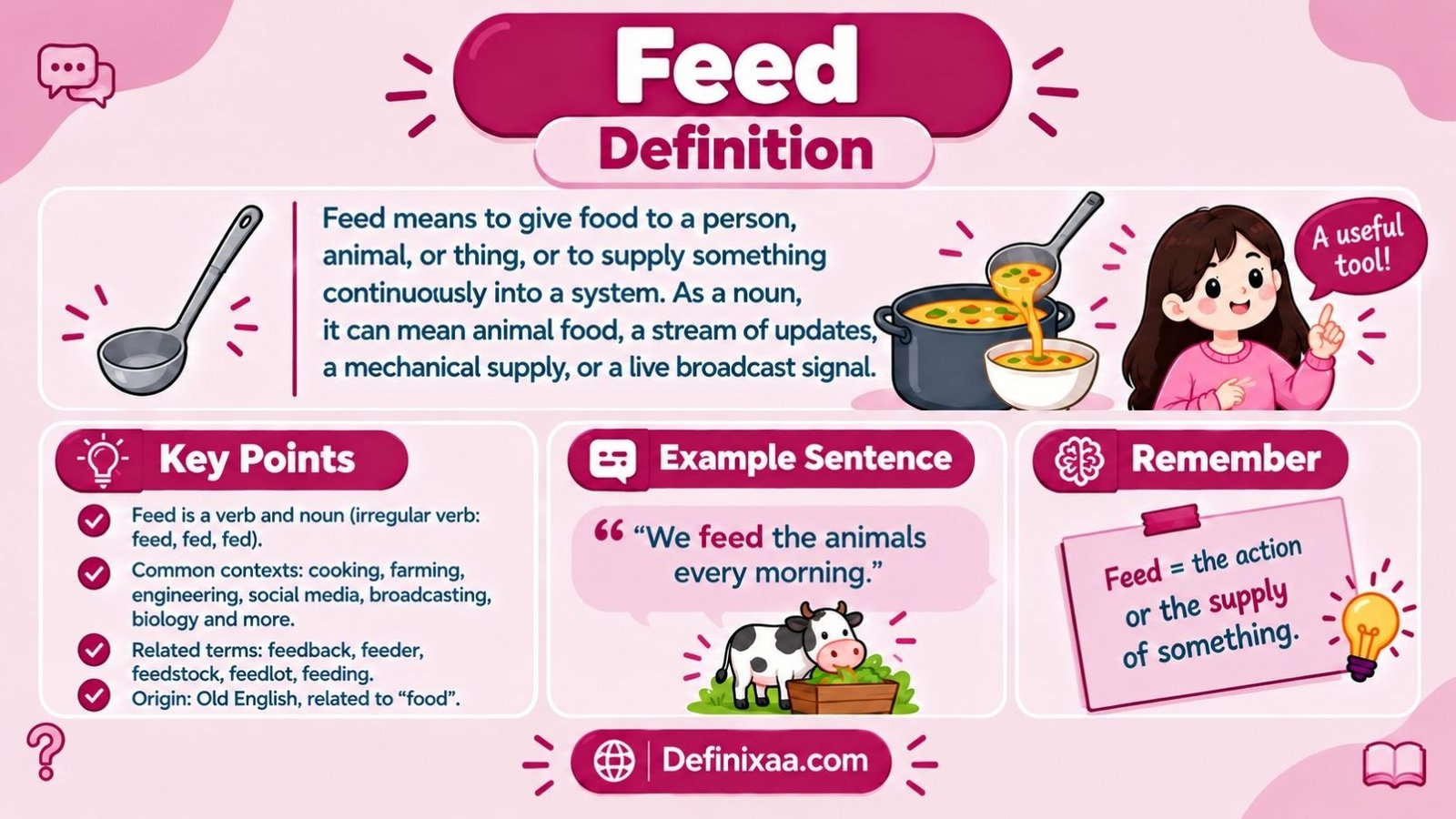
Feed means to give food to a person, animal, or thing, or to supply something continuously into a system. As a noun, feed can mean animal food, a stream of updates (like an RSS feed or a social media feed), a mechanical supply mechanism, or a live broadcast signal. The exact meaning always depends on context.
At A Glance
| Detail | Information |
| Type | Verb and noun, irregular verb (feed, fed, fed) |
| Tone | Neutral, everyday word |
| Common contexts | Cooking and parenting, agriculture, engineering, social media, broadcasting, biology |
| Related terms | Feedback, feeder, feedstock, feedlot, feeding |
| Origin | Old English, related to “food” |
Feed is one of those small, everyday words that quietly shows up in a dozen unrelated industries. A farmer, a machinist, a new parent, and a social media manager all use the word “feed” constantly, but they rarely mean the same thing. This article walks through every major meaning, in plain language, with real usage guidance for each one.
So, What Is Feed in Simple Terms?
At its core, feed describes an ongoing supply of something. That something can be food, information, material, or electricity.
- When you feed a baby or a pet, you are supplying nourishment.
- When a machine has a “feed,” it is supplying material into a process.
- When an app has a “feed,” it is supplying a stream of content.
Every specialized meaning below is really just a variation on this same idea: something is being continuously provided.
Read More: Immaculate Definition
Where Does the Word Feed Come From?
Feed has old roots. It comes from the Old English word fedan, meaning to nourish, give food to, sustain, or foster, which traces back to a Proto-Germanic root and ultimately to a Proto-Indo-European root meaning “to feed.” It is a close relative of the word “food” itself.
The word has expanded in meaning over the centuries. According to etymological research, the sense of “food for animals” was first recorded in the 1580s, and the use of feed to describe machinery, such as the action or system for supplying raw material, dates to around 1892. The modern digital sense, describing an internet content stream, is simply the newest branch on that same tree: something is still being continuously supplied, just now it is information instead of hay or coal.
Feed is also an irregular verb. The past tense and past participle are both “fed,” not “feeded.” “I feed the dog every morning” becomes “I fed the dog this morning.”
Meaning One: Feed As Giving Food
This is the meaning most people learn first, and it remains the most common everyday use of the word.
Formal meaning: Merriam-Webster’s core definition centers on giving food to someone or something, and by extension, supplying whatever is needed to sustain, maintain, or keep something running.
In simple words: You feed someone by giving them something to eat, whether that’s a baby, a pet, livestock, or a whole family.
What Does Feed Look Like in a Sentence?
- Everyday: “Can you feed the cat before you leave for work?”
- Parenting: “We feed the baby every three hours.”
- Professional or charitable: “The shelter feeds around two hundred people a night.”
- Figurative: According to Merriam-Webster’s simple definition, this word is sometimes used figuratively, as in “he was feeding information to the enemy,” meaning he was secretly giving information to someone.
Note
Feed is not only about placing food directly into someone’s mouth. Collins Dictionary explains that feeding a family or community usually means supplying food for them, as in “we have the technology to feed the population of the planet.” So feed can describe both a hands-on action and a larger-scale act of provision.
Human Feed Definition: Everyday And Figurative Uses
When people search “human feed definition,” they are usually just asking how “feed” applies to people rather than animals or machines. The answer is the same core meaning: providing food, either directly (spoon-feeding a child) or indirectly (a food bank feeding a community).
It can also stretch figuratively, describing supplying someone with information, ideas, or even lines in a comedy act. Collins notes that to feed a performer means to supply an actor, especially a comedian, with lines or action, where the responses are expected to get a laugh.
Feed Definition For Kids
For younger readers or simple explanations, feed can be described this way:
Feed means giving food to a person or an animal so they can eat and grow. When you feed your dog, you put food in its bowl. When a mother bird feeds her babies, she brings them food to eat. Feed can also mean the food itself, like the feed you give chickens or horses.
This simple version keeps the accuracy of the dictionary definition while using vocabulary a child can follow.
Feed Definition Bible
In religious and biblical usage, “feed” often carries the same core meaning of nourishment, but it is frequently used metaphorically to describe spiritual guidance and care, such as a shepherd feeding a flock or a leader feeding followers with teaching and wisdom.
This metaphorical use draws directly on the literal, agricultural meaning of feeding livestock, applied to spiritual nourishment instead of physical food. Because interpretations of specific verses vary by translation and denomination, this article does not attempt to interpret particular scripture passages, but the underlying sense of the word, “to nourish or sustain,” remains consistent with its everyday meaning.
Meaning Two: Feed In Animal Nutrition And Agriculture
Feed Definition In Animal Nutrition And Agriculture
In farming, “feed” is a noun describing food specifically prepared for livestock and poultry. Britannica explains that in agriculture, feed refers to food specifically grown or developed for livestock and poultry, and modern animal feeds are carefully formulated to provide highly nutritional diets that maintain animal health and improve the quality of products like meat, milk, or eggs.
This is different from casual “food.” Feed is typically a manufactured or grown product, such as grain, pellets, or hay, designed to meet an animal’s specific nutritional needs.
Animal Feed Definition And Feed Synonyms
Dictionary.com draws a useful distinction between four related words:
- Feed is the general word for animal food, as in pig feed or chicken feed.
- Fodder especially applies to dry or green feed, as opposed to pasture, given to horses and cattle.
- Forage is food an animal finds for itself, such as grass, by searching around.
- Provender denotes dry feed like hay, oats, or corn.
According to Dictionary.com, these four words all mean food for animals, with feed being the general word, fodder applying to dry or green feed given to livestock, forage referring to food an animal obtains by searching for it, and provender denoting dry feed such as hay, oats, or corn.
Tip: If you are writing about livestock and want to sound precise, use “fodder” for stored dry feed, “forage” for grazed food, and “feed” as the safe, general-purpose term.
Feedlot Definition
A feedlot, sometimes called a feed yard, is a specific type of farm operation. It is a confined facility used in intensive livestock farming, most commonly for beef cattle but also for swine, sheep, poultry, and other animals, where they are held and fattened before going to slaughter. The largest of these facilities are officially classified in the United States as concentrated animal feeding operations.
The core purpose of a feedlot is efficiency: animals are kept in confined pens and fed a concentrated, usually grain heavy diet so they gain weight as quickly as possible before processing.
Creep Feed Definition
Creep feed is a more specialized term inside animal agriculture. Wikipedia describes creep feeding as a method of supplementing the diet of young livestock, primarily beef calves, by offering feed to animals who are still nursing. The same source notes it is sometimes offered to swine, and is possible with companion grazing animals such as sheep and goats.
The “creep” in the name refers to the physical feeder design: a structure sized so young animals can slip in to eat while their larger mothers cannot fit through, so the milk supply and the extra feed both stay available to the young animal.
Force Feed Definition
Force feeding means physically compelling a person or animal to eat or drink, typically against their will, often through mechanical or manual means such as a tube. This term appears in contexts including animal husbandry (traditionally in some meat and foie gras production), medical care (feeding tubes for patients unable to eat safely on their own), and, more controversially, historical and political contexts involving hunger strikes.
Because this term intersects with medical ethics and human rights, its acceptability and legality vary significantly by context and jurisdiction; readers researching a specific application should consult authoritative medical or legal sources for that context.
Feedstock Definition
Feedstock is a related but distinct industrial term. It refers to raw material supplied to a machine or industrial process, most often in manufacturing, refining, or energy production.
For example, crude oil is a feedstock for a refinery, and corn can be a feedstock for ethanol production. The word borrows the same “continuously supplied input” logic as animal feed, just applied to industrial raw materials rather than nourishment.
Meaning Three: Feed In Engineering And Machining
Feed Definition Engineering
In mechanical and manufacturing engineering, “feed” describes the rate or motion at which material or a cutting tool advances during a process. This concept underlies feed definition in machining, feed definition in lathe machines, and cutting feed definition generally.
Feed Definition In Machining And In A Lathe Machine
According to a manufacturing processes textbook, the feed of a lathe is the distance the cutting tool advances along the length of the workpiece for every revolution of the spindle. For example, the same source explains, if a lathe is set for a 0.020 inch feed, the cutting tool travels 0.020 inch along the workpiece for every complete turn the workpiece makes.
More broadly, in CNC and general machining, feed rate is defined by Wikipedia as the relative velocity at which the cutter is advanced along the workpiece, with its vector perpendicular to the vector of cutting speed.
The same source notes that feed rate units depend on the motion of the tool and workpiece, and when the workpiece rotates, as in turning and boring, the units are almost always distance per spindle revolution, such as inches per revolution or millimeters per revolution.
Comparison
| Term | Meaning | Typical Use | Key Difference |
| Feed rate | How far the cutting tool advances per revolution or per minute | Turning, milling, drilling operations | Governs surface finish and material removal rate |
| Cutting speed | How fast the cutting edge moves relative to the workpiece surface | Determining spindle RPM | Governs tool wear and heat generation |
Feed rate and cutting speed are frequently confused because both are speed-related settings on the same machine, but a manufacturing guide clarifies that feed rate dictates how fast the material moves past the cutting tool and influences the depth of cut, the material removal rate, and surface roughness, while cutting speed refers to how fast the cutting tool engages with the material.
Before You Use “Feed Rate,” Remember This
Feed rate is not the same as cutting speed, even though both are commonly discussed together on a machine shop floor. Getting them confused when programming a CNC machine can lead to a poor surface finish or premature tool wear.
Meaning Four: Feed in Social Media, News, and the Internet
This is one of the newest senses of the word, and it is now one of the most searched.
Feed Meaning In Social Media
Merriam-Webster defines this modern sense of feed as an Internet service in which updates from electronic information sources, such as blogs or social media accounts, are presented in a continuous stream, and also the information presented by such a service.
In everyday use, “feed” on Instagram, X, Facebook, or TikTok refers to the running list of posts a user sees when they open the app: their own grid of posts (an “Instagram feed”), or the algorithmically or chronologically ordered stream of other people’s content.
Instagram Feed Definition And Social Media Feed Definition
An Instagram feed specifically refers to the main scrollable stream of photos and videos on a user’s profile or home screen. A social media feed, more broadly, is the same idea applied to any platform: a continuously updated stream of posts, often ranked or filtered by an algorithm rather than shown in strict chronological order.
News Feed Definition And Activity Feed Definition
A news feed is a stream of news style updates, whether that is Facebook’s central home page stream (historically named the “News Feed”) or a media outlet’s list of recent headlines.
An activity feed is a related but distinct concept, most common in software and workplace tools: it is a running log of actions taken within an app or system, such as “Jordan uploaded a file” or “Priya commented on your post,” rather than original content people chose to publish.
Read More: Persevere Definition Explained
RSS Feed Definition
RSS feed is a more technical, older cousin of the social media feed. Britannica explains that an RSS feed is a set of instructions residing on the computer server of a website, which is given upon request to a subscriber’s RSS reader, or aggregator, and the feed tells the reader when new material, such as a news article, blog posting, or audio or video clip, has been published on the website.
RSS Feed Definition Purpose And Explanation
The purpose of RSS is convenience and control. Rather than checking many websites manually, a person subscribes once, and updates arrive automatically. As one government resource puts it, RSS is an acronym for Really Simple Syndication, a method for easily distributing information to users automatically from a website, and information delivered through this method is called a feed.
RSS was not an overnight phenomenon. According to a peer-reviewed introduction to the technology, RSS has been around in some form since about 1999, when it was first introduced by the browser pioneer Netscape, and adoption accelerated in 2002 when The New York Times began offering RSS feeds, followed by major browsers integrating the technology directly by 2005.
RSS Feed Definition W3C And Technical Framing
RSS is technically a family of related XML based web feed formats, standardized informally rather than through a single strict specification body.
A university library guide describes it this way: Really Simple Syndication is the term used to refer to the collection of web feed formats that provide updated or shared information in a standardized way, and that information could be website or blog entries, news headlines, or audio or video files.
Readers looking for the precise technical schema should consult the current RSS specification documentation directly, since exact version details are a technical matter best confirmed at the source rather than summarized secondhand.
Data Feed Definition and Product Feed Definition
Outside of blogs and news, “feed” also describes structured streams of raw data moving between systems.
- A data feed is a continuously updated stream of structured data, such as stock prices, weather data, or sports scores, delivered from one system to another for automated use.
- A product feed is a structured file, usually in XML or CSV format, listing a retailer’s products with details like price, availability, and description, used to power shopping ads and online marketplaces.
- An OPRA options data feed refers to a specific real-time market data feed distributed by the Options Price Reporting Authority, delivering options quotes and trade data to brokers and financial platforms. Because financial data feed specifications and pricing change over time, anyone building on this feed should check OPRA’s own current documentation rather than relying on older summaries.
Drip Feed Definition
A drip feed, in the digital and marketing sense, means releasing content, information, or messages gradually over time rather than all at once, similar to the medical image of a slow, steady intravenous drip. It is commonly used in email marketing (“a drip fed email sequence”) and in content or social media scheduling.
Live Feed Definition
A live feed is a real time video or audio stream, typically from a camera or broadcast source, delivered as events happen rather than pre-recorded. Merriam-Webster’s own example sentences include this exact modern usage: “a live feed of the proceeding from The Associated Press,” describing a real time broadcast stream of a courtroom event.
Cluster Feed Definition
Cluster feed most often appears in a parenting context, closely related to but distinct from the dream feed discussed below. It describes a baby feeding multiple times in quick succession over a short window, usually in the evening, rather than following the usual spaced out feeding schedule.
It is generally considered a normal, temporary pattern rather than a sign of a problem, though parents with ongoing concerns about feeding frequency should check with a pediatrician.
Is a “Feed” the Same as a “Broadcast Signal”?
Yes, in one specific sense. Collins Dictionary lists a broadcasting definition of feed as a transmission by satellite, landlines, or similar means, such as that sent by a network to individual stations for broadcast, or a local television broadcast distributed by satellite or network to a wider audience.
This is the sense behind phrases like “satellite feed” or “network feed,” common in television and radio production long before the social media sense of the word existed.
Meaning Five: Feed Meaning In Chat And Texting
“Feed” rarely changes meaning in texting; people usually just use it in its ordinary internet sense, referring to a social media feed (“did you see that on your feed?”).
It can also appear as informal slang for gossip or information, similar to “spill the tea,” as in “feed me the details,” which draws on the figurative “feeding someone information” sense described earlier. This use is casual and conversational, not formal or professional English.
Meaning Six: Dream Feed
Dream Feed Definition: Feeding Baby While Asleep
A dream feed is a parenting technique, not a medical or clinical term, describing a feeding given to an infant while they are mostly or fully asleep, usually in the evening before the parent goes to bed. According to a parenting research resource, the person credited with coining the term, Tracey Hogg, defines dream feeding as feeding a young infant while he or she sleeps.
In practice, most sources describe it slightly differently: gently rousing the baby just enough to feed, without a full wake-up. One pediatric source explains that a dream feed is a late night feeding session given to a child while they are mostly asleep, typically done in the earlier part of the night before a parent goes to sleep.
Another parenting resource frames the goal plainly: dream feeding is meant to “tank your baby up” before the parent goes to sleep, in hopes the baby will sleep a longer stretch before waking again.
When Should You Try a Dream Feed?
- Many families start around six to eight weeks old, once feeding is well established.
- It’s typically offered between roughly nine in the evening and midnight, shortly before the parent’s own bedtime.
- It is a voluntary technique, not a medical requirement. Some families find it useful; others do not, particularly if a baby wakes for reasons unrelated to hunger.
Note: Dream feeding is a caregiving strategy, and results vary by baby. Parents with concerns about their infant’s feeding, weight gain, or sleep should talk to their pediatrician rather than relying solely on general parenting guidance.
Meaning Seven: Feedback And Related Words
Feedback is built directly from “feed,” but it has drifted into its own distinct meanings across several fields.
Feedback Definition And Feedback Definition In Communication
In communication, feedback is the response that lets a sender know their message was received and understood.
One educational summary describes the components of a communication feedback loop as including a sender who originates the message, the message itself, the channel through which it travels, the receiver, and feedback, which is the receiver’s response or reaction that informs the sender about the accuracy of understanding.
Feedback Loop Definition And Feedback Mechanism Definition
Outside of communication, a feedback loop describes any system where outputs circle back to influence future inputs.
MasterClass defines it broadly: a feedback loop is a cause and effect system in which the outputs of a system feed back in as inputs and prompt new cycles, which makes some feedback loops self sustaining without an identifiable starting point and endpoint.
This concept spans engineering, ecology, economics, and business management, wherever a system monitors its own results and adjusts accordingly.
Feedback Inhibition Definition (Biology) And Feedback Inhibition Definition
In biology and biochemistry, feedback inhibition is a much more specific, technical term. Britannica defines it as the suppression of the activity of an enzyme, participating in a sequence of reactions by which a substance is synthesized, by a product of that sequence, so that when the product accumulates beyond an optimal amount, its own production is decreased by inhibiting an enzyme involved in making it.
In simpler words, the end product of a chemical chain reaction “tells” an earlier enzyme in that same chain to slow down, preventing the cell from wasting energy making more than it needs.
Feeder Definition
A feeder can mean several closely related things depending on the field:
- A device that dispenses food (a bird feeder, a livestock feeder).
- A road or rail line that channels traffic into a larger route (a “feeder road”).
- In electrical engineering, a line that supplies power from a main source to a distribution point.
- In finance, a “feeder fund” channels investor money into a larger master fund.
Feed Definition Past Tense
The past tense and past participle of the verb feed are both “fed,” an irregular form rather than “feeded.” This is worth flagging because “feeded” is a common mistake among English learners.
- Present: “I feed my dog twice a day.”
- Past: “I fed my dog this morning.”
- Past participle: “The baby has been fed.”
What Does Feed Not Mean?
A few quick clarifications prevent common mix-ups:
- Feed is not the same as “feet” (the plural of foot), despite similar spelling in casual typing or autocorrect.
- An animal feed is not automatically the same as “fodder,” “forage,” or “provender,” even though all four describe animal food; each has a slightly different technical scope, as shown earlier.
- A “feedback loop” in casual business language and a “feedback loop” in engineering or biology describe the same general structural idea, but the technical mechanisms behind them are very different, so context always matters.
- A social media “feed” and an RSS “feed” are related in spirit (both are continuous content streams) but differ technically: RSS is an open, subscriber controlled standard, while a social media feed is typically shaped by a private company’s ranking algorithm.
Is Feed Formal, Informal, or Technical?
The core verb, “to feed,” is completely standard and neutral English, appropriate in any setting, from a children’s book to a legal document.
The word only becomes technical or field specific in its noun forms: “feed rate” is technical machinist language, “OPRA feed” is technical financial language, and “dream feed” is informal parenting terminology rather than a clinical medical term.
Positive, Negative Or Neutral?
Feed is generally a neutral word. It carries a mildly positive connotation when describing nourishment or care (feeding a hungry family), and it is entirely neutral and functional in technical or industrial contexts (feed rate, data feed).
It only takes on a negative tone in specific idiomatic phrases, such as “fed up,” which Etymonline traces to British slang first recorded in 1900, meaning surfeited, disgusted, or bored.
Read More: Ladle Definition
How Is Feed Actually Used in Real Life?
Putting all of this together, here is how the word tends to show up depending on setting:
- At home: feeding pets, feeding a family, feeding a baby, dream feeding.
- On a farm: animal feed, feedlot, creep feed, fodder versus forage.
- In a workshop: feed rate, cutting feed, lathe feed settings.
- Online: Instagram feed, news feed, RSS feed, data feed, product feed.
- In an office or classroom: feedback, feedback loop, giving and receiving feedback on work.
- In a science lab: feedback inhibition, metabolic regulation.
Very few English words stretch across this many completely different professional worlds while keeping one consistent underlying idea: something is being continuously supplied.
Frequently Asked Questions
What does feed mean in one sentence?
Feed means to give food to someone or something, or to supply something, such as material, power, or information, into a system on an ongoing basis.
Is feed the same as food?
No. Food is the substance itself, while feed is usually the act of giving food, or, as a noun, food prepared specifically for animals, such as chicken feed or cattle feed.
What is the past tense of feed?
The past tense and past participle of feed are both “fed.” For example, “I fed the horses this morning.”
What does feed mean on Instagram or social media?
On social media, a feed is the continuously updating stream of posts a user scrolls through, whether their own profile grid or an algorithmically ranked stream of other accounts’ content.
What is an RSS feed used for?
An RSS feed lets a website automatically notify subscribers whenever new content, such as a blog post or news article, is published, without requiring the subscriber to visit the site manually.
What is a dream feed for a baby?
A dream feed is a feeding given to an infant while they are mostly asleep, usually in the evening, intended to help the baby (and parents) sleep a longer stretch before the next hunger driven wake up.
What is the difference between feed and feedback?
Feed generally describes supplying something, such as food or content. Feedback describes a response that circles back, whether that’s a person’s reaction to a message, or a system output that influences its own future behavior.
What does feed rate mean in machining?
Feed rate is the speed at which a cutting tool advances into or along a workpiece, usually measured as distance per spindle revolution or distance per minute, and it directly affects surface finish and tool wear.
What is a feedlot?
A feedlot is a confined agricultural facility, most often for beef cattle, where animals are fed a concentrated, usually grain based diet to gain weight efficiently before slaughter.
What does creep feed mean?
Creep feed is supplemental food offered to young, still nursing livestock, such as calves or piglets, through a feeder designed so only the smaller young animals can access it.
Is “fed up” related to the word feed?
Yes. According to etymological research, the phrase is British slang first recorded in 1900, likely connected to earlier phrases like “fed up to the back teeth,” and was originally used of livestock in the sense of fattening them up through feeding.
What does feedback inhibition mean in biology?
Feedback inhibition is a regulatory process in which the final product of a chain of chemical reactions slows down or stops an earlier enzyme in that same chain, preventing the cell from producing more of the product than it needs.
The Simple Takeaway
Feed always circles back to one idea: a continuous supply, whether that’s food for a person or animal, material moving through a machine, or content streaming through an app. The specific meaning always depends on where you encounter it, from a farm to a factory floor to a phone screen, but the underlying logic of “something being steadily provided” never really changes.

Laiba Rahman is a writer and researcher behind Definixaa, dedicated to exploring words, meanings, terms, concepts, and everyday knowledge. Through clear and well-researched explanations, her goal is to help readers understand unfamiliar ideas quickly and discover useful information with ease.
2 Comments