
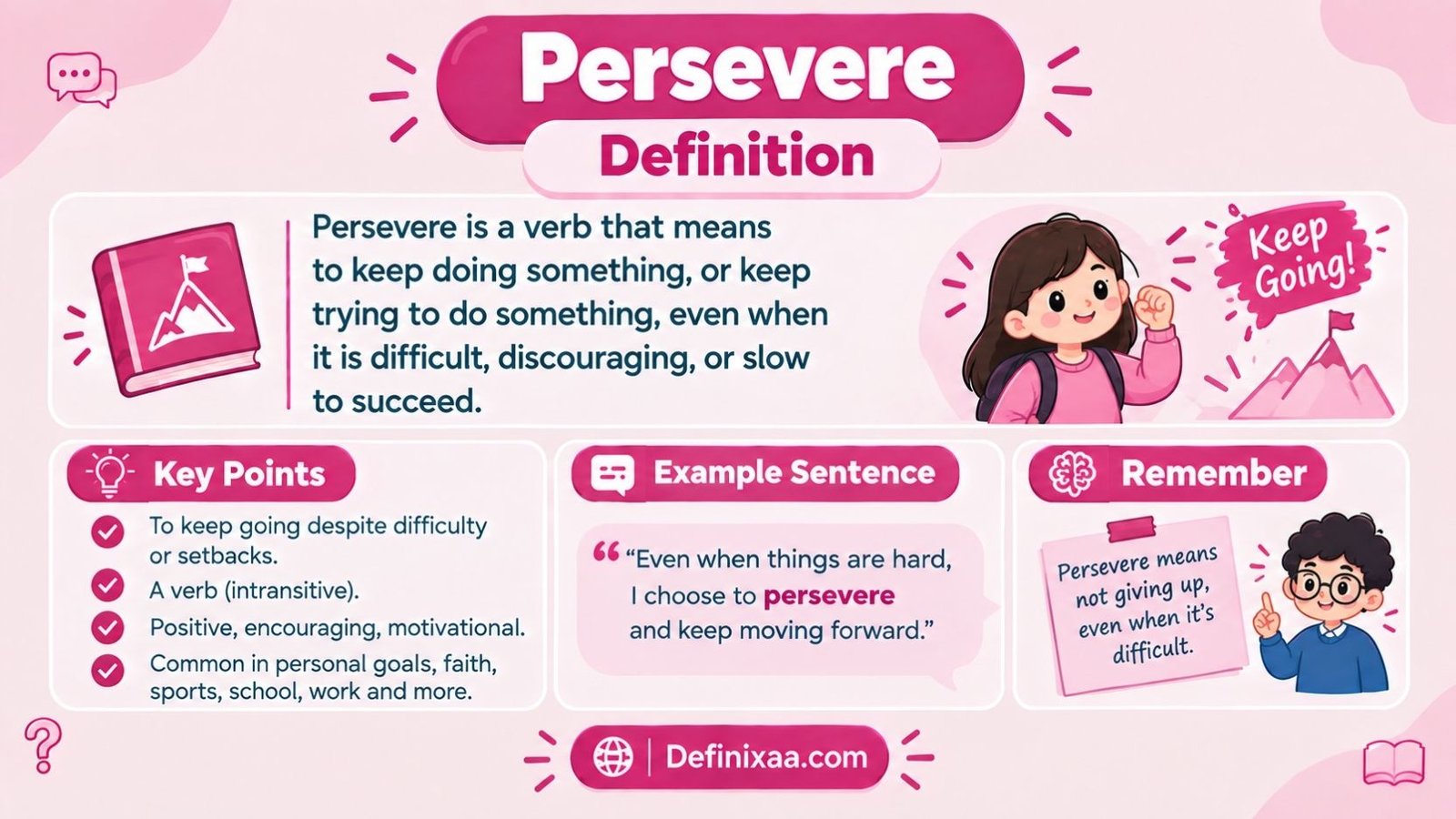
Quick definition: Persevere is a verb that means to keep doing something, or keep trying to do something, even when it is difficult, discouraging, or slow to succeed. It describes steady effort that continues in spite of obstacles rather than a single burst of motivation.
Merriam Webster’s formal entry defines the word around persisting in a state, enterprise, or task despite opposition or discouragement, while its simpler learner friendly entry puts it more plainly as continuing to try even though something is difficult.
At A Glance
| Detail | Information |
| Meaning | To keep going with something despite difficulty or setbacks |
| Word type | Verb (intransitive) |
| Tone | Positive, encouraging, motivational |
| Register | Neutral to slightly formal, used in speech and writing |
| Common contexts | Personal goals, faith, sports, school, work, math education |
| Related words | Perseverance, persevering, persevered, perseverer |
Read More: Emaculate Definition
What Does Persevere Actually Mean, in Simple Words?
In plain English, to persevere means to keep trying instead of giving up. Someone who perseveres does not necessarily enjoy the struggle. They simply refuse to quit before the task is finished or the goal is reached.
Dictionary.com frames the word the same way for everyday readers, describing it as the behavior of someone who keeps trying despite major setbacks, usually in a tone of quiet admiration rather than criticism.
The word usually implies three things at once.
- There is a real difficulty, obstacle, or source of discouragement.
- The person keeps working toward the same goal rather than switching direction entirely.
- The effort continues over time rather than stopping after a single attempt.
If any of those three pieces is missing, a different word usually fits better. Simply repeating an action with no goal is closer to persisting or repeating. Trying once and stopping is not perseverance at all.
How Do You Pronounce Persevere?
Persevere is pronounced per suh VEER, with the stress falling on the final syllable. Written more formally, the pronunciation is close to pur suh VIHR.
A simple way to say it out loud is to break it into three parts, per, suh, and VEER, and put the emphasis on VEER at the end. Related word forms follow the same rhythm.
- Perseverance is said per suh VEER unss.
- Persevering is said per suh VEER ing.
- Persevered is said per suh VEERD.
Where Does the Word Persevere Come From?
Persevere entered English in the late thirteen hundreds, arriving through Old French from an earlier Latin verb. According to Merriam Webster’s etymology notes, the word traces back to the Latin persevērāre, itself built from a root meaning stern or strict.
Language reference sites such as Etymonline describe the same connection: the Latin form combined a prefix meaning thoroughly with the adjective severus, meaning serious or strict, giving the whole word an original sense of steadfast seriousness rather than casual effort.
That origin helps explain why persevere still carries a certain weight today. It does not describe casual persistence. It describes the kind of sustained, disciplined effort that early Latin speakers associated with strictness and resolve. The word appears in English writing as early as the fourteen hundreds, and Shakespeare used it in King Lear in the early sixteen hundreds, showing that its core meaning has stayed remarkably stable for centuries.
What Does Persevere Look Like in a Sentence?
Original examples show how naturally the word fits into everyday writing and speech.
- Everyday conversation: I know the diet has not shown results yet, but try to persevere for another month.
- School or academic setting: The teacher reminded her students to persevere through the difficult chapter instead of skipping the hard problems.
- Workplace: The launch was delayed twice, but the product team decided to persevere and finish the project on their own timeline.
- Sports: Down two goals at halftime, the team chose to persevere rather than accept defeat early.
- Personal goal or health: He wanted to quit training after the injury, but his physical therapist encouraged him to persevere.
- Faith or reflection: She often repeats the phrase I will persevere when life feels overwhelming, treating it as a personal reminder rather than a complaint.
Notice that persevere almost always needs a sense of what is being pushed against. It usually appears alongside words such as through, in, or despite, as in persevere through hardship, persevere in her studies, or persevere despite setbacks.
How Is Persevere Actually Used in Real Life?
Persevere shows up across very different settings, and the tone stays fairly consistent in each one.
- In motivational and self improvement writing, persevere is one of the most common words used to describe grit, determination, and refusing to give up on a long term goal.
- In sports journalism, writers frequently use persevere to describe athletes or teams overcoming injuries, losing streaks, or difficult seasons.
- In religious and faith based writing, especially Christian writing, persevere is a key word tied to spiritual endurance through hardship, temptation, or suffering.
- In education, persevere is central to how teachers describe problem solving skills, especially in math, where giving up on a hard problem is treated as the opposite of the desired behavior.
- In news and business writing, persevere often appears when describing a company, entrepreneur, or public figure who kept operating through financial trouble, controversy, or failure before eventually succeeding.
Across every context, the tone of persevere is almost always positive or admiring. Writers rarely use it sarcastically or negatively, which sets it apart from near synonyms such as stubborn or obstinate.
Persevere Definition For Kids
For younger readers, persevere can be explained even more simply.
Persevere means to keep trying, even when something is hard, instead of giving up.
Example for kids: Learning to ride a bike is hard at first. If you fall down and get back up to try again, you are persevering.
A simple way to teach the idea to children is through three short questions. Is the task hard right now? Do I still want to finish it? Am I willing to keep trying instead of quitting? If the answer to all three is yes, that is what it means to persevere.
Persevere And Perseverance: What Is the Difference?
Persevere is the action word, or verb. Perseverance is the noun that names the quality or the ongoing effort itself.
Merriam Webster’s entry for perseverance describes it as continued effort toward something despite difficulties, failure, or opposition, essentially the noun form of the same idea captured by persevere.
So a person perseveres, and the quality they are showing while doing it is called perseverance. The related adjective persevering describes someone who is currently doing it, as in a persevering student or a persevering athlete. Perseverer, though far less common, refers to a person who perseveres, essentially meaning a persistent person.
Is Persevere the Same as Persist?
Persevere and persist overlap closely, and many dictionaries even list persist as a top synonym. There is, however, a small difference in feel that is worth knowing.
| Term | Meaning | Typical Use | Key Difference |
| Persevere | To keep going with effort despite difficulty or discouragement | Long term goals, hardship, personal growth, faith | Carries a sense of admirable, effortful struggle |
| Persist | To continue doing something, often repeatedly or stubbornly | Habits, behaviors, arguments, symptoms | Can be neutral or even negative, such as a persistent cough or a persistent problem |
In short, persevere almost always sounds positive, describing someone overcoming real difficulty. Persist is more neutral and can describe something continuing whether that is good, bad, or simply ongoing, such as rain that persists through the weekend.
Read More: Grately Definition
Persevere In The Bible: What Does It Mean in Scripture?
Persevere is a common word in modern English Bible translations, especially the New International Version, where it usually translates a Greek word tied to patient endurance under trial.
One of the clearest examples is James 1:12, which describes a person as blessed for persevering under trial, since standing firm through testing is followed by a promised reward for those who remain faithful.
In this Bible dictionary sense, persevere does not simply mean staying busy. It means remaining faithful and steady through suffering, temptation, or hardship without giving up on one’s faith. Bible commentators generally explain the underlying Greek concept as bearing up patiently and calmly under affliction, rather than merely surviving it or complaining through it.
This is why the phrase I will persevere carries extra weight for many readers with a faith background. It is often used as a personal statement of continued trust and endurance, not only a statement about finishing an ordinary task.
Note: A Bible dictionary entry for persevere will usually connect the word to related ideas such as endurance, steadfastness, and standing firm, since English translators often choose between these words depending on the exact verse and translation being used.
Persevere In French: Je Persévère and Persévérer
Persevere has a direct cognate in French, thanks to the shared Latin root. The French verb is persévérer, and it carries essentially the same meaning as the English word: to continue steadily despite difficulty.
Je persévère simply means I persevere or I keep going, and it is used the same way an English speaker would use the phrase, as a personal statement of determination. The French noun form, persévérance, also matches the English word perseverance closely in both spelling and meaning.
This close overlap is not a coincidence. Both the English and French words descend from the same Latin verb, perseverare, which explains why the translation between the two languages is almost word for word.
Endeavor To Persevere: Where That Phrase Comes From
Anyone researching persevere online will often run into the phrase endeavor to persevere. This line became widely known through the 1976 Western film The Outlaw Josey Wales, in which a Cherokee character recalls being told by a government official to endeavor to persevere, then wryly notes that after thinking it over, his people declared war instead.
The exact origin of the wording is debated. Some writers have linked similar phrasing to Abraham Lincoln or other historical figures, though that attribution is not firmly documented. What is clear is that the phrase spread widely after the film and is now used, often half jokingly, as a personal motto meaning something close to try hard and do not give up.
In this phrase, endeavor adds the idea of active effort, while persevere adds the idea of continuing that effort over time. Together the two words describe someone who is not just hoping things work out, but is actively working and refusing to quit.
Adapt And Persevere: A Related Phrase
A similar phrase, adapt and persevere, is common in military, outdoor survival, and workplace resilience contexts. It combines two separate ideas. Adapting means changing your approach when circumstances shift, while persevering means continuing to push toward the same underlying goal.
Used together, the phrase suggests that stubbornly repeating a failing method is not the same as real perseverance. Genuine perseverance often includes adjusting the method while keeping the goal the same.
Persevere In Math: What Does It Mean in a Classroom?
Persevere has a specific, well defined meaning in American math education because of the Common Core State Standards for Mathematics. The very first Standard for Mathematical Practice is built around making sense of problems and persevering in solving them, and it sits alongside seven other standards covering skills such as reasoning and modeling with mathematics.
In this classroom setting, persevering means a student keeps working through a difficult math problem instead of giving up when the first approach does not work. The official description of the standard explains that proficient students check their answers using a different method and continually ask themselves whether their solution actually makes sense.
So the math classroom definition adds one extra layer beyond the general dictionary meaning. It specifically includes trying more than one strategy, checking your own work, and staying engaged with a hard problem, rather than only repeating the same failed attempt over and over.
Before You Use Persevere: Remember This
Persevere is not the same as being stubborn or refusing to change course. A person can persevere toward a goal while still adjusting their plan, asking for help, or trying a new method. The word describes commitment to the goal, not commitment to one fixed method.
Persevere also is not the same as simply enduring passively. It usually implies active, ongoing effort rather than quietly waiting for a hard situation to pass on its own.
Is Persevere Formal or Casual? Positive or Negative?
Persevere sits comfortably in both formal and everyday English. It is common in speeches, sermons, classrooms, news writing, and personal essays, and it also works naturally in ordinary conversation.
In terms of tone, persevere is almost always positive. It signals admiration for effort, resilience, and refusal to give up. It is rarely, if ever, used sarcastically or as a criticism, which makes it different from near synonyms like obstinate or stubborn, which can carry negative shades of meaning depending on context.
When Should You Use Persevere?
Persevere works well any time you want to describe sustained effort against real difficulty, rather than a single quick action. It fits naturally in the following situations.
- Personal essays or college application essays describing overcoming a challenge
- Motivational speeches, coaching, or team pep talks
- Religious or reflective writing about faith and endurance
- News writing about people or companies overcoming hardship
- Classroom instructions encouraging students not to give up on hard problems
It is less natural for small, one time actions. Saying someone persevered to open a stuck jar sounds exaggerated, since persevere usually implies a longer or more meaningful struggle, not a brief physical effort.
What Words Mean Something Similar to Persevere?
Merriam Webster’s thesaurus groups persevere with several close synonyms and a clear set of opposites.
Close synonyms
- Persist
- Carry on
- Press on
- Hang in there
- Stick with it
Antonyms
- Give up
- Quit
- Surrender
- Falter
- Waver
Choosing between these depends mostly on tone. Persevere sounds more formal and admiring, while hang in there sounds casual and encouraging, and press on sounds slightly more urgent or forceful.
Read More: Per Se Definition
Frequently Asked Questions
What does persevere mean in simple terms?
Persevere means to keep trying to do something even when it is hard, discouraging, or slow, instead of giving up before it is finished.
How do you pronounce persevere?
Persevere is pronounced per suh VEER, with the main stress falling on the final syllable, VEER.
Is persevere a positive or negative word?
Persevere is almost always positive. It describes admirable effort and determination rather than stubbornness or being difficult.
What is the difference between persevere and perseverance?
Persevere is the verb describing the action of continuing despite difficulty. Perseverance is the noun that names that quality or ongoing effort itself.
What does persevere mean in the Bible?
In Scripture, persevere usually means remaining faithful and steady through suffering, testing, or temptation rather than giving up on one’s faith, as shown in verses such as James 1:12.
What does endeavor to persevere mean?
It combines active effort with continued determination, meaning something close to try hard and keep going. The phrase became widely known through the 1976 film The Outlaw Josey Wales.
What does persevere mean in math class?
In American math education, persevering in solving a problem means staying engaged with a difficult problem, trying different strategies, and checking your reasoning instead of giving up after one failed attempt.
Is persevere the same as persist?
They are close synonyms, but persevere usually carries a more positive, effortful tone tied to overcoming real difficulty, while persist is more neutral and can describe things continuing in either a good or unwanted way.
What is a synonym for persevere?
Common synonyms include persist, carry on, press on, hang in there, and stick with it.
How do you use persevere in a sentence?
An example is: Even though the project faced repeated setbacks, the team chose to persevere until it was finished.
The Simple Takeaway
Persevere means to keep going, and keep trying, when something is genuinely difficult. It comes from a Latin root tied to seriousness and steadfastness, and that sense of disciplined, ongoing effort has stayed attached to the word for centuries.
Whether it appears in a Bible verse, a math classroom, a French sentence, or an old Western movie line, the core idea never really changes. Persevering means refusing to quit before the goal is reached.

Laiba Rahman is a writer and researcher behind Definixaa, dedicated to exploring words, meanings, terms, concepts, and everyday knowledge. Through clear and well-researched explanations, her goal is to help readers understand unfamiliar ideas quickly and discover useful information with ease.
2 Comments