
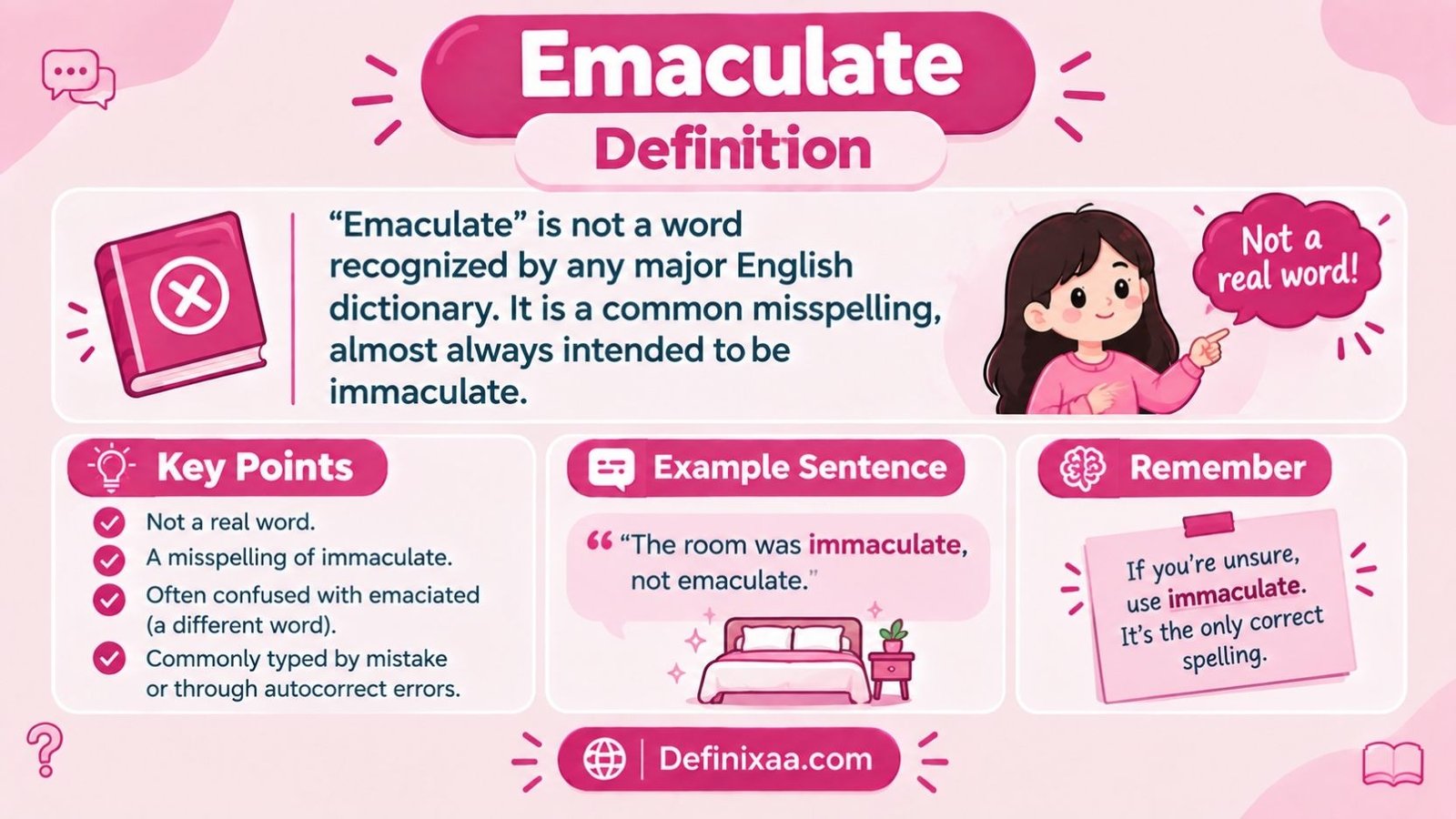
“Emaculate” is not a word recognized by any major English dictionary. It is a common misspelling, almost always intended to be immaculate, meaning extremely clean, flawless, or free from any fault, stain, or error.
Some writers also confuse it with emaciated, a completely different word meaning abnormally thin from illness or starvation. Neither meaning belongs to “emaculate” itself, since the spelling has no accepted entry of its own.
Quick Detail
| Quick Detail | Information |
| Meaning | Not a real word; a misspelling, usually of immaculate |
| Type | Common spelling error |
| Tone | Neutral, but signals a typing or spelling mistake |
| Common context | Typed by mistake in place of immaculate |
| Related terms | Immaculate, emaciate, cumulate, emulate |
So, What Is Emaculate In Simple Terms?
In simple words, “emaculate” is what happens when someone drops a letter while typing immaculate. The double “m” collapses into a single “m,” and the word that comes out is not an actual English term.
Dictionaries such as Merriam-Webster, Cambridge, and Collins do not list “emaculate” as an entry. If you search it in a serious dictionary, you will be redirected to immaculate.
Read More: Per Se Definition
Is Emaculate A Word?
No. Emaculate is not a word in standard English. It has no dictionary entry, no accepted etymology, and no formal definition of its own.
It shows up mainly as a typo, an autocorrect slip, or a phonetic guess by someone unsure how immaculate is spelled. Spell-checkers usually flag it immediately.
Note: If a word processor underlines “emaculate” in red, that is your signal the word does not exist as written.
Immaculate Or Emaculate: Which Spelling Is Correct?
Immaculate is the correct spelling. It is the only one of the two that appears in dictionaries, textbooks, and professional writing.
| Term | Meaning | Typical Use | Key Difference |
| Immaculate | Perfectly clean, flawless, free from stain or error | Formal and everyday writing, describing cleanliness or perfection | The correct, dictionary-recognized spelling |
| Emaculate | No accepted meaning; a misspelling | Appears only by mistake | Missing the double “m” that gives immaculate its meaning |
Whenever you are unsure which one to type, immaculate is always the safe choice.
Emaculate Spelling: Why the Mistake Happens
The mix-up usually comes down to pronunciation. When people say immaculate out loud, the first syllable can sound soft or almost silent, which makes “em” feel like a natural way to start the word.
Autocorrect and predictive text can also reinforce the error if a person has typed it wrong before. Once a misspelling is typed and ignored a few times, it starts to feel familiar, even though it is still incorrect.
A simple way to remember the correct form is to break the word into its parts: im, meaning “not,” plus maculate, meaning “stained.” Together they mean “not stained,” which is exactly what immaculate describes.
Immaculate Definition
Immaculate is an adjective meaning perfectly clean, neat, or free from any flaw, stain, or error. It describes something in a state of complete cleanliness or perfection, with nothing wrong or out of place.
In Simple Words: Picture a hotel room right after housekeeping finishes. Nothing is out of place, there is no dust, and everything looks brand new. That room is immaculate.
The word can describe physical spaces, objects, appearances, records, and even moral character. It is flexible enough to use in casual conversation and in formal writing.
Immaculate Definition English
In standard English usage, immaculate covers two closely related ideas.
- Physically spotless: no dirt, dust, stains, or mess.
- Free from error or fault: no mistakes, flaws, or imperfections.
Both senses point back to the same core idea of being completely clean or completely correct, with nothing to criticize.
Immaculate Meaning Slang
In casual and slang usage, immaculate often stretches beyond literal cleanliness. People use it to praise something that looks perfect, put together, or impressively well done.
- “Your fit is immaculate today” means someone’s outfit looks flawless.
- “That performance was immaculate” means the execution had no visible mistakes.
- On social media, it frequently pairs with style, skill, timing, or taste rather than actual cleanliness.
This informal use is common online and in everyday speech, and it is generally understood as high praise rather than literal description.
Immaculate Person Meaning
Describing a person as immaculate usually refers to their appearance or conduct rather than their skin or body alone. It can mean their clothing, grooming, and presentation are flawless and neatly put together.
It can also describe behavior or character, suggesting someone is above reproach, careful, and precise in how they act. In this sense, immaculate leans toward “impeccable” more than “spotless.”
What Does Emaculate Look Like in a Sentence?
Since emaculate is not a standard word, the examples below show the correct form, immaculate, used the way people actually intend it.
- Casual conversation: “Your kitchen is immaculate, how do you keep it this clean?”
- Professional setting: “The auditor praised the immaculate accuracy of the financial records.”
- Online conversation: “That outfit is immaculate, no notes.”
- Academic context: “The manuscript was immaculate, without a single grammatical error.”
Each example shows immaculate describing either literal cleanliness or a flawless standard of quality.
Read More: Oversight Definition
Cumulate Definition
Cumulate is a separate word that sometimes appears near “emaculate” in keyword lists, though the two are unrelated in meaning. Cumulate means to gather or pile up into a mass, similar to accumulate.
It usually appears in academic, statistical, or formal writing, such as describing scores, effects, or data that build up over time. It should not be confused with immaculate, cleanliness, or perfection in any way.
Emulate Meaning
Emulate is another word frequently confused with “emaculate” because of the similar first syllable. Emulate means to try to match or match the achievement of someone else, usually by imitating admirable behavior or qualities.
For example: “She emulated her mentor’s work ethic” means she tried to match that level of dedication. Emulate has nothing to do with cleanliness. It relates entirely to imitation and aspiration.
Emaculation Meaning
“Emaculation” is not a standard English word either, and it does not appear in reputable dictionaries. It occasionally shows up as an invented noun form of “emaculate,” but since the base word itself is a misspelling, this derived form carries no accepted meaning.
If you encounter “emaculation” in writing, it is almost certainly meant to reference immaculate or a related concept of flawlessness, rather than a distinct, legitimate term.
Immaculate Definition Catholic
In Catholic teaching, immaculate carries a specific theological meaning tied to the Immaculate Conception. This doctrine holds that Mary, the mother of Jesus, was conceived without original sin.
Here, immaculate does not describe physical cleanliness. It describes a state of being free from sin from the very moment of conception, according to Catholic doctrine. This is one of the most well known religious uses of the word.
Immaculate Definition Bible
The Bible itself does not use the modern English word “immaculate,” since that term entered English through Latin long after biblical texts were written. However, the concept behind it, being without blemish or fault, appears throughout scripture in relation to purity, sacrifice, and moral standing.
Many English translations use words like “spotless,” “unblemished,” or “without fault” to express the same idea that immaculate later came to represent in English.
Immaculate Definition For Kids
For a younger reader, immaculate simply means super clean, with nothing dirty or messy anywhere. Think of a bedroom right after it has been completely tidied up, with every toy put away and no dust in sight. That room would be called immaculate.
It can also describe doing something with no mistakes at all, like a spelling test where every single word is correct.
Immaculate Definition In The Crucible
In Arthur Miller’s play, The Crucible, characters are sometimes described in terms connected to purity, reputation, and moral standing rather than physical cleanliness. When a character or their name is called immaculate, it usually points to an untarnished reputation or a claim of being free from wrongdoing, within the play’s themes of guilt, accusation, and moral judgment.
Readers analyzing the play often connect this word choice to the broader tension between appearing innocent and actually being innocent.
Immaculate Definition Francais
In French, the equivalent word is immaculé for masculine nouns and immaculée for feminine nouns. Both carry the same core meaning as the English immaculate: spotless, pure, or without blemish.
The French term is also used in a religious context, particularly in reference to the Immaculate Conception, known in French as l’Immaculée Conception.
Immaculate Definition Food
In a food or culinary context, immaculate usually describes presentation rather than taste. A plate described as immaculate has clean lines, careful arrangement, and no mess or spills, the way a dish might look in a high end restaurant.
It can also describe kitchen cleanliness, such as an immaculate prep station with everything sanitized and organized.
What Words Mean Something Similar to Immaculate?
Several words overlap closely with immaculate, though each carries a slightly different shade of meaning.
- Spotless: emphasizes complete absence of dirt or marks.
- Pristine: suggests something is in its original, untouched condition.
- Flawless: focuses on the absence of defects or mistakes.
- Impeccable: often applies to behavior, style, or performance.
- Pure: can apply to both physical cleanliness and moral character.
These words are close synonyms, but immaculate is often considered the strongest term for total, uncompromising cleanliness or perfection.
Before You Use Immaculate, Remember This
Immaculate implies a very high, almost absolute standard. Calling something “pretty clean” and calling it “immaculate” are not the same claim, since immaculate suggests there is nothing left to criticize at all.
Reserve it for situations where the cleanliness, accuracy, or presentation is genuinely exceptional, rather than simply above average.
Read More: RSS Feed Definition
Is Immaculate Appropriate to Use?
Immaculate is appropriate in nearly every setting, from casual conversation to formal writing, professional reports, and religious or academic contexts. It carries no offensive or outdated connotations.
The only caution is tone: using it for something only mildly clean can come across as exaggerated. In precise or technical writing, reserve it for cases where the standard truly is close to perfect.
Frequently Asked Questions
Is emaculate a real word?
No. Emaculate does not appear in standard English dictionaries. It is almost always a misspelling of immaculate.
What word do people mean when they type emaculate?
They almost always mean immaculate, which describes something perfectly clean, flawless, or free from error.
How do you spell immaculate correctly?
Immaculate is spelled with a double “m”: i, m, m, a, c, u, l, a, t, e.
Where does the word immaculate come from?
Immaculate comes from the Latin immaculatus, formed from im, meaning “not,” and maculatus, meaning “stained” or “spotted.”
How do you pronounce immaculate?
Immaculate is pronounced ih MAK yuh lit, with the stress on the second syllable.
Is immaculate the same as emaciated?
No. Immaculate means perfectly clean or flawless. Emaciated means abnormally thin due to illness or lack of food. The two words are unrelated in meaning despite a similar sound.
Can immaculate describe a person’s behavior, not just cleanliness?
Yes. Immaculate can describe conduct, character, or reputation, meaning it is beyond fault or reproach, in addition to describing physical cleanliness.
Is immaculate slang when used online?
Immaculate has an informal, slang like use online to praise style, skill, or presentation, in addition to its standard dictionary meaning.
What is the religious meaning of immaculate?
In Catholic teaching, immaculate is tied to the Immaculate Conception, the belief that Mary was conceived without original sin.
The Simple Takeaway
Emaculate is not a genuine English word. It is a spelling mistake for immaculate, which correctly means perfectly clean, flawless, or free from fault. When in doubt, spell it with a double “m,” and remember that immaculate can describe anything from a spotless room to an untarnished reputation.

Laiba Rahman is a writer and researcher behind Definixaa, dedicated to exploring words, meanings, terms, concepts, and everyday knowledge. Through clear and well-researched explanations, her goal is to help readers understand unfamiliar ideas quickly and discover useful information with ease.
2 Comments