
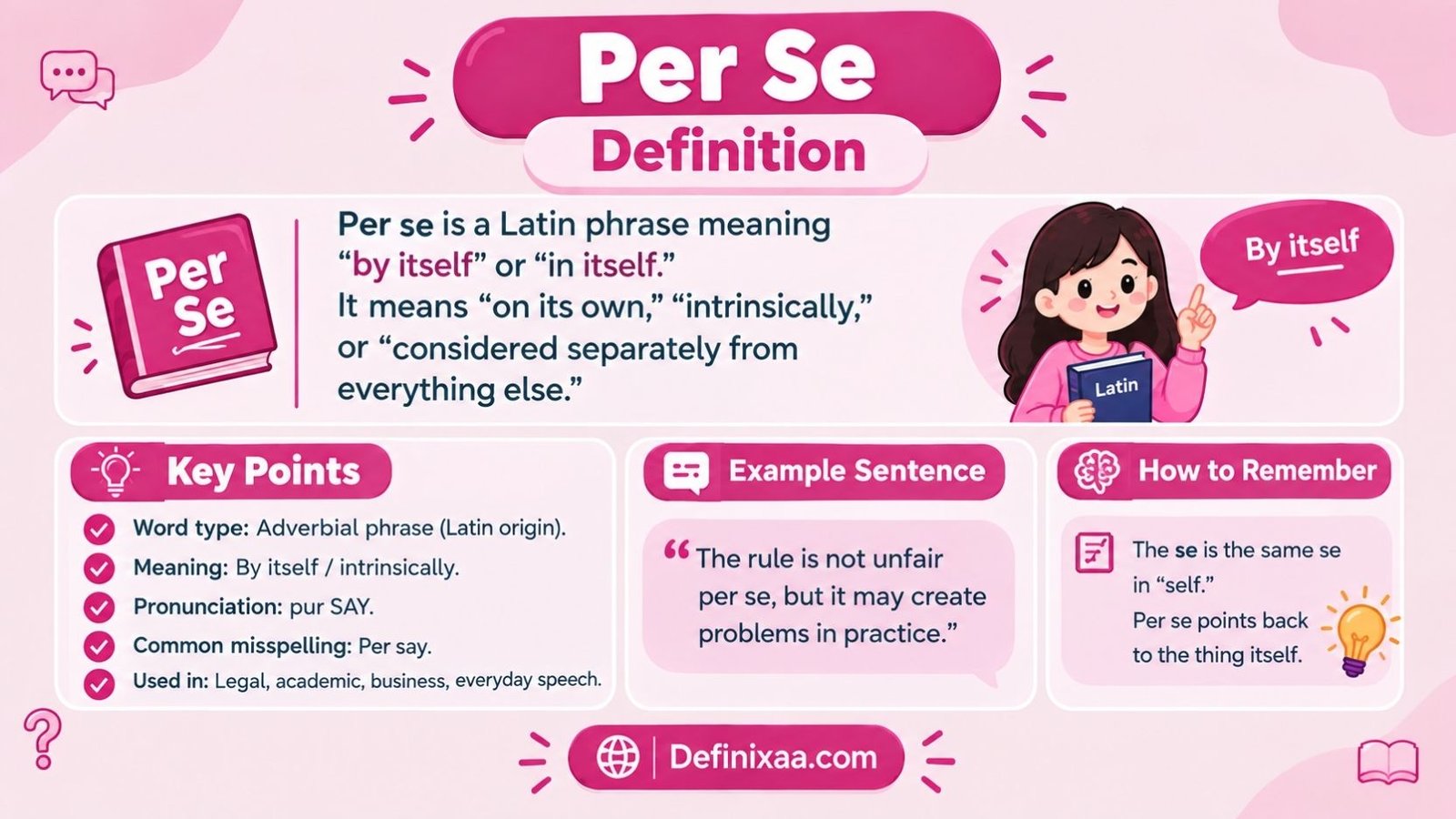
Quick definition: Per se is a Latin phrase meaning “by itself” or “in itself.” In everyday English it means “on its own,” “intrinsically,” or “considered separately from everything else.” In law it carries a stronger sense: something is per se when it counts as a violation automatically, without further proof.
That one sentence answers most searches. The rest of this page explains the parts that trip people up: how to pronounce it, why “per say” is wrong, where the phrase sounds natural, and why lawyers attach it to words like negligence, slander, and DUI.
At A Glance
- Term: Per se
- Type: Latin adverbial phrase used in English
- Literal meaning: By itself
- Everyday meaning: Intrinsically, in and of itself, strictly speaking
- Legal meaning: Inherently, or automatically, by operation of law
- Pronunciation: pur SAY
- Register: Formal to neutral, common in professional and academic speech
- Tone: Neutral
- Common misspelling: Per say
- Closely related terms: Per quod, prima facie, ipso facto, inherently
- Where you will see it: Legal writing, academic writing, journalism, business email, careful conversation
Read More: Courtesy Definition
What Does Per Se Actually Mean?
Per se means “by itself.” It was borrowed directly from Latin per sē, built from per, meaning “by” or “through,” and sē, the reflexive pronoun meaning “itself.”
In modern English the phrase does one job very well. It isolates a thing from its surroundings so you can judge that thing alone.
Dictionary sources describe it as carrying the sense of “intrinsically” or “in and of itself,” and note that speakers often use it to separate two closely related ideas.
So when someone says a rule is not unfair per se, they mean the rule by itself is not unfair. Something else might be. The rule alone is not the problem.
Note: Per se is a qualifier, not an intensifier. It narrows a claim instead of strengthening it.
Per Se In Simple Words
Think of per se as a spotlight.
Everything else goes dark. Only the one thing under discussion stays lit. You are asking the listener to judge that thing on its own merits, stripped of context, reputation, and side effects.
Three plain English swaps work almost every time:
• By itself
• In and of itself
• Strictly speaking
If you can drop one of those three into the sentence and the meaning survives, you are using per se correctly.
Example: “Coffee is not harmful per se” means coffee by itself is not harmful. Six cups before bed might be.
What Language Is Per Se And Where Did It Come From?
It is Latin, and it entered English during the Renaissance, when educated writers borrowed heavily from classical sources.
Etymology references date its English use to the 1570s, with the literal sense “by itself,” and note that the Latin phrase was itself a translation of the Greek kath’ hauto used by Aristotle. That Aristotelian link matters. Philosophers needed a way to talk about what belongs to a thing essentially rather than accidentally, and per se became the standard label.
Merriam Webster records the adverbial use as first appearing in 1574.
There is also a curious earlier English habit. The phrase first appeared in English in the 1500s in reference to letters standing alone, as in “A per se.” That usage is long gone, but it explains why the phrase felt familiar to English speakers before lawyers adopted it.
Research note: The etymology above was checked against established dictionary and etymology references rather than reconstructed from general knowledge.
How Do You Pronounce Per Se?
The standard American pronunciation is pur SAY, with the stress on the second syllable.
In IPA that is roughly /pər ˈseɪ/.
Two points worth knowing:
• The second word rhymes with “day,” not with “see.”
• The phrase is two words. It is never written as one word.
You may occasionally hear a classical Latin pronunciation closer to “pair SAY,” usually from Latin teachers or classicists. In ordinary American English, “pur SAY” is what people expect.
Tip: If you are nervous about saying it, use “in itself” instead. Nobody has ever been marked down for clarity.
Per Se or Per Say? Settling the Most Common Mistake
Per se is correct. Per say is not a word, and neither is persay.
The error happens because the phrase sounds exactly like “per say” when spoken aloud. Reference sources specifically flag that English speakers increasingly misspell it as “per say” or “persay.”
There is no meaning difference to debate here. One spelling exists and the others do not.
How to remember it: The se is the same se in “self.” Per se points back at the thing itself.
If you are writing formally, some style guides still italicize the phrase because it is a borrowing. Italicization is common precisely because the phrase originated in Latin. Most American publications now set it in plain roman type. Either choice is defensible. Consistency matters more than the choice.
How Is Per Se Actually Used in Everyday English?
This is where a dictionary definition stops being enough.
In real conversation, per se almost always appears in a negative or qualifying construction. People rarely say “X is true per se.” They say “X is not true per se, but…”
That pattern is the key to natural usage.
Typical spoken patterns:
• “It is not a problem per se, but it slows everything down.”
• “She is not my boss per se. She runs a different team.”
• “I would not call it a failure per se.”
Notice what the speaker is doing. They are refusing a label while admitting something close to it is true. This distinguishing function, separating two related but different ideas, is exactly how the phrase behaves in everyday speech.
Where you will hear it:
• Professional meetings, when someone wants to be precise without being blunt
• Academic writing and philosophy
• Journalism and opinion writing
• Legal documents, where it has a technical job
• Casual speech among people who enjoy precise language
Where it sounds out of place:
• Text messages between friends
• Simple instructions
• Writing aimed at children or English learners
• Any sentence where “by itself” would read more smoothly
Honest observation about tone: Per se has a slight reputation for sounding pretentious. Usage guides openly note that people reach for it when they want to sound a little smart. Used once, in the right sentence, it reads as precise. Used three times in a paragraph, it reads as showing off.
What Does Per Se Look Like in a Sentence?
Here are original examples across different contexts. Each one places the phrase immediately after the thing being isolated.
Casual conversation
“I do not hate the new layout per se. I just cannot find anything in it.”
Workplace email
“The delay was not caused by the vendor per se, but their late shipment made the schedule impossible.”
Academic writing
“The study does not measure intelligence per se, only performance on a narrow set of tasks.”
Restaurant review
“The dish is not spicy per se. The heat arrives about ten seconds later.”
Legal writing
“Licensing adult entertainment venues is not a per se violation of the First Amendment.”
Product discussion
“Battery life is not the weakness per se. Charging speed is.”
Sports commentary
“He is not a shooter per se. He scores by getting to the rim.”
Read those aloud and you will hear the rhythm. The phrase slots in right after the noun or adjective it is limiting, and a comma is usually optional.
Note on punctuation: Both “not spicy per se” and “not spicy, per se,” appear in edited writing. Commas around the phrase are a style choice, not a grammar rule.
Per Se in Law: Why the Phrase Carries Extra Weight
Everyday per se is a softener. Legal per se is the opposite. It is a hammer.
Cornell Law School’s Legal Information Institute defines the legal sense as “by itself,” meaning inherently, and gives statutory violation as the classic example: violating a statute is negligence per se.
Legal dictionaries expand this to mean “inherently, strictly, or by operation of statute, constitutional provision, doctrine, or case law,” and add a second sense specific to defamation: without proof of special damages or reference to outside circumstances.
Translate that into plain language and you get the core legal idea:
When something is per se unlawful, the court does not weigh the circumstances. The conduct itself settles the question.
That single idea explains every legal phrase below.
Negligence Per Se
This is the most searched legal use of the phrase in the United States.
Definition: Negligence per se is a doctrine under which violating a safety statute counts as a breach of the duty of care automatically, without the jury deciding whether the defendant acted reasonably.
Ordinary negligence asks four questions: duty, breach, causation, damages. Negligence per se collapses the first two.
Because there is a duty to obey the law bound up in the duty to act non negligently, a person who violates the statute has inherently breached that duty, so the plaintiff does not need to prove breach separately.
The elements courts typically require:
- The defendant violated a statute or regulation.
- The plaintiff belongs to the class of people the statute was designed to protect.
- The harm suffered is the type of harm the statute was designed to prevent.
- The violation caused the injury.
Standard summaries of the doctrine list the same core showing: violation of the statute, harm of the kind the statute aimed to prevent, and a plaintiff within the statute’s protected class. Detailed treatments add proximate cause as the fourth element.
Plain English example: A driver runs a red light and hits a pedestrian in a crosswalk. The traffic law exists to protect pedestrians. The pedestrian was harmed in exactly the way the law anticipated. The driver does not get to argue that running the light was reasonable that day.
Important limits:
• In some jurisdictions the doctrine creates only a rebuttable presumption of negligence rather than conclusive liability.
• Causation still has to be proved. Breaking a law that had nothing to do with the injury does not help the plaintiff.
• Recognized excuses exist, such as an emergency or a statute that is genuinely unclear.
Note: Negligence per se decides breach. It does not decide the whole case.
Defamation Per Se, Slander Per Se, and Libel Per Se
Here per se means something different again: harmful on its face.
Definition: A statement is defamatory per se when it is so obviously damaging that the law presumes harm, so the plaintiff does not have to prove specific financial loss.
Defamation per se is contrasted with defamation per quod, where the court must look at context and the plaintiff must prove the statement caused damages. The doctrine rests on the recognition that certain statements are so inherently harmful that damage should simply be presumed.
The four traditional categories recognized across most American jurisdictions:
- Falsely accusing someone of a serious crime
- Falsely saying someone has a loathsome or contagious disease
- Statements injuring a person in their trade, business, or profession
- Imputing sexual misconduct, historically framed as unchastity in a woman
The Restatement (Second) of Torts section 570 lists these same four categories, and a statement falling into one of them is actionable without proof of special damages. New York’s highest court has stated the four exceptions in almost identical terms, adding that when statements fall within these categories the law presumes damages, which need not be alleged or proven.
Slander per se applies to the spoken form. Libel per se applies to the written or published form. A libel per se statement must be egregious on its face, so that the plaintiff does not need to prove damages, and it must appear in a fixed medium such as writing or a recording.
Actionable per se is the umbrella phrase. It means a claim can proceed on the statement alone, without pleading special damages.
Note on modern drift: Federal courts have recognized that the chastity category now applies across genders and is read as implying serious sexual misconduct, and some older extra categories have been abandoned as outdated. State law varies. This is one area where the general rule and your state’s rule may differ.
Read More: Oversight Definition
Per Se DUI Laws and Admin Per Se
If you searched per se after a traffic stop, this is the section you want.
Per se DUI definition: A per se DUI law makes it illegal to drive with a blood alcohol concentration at or above a set number, regardless of whether the driver appeared impaired.
The prosecutor does not have to prove bad driving. The number proves the offense.
In every state the adult threshold is 0.08 percent, with one exception: Utah lowered its limit to 0.05 percent. Commercial drivers face a 0.04 percent limit, and drivers under 21 fall under zero tolerance rules, with underage thresholds varying by state, some at 0.01 and others at 0.02.
Admin per se definition: Administrative per se, often shortened to admin per se or APS, is the separate process by which a state motor vehicle agency suspends a license immediately after a failed or refused chemical test, before any criminal conviction.
These are state laws rather than a single federal statute, and they give the state motor vehicle agency authority to suspend or revoke driving privileges when a driver tests at or above the limit or refuses a chemical test after a lawful arrest. California’s own enforcement manual illustrates the mechanics: a test result of 0.08 percent or more triggers a four month suspension, or one year where the driver has prior convictions within ten years, while refusing the test triggers a one year suspension.
The key practical point: the administrative case and the criminal case are separate. California’s evaluation research describes the illegal per se BAC limit and the administrative per se pre conviction license suspension as two distinct laws serving different functions. Winning one does not automatically win the other, and the deadline to request an administrative hearing is usually very short.
Note: Nothing here is legal advice. Deadlines, thresholds, and hearing procedures differ by state, and a licensed attorney in your state is the right source for your own situation.
Per Se Violations in Antitrust Law
Antitrust uses per se as a standard of review.
Definition: Conduct that is per se illegal under antitrust law is condemned automatically, without any inquiry into its actual effects on the market.
Under the per se rule, a court proceeds to judgment for the plaintiff without considering evidence of actual effects or claimed business justifications. The alternative standard, the rule of reason, weighs harms against competitive benefits.
Commonly treated as per se illegal:
• Horizontal price fixing among competitors
• Bid rigging
• Market or customer allocation agreements
• Certain group boycotts
• Minimum resale price maintenance, which the FTC has described as per se illegal while most vertical arrangements get the rule of reason
Courts limit per se treatment to practices that facially appear to always or almost always restrict competition and reduce output. That caution is deliberate. Labeling conduct per se illegal removes the defendant’s ability to explain itself.
Nuisance Per Se
Definition: A nuisance per se is an activity, condition, or structure that is a nuisance at all times and under all circumstances, regardless of location or how carefully it is conducted.
Contrast that with nuisance per accidens, which becomes a nuisance only because of where it sits or how it is run. A lawful business operating legally is usually judged by its circumstances. An activity forbidden outright by statute can be a nuisance per se.
Contract, Crime, and Other Per Se Phrases
You will also meet the phrase in looser combinations:
• Per se illegal or illegal per se: unlawful in itself, without needing surrounding facts
• Crime per se: conduct wrong because a statute forbids it, often discussed alongside the older idea that some acts are wrong in themselves
• Per se in contract discussion: used to isolate a clause, as in “the clause is not unconscionable per se”
• Per se rule: any legal test that applies automatically rather than case by case
Note: “Contract per se” is not a recognized doctrine with its own definition. Where you see it, per se is doing its ordinary job of isolating the thing under discussion.
Is Per Se Used in Medicine?
Yes, but not as a technical term.
There is no medical doctrine called “per se” the way there is a legal doctrine called negligence per se. In clinical writing, the phrase keeps its ordinary meaning: by itself.
How it appears in medical and scientific writing:
• “The medication is not sedating per se, but it interacts with several sleep aids.”
• “Obesity per se was not associated with the outcome after adjusting for activity level.”
• “The virus does not cause the tissue damage per se. The immune response does.”
That last pattern is the useful one. Researchers use per se to separate a direct cause from a downstream effect. It signals that the thing named is not the mechanism, even though it is connected to the outcome.
Where medical searches often land instead: Medical negligence cases sometimes involve negligence per se, for example when a provider violates a specific licensing or safety statute. That is a legal concept appearing in a medical setting, not a medical definition.
Per Se in German and Other Languages
Because Latin fed most European legal and academic vocabulary, per se travels well.
German: Per se is used in German with essentially the same meaning: an sich, von selbst, or grundsätzlich. German speakers use it much as English speakers do, in formal, academic, and journalistic contexts.
French: The equivalent native phrase is en soi, though per se appears in legal and academic French.
Spanish and Italian: Both use per se or close variants such as per sé, again with the sense of “in itself.”
Note: The meaning is stable across these languages because they all inherited it from the same Latin source rather than developing it independently.
What Per Se Does Not Mean
This is where most confusion lives. Several very common assumptions are wrong.
It does not mean “per say” or “so to speak.”
Many speakers use it as a vague verbal cushion, roughly meaning “sort of.” That is not the meaning. If you can replace it with “like” or “you know,” you are using it as filler.
It does not mean “exactly” or “specifically.”
“That is not what I said per se” is a common construction, but the speaker usually means “that is not exactly what I said.” Per se is doing no real work there.
It does not mean “per each” or “per unit.”
The per in per se is not the per in “per hour” or “per person.” Different construction entirely.
It does not mean “automatically” in ordinary speech.
That sense belongs to the legal usage only. Outside law, per se narrows a claim rather than triggering a consequence.
It is not a synonym for “technically.”
“Technically” suggests a rule based technicality. Per se suggests inherent nature. They overlap sometimes and are not interchangeable.
It does not refer only to the restaurant.
Per Se is also the name of a well regarded New York City restaurant, and the phrase appears in several distinct entries including illegal per se and negligence per se. If your search results mix fine dining with tort law, that is why.
Words That Mean Something Similar to Per Se
Choose the replacement that matches your register.
Closest synonyms
• In itself
• In and of itself
• By itself
• Intrinsically
• Inherently
• As such
Standard reference sources list “by itself,” “in itself,” “in and of itself,” and, in certain senses, “as such” as the accepted synonyms.
Near synonyms with a slightly different angle
• Essentially, which emphasizes core nature
• Fundamentally, which emphasizes a base level
• Strictly speaking, which emphasizes precision
• On its own merits, which emphasizes fair evaluation
Opposites and contrasts
• Contextually
• Circumstantially
• In practice
• Per quod, in legal writing
Tip: In business writing, “in itself” is almost always the better choice. It is shorter, clearer, and never reads as affectation.
Is Per Se the Same as Prima Facie, Ipso Facto, or Per Quod?
They are related Latin phrases that lawyers deliberately keep distinct. Mixing them up changes the meaning of a sentence.
Per se
Meaning: by itself, inherently, or automatically by operation of law.
Typical use: negligence per se, per se antitrust violations.
Key difference: the conduct itself settles the issue.
Prima facie
Meaning: at first sight, or sufficient on its face unless rebutted.
Typical use: a prima facie case that survives dismissal.
Key difference: it creates a starting presumption that the other side may rebut. Per se is stronger.
Ipso facto
Meaning: by that very fact.
Typical use: an ipso facto clause in a contract triggered by bankruptcy.
Key difference: it describes an automatic consequence flowing from an event, not an inherent quality.
Per quod
Meaning: by which, requiring outside facts to show the harm.
Typical use: defamation per quod.
Key difference: it is the direct opposite of the defamation sense of per se. Legal dictionaries explicitly pair the two, defining the per se sense as proceeding without proof of special damages and pointing readers to per quod for the comparison.
In simple terms: per se means it speaks for itself, prima facie means it looks right for now, ipso facto means it follows automatically from an event, and per quod means you need to explain the surrounding facts.
When Should You Use Per Se?
Use it when you are drawing a genuine distinction that matters.
Good reasons to use it
• You want to limit a claim to the thing itself, not its consequences
• You are conceding part of a point while refusing the label
• You are writing formally and precision is the priority
• You are working in a legal, medical, academic, or policy context where the phrase has a settled role
Reasons to skip it
• You are writing for a general or international audience
• “In itself” would read more naturally
• You are using it as a filler sound rather than a qualifier
• You have already used it once in the same paragraph
Is it appropriate in professional writing? Yes. It is neutral in tone and standard in edited English. It is not slang, not outdated, and not offensive. Major dictionaries cite it in current mainstream journalism, including recent examples from national outlets.
Is it appropriate in casual conversation? It is acceptable but noticeable. Among friends it can sound stiff. Used once, in the right spot, it lands fine.
Read More: Simular Definition
Before You Use Per Se, Remember This
One distinction is worth holding on to.
In everyday English, per se weakens a statement. In legal English, it strengthens one.
“The policy is not discriminatory per se” is a hedge. It concedes that something nearby might be discriminatory.
“The conduct is a per se violation” is the strongest possible accusation. It means the court will not even listen to a justification.
Same two words. Opposite force. Context tells you which one you are reading.
Tip: If you encounter per se in a contract, a statute, a court opinion, or a legal notice, read it as “automatically” first. If you encounter it in conversation or an essay, read it as “by itself.”
The Simple Takeaway
Per se is Latin for “by itself.” In ordinary English it isolates one thing so you can judge it alone, usually in a sentence that concedes something without accepting a label. In law it means the opposite of a hedge: conduct that counts as a violation automatically, as in negligence per se, defamation per se, or a per se DUI limit.
Spell it as two words. Say it as “pur SAY.” And when in doubt, “in itself” says the same thing with less risk.
Frequently Asked Questions
What does per se mean in simple terms?
It means “by itself” or “in and of itself.” You use it to focus attention on one thing alone, separate from its context, consequences, or associations. It usually appears in a sentence that rejects a label while admitting something close to it.
Is it per se or per say?
Per se is the only correct spelling. “Per say” and “persay” are misspellings caused by how the phrase sounds when spoken. The se comes from the Latin reflexive pronoun meaning “itself.”
How do you pronounce per se?
Say it as “pur SAY,” with stress on the second syllable. It rhymes with “day,” not “see.” The IPA rendering is approximately /pər ˈseɪ/.
What does negligence per se mean in law?
It means violating a safety statute counts as a breach of the duty of care automatically. Because obeying the law is part of acting non negligently, statutory violation establishes breach without separate proof. The plaintiff still must prove causation and damages.
What is defamation per se?
It refers to statements so obviously damaging that harm is presumed and the plaintiff does not need to prove financial loss. It stands in contrast to defamation per quod, where context must be examined and damages proved.
What counts as slander per se?
Four traditional categories: accusing someone of a serious crime, claiming they have a loathsome disease, attacking their business or profession, or imputing serious sexual misconduct. These are the categories listed in the Restatement (Second) of Torts section 570.
What is a per se DUI?
It is a charge based purely on blood alcohol concentration at or above the legal threshold, without any need to prove impaired driving. The adult limit is 0.08 percent in nearly every state, with Utah at 0.05 percent and commercial drivers at 0.04 percent.
What does admin per se mean?
It is the administrative license suspension a state motor vehicle agency imposes after a failed or refused chemical test. These state laws let the agency suspend driving privileges independently of the criminal case. Hearing deadlines are short.
Is per se formal or informal?
It is formal to neutral. It is standard in legal, academic, medical, and journalistic writing, and acceptable in professional speech. It is not slang and not offensive, though overuse can sound affected.
What language is per se from?
Latin. It entered English in the 1570s with the literal meaning “by itself,” and the Latin phrase itself translated a Greek expression used by Aristotle.
What is the difference between per se and prima facie?
Per se means something is inherently or automatically so. Prima facie means something appears sufficient at first look but can still be rebutted. Per se is the stronger and more conclusive of the two.
Can I use per se in academic writing?
Yes, and it is common there. Researchers use it to separate a direct cause from an associated factor, as in “the condition itself was not associated with the outcome.” Use it once where the distinction genuinely matters.

Laiba Rahman is a writer and researcher behind Definixaa, dedicated to exploring words, meanings, terms, concepts, and everyday knowledge. Through clear and well-researched explanations, her goal is to help readers understand unfamiliar ideas quickly and discover useful information with ease.
One Comment