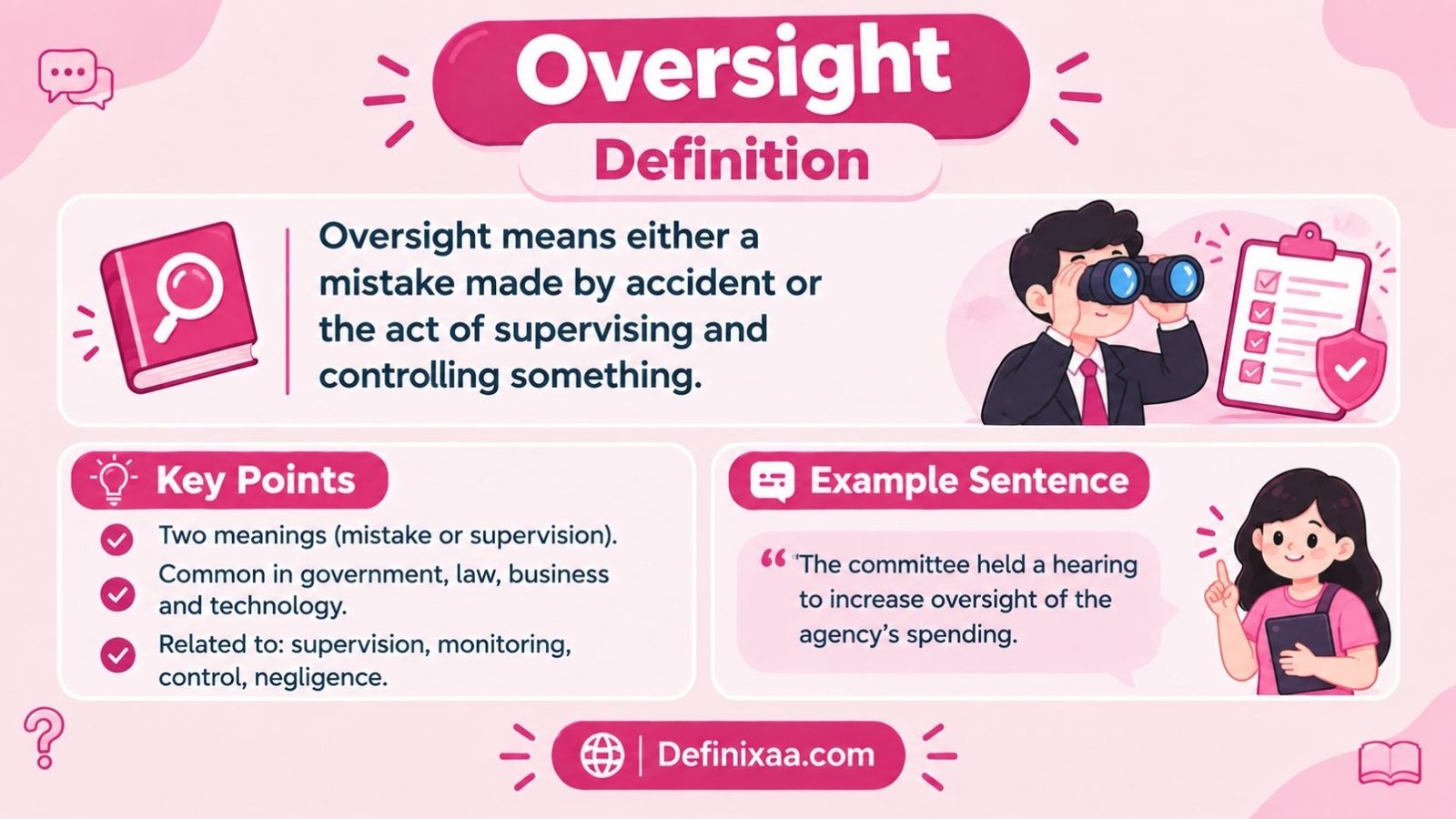
Quick Definition: Oversight is a noun with two main meanings. It can mean a mistake made because someone forgot or failed to notice something, or it can mean the responsible watching, supervision, or control of an activity, organization, or process. Which meaning applies depends entirely on context.
At A Glance
| Detail | Information |
| Meaning | An unintentional mistake, or the act of supervising and controlling something |
| Word type | Noun (an oversight, oversight of something) |
| Tone | Neutral; can sound apologetic (mistake) or authoritative (supervision) |
| Common context | Everyday conversation, government, law, business, technology |
| Related terms | Supervision, negligence, monitoring, oversee, overlook |
| Opposite meanings | Precision, accuracy (opposite of the mistake sense); neglect, inattention (opposite of the supervision sense) |
What Does Oversight Mean?
Oversight most commonly means one of two things. First, it can mean an unintentional error, something that was missed or forgotten. Second, it can mean the act of watching over, directing, or being responsible for how something is run.
Merriam-Webster defines oversight as watchful and responsible care, regulatory supervision, and an inadvertent omission or error. That single entry captures the split personality of this word better than almost any other explanation could.
So when someone says, “That was an oversight,” they usually mean a small mistake. When someone says, “The board provides oversight of the company,” they mean supervision and responsibility. Same word, nearly opposite feel, and the reader has to rely on context every time.
Read More: Reasonable Suspicion Definition
Oversight In Simple Words
Think of the word “sight” hiding inside “oversight.” That is not an accident.
In the mistake sense, oversight means something slipped past your sight. You looked, but you did not truly notice it, so it got missed.
In the supervision sense, oversight means you are actively keeping something in your sight. You are watching over it on purpose, checking that it runs correctly.
One meaning is about missing something by accident. The other is about watching something on purpose. Once a reader holds onto that contrast, the rest of the word’s many uses become far easier to follow.
Oversight Can Mean Two Very Different Things
Meaning One: A Mistake or Omission
This is oversight in its most casual, everyday sense. It describes a small, unintentional error, usually caused by forgetting, missing a detail, or simply not paying close enough attention.
Merriam-Webster’s simple definition describes an oversight as a mistake made because someone forgets or fails to notice something. It is rarely used to describe a serious or deliberate failure. It is the language of an honest slip, not intentional wrongdoing.
Typical examples of this sense include a missing name on a guest list, a typo that slipped through editing, or a forgotten line item on an invoice.
Meaning Two: Supervision or Responsible Control
This is the formal, institutional sense of the word. Here, oversight describes the act or job of directing, monitoring, or being responsible for how work is carried out.
Cambridge Dictionary defines this sense as systems or actions used to control an activity and make sure it is done correctly and legally. This is the meaning behind phrases such as government oversight, financial oversight, and oversight committee.
Both meanings are correct. Neither one is more “proper” than the other. The right meaning is determined entirely by the sentence around it.
Oversight Definition In Government And Politics
In American civic life, oversight almost always refers to how one branch of government, especially Congress, monitors and checks another branch, particularly federal agencies.
Congressional Oversight Definition
Congressional oversight is the power Congress uses to review, monitor, and supervise how the executive branch, particularly federal agencies, carries out the laws Congress passes.
Congress engages in oversight of the executive branch through the review, monitoring, and supervision of the implementation of public policy. This is not a modern invention. The earliest Congresses used special investigations and reporting requirements to carry out this same function.
Congress does this through several concrete tools:
- Committee hearings, where agency officials testify and answer questions
- Investigations into how a law is being carried out
- The power of the purse, meaning Congress can fund or defund an agency’s activities
- Reports, audits, and reviews conducted by congressional staff or independent watchdogs such as inspectors general
These oversight activities range from formal committee hearings to informal contact between staff and executive officials, and from agency studies to casework handled by individual member offices.
Why does this power exist at all? The philosophical basis for oversight comes from the Constitution’s system of checks and balances among the legislature, executive, and judiciary, an idea James Madison described in Federalist No. 51 as dividing power so that each branch checks the others.
Note: The Supreme Court has repeatedly upheld this power. In Watkins v. United States, the Court described Congress’s power to investigate as inherent in the legislative process and broad enough to cover how existing laws are being administered.
Legislative Oversight Definition
Legislative oversight is the broader version of the same idea, describing any legislature, not just the U.S. Congress, monitoring how laws it passed are actually being carried out.
State legislatures, city councils, and foreign parliaments all perform legislative oversight over the agencies and officials that answer to them. Congressional oversight is simply the American federal example of this wider concept.
Oversight Definition For AP Government Students
For AP Government and Politics, oversight is a testable vocabulary term, and it comes with a fairly precise classroom definition.
Congressional oversight is Congress’s power to review, monitor, and supervise the executive branch, especially federal bureaucratic agencies, using committee hearings, investigations, and the power of the purse to make sure laws are implemented as Congress intended.
On the AP exam, when a question simply says “oversight” without further qualification, it almost always means congressional oversight of the bureaucracy. The reasoning behind this power is that unelected bureaucrats hold real authority, such as writing regulations and issuing fines, so elected lawmakers need tools to hold them accountable.
Tip: If an AP Gov question asks how Congress checks the bureaucracy, “oversight” through hearings, investigations, or the power of the purse is almost always part of the correct answer.
Read More: RSS Feed Definition
Fire Alarm Oversight Vs Police Patrol Oversight
Political scientists often describe two different styles of congressional oversight, and the terms come from a well known 1984 study.
Police patrol oversight is centralized, active, and direct: Congress, on its own initiative, chooses a sample of executive agencies to examine, aiming to detect and correct violations of legislative goals through its own surveillance.
Fire alarm oversight is less centralized and less active. Instead of examining agencies directly, Congress sets up rules and procedures that let citizens and interest groups flag violations themselves, and Congress only responds once a complaint is raised.
Researchers who studied this distinction concluded that Congress rationally prefers fire alarms over police patrols, not because Congress neglects oversight, but because fire alarm oversight uses fewer resources while still catching serious problems.
| Term | Meaning | Typical Use | Key Difference |
| Police patrol oversight | Congress actively and directly checks agencies on its own initiative | Committee investigations Congress starts without a complaint | Proactive and resource heavy |
| Fire alarm oversight | Congress reacts once citizens or interest groups raise a complaint | Constituent complaints, lawsuits, media reports that trigger a hearing | Reactive and more efficient |
Oversight Definition In Law
In legal contexts, oversight usually describes formal review carried out by a court, agency, board, or committee to confirm that rules, procedures, or rights are being respected.
Legal oversight can involve a court reviewing a lower court’s decision, a licensing board monitoring professional conduct, or a compliance department checking that a company follows financial regulations. The unifying idea is accountability: some body has the authority and the responsibility to check that the rules are actually being followed.
Regulatory Oversight Definition
Regulatory oversight refers specifically to government or independent bodies monitoring and enforcing compliance with laws, regulations, and industry standards.
Regulatory oversight is the process by which governmental and independent bodies monitor and enforce compliance with laws, regulations, and standards across industries, ensuring organizations operate ethically, transparently, and in line with established guidelines.
This term shows up constantly in financial news, healthcare policy, and environmental reporting, usually in the context of whether an industry has enough independent checking, or not nearly enough.
Human Oversight Definition
In technology and artificial intelligence policy, human oversight refers to keeping a person actively involved in reviewing, checking, or being able to override an automated or AI driven decision, rather than letting a system act completely on its own.
This concept has become increasingly common in workplace and product news coverage. For instance, proposed measures covered by the Los Angeles Times would require human oversight when AI tools are used to discipline or fire workers. The underlying principle is simple: a person, not just software, remains responsible for reviewing a consequential decision.
Judicial Oversight Definition
Judicial oversight describes courts reviewing the actions of government agencies, law enforcement, or lower courts to confirm they acted within legal limits.
It commonly appears in discussions of search warrants, surveillance programs, or agency rulemaking, where a judge’s review acts as an independent check before or after an action is taken.
What Does Oversight Look Like In A Sentence?
Seeing the word used naturally helps more than any definition alone. Here are original examples across a range of contexts.
- Casual conversation: “Forgetting your birthday was a complete oversight on my part, I feel terrible.”
- Workplace setting: “The finance team has oversight of every purchase over five thousand dollars.”
- Government or news context: “The committee held a hearing to strengthen oversight of the agency’s spending.”
- Academic or textbook context: “Congressional oversight allows lawmakers to monitor how executive agencies apply the laws Congress passes.”
- Everyday mistake: “Skipping the safety inspection was an oversight, not a deliberate shortcut.”
- Business and compliance: “Regulatory oversight of the industry increased sharply after last year’s scandal.”
Oversight As A Verb
Oversight itself is a noun, not a verb. English speakers often reach for “oversight” when they actually mean to describe the action of overseeing, but the correct verb form is “oversee.”
Correct: “She will oversee the merger process.”
Incorrect: “She will oversight the merger process.”
If a sentence needs an action word, “oversee,” “supervise,” or “monitor” is the correct choice. “Oversight” stays a noun describing either the mistake or the supervisory role itself.
Due To An Oversight Meaning And Oversight On My Part Meaning
“Due to an oversight” simply means “because of a mistake or something that was missed.” It is a polite, slightly formal way of admitting an error without placing heavy blame on anyone.
Example: “Due to an oversight, your invoice was never sent last month.”
“Oversight on my part” works the same way but personalizes the mistake, taking direct responsibility for it. It is common in apologies, both spoken and written.
Example: “The missing attachment was an oversight on my part. I have resent it now.”
Note: Both phrases describe the mistake sense of oversight, never the supervision sense. Nobody says “supervision on my part” to mean a slip up.
How Do You Pronounce Oversight?
Oversight is pronounced OH ver syt, with the stress on the first syllable. The word breaks cleanly into its two parts: “over,” as in above or across, and “sight,” as in vision or view.
Reading it as those two familiar words joined together is the simplest way to get the pronunciation right without needing a phonetic chart.
Where Does The Word Oversight Come From?
The related verb traces back to Old English oferseon, meaning to look down upon, keep watch over, survey, or observe, built from “over” plus “see”. The meaning shifted toward “to supervise or superintend” by the middle of the fifteenth century.
The noun form followed its own path and picked up the double meaning readers see today. According to the Oxford English Dictionary, the noun oversight dates back to the Middle English period, with the earliest recorded use appearing before 1400 in the poem Cursor Mundi.
So the word has carried both senses, careful watching and a missed detail, for centuries. This is not a modern confusion. English speakers have used oversight both ways since long before the word reached its current spelling.
What Words Mean Something Similar To Oversight?
The right synonym depends entirely on which meaning is intended.
- For the supervision sense: Supervision, management, control, administration, monitoring, stewardship, governance.
- For the mistake sense: Mistake, omission, error, slip, lapse, blunder, negligence.
Merriam-Webster’s thesaurus lists management, supervision, control, operation, administration, handling, stewardship, and government as synonyms for the supervision sense, with accuracy, precision, and correctness listed as opposites.
For the mistake sense, the thesaurus lists an unintentional departure from truth or accuracy as a matching concept, giving the example of saying “three billion” instead of “three million” by oversight.
Is Oversight the Same as Supervision or an Overlook?
Not quite. These three words overlap but are not fully interchangeable.
| Term | Meaning | Typical Use | Key Difference |
| Oversight | Either a mistake, or responsible supervision of an activity | “Financial oversight” or “That was just an oversight” | Carries two nearly opposite meanings depending on context |
| Supervision | Actively directing and guiding people or a process | “Under a manager’s supervision” | Always positive or neutral, never means a mistake |
| Overlook | To fail to notice something, or to view something from above | “He overlooked the error in the report” | As a verb, almost always means missing something, rarely means supervision |
Note: Oversight and overlook share the “missed something” meaning, but overlook rarely carries the supervisory sense that oversight does. Calling a manager’s supervisory role an “overlook” would sound wrong to most native speakers.
How Is Oversight Actually Used In Real Life?
Real usage confirms that context, not the word itself, carries the meaning. News examples show phrases such as “there’s an oversight question too,” “the lack of oversight opens the door for abuse,” and the need for “human oversight” even as automation increases, all pointing toward the supervision sense.
At the same time, everyday and personal usage leans toward the mistake sense. A Vulture writer described something as feeling “like a bit of an oversight,” a phrasing that fits casual, conversational admission of a small error.
In professional and government writing, oversight overwhelmingly points to supervision. In personal apologies and casual speech, it usually points to a mistake. Readers rarely misread the word once they notice which of these two worlds the sentence belongs to.
Oversight In Other Common Workplace And Technical Contexts
Beyond government and law, oversight shows up constantly in business and technology, each time keeping its core supervisory meaning but pointing to a different kind of relationship.
Federal oversight describes supervision carried out by a national government agency, rather than a state, local, or private body. It commonly appears in discussions of banking, aviation, food safety, and environmental protection, where a federal agency holds the authority to inspect, license, or penalize.
Vendor oversight refers to a company monitoring outside suppliers, contractors, or service providers to confirm they meet contract terms, security standards, or quality expectations. Businesses in finance and healthcare often use formal vendor oversight programs because they remain responsible for a vendor’s mistakes even when the work is outsourced.
Third party oversight is closely related. It describes an outside, independent body checking whether an organization or process meets required standards, rather than the organization checking itself. Independent audits and external compliance reviews are common examples.
Medical oversight describes a licensed physician supervising the clinical decisions of paramedics, nurses, or other healthcare staff, particularly in emergency medical services, to confirm that treatment protocols are followed correctly.
Technical oversight refers to expert supervision of a technical process, system, or project, confirming that engineering, safety, or quality standards are actually being met rather than assumed.
Scalable oversight is a more specialized term from artificial intelligence research. Rather than a person supervising a machine directly, it describes methods for supervising AI systems whose abilities may eventually exceed the humans reviewing them. Researchers in this field are exploring approaches such as having multiple AI systems check each other’s work or having weaker systems help evaluate a stronger one, all in an effort to keep advanced AI aligned with human intent even as direct human review of every output becomes impractical.
Before You Use Oversight: Remember This
Oversight does not always mean a mistake, and it does not always mean supervision. The two meanings sit inside the same word, and only the surrounding sentence tells the reader which one applies.
When precision matters, especially in writing, consider whether a clearer synonym, such as “supervision” or “omission,” would prevent any possible confusion.
What Does Oversight Not Mean?
Because oversight carries two meanings, it is easy to misapply it in a sentence that only supports one of them.
Oversight does not mean active, hands on control of every small detail. That closer describes micromanagement, not oversight. Oversight typically implies responsibility and monitoring at a broader level, checking outcomes and compliance rather than dictating every step.
Oversight does not automatically mean wrongdoing or a cover up, even though news coverage often uses the word “oversight” alongside criticism, as in “a lack of oversight.” The word itself is neutral. It is the surrounding reporting, not the word, that supplies the negative framing.
Oversight, in the mistake sense, does not mean a deliberate or dishonest act. Calling something an oversight generally signals that no bad intent was involved, only an honest lapse in attention. If intent to deceive is present, words such as “fraud,” “cover up,” or “misconduct” are more accurate.
Finally, oversight is not a verb. Some speakers try to use it as one, as in “to oversight a project,” but standard English requires “oversee” for that role.
When Should You Use the Word Oversight?
Oversight works well anywhere responsibility, monitoring, or accountability needs to be described precisely, especially in formal, business, legal, or academic writing. Phrases such as “regulatory oversight,” “financial oversight,” and “oversight committee” all sound natural and are widely used in professional contexts.
For the mistake sense, oversight fits situations where a simple, honest slip needs to be acknowledged without exaggerating the severity of the error. It works well in apologies, corrections, and clarifications, where a more serious word such as “negligence” or “failure” would sound harsher than the situation calls for.
Oversight is less useful when a sentence needs an action word. In those cases, “oversee,” “monitor,” or “supervise” communicates the intended meaning more clearly and grammatically than “oversight” ever could.
Read More: Grately Definition
Oversight In Spanish
Oversight does not translate into a single Spanish word, because Spanish uses separate words for its two English meanings.
For the mistake sense, Cambridge Dictionary translates oversight as descuido, as in “Afirmaron que fue simplemente un descuido,” meaning “They claimed it was simply an oversight.”
For the supervision sense, the same dictionary gives supervisión, as in “tenemos derecho a la supervisión,” meaning “we have a right to oversight.”
Britannica’s Spanish reference notes that oversight, along with supervision and surveillance, all describe a form of careful observation, but oversight specifically implies the observer holds the power or right to act, aiming to ensure that whatever is being watched functions well or is in good condition.
| English term | Spanish translation | Meaning conveyed |
| Oversight (mistake) | Descuido, omisión | An accidental error |
| Oversight (supervision) | Supervisión | Responsible monitoring or control |
Frequently Asked Questions
What does oversight mean in simple terms?
Oversight means either an accidental mistake caused by not noticing something, or the responsible supervision and control of an activity. The correct meaning always depends on the sentence.
Is oversight a positive or negative word?
It can be either. As supervision, it is neutral to positive, since it signals accountability. As a mistake, it carries a mildly negative, apologetic tone, though it is far softer than words like “negligence.”
What is congressional oversight in simple words?
Congressional oversight is Congress checking up on federal agencies to make sure they are carrying out laws the way Congress intended, mainly through hearings, investigations, and control of agency funding.
Is oversight the same as micromanagement?
No. Oversight refers to responsible monitoring and accountability, while micromanagement describes excessive, overly controlling supervision of small details. Oversight can exist without micromanagement.
What is the difference between oversight and negligence?
Oversight, in the mistake sense, describes a single unintentional slip. Negligence describes a pattern of carelessness or a failure to exercise a reasonable duty of care, and it often carries legal consequences that a simple oversight does not.
Can oversight be used as a verb?
No, oversight is only a noun. The correct verb form is “oversee,” as in “She will oversee the project,” never “She will oversight the project.”
What does human oversight mean in AI?
Human oversight means a person remains actively involved in reviewing or approving decisions made by an automated system or AI tool, rather than letting the system act completely without review.
What is regulatory oversight?
Regulatory oversight is the ongoing process by which government or independent bodies monitor industries to make sure companies follow relevant laws, regulations, and safety or ethical standards.
How do you say oversight in Spanish?
It depends on the meaning. For a mistake, use descuido. For supervision or responsible control, use supervisión.
What is fire alarm oversight?
Fire alarm oversight is a style of congressional oversight where Congress reacts to complaints raised by citizens or interest groups, rather than actively investigating agencies on its own initiative.
The Simple Takeaway
Oversight carries two nearly opposite meanings inside one word: an honest mistake, or responsible supervision and control. Government, legal, and technology contexts almost always mean the supervision sense, while everyday apologies almost always mean the mistake sense. Once a reader notices which world the sentence belongs to, oversight stops being confusing and becomes one of the more useful, flexible words in English.

One Comment