
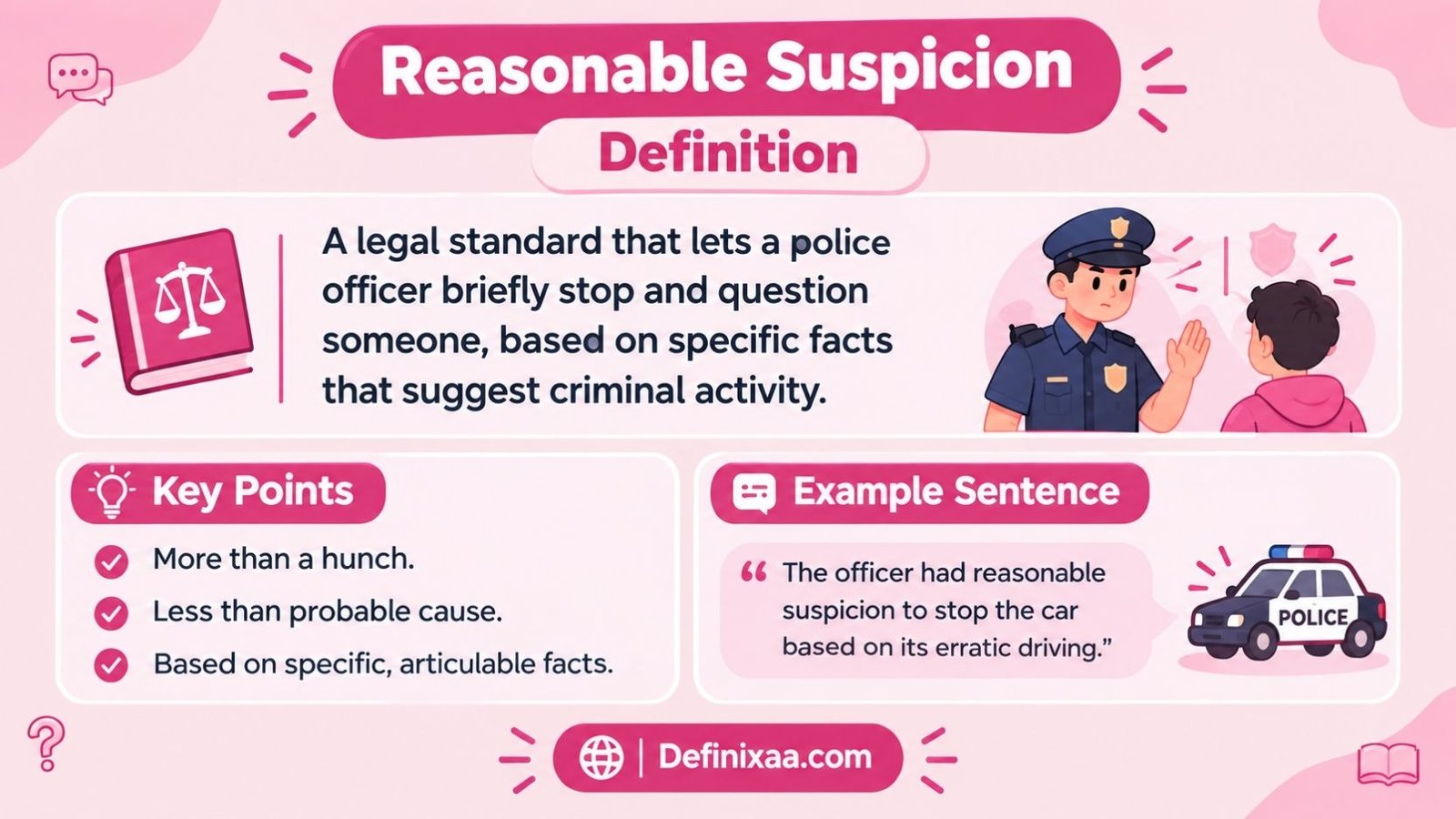
Reasonable suspicion is the legal standard that lets a police officer briefly stop and question someone, based on specific facts that suggest criminal activity may be happening. It is more than a hunch, but it is a lower bar than probable cause, which is needed for an arrest or a full search.
This standard comes from the Fourth Amendment to the U.S. Constitution and from the Supreme Court’s 1968 decision in Terry v. Ohio. It shows up constantly in traffic stops, street encounters, school searches, workplace drug testing, and military law.
So, What Is Reasonable Suspicion In Simple Terms?
Think of it as the difference between a gut feeling and a fact you can actually point to.
An officer cannot stop you just because something feels off. But if the officer can describe specific behavior, such as matching a suspect’s description or driving erratically late at night, that description can add up to reasonable suspicion.
Quick Detail
| Quick Detail | Information |
| Meaning | A legal standard requiring specific, articulable facts suggesting criminal activity |
| Type | Legal concept and constitutional standard |
| Governs | Brief police stops, pat downs, some searches, and certain workplace or military testing |
| Source | Fourth Amendment, Terry v. Ohio, 1968 |
| Compared to | Weaker than probable cause, stronger than a hunch |
| Who uses it | Police officers, courts, employers, and military commanders |
Note: This article focuses mainly on the U.S. legal standard, with a shorter comparison of how similar language is used in Australia, since several searches for this term come from Queensland.
Where Does the Reasonable Suspicion Standard Come From?
The phrase itself does not appear in the Constitution. The Fourth Amendment only bars unreasonable searches and seizures and requires probable cause for warrants. Reasonable suspicion is a standard the courts developed to handle a narrower problem: brief street stops that fall short of a full arrest.
In Terry v. Ohio, a Cleveland detective watched two men repeatedly walk past a store window in a pattern that looked like they were casing it for a robbery. He approached them, identified himself, and patted them down, finding a concealed weapon. The men argued the search violated their Fourth Amendment rights.
The Supreme Court decided the case in June 1968 and held that police may stop a person if they have reasonable suspicion that the person has committed, is committing, or is about to commit a crime, and may frisk the person for weapons if there is a reasonable belief the person is armed and dangerous, without this violating the Fourth Amendment.
The Court reasoned that a full arrest requires probable cause, but a brief stop and a limited pat down for weapons can be reasonable even without probable cause, because the government has a genuine interest in protecting officer and public safety during street encounters.
This created a two tier system. Full arrests and full searches need probable cause. Brief investigative stops, often called Terry stops, only need reasonable suspicion.
The Legal Definition Of Reasonable Suspicion
Reasonable suspicion is the standard used in criminal procedure to decide whether an officer’s decision to briefly stop someone, or run a limited search, complies with the Fourth Amendment. It requires specific facts that would lead a reasonable officer to believe criminal activity may be occurring, which is more than an unparticularized hunch but requires less certainty than probable cause.
Courts usually break the standard into two parts:
- The officer must point to specific, articulable facts, not just a feeling.
- Those facts, combined with rational inferences, must reasonably suggest a person is, has been, or is about to be involved in criminal activity.
This is evaluated under a reasonable person, or reasonable officer, standard, based on the totality of the circumstances. Courts have made clear this can come from a combination of details that would each seem harmless on their own. A single detail is rarely enough by itself, but several small details together often are.
Articulable Reasonable Suspicion: What Articulable Actually Adds
You will often see the phrase specific and articulable facts attached to reasonable suspicion. This is not a separate legal standard. It is the same standard, phrased to stress one requirement: the officer must be able to explain, in words, exactly what they observed.
Courts have repeatedly held that for a brief investigatory stop, an officer must be able to point to specific and articulable facts that, combined with rational inferences from those facts, reasonably justify the intrusion.
In practice, this means an officer cannot testify that something just seemed suspicious. They must describe the actual behavior observed, such as the direction someone ran, the specific description that matched, or the exact traffic violation. If they cannot articulate it clearly, the stop can be challenged and any resulting evidence can be thrown out of court.
Reasonable Suspicion Vs Probable Cause
This is one of the most searched comparisons in this area of law, because the two standards are easy to confuse.
Probable cause exists when the facts and circumstances within an officer’s knowledge would lead a reasonable person to believe a crime has been committed, or that evidence of a crime is present in a specific location. It requires more certainty than reasonable suspicion, which only permits brief, limited investigative stops and pat downs based on specific, articulable facts suggesting criminal activity may be occurring.
| Standard | Meaning | Typical Use | Key Difference |
| Reasonable Suspicion | Specific, articulable facts suggesting possible criminal activity | Brief investigative stops, limited pat downs for weapons | Lower bar, allows only a short detention or safety search |
| Probable Cause | Facts that would lead a reasonable person to believe a crime occurred or evidence is present | Arrests, search warrants, full vehicle or property searches | Higher bar, allows a full search or an arrest |
A simple way to remember the order: a hunch, then reasonable suspicion, then probable cause, then a warrant based on probable cause and reviewed by a judge. Each step up requires more concrete evidence and permits more intrusive police action.
Probable Cause Definition: In Its Own Right
Since this term is searched almost as often as reasonable suspicion, it deserves a direct answer.
Probable cause is a requirement under the Fourth Amendment that must generally be satisfied before police may make an arrest, conduct a search, or obtain a warrant. It requires a higher degree of certainty and a fair probability that evidence or criminal conduct will actually be found, and under certain emergency circumstances it can even justify a warrantless search or seizure.
The Fourth Amendment itself never defines the term, so the Supreme Court has treated probable cause as a flexible, practical standard. In Illinois v. Gates, the Court described it as a practical, everyday concept based on the kind of factual and common sense judgments that ordinary, reasonable people rely on in daily life.
Note: Probable cause is also the standard grand juries use when deciding whether to issue a criminal indictment, and it is the standard judges apply before signing off on a search warrant.
Reasonable Suspicion Vs Probable Cause Examples
Seeing the standards applied side by side often makes the difference click faster than a definition alone.
- Reasonable Suspicion Example: An officer sees a car weaving between lanes late at night, shortly after bars have closed nearby. That alone does not prove intoxication, but it is enough to justify a brief stop to investigate further.
- Probable Cause Example: During that stop, the officer smells alcohol, notices slurred speech, and the driver fails a field sobriety test. Those combined observations can amount to probable cause for a DWI arrest.
- Reasonable Suspicion Example: A person matches the specific description of a robbery suspect given minutes earlier, in the same neighborhood, wearing similar clothing. This can support a brief detention for questioning.
- Probable Cause Example: A witness identifies that same person by name and states they saw them commit the robbery. This can support a full arrest.
In each pair, reasonable suspicion opens the door to a short investigation. Probable cause is usually what walks through that door and justifies the arrest or full search.
How Is Reasonable Suspicion Actually Used In Real Life?
This standard rarely appears in ordinary conversation. It lives almost entirely in three settings.
Police stops and traffic stops. This is the most common real world use. Reasonable suspicion is the legal standard police must meet before they can pull someone over or briefly detain them, and it requires more than a hunch, since officers must be able to point to specific, articulable facts suggesting criminal activity is happening.
Workplace and military drug testing. In federal workplace drug programs, a test can be authorized when management has a reasonable suspicion that an employee is using illegal drugs, and that belief must rest on specific, objective facts and reasonable inferences drawn from those facts. The same logic applies in the military, where a commander may order a service member to provide a urine sample based on a documented reasonable suspicion of drug use or drug involvement.
School and security settings. School officials, campus security staff, and some regulatory agencies apply a similar, sometimes slightly relaxed, reasonable suspicion standard before searching a student’s bag or locker.
Outside legal and workplace contexts, the phrase almost never appears in casual conversation. It is a formal, technical term, not everyday slang.
What Does Reasonable Suspicion Look Like In A Sentence?
In a police report: The officer detained the suspect based on reasonable suspicion that he matched the description of the burglary suspect broadcast minutes earlier.
In a courtroom motion: The defense argued the officer lacked reasonable suspicion for the stop, since nervousness alone is not enough.
In a workplace policy: Employees may be required to submit to testing when a supervisor documents reasonable suspicion of on the job impairment.
In casual explanation: The officer only needed reasonable suspicion to ask a few questions, not the higher standard needed to search his car.
Reasonable Suspicion Definition By State: Texas
Texas is one of the most searched jurisdictions for this term, and Texas courts apply the Terry v. Ohio standard directly.
Texas law allows police officers to briefly detain individuals when they have reasonable suspicion that criminal activity is afoot, applying the standard established in Terry v. Ohio, which permits officers to stop and question someone based on specific and articulable facts rather than mere hunches.
Texas courts have reinforced that reasonable suspicion must be based on the totality of the circumstances. In Ford v. State, the Texas Court of Criminal Appeals ruled that an officer’s belief must be grounded in specific facts that, combined with rational inferences, suggest criminal activity. Importantly, an officer cannot stop someone solely because they are in a high crime area or appear nervous; there must be a clear connection between the observed behavior and potential illegal conduct.
Tip: Texas defense attorneys frequently challenge traffic stops on this exact point. If the only justification an officer offers is a vague area or a nervous demeanor, courts have suppressed the resulting evidence.
Reasonable Suspicion Definition: Washington RCW
Washington State applies the same constitutional standard, but its statutes also spell out specific situations where reasonable suspicion is legally presumed.
In Washington, reasonable suspicion is a legal standard that lets officers stop and briefly detain individuals when they have specific, articulable facts suggesting someone may be engaged in criminal activity, and it is less demanding than probable cause, which is required for arrests and certain searches.
Washington’s own code goes further in one area. Under RCW 10.79.130, a reasonable suspicion is treated as automatically present for purposes of authorizing a strip search when the person has been arrested for a violent offense, or for an offense involving escape, burglary, or the use of a deadly weapon, among other listed categories. This shows how a general constitutional standard can be given a specific statutory meaning for a particular type of search.
Reasonable Suspicion Definition: Navy And Coast Guard Context
Search interest in this term alongside Navy and USCG points to a different but related use: reasonable suspicion drug testing in the armed forces.
Within Department of the Navy policy, a drug test may be authorized when management has a reasonable suspicion that an employee is using illegal drugs. That belief must be based on specific, objective facts and reasonable inferences, which can include direct observation of drug use, physical symptoms of impairment, an arrest for a drug related offense, or credible, corroborated information from a reliable source.
This differs from random testing, which requires no individualized suspicion at all, and from probable cause testing, which requires a stronger, more specific belief tied to a particular incident. A probable cause urinalysis, for example, can be authorized when a commander has a reasonable belief that a member recently used drugs and that the drug or its metabolite is still detectable in the member’s system. The Coast Guard, operating under comparable federal drug free workplace rules, applies a similar reasonable suspicion testing standard for its own personnel.
Reasonable Suspicion Definition: Queensland and Australian Law
Search demand for this term alongside Queensland reflects a separate legal system with its own wording, so it is worth covering directly rather than assuming it matches U.S. law.
Under Queensland’s Police Powers and Responsibilities Act, a reasonable suspicion means police must have more than a mere idle wondering. They need a genuine feeling of mistrust or actual apprehension, amounting at least to a slight opinion, before acting and conducting a personal search without a warrant.
New South Wales courts have described a similar bar in the case R v Rondo, holding that reasonable suspicion involves less than a reasonable belief but more than a mere possibility, that the suspicion must rest on an actual factual basis rather than hearsay or speculation, and that it must exist at the time of the stop rather than being justified afterward.
The core idea, a factual basis somewhere between a guess and a firm belief, is shared across the U.S. and Australian systems, even though the exact wording and supporting case law differ.
What Does Reasonable Suspicion Not Mean?
This is where a lot of public confusion happens, so it is worth being direct.
- It does not mean certainty of guilt. Reasonable suspicion only justifies a brief stop, not a conviction or even an arrest.
- It does not mean any feeling qualifies. The standard requires specific and articulable facts, viewed in light of the officer’s training and experience, not a generalized hunch.
- It does not automatically justify a full search of belongings or a vehicle. Reasonable suspicion allows an officer to briefly detain and question someone, but on its own it typically does not authorize a full search. A pat down for weapons is different from a full search and requires its own added justification that the person may be armed.
- It does not mean being in a high crime area is enough by itself. Texas courts, among others, have specifically rejected location or nervousness alone as sufficient grounds for a stop.
- It is not interchangeable with probable cause, even though people sometimes use the two terms loosely in everyday conversation.
Before You Use This Term, Remember This
Reasonable suspicion and probable cause are related but not interchangeable. Swapping them in a legal document, a report, or an argument about a stop’s legality can change the entire outcome, since each standard permits different police actions.
When Should You Use the Term Reasonable Suspicion?
Use reasonable suspicion when discussing:
- A brief investigative stop, sometimes called a Terry stop
- A pat down search for weapons during a stop
- Workplace or military drug testing based on specific observed behavior
- Any situation where police detained someone briefly without making an arrest
Use probable cause instead when discussing an arrest, a search warrant, a full vehicle search, or a grand jury indictment decision. When it is unclear which standard applies to a specific police action, that exact question is often what defense attorneys litigate in court.
Reasonable Suspicion Case Law: Key Cases to Know
Terry v. Ohio, 1968. Established that a police officer may stop a suspect on the street and frisk them without probable cause to arrest, if the officer has reasonable suspicion the person has committed, is committing, or is about to commit a crime, along with a reasonable belief the person may be armed and presently dangerous. This is the foundational case for the entire standard.
Illinois v. Wardlow, 2000. The Supreme Court held that unprovoked, headlong flight at the sight of a police car, in an area known for heavy drug activity, can amount to reasonable suspicion once the totality of the circumstances is considered. This case is frequently cited for the idea that ordinarily innocent behaviors can combine into reasonable suspicion.
Illinois v. Gates, 1983. While primarily a probable cause case, its description of probable cause as a flexible, practical, non technical standard is often used by contrast to explain how much lower the reasonable suspicion bar actually sits.
Brodnex v. State, Texas, 2016. The Texas Court of Criminal Appeals held that a defendant was illegally detained, because under the totality of the circumstances, the facts apparent to the officer did not provide reasonable suspicion for the stop. This case shows courts actively policing the line when officers overreach.
Reasonable Suspicion Definition Supreme Court: Is There One Exact Wording?
The Supreme Court has never reduced reasonable suspicion to a single rigid sentence. Instead, it has built the standard through a line of cases, beginning with Terry v. Ohio and later refined in decisions like Illinois v. Wardlow and United States v. Cortez.
The Court has consistently framed the standard as requiring a particularized and objective basis for suspecting legal wrongdoing, evaluated under a reasonable officer standard and the totality of the circumstances, where even individually innocent facts can combine to create reasonable suspicion.
This flexible, fact specific approach is intentional. It lets courts apply the same underlying principle to very different real world situations, from a late night traffic stop to an airport encounter.
Criminal Justice Definition of Reasonable Suspicion
In criminal justice textbooks and officer training materials, reasonable suspicion is typically taught as the first rung on a ladder of legal justification for police intrusion.
A search warrant provides the strongest justification, followed by probable cause, while reasonable suspicion authorizes more limited actions and generally permits only brief investigative stops and limited searches aimed at addressing immediate safety concerns.
Training programs also stress the difference between an investigatory stop and a full seizure. A reasonable suspicion stop must stay brief and limited in scope. If it drags on too long or expands beyond its original purpose without new justification, courts may treat it as an unlawful, prolonged detention.
Frequently Asked Questions
What is the simplest definition of reasonable suspicion?
It is a legal standard requiring specific facts, not just a hunch, that would lead a reasonable officer to believe someone may be involved in criminal activity. It is enough to justify a brief stop, but not an arrest.
Is reasonable suspicion the same as probable cause?
No. Reasonable suspicion is a lower standard that permits brief stops and limited pat downs. Probable cause is a higher standard required for arrests, full searches, and warrants.
What case created the reasonable suspicion standard?
Terry v. Ohio, decided by the Supreme Court in 1968, established the standard for brief investigative stops and protective pat downs for weapons.
Can an officer stop someone just for being nervous?
Generally no. Courts, including Texas courts, have held that nervousness or presence in a high crime area alone is not enough without additional specific facts.
Does reasonable suspicion allow a full search of my car?
Not by itself. Reasonable suspicion typically supports only a brief stop and, if the officer separately believes the person is armed, a limited pat down for weapons, not a full vehicle search.
What does articulable mean in this context?
It means the officer must be able to describe the specific facts and observations that led to the suspicion, rather than only stating a general feeling.
How is reasonable suspicion used outside of police stops?
It also applies in workplace and military drug testing, where a supervisor or commander must document specific, observable facts before ordering a test.
What happens if a stop lacked reasonable suspicion?
Evidence gathered during an unlawful stop can often be suppressed in court under the exclusionary rule, meaning prosecutors cannot use it against the defendant.
Is reasonable suspicion defined differently in other countries?
Yes. Australian jurisdictions such as Queensland and New South Wales use similar language, but their own legislation and case law, including R v Rondo, define the exact threshold somewhat differently from U.S. law.
Can several minor facts add up to reasonable suspicion?
Yes. Courts have repeatedly held that a combination of individually innocent facts can together support reasonable suspicion, based on the totality of the circumstances.
Is Reasonable Suspicion A Positive, Negative Or Neutral Term?
Reasonable suspicion is a neutral, technical term rather than an emotionally loaded one. It does not label a person guilty, and it does not carry a positive or negative tone on its own. Its meaning depends entirely on the facts of a specific encounter.
That said, the term does carry weight in public debate. Civil liberties advocates sometimes argue the standard is applied inconsistently, particularly in stops involving minority communities, while law enforcement groups generally defend it as a necessary tool for officer safety and crime prevention. The legal definition itself stays neutral even when its real world application is contested.
What Words Mean Something Similar to Reasonable Suspicion?
A few related terms appear alongside reasonable suspicion in legal writing, and it helps to know how they differ.
- Terry Stop: An informal name for the brief detention that reasonable suspicion authorizes, taken directly from Terry v. Ohio.
- Investigative Detention: A more formal, textbook term for the same type of brief stop.
- Stop And Frisk: Describes the combination of a reasonable suspicion stop with a limited pat down for weapons.
- Articulable Suspicion: Used interchangeably with reasonable suspicion, emphasizing that the officer must be able to state the specific facts involved.
- Probable Cause: A related but distinct and higher standard, required for arrests, full searches, and warrants.
- Reasonable Belief: Sometimes used in military and workplace policy language in place of reasonable suspicion, though courts generally treat the two as functionally similar.
None of these terms are true synonyms in the strict sense. Each one applies to a slightly different stage or type of police or institutional action, so using the wrong one in a legal document can misstate what actually happened.
The Simple Takeaway
Reasonable suspicion is the legal middle ground between a hunch and probable cause. It requires specific, articulable facts, not just a feeling, and it only justifies a brief stop or a limited safety search, not a full search or an arrest. Understanding this distinction matters whether you are reading a police report, following a court case, or simply trying to understand your own rights during a stop.
Research note: This explanation was checked against Cornell Law School’s Wex Legal Dictionary, primary case sources including Terry v. Ohio, and state specific legal resources for Texas, Washington, and Queensland, to distinguish the general constitutional standard from state and jurisdiction specific applications.

Laiba Rahman is a writer and researcher behind Definixaa, dedicated to exploring words, meanings, terms, concepts, and everyday knowledge. Through clear and well-researched explanations, her goal is to help readers understand unfamiliar ideas quickly and discover useful information with ease.
2 Comments