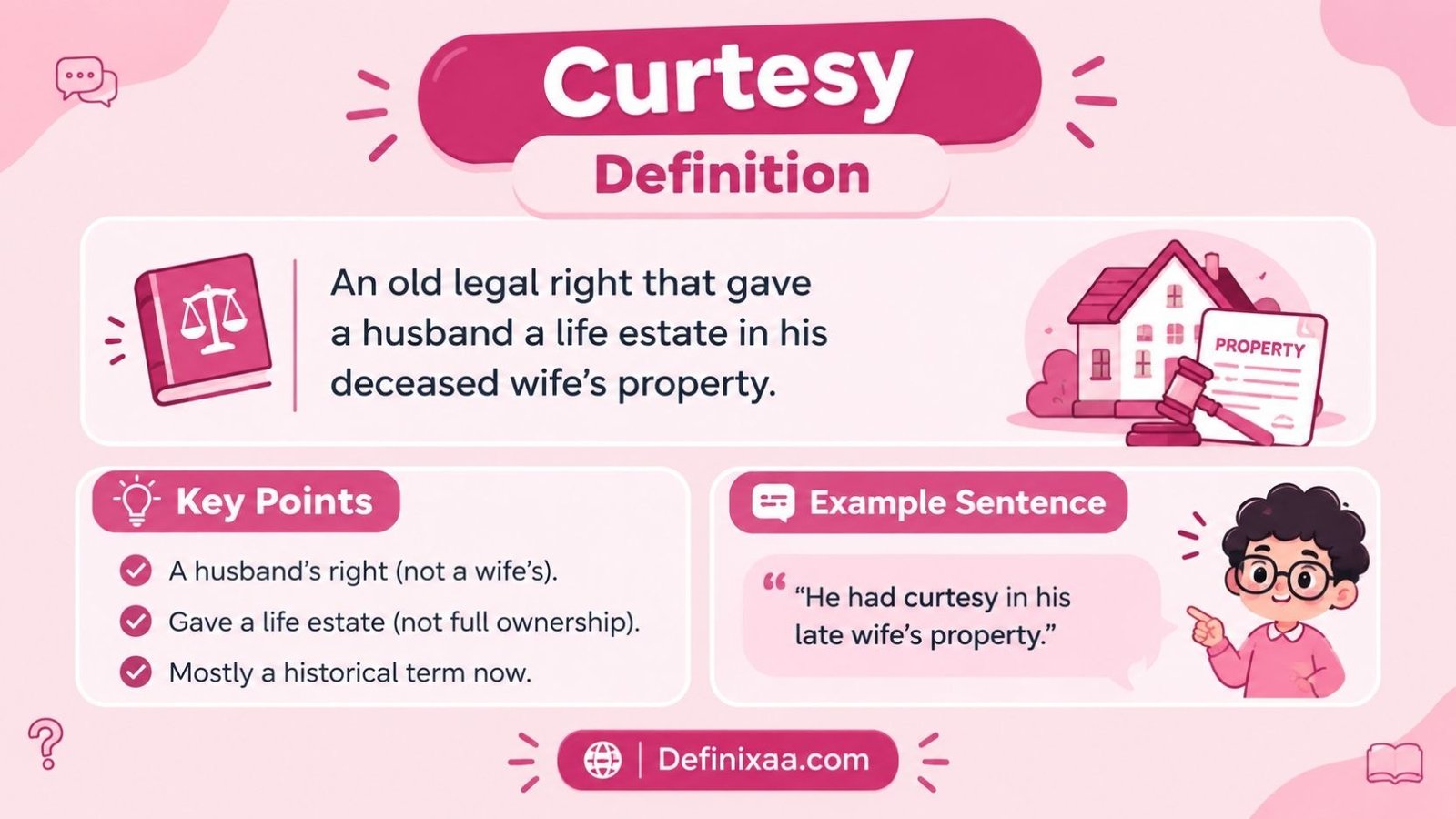
Curtesy is a common law right that once gave a surviving husband a life estate in his deceased wife’s real property. It applied only if the couple had a child together during the marriage.
Today, curtesy is mostly a historical and legal term, largely replaced by modern spousal inheritance laws. Curtesy is also frequently confused with courtesy, the everyday word for politeness. They sound identical but mean completely different things.
At A Glance
| Detail | Information |
| Meaning | A husband’s historic right to a life estate in his deceased wife’s land |
| Type | Legal term, real estate and inheritance law |
| Tone | Formal, historical, largely obsolete in modern statutes |
| Common context | Property law, estate planning, real estate title searches |
| Related terms | Dower, elective share, life estate, marital property |
| Not to be confused with | Courtesy (politeness), curtsy (a bow) |
So, What Is Curtesy in Simple Terms?
Curtesy is the male counterpart to dower. Under English common law, when a wife died, her husband could claim a life estate in the real property she owned during the marriage.
A life estate means he could live on and profit from the land for the rest of his life. He could not sell it outright or leave it to his own heirs. Ownership eventually passed to whoever was entitled to inherit it, usually the couple’s children.
Curtesy historically granted a husband a life estate in property owned by his wife at her death, serving as the counterpart to a widow’s dower rights.
Is Curtesy the Same as Dower?
No. They are mirror-image rights, but they historically applied to different spouses and under different conditions.
| Term | Meaning | Typical Use | Key Difference |
| Curtesy | A husband’s life estate in his deceased wife’s real property | Estate and property law, historically | Traditionally required a surviving child from the marriage |
| Dower | A widow’s life estate in a portion of her deceased husband’s real property | Estate and property law, historically | Traditionally applied regardless of whether children existed |
Curtesy referred to the portion of an estate a husband was entitled to upon his spouse’s death, historically requiring the couple to have had a child together, while dower referred to a wife’s right to a life estate in roughly one third of her husband’s estate regardless of children.
Note: Requirements varied by state and changed over time. Some jurisdictions eventually dropped the child requirement for curtesy. Always confirm current rules with a licensed attorney in the relevant state.
Where Does the Word Curtesy Come From?
Curtesy and courtesy share the same root, which is exactly why they are so easy to confuse.
Merriam-Webster traces curtesy to Anglo-French curteisie, meaning favor or courtesy, originally used in the phrase “par la corteysie de Engleterre,” meaning “by the courtesy of the law of England,” as opposed to a right someone held by natural or automatic entitlement. In other words, a husband’s claim to his late wife’s land was framed as something granted by the special favor of English law, not as an automatic inheritance.
Courtesy comes from the same medieval French family of words, tracing back to Old French curteis, meaning having elegant manners or a courtly bearing. Both words ultimately connect to the idea of the royal court and the behavior or privileges associated with it.
Over time, the two spellings split into completely separate roles. Courtesy kept its everyday meaning of politeness and good manners. Curtesy narrowed into a single, technical legal meaning tied to English property law, and it stopped evolving alongside the everyday word.
Quick Detail: Word Origin
| Word | Root | Original Sense |
| Courtesy | Old French curteis, courtly manners | Polite, refined behavior associated with a royal court |
| Curtesy | Anglo-French curteisie, favor or courtesy | A legal favor or privilege granted “by the courtesy of the law of England” |
Curtesy In Real Estate: Why It Still Comes Up
Curtesy is rarely enforced today, but it still appears in real estate practice for two main reasons.
Title searches and old deeds. Older property records sometimes reference dower and curtesy rights attached to land. Title companies review historical documents to confirm no lingering claim exists.
Spousal signature requirements. In states that once recognized dower and curtesy, both spouses were required to sign a deed even if only one spouse owned the property, so a buyer could take the property free of either right. Some states kept a version of this signature rule even after formally abolishing the old common law rights, simply to protect surviving spouses.
Practical usage example
A title examiner reviewing a 1962 deed might write: “Property is subject to a potential curtesy interest; request a quitclaim deed from the surviving spouse to clear title.”
What Curtesy Does Not Mean
Curtesy is not the same as any of the following, even though they sound alike or occasionally get mixed up.
- It is not courtesy, which means politeness or a considerate act.
- It is not a curtsy, the bending gesture of respect, usually performed by women.
- It is not a dowry, which is property a bride brings into a marriage, not something claimed after a spouse’s death.
- It is not the modern elective share, though elective share statutes largely replaced dower and curtesy in most states.
Elective share is essentially the modernized version of the older curtesy and dower laws, giving a surviving spouse an entitlement to inheritance without distinguishing between wife and husband.
Curtesy Or Courtesy: Which Spelling Is Correct?
This is the single most common point of confusion tied to this word, and it depends entirely on what you are trying to say.
If you mean politeness, respect, or a considerate gesture, the correct spelling is always courtesy. This is true in emails, essays, business writing, and everyday speech.
If you mean the historic legal right to a deceased spouse’s property, the correct spelling is curtesy, without the letter “o.” This spelling only belongs in legal, historical, or academic writing about estates and property law.
Outside of that narrow legal context, curtesy is considered a misspelling of courtesy in modern English.
Quick Confusion Check
Before you use either word, remember this: courtesy is the word you almost always want. Curtesy only applies if you are specifically discussing historical inheritance law.
Courtesy Of Someone: What That Phrase Means
The everyday word courtesy also appears in the common phrase “courtesy of someone,” which has nothing to do with the legal term above.
“Courtesy of” means that something was provided freely, or as a result of someone’s generosity or effort. For example: “The upgrade was courtesy of the hotel manager.” It signals thanks or attribution, not a property right.
Courtesy Definition With Example
Since courtesy and curtesy are often searched together, it helps to see the everyday word defined and used clearly.
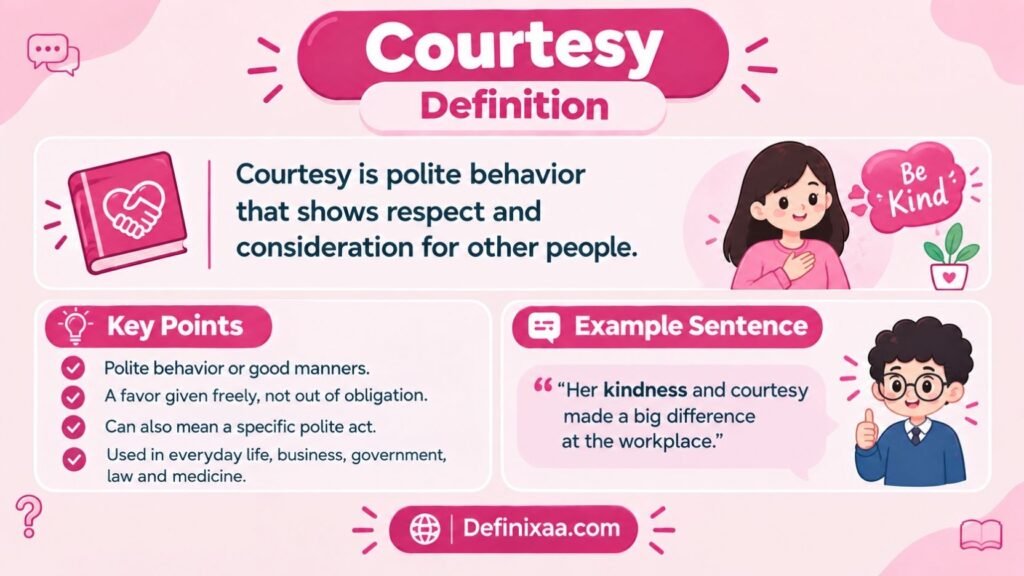
Courtesy means polite behavior, respect, or a considerate act toward another person.
Example sentence: She held the door open as a simple courtesy to the person behind her.
Professional example: As a courtesy, the airline notified passengers of the delay two hours in advance.
Everyday example: Thank you for your courtesy during a difficult week.
Courtesy Definition In Communication
In communication, courtesy means expressing respect and consideration for the other person through tone, wording, and timing, not just through content.
A courteous message typically:
- Uses polite phrasing, such as “please” and “thank you”
- Acknowledges the other person’s time or effort
- Avoids blunt or dismissive wording, even when delivering bad news
- Responds within a reasonable timeframe
Example, low courtesy: “Send the file now.”
Example, higher courtesy: “Could you send the file when you get a chance? No rush, just checking in.”
Both messages request the same thing. The second one shows courtesy through tone and phrasing.
What Words Mean Something Similar to Courtesy?
Courtesy has several close synonyms, though each carries a slightly different shade of meaning.
- Politeness – general good manners in speech and behavior
- Civility – basic respectful conduct, often in a formal or public setting
- Graciousness – warmth combined with good manners
- Consideration – attentiveness to another person’s feelings or needs
- Etiquette – the accepted rules of polite behavior in a specific setting
These words overlap but are not perfectly interchangeable. Etiquette, for example, refers to a set of rules, while courtesy refers to the underlying attitude of respect behind following them.
Courtesy In The Bible
Courtesy also appears as a specific virtue in some Bible translations, most notably in 1 Peter 3:8. The King James Version renders part of that verse as an instruction to “be pitiful, be courteous.”
In that context, courtesy points to a friendly, considerate, humble-minded attitude toward other people, rather than simple social politeness. Some translations use words like “kind,” “gentle,” or “humble” in that same verse instead of “courteous,” reflecting differences in how translators rendered the underlying Greek term.
This religious sense fits within the everyday meaning of courtesy: treating others with respect and genuine consideration, rather than only performing surface-level manners.
Courtesy Definition For Kids
Courtesy means being polite and kind to other people. It includes saying please and thank you, waiting your turn, and treating others the way you would like to be treated.
Curtesy Pronunciation
Curtesy is pronounced the same way as courtesy: roughly KUR-tuh-see, or in phonetic notation, /ˈkɜːr.tə.si/. The two words are pronounced nearly identically, which is part of why people frequently confuse the spellings.
Because the pronunciation is identical, spelling is the only reliable way to tell the words apart in writing.
Is Curtesy Formal, Informal Or Outdated?
Curtesy is a formal, historical legal term. It is not used in casual conversation, and it rarely appears in modern statutes by that name. Curtesy is generally described as an outdated term that has largely been replaced by equal inheritance treatment for both spouses.
You would encounter it in:
- Property law textbooks
- Estate planning and probate discussions
- Historical deeds and title abstracts
- Bar exam or law school property courses
You would not typically encounter it in ordinary professional writing, casual speech, or social media, except when someone is asking about the correct spelling.
Dower And Curtesy Definition Together
Dower and curtesy are usually discussed as a paired legal concept, since they historically formed a matched system of spousal property rights.
Dower and curtesy are outdated terms referring to a spouse’s rights to the other spouse’s property after death, with dower traditionally covering a wife’s rights and curtesy covering a husband’s rights. Because sex-based discrimination is now illegal in nearly all circumstances, most states have equalized these rights regardless of gender, though the exact share still varies by state.
Cornell Law School’s Wex legal dictionary describes dower as an antiquated term for how a widow inherited a portion of her husband’s property, typically a life estate of one third to one half, with curtesy referring to the historically separate rights once held by the husband.
Common Historical Requirements
| Requirement | Dower (Wife’s Right) | Curtesy (Husband’s Right) |
| Marriage required | Yes | Yes |
| Live child required | Not typically required | Traditionally required in most jurisdictions |
| Typical share | One third to one half of husband’s qualifying property | Life estate in all of wife’s qualifying property |
| Modern status | Largely abolished or merged into elective share | Largely abolished or merged into elective share |
Note: These are historical common law defaults. Individual state statutes varied, and most states have since replaced both rights with modern elective share or equitable distribution laws.
Curtesy Legal Definition: In Plain Terms
If you strip away the history, the modern practical definition looks like this:
Curtesy is a legal doctrine, mostly abolished, under which a widower could claim a life interest in real property his late wife owned, generally conditioned on the couple having had a child together during the marriage.
Today, in the United States, the historically separate rights of dower and curtesy have generally been replaced so that surviving spouses are treated the same, regardless of gender.
Curtesy Real Estate Definition: A Working Example
Imagine a couple married in a state that historically recognized dower and curtesy. The wife owns a farm in her own name. They have one child together.
Under the old common law rule, if the wife died first, the husband could claim curtesy: a life estate in the farm, allowing him to live there and use it until his own death. He could not sell the land outright, and after his death, it would pass to their child.
If the husband had died first instead, the wife could claim dower: typically a life estate in one third to one half of his qualifying real property, whether or not they had children together.
A husband’s entitlement to a life estate that his wife possessed at her death is generally described as the curtesy right.
When Would You Actually Use the Word Curtesy?
You would use curtesy specifically when:
- Writing about the history of common law property rights
- Explaining an old deed or title abstract that references it
- Studying property law, wills, or estates in a legal course
- Comparing historic spousal rights to modern elective share law
You would not use it when writing a thank-you note, a business email, or anything involving politeness. In those situations, courtesy is always the correct word.
Should You Use the Word Curtesy?
In modern general writing, no. Curtesy is not accepted as a standard spelling in modern English dictionaries, with the rare exception of its historical use as a legal term in English common law.
If your goal is to describe politeness, respect, or a considerate gesture, using “curtesy” will read as a spelling mistake to almost every reader, including legal professionals. Save the spelling for genuine discussions of historical property law.
What Words Mean Something Similar to Curtesy?
Curtesy does not have true everyday synonyms, since it is a specific legal doctrine rather than a general concept. However, related and comparable legal terms include:
- Dower – the wife’s historical equivalent right
- Life estate – the type of interest curtesy actually granted
- Elective share – the modern, gender-neutral replacement in most states
- Marital property – the broader category of property acquired during a marriage
- Intestate succession – inheritance rules that apply when someone dies without a will
None of these terms are perfect synonyms. Each describes a related but distinct legal concept, so avoid using them interchangeably in formal writing.
Curtesy And Dower Compared to Dowry
People sometimes assume dower and dowry are the same word with different spellings. They are not.
Dowry is property a bride brings with her into a marriage to support the new household, while dower is a right entitling a widow to a share of her husband’s estate after his death. One happens at the start of a marriage; the other only arises after a spouse’s death.
How Curtesy Developed Under English Common Law
Curtesy originated in medieval England as part of a broader system that governed how land passed between spouses and their heirs. Land ownership carried enormous economic weight at the time, so the law built specific rules around what happened to it when one spouse died.
Merriam-Webster’s legal definition describes curtesy as a husband’s interest at common law in a life estate upon the death of his wife, in real property she either solely owned or inherited, provided the couple bore a child capable of inheriting the property.
That single condition, a child capable of inheriting, is the detail that most reliably separates curtesy from dower in the historical common law. Dower generally did not require a child. Curtesy usually did.
This system eventually crossed the Atlantic and became part of early American common law in many states, since much of early U.S. property law was inherited directly from English legal tradition. As American inheritance law modernized through the nineteenth and twentieth centuries, most states gradually replaced both rights with statutory alternatives.
How Curtesy Rights Were Historically Created and Ended
Curtesy did not apply automatically to every marriage. Certain conditions generally had to be met, and certain actions could remove the right entirely.
Typical requirements for curtesy to attach:
- A valid, legal marriage
- The wife owned qualifying real property during the marriage
- A child was born alive to the couple, capable of inheriting the property
Common ways the right could be limited or released:
- A prenuptial or antenuptial agreement releasing the right in advance
- The property being held in a form of ownership, such as certain joint tenancies, that did not allow the right to attach
- The property being personal property, such as partnership interests or corporate shares, rather than real property, since dower and curtesy applied only to real property, not personal property
Do Any States Still Recognize Curtesy Today?
Almost all U.S. states have fully abolished dower and curtesy. A small handful of states still retain a version of these rights, though the details vary.
Ohio, Arkansas, and Kentucky are commonly cited as the remaining states that still recognize dower rights in some form, now generally applied equally regardless of gender rather than under the old separate dower and curtesy labels. Michigan was reportedly the last state to fully repeal its dower statute, doing so in 2017.
Where these rights still exist, they now function as gender-neutral protections for a surviving spouse, rather than separate rights that depend on whether the surviving spouse is a widow or a widower.
Quick Detail: Where Dower-Style Rights Persist
| State | General Status |
| Ohio | Reported to still recognize a form of dower, often requiring spousal consent in property transactions |
| Arkansas | Reported to still recognize dower rights, with the share sometimes depending on whether the couple had children |
| Kentucky | Reported to still recognize a form of dower affecting real property inherited or owned during marriage |
| Most other states | Dower and curtesy have been abolished and replaced with elective share or community property rules |
Note: Property law varies by state and can change through new legislation or court rulings. Anyone dealing with an actual property or inheritance question involving one of these states should confirm current requirements with a licensed real estate or estate attorney in that state, rather than relying on a general definition article.
Curtesy Versus Modern Elective Share, In Practice
Understanding how curtesy differs from its modern replacement helps explain why the old term still matters in legal history, even though it rarely applies in practice.
Under classic curtesy, a husband’s right depended on specific facts: a valid marriage, real property owned by the wife, and a live child from the marriage. Miss any one of those facts, and the right never attached at all.
Under a modern elective share statute, the surviving spouse’s right generally does not depend on the couple having children. It typically applies to a broader range of the deceased spouse’s assets, not just real property, and it applies equally whether the surviving spouse is a husband or a wife.
In short, elective share statutes traded a narrow, condition-heavy, gender-specific right for a broader, simpler, gender-neutral one. That shift is the main reason curtesy faded out of active use rather than being repealed all at once.
Frequently Asked Questions
What does curtesy mean in real estate?
It refers to a husband’s historic right to a life estate in his deceased wife’s real property, typically conditioned on the couple having had a child together during the marriage.
Is curtesy still a legal right today?
In most U.S. states, no. Most states have replaced dower and curtesy with gender-neutral elective share or inheritance laws.
Is curtesy the same as dower?
They are counterparts, not the same thing. Curtesy traditionally applied to husbands, while dower traditionally applied to wives, and the conditions for each historically differed.
How do you spell curtesy correctly?
If you mean politeness, spell it courtesy. If you mean the historic legal property right, spell it curtesy, without an “o.”
How is curtesy pronounced?
It is pronounced the same as courtesy, roughly KUR-tuh-see.
Why do people confuse curtesy and courtesy?
The two words are near-identical in pronunciation, which makes it easy to swap the spelling in writing even though the meanings are completely different.
Does curtesy require having children?
Traditionally, yes. Most common law versions of curtesy required a child to be born alive during the marriage, though dower for wives generally did not carry that same requirement.
Is curtesy a formal or informal word?
It is a formal, historical legal term. It is not used in casual conversation or everyday professional writing.
What replaced dower and curtesy in most states?
Most states now use elective share statutes, which give a surviving spouse, regardless of gender, a right to claim a portion of the deceased spouse’s estate.
Can curtesy still affect a property title today?
In rare cases, yes. Old deeds may still reference the right, which is why some title companies and attorneys check historical records before closing certain older properties.
Where does the word curtesy come from?
It comes from Anglo-French curteisie, meaning favor or courtesy, originally used to describe a right granted “by the courtesy of the law,” rather than one held automatically.
Why did courtesy and curtesy end up with different spellings?
Both trace back to the same medieval French root tied to courtly manners. Courtesy kept the everyday meaning of politeness, while curtesy narrowed into a single, specialized legal term and stopped changing alongside it.
The Simple Takeaway
Curtesy is a largely retired legal term for a husband’s historic right to a life estate in his deceased wife’s property, once the counterpart to a wife’s dower right. Outside of legal or historical writing, the word you almost always want is courtesy, meaning politeness or a considerate gesture. If you are researching real estate or estate law, curtesy is worth understanding as background, but modern elective share statutes now govern most spousal inheritance rights in the United States.

Laiba Rahman is a writer and researcher behind Definixaa, dedicated to exploring words, meanings, terms, concepts, and everyday knowledge. Through clear and well-researched explanations, her goal is to help readers understand unfamiliar ideas quickly and discover useful information with ease.