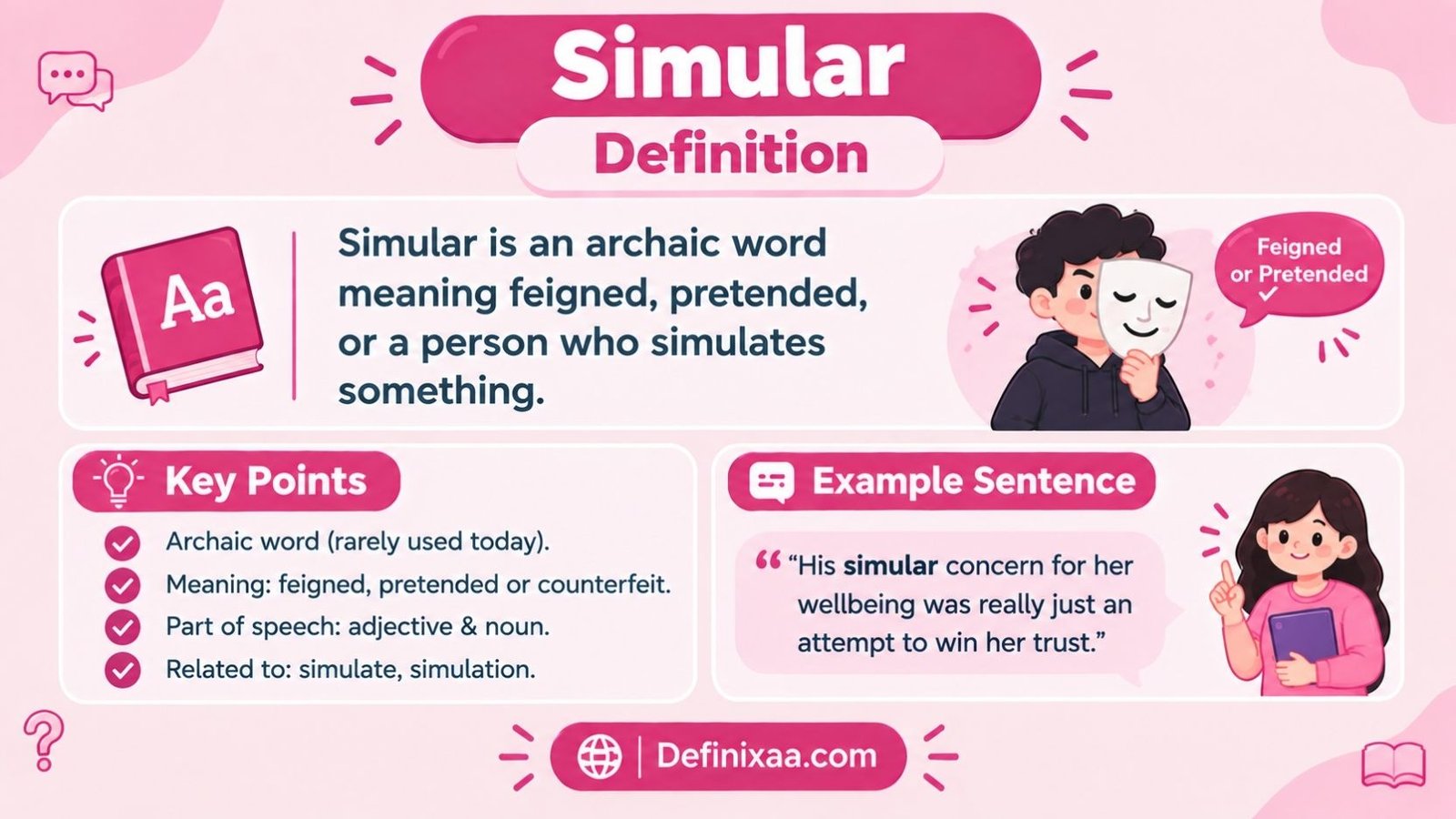
Simular is, in almost every modern case, a misspelling of the word similar. But simular is also a real, though archaic, English word in its own right. As an adjective, it means feigned, pretended, or counterfeit. As a noun, it means a person or thing that simulates something, in other words, a pretender.
Similar, the word almost everyone is actually looking for means having a resemblance or likeness to something else, without being the same.
If you typed “simular” into a search bar because you meant “similar,” you are in good company. The two words look and sound close, and the mix up is extremely common.
At a Glance
| Detail | Simular | Similar |
| Meaning | Archaic: pretended, feigned, or one who simulates | Alike or comparable, though not identical |
| Type | Rare archaic adjective and noun | Everyday adjective, plus a technical math term |
| Tone | Formal, literary, almost never used today | Neutral, used constantly in speech and writing |
| Common today | Almost always a spelling mistake for similar | Yes, extremely common |
| Related word | Simulate, simulation | Similarity, similarly |
So, Is Simular Actually a Word?
Yes, technically it is. Merriam Webster lists simular as an archaic noun meaning “one that simulates: dissembler,” and as an archaic adjective meaning “counterfeit, pretended.” The Oxford English Dictionary also carries an entry for it.
But here is the important part for almost everyone reading this. If you encountered the word simular in an online form, a text message, an essay, or a social media post, the person almost certainly meant similar. The genuine archaic meaning of simular survives mainly in old literature and in specialist dictionaries, not in everyday conversation.
So there are really two separate questions hiding inside one search:
- What did the archaic word simular used to mean?
- What does the common word similar mean, the one most people are actually searching for?
This article answers both, clearly and separately.
Read More: Oversight Definition
What Does the Archaic Word Simular Mean?
When simular shows up in older English writing, it carries one of two closely related meanings.
As an adjective, simular means feigned, pretended, or counterfeit. A “simular affection,” for example, is a fake display of caring that is not genuine.
As a noun, a simular is a person who pretends to be something they are not, essentially an impersonator or a fraud.
Both senses trace back to the same idea: something that imitates or simulates the real thing rather than being genuine.
Simulare Meaning And Word Origin
Merriam Webster traces simular to the Latin verb simulare, meaning “to pretend” or “to assume the appearance of.” This is the same Latin root behind the modern English words simulate and simulation.
Interestingly, dictionary sources also note that similar was sometimes spelled “simular” in early Modern English, and that this older spelling may have influenced how the archaic word simular developed. In other words, the overlap between these two words is not a brand new internet era mistake. Writers have been blending similar and simular for centuries.
Simular Pronunciation
The archaic word simular is pronounced sim yuh ler, with the emphasis on the first syllable. One language reference specifically warns readers to remember the “u” in the middle of the word, since it is easy to drop when speaking quickly, which is part of why people confuse it with similar in writing.
If you are trying to pronounce the common word similar instead, it sounds like sim uh ler, again with stress on the first syllable, but without the extra “yuh” sound in the middle.
Simular In A Sentence
Since the archaic word is rare, genuine examples mostly come from older literature. A modern, original example that reflects the correct historical meaning would look like this:
- His simular concern for her wellbeing was really just an attempt to win her trust.
- The novel’s antagonist is a simular, a man who spent decades pretending to be someone he was not.
If you meant to use the common word instead, the correct spelling and sentence would be:
- These two paintings are similar, though one uses brighter colors.
Simular Spelling: Why The Mix Up Happens
Simular and similar differ by only one letter position, with the “u” and the “i” swapped in the middle of the word. That small difference is easy to miss when typing quickly, especially since both words are pronounced with a similar rhythm.
Autocorrect does not always catch it either, because simular is a real entry in some large dictionaries, even though it is archaic. That means some spell checkers will not flag it as an error the way they would flag a completely made up word.
If you are ever unsure which spelling you need, remember this simple rule: unless you are specifically discussing pretending, faking, or simulation in an old or literary sense, you almost certainly want similar.
Simular Vs Similar: A Side by Side Comparison
| Term | Meaning | Typical Use Today | Key Difference |
| Simular | Feigned, pretended, or one who simulates | Almost never used; occurs mainly as a spelling mistake | Refers to fakery or imitation, not resemblance |
| Similar | Alike or comparable in nature, without being identical | Used constantly in everyday speech and writing | Refers to genuine resemblance between two things |
Note: These words are not interchangeable. Similar describes two things that are alike. The archaic simular describes something that is fake or pretended. They share a Latin ancestor, but their meanings point in different directions.
Is Simular The Same As Similar?
No. Even though they share a common Latin root, “similar the same” as “simular” is a misconception. Similar means alike or comparable. Simular, in its rare historical sense, means fake or pretended.
If your sentence is about two things looking or acting alike, the word you want is similar, spelled with the letters i and m together, followed by i-l-a-r.
Now, What Does Similar Actually Mean?
Formal Meaning
Similar is an adjective describing something that has a likeness or resemblance to something else, especially in a general way, without being exactly the same.
In Simple Words
If two things are similar, they share some noticeable features, but they are not identical. Two people can have similar taste in music without liking every single song. Two houses can be similar in style without being the same house.
Similar is one of the most common words in English for describing partial sameness. It sits between “identical,” which means exactly the same, and “different,” which means not alike at all.
Similar Definition In Simple Terms For Kids
For younger readers, similar simply means “almost the same” or “alike in some ways.” Two apples can be similar even if one is red and one is green, because they are still both apples, both round, and both fruit. Similar does not mean identical. It means “alike, but not exactly the same.”
Where Does the Word Similar Come From?
Similar entered English in the early 1600s. It traces back through French similaire and Medieval Latin similaris to the Latin word similis, meaning “like.” That same Latin root, similis, is related to simul, meaning “together,” which also gives English words like simultaneous.
An older English spelling, similary, appeared before similar settled into its modern form.
Similar Definition In Geometry
In geometry, similar has a precise, technical meaning that goes beyond everyday resemblance.
Two figures are similar if they have the same shape, even if they are different sizes. For this to be true, two conditions must both hold:
- Corresponding angles are equal.
- Corresponding sides are proportional, meaning they share the same ratio.
Mathematicians write this relationship using a tilde symbol, so “triangle ABC is similar to triangle DEF” is written as triangle ABC ~ triangle DEF.
A useful way to picture this: if you can shrink or enlarge one shape and it lines up perfectly with another shape, without changing any angles, the two shapes are similar. All circles are similar to each other, and all squares are similar to each other, because their basic shape never changes, only their size does.
Similar Vs Congruent
People often confuse similar with congruent, so it helps to separate them clearly.
| Term | Meaning | Requires Same Size? |
| Similar | Same shape, corresponding angles equal, sides proportional | No |
| Congruent | Same shape and same size exactly | Yes |
Every pair of congruent figures is also similar, but not every pair of similar figures is congruent. Congruent is the stricter, more exact relationship.
Similar Definition In Math: Outside Of Geometry
Outside of pure geometry, math uses “similar” in a few related but distinct ways.
In basic arithmetic and general math instruction, similar usually just means the geometric idea above: same shape, proportional sides, equal angles.
In a completely different branch of math, set theory, two sets are sometimes described as similar, or equinumerous, if there is a one to one correspondence between their elements, meaning they have the exact same number of members, even if the members themselves are different.
Similar Definition In Linear Algebra
Linear algebra gives “similar” a much more specific and technical meaning than everyday English does.
Two square matrices, A and B, are called similar matrices if there exists some invertible matrix P such that B equals P inverse times A times P.
In plain language, similar matrices represent the exact same linear transformation, just described using a different coordinate system or basis. Changing the basis changes how the transformation looks on paper, but not what it actually does.
Similar matrices always share several important properties:
- The same rank
- The same determinant
- The same trace, meaning the sum of the diagonal entries
- The same eigenvalues, although typically different eigenvectors
Note: Sharing the same eigenvalues, trace, and determinant does not automatically prove two matrices are similar. Those shared properties are necessary, but on their own they are not enough to guarantee similarity.
This concept matters in fields like engineering, physics, computer graphics, and control theory, anywhere a system needs to be simplified or transformed into an easier form to analyze, such as diagonalizing a matrix, without changing the underlying behavior of the system.
Similarity Definition
Similarity is the noun form of similar. It describes the state or quality of being alike.
Formally, similarity means resemblance or correspondence between two or more things.
In geometry specifically, similarity refers to the relationship between two figures that share the same shape but not necessarily the same size, following the equal angle and proportional side rules explained above.
In everyday conversation, similarity simply means a shared trait or a point of resemblance, as in “there is a real similarity between the two proposals.”
Read More: RSS Feed Definition
What Words Mean Something Similar to Similar?
Several words overlap with similar, though they carry slightly different shades of meaning.
- Alike: informal, general resemblance
- Comparable: emphasizes that two things can be measured or judged against each other
- Analogous: emphasizes a similarity in function or relationship, rather than appearance
- Resembling: focuses specifically on outward appearance
- Corresponding: emphasizes matching parts or roles
Merriam Webster’s thesaurus groups similarity with analogy, likeness, resemblance, and similitude as closely related synonyms, noting that likeness usually implies a closer match than similarity, which often just means things are somewhat alike.
None of these words are perfectly interchangeable. Choose based on whether you want to emphasize appearance, function, or degree of closeness.
Similar Vs Same
People sometimes use similar and same as if they mean the same thing, but they do not.
| Term | Meaning | Example |
| Similar | Alike in some ways, not identical | These two jackets are similar in style. |
| Same | Identical, with no meaningful difference | These two jackets are the same brand. |
If two things are the same, there is essentially one thing being described twice. If two things are similar, there are two distinct things that happen to share some features.
How Is Similar Actually Used In Real Life?
Similar shows up constantly across nearly every kind of writing and speech in American English.
In casual conversation: People use similar to compare tastes, opinions, appearances, and experiences, as in “we had a similar reaction to the movie.”
In professional writing: Similar is used to compare data, proposals, products, or outcomes, as in “sales followed a similar pattern to last quarter.”
In academic and scientific Writing: similar often introduces a careful comparison, as in “the two samples showed similar chemical properties under testing.”
In technical fields like math: Computer science, and engineering, similar carries the precise definitions covered above, referring to matching shapes, proportional relationships, or equivalent transformations.
Across every one of these contexts, the underlying idea stays the same: things that resemble each other without being identical.
Similar In A Sentence, Across Different Contexts
Casual conversation: “Our vacations always end up similar, we both love the beach.”
Professional setting: “This candidate has a background similar to our top performer from last year.”
Online or social media: “Just watched a documentary with a plot similar to that other one everyone was talking about.”
Academic context: “The two studies reported similar findings, though their methods differed.”
Math or technical context: “Since the two triangles have equal angles and proportional sides, they are similar.”
A Quick Usage Note
One small but common mistake involves the word that follows similar. The correct preposition is “to,” not “as.” Say “this system is similar to the one used in France,” not “similar as the one used in France.”
Should You Use Similar Or Simular?
For virtually every situation you will encounter today, from casual texting to formal writing to academic papers, the correct word is similar, not simular.
Reach for simular only if you are specifically writing in an old fashioned, literary, or archaic style and you mean “pretended” or “feigned.” Outside of that narrow case, simular will read as a spelling error to almost any reader.
What Similar Does Not Mean
Similar is often stretched further than it should go, so it helps to be clear about what the word does not mean.
Similar does not mean identical. If two things are truly identical, the accurate word is same, or identical itself, not similar.
Similar does not mean better or worse. Saying two products are similar makes no judgment about quality, only about resemblance.
Similar does not mean related by origin. Two things can be similar by coincidence, without sharing any history or connection at all. Two unrelated companies can build similar products independently.
Similar does not guarantee interchangeability. In technical fields especially, two similar items, materials, or systems may still behave differently in practice, even though they share key features on paper.
Before You Use Similar: Remember This
Similar describes a comparison, so it normally needs something to be compared against. A sentence like “this house is similar” feels incomplete on its own. Native speakers usually finish the thought, either directly, as in “similar to the one next door,” or through context that has already been established earlier in the conversation.
Also remember the preposition rule already mentioned above: similar pairs with “to,” never with “as.”
Similar Definition And Examples, One More Look
Because “similar definition and examples” is one of the most common searches related to this word, here is a compact reference combining the definition with a range of examples in one place.
Definition: alike or comparable to something else, without being exactly the same.
- Weather example: “Tuesday’s forecast looks similar to Monday’s, mild with a chance of rain.”
- Shopping example: “This laptop has similar specs to the pricier model, but costs less.”
- Relationship example: “They have similar senses of humor, which is part of why they get along.”
- School example: “Both essays reached similar conclusions, even though the students worked separately.”
- Workplace example: “Our two teams are handling similar challenges this quarter.”
Each example shows two distinct things being placed next to each other, with a clear point of resemblance connecting them.
Similar Across Different Fields
Beyond geometry and linear algebra, several other fields lean on their own version of similar.
In biology, similar traits between species can point to a shared evolutionary history, though similarity alone does not prove a direct relationship.
In computer science, similarity often describes how closely two pieces of data, text, or images match, frequently expressed as a similarity score or percentage.
In law, similar fact patterns between cases can influence how a court reasons through a new case, without those cases being treated as identical.
In everyday retail and marketing, “similar items” or “similar products” typically means items sharing key features, style, or function, intended to help a shopper compare options.
Each of these uses shares the same core meaning as everyday similar. Only the context, and sometimes the precision required, changes.
Similar In French
The French equivalent of similar is similaire. It functions the same way in French as similar does in English, describing two things that resemble each other without being identical. This is also the direct ancestor of the English word, since similar entered English partly through the French similaire.
Simular In Older Literature
The archaic word simular does show up in older English texts, mostly from the 1600s through the 1800s. In these older passages, writers used it either to describe something fake or feigned, such as a false show of emotion, or to label a person as an impersonator or fraud.
Some old regional or dialect writing also used simular loosely where a modern writer would simply say similar, reflecting looser spelling conventions from earlier centuries, long before dictionaries and spell checkers standardized English spelling the way they do today. That historical looseness is part of why the two spellings still get tangled together now.
Modern readers rarely need to use simular themselves. Recognizing it while reading older literature, however, can prevent real confusion about a sentence’s meaning, since mistaking simular for similar would flip the intended meaning of an old sentence completely.
Common Misunderstandings Around Simular and Similar
A few misunderstandings come up often enough to address directly.
Some readers assume simular is simply a newer or more casual spelling of similar. It is not. It is a separate, older word with its own distinct meaning tied to pretending or faking, even though it is rarely used that way today.
Some readers assume similar and same can be swapped freely. They cannot, since same implies no meaningful difference at all, while similar always allows for some degree of difference.
Some readers assume similar always implies a close or strong match. In practice, similar can describe anything from a very close resemblance to a fairly loose, general one. The word itself does not specify how close the resemblance needs to be. Writers often add words like “closely similar” or “broadly similar” to clarify the degree.
Finally, some readers assume the math definitions of similar, in geometry or linear algebra, are just casual extensions of the everyday meaning. They are actually precise, testable definitions with their own formal rules, even though they grew out of the same basic idea of resemblance without identity.
Read More: Grately Definition
When Should You Use the Word Similar?
Similar fits naturally almost anywhere a comparison is being made without claiming two things are identical.
It works well in formal writing, professional communication, academic work, and everyday conversation alike, which is part of why it is such a common word in English.
Consider a more specific alternative when precision matters more than general resemblance. In geometry or linear algebra, for example, “similar” carries a strict technical definition, so it should only be used when that definition genuinely applies, not simply as a loose stand in for “kind of like.”
In careful academic or scientific writing, some writers prefer more specific words, such as analogous or comparable, when they want to highlight a particular kind of resemblance rather than a general one. Similar remains the safer, broader default choice in most everyday situations.
Frequently Asked Questions
What does simular mean?
Simular is mainly known today as a misspelling of similar. As a genuine, though archaic, English word, simular means pretended, feigned, or counterfeit, and can also refer to a person who pretends to be something they are not.
Is simular a real word?
Yes, but it is archaic. Dictionaries such as Merriam Webster and the Oxford English Dictionary include it, though it almost never appears in modern writing except by mistake.
How do you pronounce simular?
The archaic word is pronounced sim yuh ler, with stress on the first syllable and a distinct “yuh” sound in the middle.
What does similar mean in simple words?
Similar means alike in some ways, but not exactly the same. It describes a resemblance, not an identical match.
What is the difference between similar and same?
Similar means two things resemble each other without being identical. Same means two things are identical or treated as one and the same thing.
What does similar mean in geometry?
In geometry, two figures are similar if their corresponding angles are equal and their corresponding sides are proportional, meaning they share the same shape but not necessarily the same size.
What does similar mean in linear algebra?
Two square matrices are similar if one can be transformed into the other using an invertible matrix, following the formula B equals P inverse times A times P. Similar matrices represent the same linear transformation viewed from different bases.
Is similar the same as congruent?
No. Similar figures share the same shape but can differ in size. Congruent figures must share the same shape and the same size exactly.
What is a synonym for similar?
Common alternatives include alike, comparable, analogous, and resembling, though each carries a slightly different emphasis.
How do you use similar in a sentence?
You can write, “the two houses are similar in layout, though one has an extra bedroom.” Similar is typically followed by the word “to” when comparing two specific things.
What does similaire mean in French?
Similaire is the French word for similar. It carries the same meaning, describing two things that resemble each other without being identical.
Why do people spell similar as simular?
Because the letters “u” and “i” sit close together in the middle of the word, and the two spellings sound almost alike when spoken quickly. The rare archaic word simular, which does exist in some dictionaries, adds to the confusion.
Is similar formal or informal?
Similar works in both formal and informal English. It appears in casual conversation, professional writing, and academic papers without sounding out of place in any of them.
Can similar be used for people as well as things?
Yes. Similar can describe people’s personalities, tastes, backgrounds, or appearances, just as easily as it describes objects, ideas, or data.
What is an antonym for similar?
Common opposites include different, distinct, dissimilar, and unlike.
The Simple Takeaway
Simular is almost always a misspelling of similar, though a genuine archaic version of the word does exist, meaning pretended or feigned. Similar, the word most people actually mean, describes things that resemble each other without being identical, and it carries extra precise meanings in geometry and linear algebra. When in doubt about spelling, similar, ending in i-l-a-r, is the word you want.

One Comment