
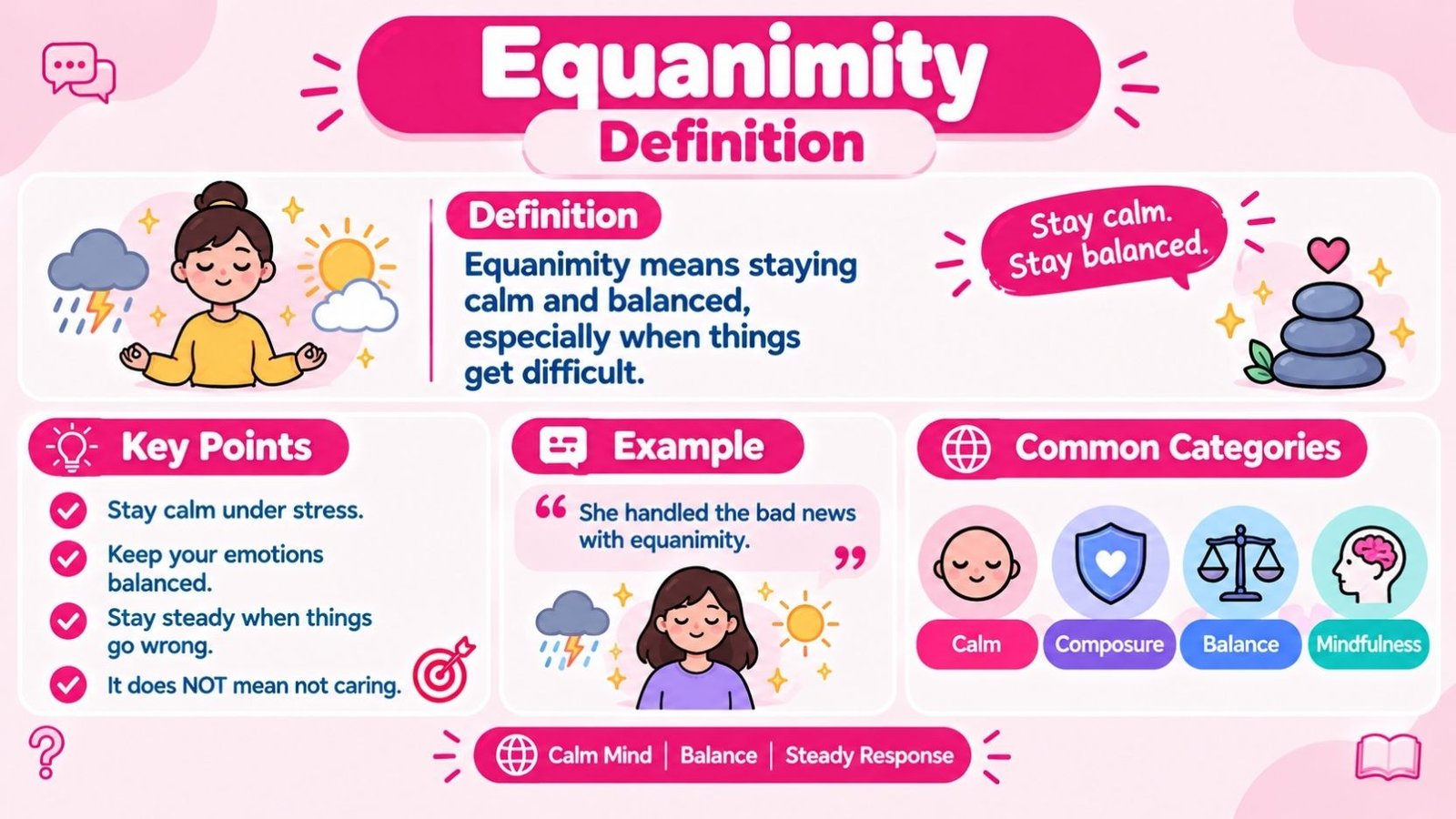
Quick definition: Equanimity is mental calmness and evenness of temper, especially under stress. A person with equanimity stays steady when things go wrong and does not get thrown off by every shock. It is a noun, and it sounds formal in everyday speech.
At A Glance
| Quick Detail | Information |
| Meaning | Calm, balanced state of mind, especially under pressure |
| Part of speech | Noun (adjective form: equanimous) |
| Register | Formal, according to Oxford Learner’s Dictionaries |
| Tone | Positive, admiring |
| Common contexts | Psychology, Buddhism, philosophy, literature, journalism |
| Similar words | Composure, calm, serenity, poise, sangfroid |
| Opposite ideas | Agitation, anxiety, turmoil, volatility |
So, What Is Equanimity In Simple Terms?
Equanimity means staying level when life gets bumpy. Bad news arrives, and you take it in without panic. Good news arrives, and you enjoy it without losing your head.
Think of a boat with a deep keel. Waves still hit it, but it does not flip.
Note: Equanimity is not the absence of feeling. Reliable sources in psychology and Buddhism both stress that a person can feel sadness, fear or joy and still keep their balance.
Read More: Durable Goods Definition
What Does Equanimity Mean In A Dictionary?
Dictionaries agree on the core idea, though each phrases it a little differently.
- Merriam-Webster defines it as evenness of mind, especially under stress. Its second sense is a “right disposition,” or balance.
- Oxford Learner’s Dictionaries describes a calm state of mind in which you do not become angry or upset, especially in difficult situations.
- Webster’s New World, as shown on YourDictionary, gives the quality of remaining calm and undisturbed, with composure as a near match.
- Vocabulary.com defines it as steadiness of mind under stress and lists calm, calmness and composure as synonyms.
The shared thread is a steady mind under pressure. The second Merriam-Webster sense, which stresses balance, appears far less often in everyday writing.
The Formal Meaning
Equanimity is the quality of remaining calm, composed and even tempered, particularly in difficult circumstances.
In Simple Words
It is the ability to keep your cool and your balance, even when things are hard.
How Do You Pronounce Equanimity?
Equanimity is pronounced ee-kwuh-NIM-uh-tee or eh-kwuh-NIM-uh-tee. The stress falls on the third syllable, “NIM.”
Dictionaries record slightly different first vowels:
- Merriam-Webster shows two pronunciations: ˌē-kwə-ˈni-mə-tē and ˌe-kwə-ˈni-mə-tē.
- Oxford Learner’s Dictionaries gives the IPA /ˌekwəˈnɪməti/.
- Vocabulary.com gives /ˌikwəˈnɪmɪti/.
Both “ee” and “eh” at the start are accepted. Tip: Say it in five beats, e-qua-NIM-i-ty, and lean on the third beat.
For audio, Merriam-Webster’s entry for equanimity includes a pronunciation recording.
Is Equanimity A Noun, Or Can It Be An Adjective?
Equanimity is a noun. If you are searching for an adjective, the word you want is equanimous.
Merriam-Webster defines equanimous as possessing or displaying equanimity. The adverb is equanimously.
- Noun: She faced the delay with equanimity.
- Adjective: He is an equanimous manager who rarely raises his voice.
- Adverb: The team equanimously accepted the schedule change.
Equanimous is the rarer word. Most writers prefer phrases such as “with equanimity” or “calm and composed.”
What Does Equanimity Look Like in a Sentence?
Equanimity usually appears after the word “with,” as in “accepted it with equanimity.” It also works as a subject or object. Here are original examples across different settings.
Everyday Conversation
- “I was surprised at how much equanimity my dad showed when the flight got cancelled.”
- “She took the criticism with equanimity and asked for specifics.”
Professional Setting
- “The project lead handled the budget cuts with equanimity, which kept the team steady.”
- “A good negotiator keeps equanimity even when the other side turns aggressive.”
Academic or Reflective Writing
- “The essay argues that equanimity, not happiness, was the central goal of ancient philosophy.”
- “Researchers describe equanimity as a skill that can be practiced.”
Journalistic Style
- “The goalkeeper’s equanimity after the missed save impressed commentators.”
- “The mayor met the protest with equanimity.”
Tip: These are original examples written to show the word in different registers. They are not quotations from published work.
How Is Equanimity Actually Used In Real Life?
Equanimity is a “grown up” word. It rarely appears in casual texting or fast conversation. Most people say “stay calm” or “keep it together” instead.
You will mostly meet it in four places.
- Writing and journalism. Reporters use it to praise someone who handled a crisis gracefully. Merriam-Webster’s example sentences include a diver who shows remarkable equanimity on the platform.
- Meditation and spiritual teaching. Teachers of mindfulness and Buddhism use it constantly, often as a translation of a specific Pali or Sanskrit term.
- Psychology and wellbeing. It appears in discussions of emotional regulation, resilience and mindfulness.
- Philosophy. Writers on Stoicism, and other ancient schools, often use it to describe the ideal mental state.
The word nearly always carries admiration. Calling someone equanimous is a compliment about character, not just mood.
It can sound slightly lofty in a casual setting. Telling a friend “you handled that with equanimity” works, but it has a polished, almost literary sound.
What Does Equanimity Mean In Psychology?
In psychology, equanimity usually means the capacity to stay balanced and calm amid changing circumstances. It is less about a personality trait you either have or lack, and more about a skill that can be developed.
An article in Psychology Today describes equanimity as a capacity for calmness and balance despite daily challenges and life’s changing circumstances. The same piece says the term is used most often in Buddhist and spiritual teaching, while psychological research shows how it applies to everyday life.
It also notes that emotional intelligence is a building block. According to that article, positive psychology researcher Ryan Niemiec suggested that the central strength behind equanimity is self regulation.
What Equanimity Is Not? According To Psychology Writers
Psychology writers are careful to separate equanimity from numbness. The Psychology Today piece says directly that equanimity is not indifference, passivity or resignation.
That distinction matters. Suppressing emotion is different from allowing it and staying steady.
Equanimity And Mindfulness
Mindfulness and equanimity are closely linked. Meditation teacher Margaret Cullen, writing in Tricycle, describes mindfulness as both a route to equanimity and a result of it. She also describes equanimity as seeing without being caught by what we see.
Practices that build attention, like breath awareness, are commonly used to train this steadiness.
Note: Equanimity is not a clinical diagnosis or a treatment on its own. If stress, anxiety or low mood is affecting your daily life, a licensed mental health professional can help.
What Does Equanimity Mean In Buddhism?
Equanimity is one of the most important qualities in Buddhist thought. The Pali word is upekkhā, and the Sanskrit form is upekṣā. Britannica describes upekṣa as the perfect virtue of equanimity and one of the four practices known as the brahmavihāras.
The Four Immeasurables
Equanimity is the fourth of the “four immeasurables,” also called the four divine abodes or brahmavihāras:
- Loving kindness (mettā)
- Compassion (karuṇā)
- Empathetic joy (muditā)
- Equanimity (upekkhā)
A Springer chapter on equanimity in mental healthcare lists the same four qualities. Study Buddhism notes that each is described as free of attachment, repulsion and indifference.
Why Equanimity Comes Last
Equanimity is often listed last, but it is not an afterthought. A commentary on upekkhā argues that without equanimity, loving kindness can turn into attachment, compassion into sorrow, and empathetic joy into envy or partiality.
In other words, it keeps the other three healthy. That is an interpretation from a modern commentary, but it matches how many teachers describe the role of equanimity.
Equanimity Appears in More Than One Buddhist List
Tricycle notes that equanimity is the last of the ten paramis (perfections), one of the four immeasurables, and one of the seven factors of awakening. Cullen adds that the fifth century text Visuddhimagga, by Buddhaghosa, defines equanimity in ten different ways.
That variety explains why Buddhist definitions can sound different from a dictionary’s.
The Most Important Buddhist Warning
Buddhist teachers repeatedly warn that equanimity is not coldness. Tricycle quotes teacher Gil Fronsdal describing mature equanimity as producing a radiance and warmth of being, not dry neutrality.
The same article gives a practical tip. If you notice yourself growing distant and calling it equanimity, check whether you have simply disengaged.
A short Buddhist equanimity definition would read: a balanced, impartial state of mind that meets pleasant and unpleasant experiences without clinging or aversion, while staying kind.
How Do the Stoics Understand Equanimity?
Stoic philosophy cares deeply about inner steadiness. But the Stoics did not use the English word. English writers often use “equanimity” to translate Greek terms such as apatheia and ataraxia.
Apatheia
An explainer on Stoic apatheia describes it as a state in which a person is not disturbed by the passions. It adds that, despite the look of the English word “apathy,” apatheia does not mean indifference or lack of feeling.
Instead, it means freedom from emotional turmoil. The Stoics held that unhealthy emotions come from false judgments about what is good or bad.
Control And Judgment
A central Stoic idea is the difference between what we control and what we do not. Our judgments, choices and actions are in our hands. Other people’s behavior and outside events are not.
Marcus Aurelius and Epictetus both stress that our judgments about events upset us more than the events themselves. That is why Stoic practice focuses on examining and correcting judgments.
A Famous Stoic Image
According to Daily Stoic, Marcus Aurelius compared the steady mind to a rock that waves keep crashing over, while the sea falls still around it. The same source says the last word Marcus heard from his stepfather Antoninus was aequanimitas, the Latin ancestor of our word.
Note: Ataraxia is a related Greek term. Wikipedia notes it is generally translated as imperturbability, equanimity or tranquility, and that Pyrrhonists, Epicureans and Stoics all pursued it in different ways. So a “Stoic equanimity definition” depends on which Greek word and which philosopher you mean.
Does The Bible Define Equanimity?
Equanimity is not a typical Bible term, and this article did not find a verified Bible dictionary entry that defines it. So no verse will be quoted as using the word.
Readers searching for an “equanimity Bible definition” are usually looking for related ideas. These include contentment, peace and trust in hard times. One familiar example is Paul’s statement in Philippians 4 that he had learned to be content in whatever circumstances he faced.
Interpretations vary between traditions. If this question matters to you, a trusted pastor, study Bible or commentary is a better guide than a general word article.
Where Do People Often Get Equanimity Wrong?
Confusion usually comes from the “calm” part of the meaning. Several common mistakes follow.
Mistake 1: Equanimity Means Not Caring
This is the most common misunderstanding. Indifference means you do not care. Equanimity means you care and still stay steady.
Buddhist and Stoic sources both reject the indifference reading. Wikipedia’s entry on upekkhā likewise says the virtue is indifference only to the demands of the ego, not to the wellbeing of other people.
Mistake 2: Equanimity Means Suppressing Emotion
Suppression is pushing feelings down. Equanimity involves noticing feelings and not being ruled by them. The Wikiversity course on the topic makes the same distinction, though it is a less authoritative source than the others in this article.
Read More: Rotate Definition
Mistake 3: Equanimity Means Passivity
Staying calm does not mean doing nothing. A calm mind can act clearly, set boundaries and push for change. Psychology Today lists passivity and resignation among the things equanimity is not.
Mistake 4: Equanimity Is Always Warm and Happy
It is not the same as happiness. Equanimity is steadiness. You can be equanimous while sad.
Mistake 5: Equanimity Is a Fixed Personality Trait
Some people are naturally steadier. But teachers in Buddhism and psychology describe equanimity as something that can be cultivated through practice.
What Words Mean Something Similar To Equanimity?
Several words overlap with equanimity, but each has its own shade.
Synonyms And Near Synonyms
- Composure. Calm self control, often during a specific stressful moment.
- Calm or calmness. The general, everyday word.
- Sangfroid. Coolness under strain, borrowed from French.
- Poise. Graceful, balanced self assurance.
- Aplomb. Confident ease in a difficult situation.
- Serenity. A peaceful, untroubled state.
- Tranquility. Quiet peacefulness.
- Placidity. A mild, undisturbed calm.
- Imperturbability. The quality of not being easily upset.
Vocabulary.com lists calm, calmness and composure as synonyms, and several of the others as related types.
Opposites
- Agitation
- Anxiety
- Turmoil
- Volatility
- Panic
Equanimity Vs Composure: A Useful Distinction
Merriam-Webster’s synonym guide separates the two. Equanimity suggests a habit of mind that is rarely disturbed even under great strain. Composure suggests controlling emotional or mental agitation, by effort or by habit.
So composure can be something you summon in the moment. Equanimity sounds more like a settled character.
Is Equanimity The Same As Composure, Serenity Or Indifference?
Not quite. These words sit close together but point to different things. The table below summarizes how they differ.
| Term | Meaning | Typical Use | Key Difference |
| Equanimity | Steady, balanced mind, especially under stress | Character, meditation, philosophy | A settled habit of mind |
| Composure | Calm self control | Moments of pressure | Can involve effort in the moment |
| Serenity | Peaceful, untroubled state | Places, moods, spiritual life | Emphasizes peace more than steadiness under strain |
| Sangfroid | Coolness under strain | Dramatic or risky situations | Sounds more dashing, less spiritual |
| Indifference | Lack of interest or concern | Everyday speech | Equanimity involves care; indifference does not |
| Apathy | Absence of feeling or motivation | Psychology, everyday speech | A deficit, not a skill |
Tip: When in doubt, ask whether the person still cares. If they do, equanimity may fit. If they do not, indifference or apathy fits better.
When Should You Use the Word Equanimity?
Use equanimity when you want to praise steadiness of character. It works best in writing, speeches, reflective conversation and discussions of philosophy or wellbeing.
Good situations:
- Describing how someone handled a crisis, loss or disappointment
- Writing about mindfulness, Buddhism or Stoicism
- Academic, professional or literary writing
- Reference letters or reviews that praise temperament
Less ideal situations:
- Fast casual texting, where “calm” or “chill” sounds more natural
- Conversations where a simpler word would be clearer
- Talking to young learners or non native speakers who may not know the word
Is it appropriate in professional writing? Yes. Oxford Learner’s Dictionaries labels it formal, which suits reports, essays and cover letters.
Tip: Pair it with “with” and a verb of reaction. Phrases like “accepted with equanimity,” “faced with equanimity” and “responded with equanimity” sound natural.
How Do You Say Equanimity in French, Spanish and Chinese?
Translations can differ by context. The suggestions below are standard renderings, but a bilingual dictionary is the best check for your exact sentence.
French
The French word is équanimité. Wiktionary, via YourDictionary, notes that English borrowed the word from French équanimité, which came from Latin aequanimitas.
Example: Elle a accepté la nouvelle avec équanimité. (She accepted the news with equanimity.)
Spanish
The Spanish word is ecuanimidad.
Example: Aceptó el cambio con ecuanimidad. (He accepted the change with equanimity.)
Chinese
Chinese has no single word that fits every context. Common choices include 平静 (píngjìng), meaning calm, and 镇定 (zhèndìng), meaning composed. In reflective or spiritual settings, 平常心 (píngchángxīn), roughly “an ordinary, steady mind,” is often used for a similar idea.
Example: 她以平静的心态接受了这个消息。 (She accepted the news with a calm mind.)
Note: Treat these Chinese options as starting points. The best word depends on whether you mean everyday calm, composure under pressure or a spiritual quality.
Where Does the Word Equanimity Come From?
Equanimity comes from Latin. Oxford Learner’s Dictionaries traces it to Latin aequanimitas, from aequus (equal) plus animus (mind).
Vocabulary.com gives a slightly fuller picture. It says the Latin aequanimus meant even tempered or fair, and that English borrowed the noun from it. The same source notes that the old phrase “to bear with equal mind” is a translation of the Latin idea.
Merriam-Webster dates the first known use of equanimity in English to 1663. Oxford places it in the early 17th century and notes an early sense of fairness or impartiality.
That earlier sense of impartiality helps explain why Buddhist teachers sometimes link equanimity to treating all beings evenly.
The adjective equanimous is a back formation from the Late Latin aequanimitas, according to Merriam-Webster.
Before You Use Equanimity: Remember This
Equanimity is a compliment about steadiness, not about emotion level. A person can be deeply moved and still equanimous.
Do not use it as a polite word for “doesn’t care.” That meaning is the opposite of what teachers, philosophers and dictionaries intend.
Tip: If you describe someone as having equanimity, add a detail. “She showed equanimity by asking calm questions” is stronger than a bare compliment.
Read More: Notions Definition
Where Can You Verify And Learn More?
These sources were found during research and provide additional context:
- Merriam-Webster entry for equanimity: definition, pronunciation audio, synonym guide and first known use.
- Oxford Learner’s Dictionaries entry: definition, formal label, IPA and origin.
- Vocabulary.com entry: synonyms and Latin background.
- Britannica entry on upekṣa: the Buddhist virtue of equanimity.
- Tricycle: Margaret Cullen on equanimity: a practitioner’s explanation of equanimity in Buddhism, including what it is not.
- Psychology Today: Feeling Anxious About Daily Challenges?: equanimity as a psychological capacity.
No video is linked here, because none was verified during research.
Frequently Asked Questions
What does equanimity mean in simple words?
Equanimity means staying calm and balanced when life gets stressful. A person with equanimity does not panic or lose their temper easily. They can feel emotions and still keep steady.
What is the dictionary definition of equanimity?
Merriam-Webster defines equanimity as evenness of mind, especially under stress. Oxford Learner’s Dictionaries describes a calm state of mind in which you do not become angry or upset, especially in difficult situations.
How do you pronounce equanimity?
It is pronounced ee-kwuh-NIM-uh-tee or eh-kwuh-NIM-uh-tee, with stress on the third syllable. Merriam-Webster accepts both starting sounds. Oxford gives the IPA as /ˌekwəˈnɪməti/.
Is equanimity a noun or an adjective?
Equanimity is a noun. The adjective is equanimous, and the adverb is equanimously. Most writers prefer the noun in the phrase “with equanimity,” since the adjective is less common.
What is a good example of equanimity in a sentence?
“She handled the sudden schedule change with equanimity and quickly reorganized the meeting.” The word often follows “with” and describes a calm response to difficulty.
What is the psychological definition of equanimity?
In psychology, equanimity is a capacity for calmness and balance despite life’s changing circumstances. Writers describe it as a skill linked to emotional intelligence, self regulation and mindfulness, not as indifference.
What is equanimity in Buddhism?
In Buddhism, equanimity is upekkhā in Pali and upekṣā in Sanskrit. Britannica calls it the perfect virtue of equanimity. It is the fourth of the four immeasurables, alongside loving kindness, compassion and empathetic joy.
Is equanimity the same as indifference?
No. Indifference means not caring, while equanimity means caring and staying steady. Buddhist teachers, Stoic explainers and psychology writers all stress this difference.
What is the Stoic view of equanimity?
Stoic writers often link equanimity to apatheia, freedom from disturbing passions. The Stoics held that false judgments cause emotional turmoil. Focusing on what you control is a key practice.
What is another word for equanimity?
Common synonyms include composure, calm, calmness, serenity, poise, aplomb and sangfroid. Each has a slightly different shade. Composure often sounds more effortful, while equanimity sounds more habitual.
Is equanimity a formal word?
Yes. Oxford Learner’s Dictionaries labels it formal. It suits writing, speeches and reflective discussion better than quick casual texting, where “calm” usually sounds more natural.
Where does the word equanimity come from?
It comes from Latin aequanimitas, built from aequus (equal) and animus (mind). Merriam-Webster dates its first known English use to 1663.
Last Words
Equanimity is steadiness of mind under pressure. It is a formal, admiring word that appears in writing, psychology, philosophy and Buddhism.
It does not mean coldness or not caring. It means feeling what you feel and staying balanced. Use “with equanimity” to describe a calm, grounded response to difficulty.

Laiba Rahman is a writer and researcher behind Definixaa, dedicated to exploring words, meanings, terms, concepts, and everyday knowledge. Through clear and well-researched explanations, her goal is to help readers understand unfamiliar ideas quickly and discover useful information with ease.

One Comment