
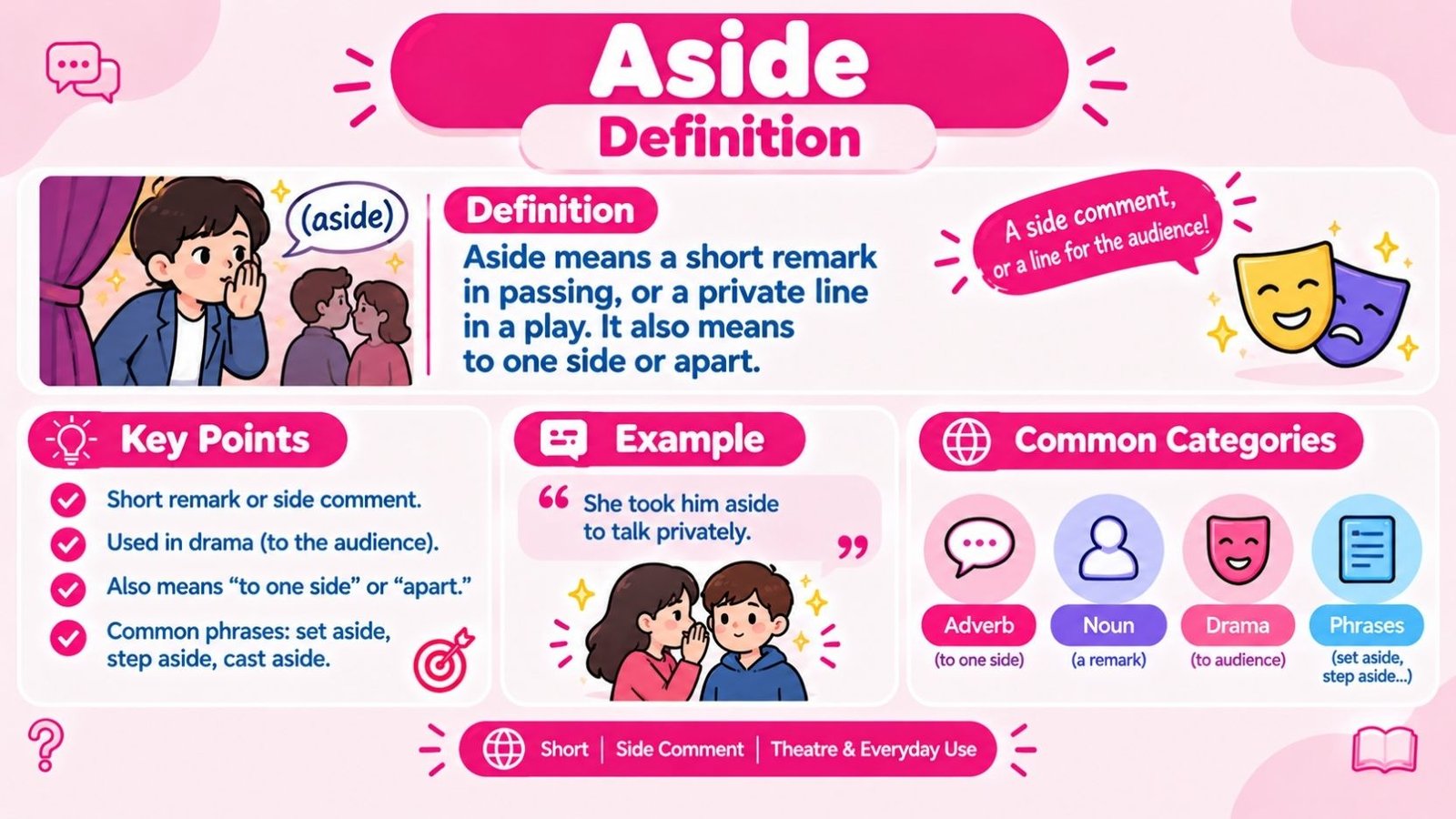
Aside most often means a short remark made in passing, or, in drama, words spoken to the audience that the other characters are supposed not to hear. As an adverb, it means “to one side” or “apart.” It also appears in phrases such as set aside, step aside, and cast aside.
The meaning you need depends on where you met the word. A student reading Shakespeare needs the theatre meaning. Someone reading a legal notice needs a different one. This guide covers both and shows how to tell them apart.
At A Glance
| Detail | Information |
| Word | Aside |
| Parts of speech | Adverb, noun, and part of several phrases |
| Most common noun meaning | A remark made in passing, or a private line in a play |
| Most common adverb meaning | To one side, apart, or away |
| Register | Neutral, suitable for formal and casual writing |
| Plural | Asides |
| Pronunciation | uh SIDE |
| Related terms | Digression, soliloquy, parenthetical remark, tangent |
Read More: Equanimity Definition
What Does Aside Actually Mean?
Aside has three main uses. Each has its own definition.
Aside As An Adverb
As an adverb, aside means toward one side, out of the way, or apart from something else.
- She moved the box aside.
- He took his friend aside to talk privately.
- Joking aside, the plan has a real problem.
Aside As A Noun In Conversation And Writing
As a noun, an aside is a comment that departs briefly from the main topic. Speakers and writers use it to add a side thought without changing the subject.
It is often introduced with the phrase “as an aside” or “just as an aside.”
Aside As A Noun In Drama
In theatre, an aside is a short speech by a character, usually directed to the audience or spoken privately. The convention is that the other characters on stage do not hear it.
This is the meaning most students are searching for when they type “aside definition literature” or “aside definition theatre.” It gets its own section below.
So, What Is an Aside in Simple Terms?
Think of an aside as stepping out of the main conversation for a moment.
In everyday talk, it is a side comment. In a play, it is a secret thought or comment shared with the audience. In both cases, the aside sits slightly apart from the main flow.
Simple version: an aside is something said “off to the side.”
A quick comparison of the two noun meanings:
- In conversation: a remark that wanders briefly from the topic
- In a play: a line the audience hears but the other characters supposedly do not
What Is An Aside In Drama?
An aside in drama is a brief speech in which a character speaks directly to the audience or to themselves. The other characters on stage are assumed not to hear it.
It is a theatrical convention, meaning the audience agrees to accept it even though it is not realistic. In real life, people on stage would hear each other. In the theatre, we pretend they do not.
What An Aside Does In A Play
Playwrights use asides to do several things:
- Reveal what a character really thinks
- Create humor through a gap between words and thoughts
- Build tension by sharing a secret with the audience
- Make the audience feel like a partner in the story
- Show that a character is lying or hiding something
Key features Of A dramatic aside
- It is usually short, often a line or two.
- It is meant to be heard by the audience, not the other characters.
- It often reveals honest feelings or intentions.
- Stage directions in printed scripts often label it “Aside.”
- It does not stop the action of the scene for long.
Note: Some asides are directed at another character who is meant to overhear, or at only one or two characters on stage. The core idea is still the same: it is meant to be a private communication.
Aside Definition In Shakespeare
Shakespeare used asides often, in comedies, histories, and tragedies. His characters comment on events as they happen, and the audience learns the truth before the other characters do.
Printed editions of his plays commonly mark these lines with the word “Aside” in brackets or italics. Early printings did not always mark them, and editors have sometimes decided which lines count as asides. Different editions can therefore label different lines.
Aside definition In Romeo and Juliet
A well known example comes from the balcony scene in Act 2, Scene 2. Romeo, hidden below Juliet’s window, hears her speak. He says:
“Shall I hear more, or shall I speak at this?”
Romeo is speaking to himself and the audience. Juliet does not hear him. The line lets us feel his hesitation as he decides whether to reveal himself.
Aside In Macbeth
Macbeth also contains asides. In Act 1, Scene 4, after the king names his son as heir, Macbeth speaks lines that reveal his dark ambition. The other characters on stage do not know what he is thinking. Editors commonly treat this passage as an aside.
For readers new to Shakespeare, noticing asides is a good way to follow a character’s true motives.
Aside vs Soliloquy vs Monologue: Are They the Same?
These three terms are related but not interchangeable. Students often mix them up.
| Term | Meaning | Typical Use | Key Difference |
| Aside | A short private remark to the audience or to oneself | Quick comment during a scene | Brief, and other characters are on stage |
| Soliloquy | A longer speech by a character who is alone or acts as if alone | Revealing deep thoughts | Longer, and the character speaks their thoughts aloud |
| Monologue | A long speech by one character, often to others | Speeches, confessions, arguments | Others may hear it |
Tip: Ask two questions. How long is the speech? Who is supposed to hear it? A short line that others cannot hear is an aside. A long speech made alone is a soliloquy.
Aside Definition In Poetry And Other Literature
Asides are not limited to plays. In poetry, fiction, and essays, writers often use parenthetical remarks, digressions, or direct addresses to the reader that work like asides.
A narrator might pause the story to comment to the reader. A poet might insert a bracketed thought. These are sometimes called asides in a looser sense.
Strictly speaking, the formal literary term comes from drama. In prose and poetry, “aside” is used more loosely to describe any short side comment from the narrator or speaker.
How Is Aside Actually Used In Real Life?
Outside the classroom, people use “aside” in a few common ways.
In conversation and writing
The phrase “as an aside” signals that a comment is a side note. Speakers use it to share an interesting fact that is not central to the main point.
- “As an aside, that restaurant also does great desserts.”
- “Just as an aside, the meeting has moved to Thursday.”
With “from”
“Aside from” is very common in American English. It can mean “except for” or “in addition to,” and context tells you which.
- “Aside from the price, the car is perfect.” (except for)
- “Aside from cooking, she also bakes.” (in addition to)
In phrasal verbs
Aside also forms many everyday phrasal verbs. These are covered in detail below.
Aside is neutral in tone. It sounds natural in speech and works in professional or academic writing.
What Does Aside Look Like In A Sentence?
Here are original examples showing different contexts.
Adverb examples
- Please set your phone aside during dinner.
- The teacher pulled him aside after class.
- The cat pushed the curtain aside and climbed out.
Noun examples (conversation)
- That was a funny aside, but let’s get back to the budget.
- His lecture was full of interesting asides.
- She made a quiet aside to her friend during the meeting.
Drama examples
- The actor delivered his aside with a wink to the audience.
- In the aside, the villain admits he plans to betray the king.
- The director asked her to speak the aside more softly, as if sharing a secret.
Phrase examples
- Joking aside, we need to fix this by Friday.
- Politics aside, the two neighbors get along well.
- All kidding aside, I really appreciate your help.
Aside Definition For Kids
Here is a version for younger readers.
An aside is a quiet comment. In a play, it is when an actor says something just for the audience, like a secret. The other actors on stage act like they did not hear it.
You can also use “aside” to mean “to the side.” If you move your toy aside, you put it next to where you were playing so it is out of the way.
Example for kids: “The funny character whispered an aside to the audience about his plan to eat the cake.”
Aside Can Mean More Than One Thing
The word has several legitimate meanings. Here is a quick guide.
| Meaning | Part of Speech | Where It Appears |
| To one side, apart | Adverb | Everyday speech |
| A passing remark | Noun | Conversation, essays |
| A private line to the audience | Noun | Theatre, literature |
| Except for, in addition to | Part of “aside from” | Speech, writing |
| Part of phrasal verbs | Adverb in a phrase | Everyday English |
If you searched “aside definition English,” the adverb meaning and the noun meaning are both relevant. If you searched “aside definition literature,” the dramatic meaning is the one you want.
What Do Phrases With Aside Mean?
Many search queries involve “aside” in a phrase. Each phrase has its own meaning.
Set aside
Set aside has several related meanings:
- To reserve: to save something for a purpose. “She sets aside money every month.”
- To put away temporarily: “Set the project aside for now.”
- To disregard: “Let’s set our differences aside.”
- In law: to cancel or overturn a decision. A court may set aside a verdict or judgment.
Cast aside
Cast aside means to discard, reject, or abandon something or someone, often carelessly.
- “He cast aside his old habits.”
- “She felt cast aside after the company reorganized.”
It often carries a negative tone, suggesting that something was thrown away too easily.
Turn aside
Turn aside means to change direction, or to avert or deflect something.
- “He turned aside to avoid the puddle.”
- “A gentle answer can turn aside anger.”
It sounds slightly more formal or literary than “turn away.”
Read More: Notions Definition
Step aside
Step aside means to move out of someone’s way, or to give up a position so someone else can take over.
- “Please step aside and let the nurse through.”
- “The CEO will step aside next year.”
It can also mean to withdraw from a role because of a conflict of interest, as discussed next.
Lay aside
Lay aside means to stop using something, to abandon it, or to save it for later.
- “He laid aside his pen and listened.”
- “They laid aside part of their income for a house.”
It is somewhat formal and appears more often in writing than in casual speech.
Put aside
Put aside is the everyday version of several of these meanings.
- To save: “I put aside some cash for emergencies.”
- To ignore for now: “Put your worries aside tonight.”
- To set down temporarily: “She put the book aside.”
Quick comparison Of aside phrases
| Phrase | Core Meaning | Tone | Example |
| Set aside | Reserve, disregard, or overturn | Neutral | Set aside time to study |
| Cast aside | Reject or discard | Often negative | Cast aside old ideas |
| Turn aside | Deflect or change direction | Formal | Turn aside a question |
| Step aside | Move away or give up a role | Neutral | Step aside for the manager |
| Lay aside | Abandon or save | Formal | Lay aside your doubts |
| Put aside | Save or set down | Casual | Put aside some money |
What Does A Judge Stepping Aside Mean?
When people search “recuse meaning judge step aside definition,” they are asking about a legal practice.
To recuse means to withdraw from a case because of a possible conflict of interest or bias. A judge who steps aside, or recuses, no longer takes part in deciding that case.
Common reasons include:
- A personal relationship with someone in the case
- A financial interest in the outcome
- Prior involvement in the matter
- Any situation where impartiality might reasonably be questioned
Note: “Step aside” is the everyday phrase. “Recuse” is the formal legal term. A judge may step aside voluntarily, or a party may ask the judge to do so.
What Does Set Aside Mean In Business And Law?
Two specific uses of “set aside” appear often in searches.
8(a) set aside
In United States federal contracting, a set aside is a contract reserved for a particular group of businesses, such as small businesses. The 8(a) program is run by the U.S. Small Business Administration to support certain small businesses owned by socially and economically disadvantaged people. Contracts can be set aside for firms in this program.
In this context, “set aside” means reserved for eligible businesses, not saved money or discarded.
For eligibility rules and current details, readers should check the Small Business Administration directly, since program requirements can change.
Medicare set aside
A Medicare set aside, often shortened to MSA, is a portion of an injury settlement set aside to pay for future medical care related to the injury. The goal is to protect Medicare from paying for expenses that a settlement already covers.
This term is most common in workers’ compensation and liability settlements. Rules and review thresholds are technical, so anyone dealing with a real settlement should consult an attorney or a qualified professional.
Note: Neither of these is the same as the dramatic aside. They share a word, not a meaning.
Aside and Beside: What Is the Difference?
People often mix up aside and beside. The two words sound similar but behave differently.
| Term | Meaning | Typical Use | Key Difference |
| Aside | To one side, apart | Moving or setting something away | Describes direction or separation |
| Beside | Next to, at the side of | Describing position | A preposition showing location |
| Besides | In addition to, or also | Adding information | Means “also” or “other than” |
Examples
- She sat beside me. (next to me)
- She moved her bag aside. (to one side)
- Besides the cost, there is another problem. (in addition to)
Tip: If you can replace the word with “next to,” use beside. If you mean “to the side” or “apart,” use aside. If you mean “also” or “in addition,” use besides.
A common phrase: beside the point
“Beside the point” means irrelevant. It uses beside, not aside. The phrase suggests the comment stands next to the main issue rather than on it.
What Does “Aside Me” Mean?
“Aside me” is not a standard English phrase, and reliable dictionaries do not list it as a set expression.
People who search it are most likely looking for one of these:
- “Aside from me,” meaning “except for me” or “in addition to me”
- “Beside me,” meaning “next to me”
- “Aside” in a general definition search with a stray word attached
If you saw “aside me” in a specific text, check the context. It may be a typo or informal usage.
What Words Mean Something Similar to Aside?
Synonyms depend on which meaning you need.
Synonyms for the adverb
- Apart
- Away
- Separately
- To one side
- Out of the way
Synonyms for the noun (side remark)
- Digression
- Tangent
- Parenthetical remark
- Side comment
- Interjection
- Whisper (informal)
Related literary terms
- Soliloquy: A longer speech of a character’s inner thoughts
- Monologue: A long speech by one character
- Direct address: Speaking straight to the audience or reader
Note: Synonyms are not always interchangeable. A digression usually means a longer departure from the topic. An aside is typically brief.
Opposites
The adverb has no single perfect opposite. Depending on context, you might use “together,” “front and center,” or “in the main.”
How Do You Pronounce Aside?
Aside is pronounced uh SIDE. The stress falls on the second syllable. The IPA transcription is /əˈsaɪd/.
The first syllable is a soft “uh” sound. The second rhymes with “ride” and “wide.”
Where Does The Word Aside Come From?
Aside is formed from the prepositional phrase “on side,” with “on” later reduced to “a.” Over time, the two words merged into a single adverb.
The dramatic noun sense developed later, from the idea of speech delivered “to the side” of the main action. For a detailed history with dates, a major dictionary’s etymology entry is the best source.
When Should You Use Aside?
Aside is useful in many situations.
Use it when:
- You want to add a short side thought
- You are moving or reserving something
- You are discussing a play or a literary device
- You want to set a topic apart: “Politics aside…”
Writing tips:
- “As an aside” works well in blogs, essays, and speeches.
- In formal writing, keep asides brief so they do not distract.
- Avoid overusing parenthetical asides, which can weaken a clear argument.
Is Aside Appropriate To Use?
Aside is a neutral, standard word. It is not slang and not offensive. You can use it in professional, academic, and casual settings.
A few small cautions:
- “Cast aside” and “cast aside” situations can sound harsh when describing people.
- “Set aside” in legal documents has a precise meaning, so use it carefully.
- In very formal writing, “lay aside” and “turn aside” may feel old fashioned to some readers.
Read More: Durable Goods Definition
Before You Use Aside: Remember This
Aside has more than one meaning, and context decides which applies.
- In a theatre class, it means a private line to the audience.
- In a business email, “set aside” may mean reserve.
- In a legal document, “set aside” may mean overturn or cancel.
- “Aside” and “beside” are not interchangeable.
When in doubt, check the sentence around the word.
Frequently Asked Questions
What does aside mean in simple words?
Aside means “to one side” or “apart.” As a noun, it means a quick side remark. In a play, it is a private comment to the audience that other characters are supposed not to hear.
What is an aside in a play?
It is a short speech by a character directed to the audience or to themselves. The other characters on stage do not hear it. Playwrights use asides to reveal true thoughts, add humor, or build tension.
Is an aside the same as a soliloquy?
No. An aside is brief and happens while other characters are present. A soliloquy is a longer speech made by a character who is alone or acts as if alone, revealing deeper thoughts.
What does “as an aside” mean?
It introduces a comment that is related but not central to the main topic. Speakers use it to share a quick extra thought without changing the subject.
Is aside a noun or an adverb?
It is both. As an adverb, it means to one side or apart. As a noun, it means a side remark or a private line in a play. Context shows which one is used.
What does set aside mean?
Set aside can mean to reserve, to put away for now, to ignore, or, in law, to cancel a decision. The meaning depends on context, so look at the surrounding sentence.
What is the difference between aside and beside?
Aside means to one side or apart. Beside means next to. Besides means in addition to or also. They are related in sound but different in use.
What does a Medicare set aside mean?
It is money from an injury settlement reserved to pay for future medical care related to the injury. Its purpose is to protect Medicare from paying costs that the settlement already covers.
What does it mean when a judge steps aside?
It usually means the judge recuses, or withdraws from the case because of a possible conflict of interest or bias. Another judge then handles the matter.
Can I use aside in formal writing?
Yes. Aside is neutral and acceptable in formal writing. Keep asides short in essays and reports, and use “as an aside” sparingly so your main point stays clear.
Last Words
Aside means “to one side,” a passing remark, or in drama, a private line spoken to the audience. Phrases like set aside, step aside, and cast aside each carry their own meanings. Check the context first, and you will almost always know which one applies.

Laiba Rahman is a writer and researcher behind Definixaa, dedicated to exploring words, meanings, terms, concepts, and everyday knowledge. Through clear and well-researched explanations, her goal is to help readers understand unfamiliar ideas quickly and discover useful information with ease.
One Comment