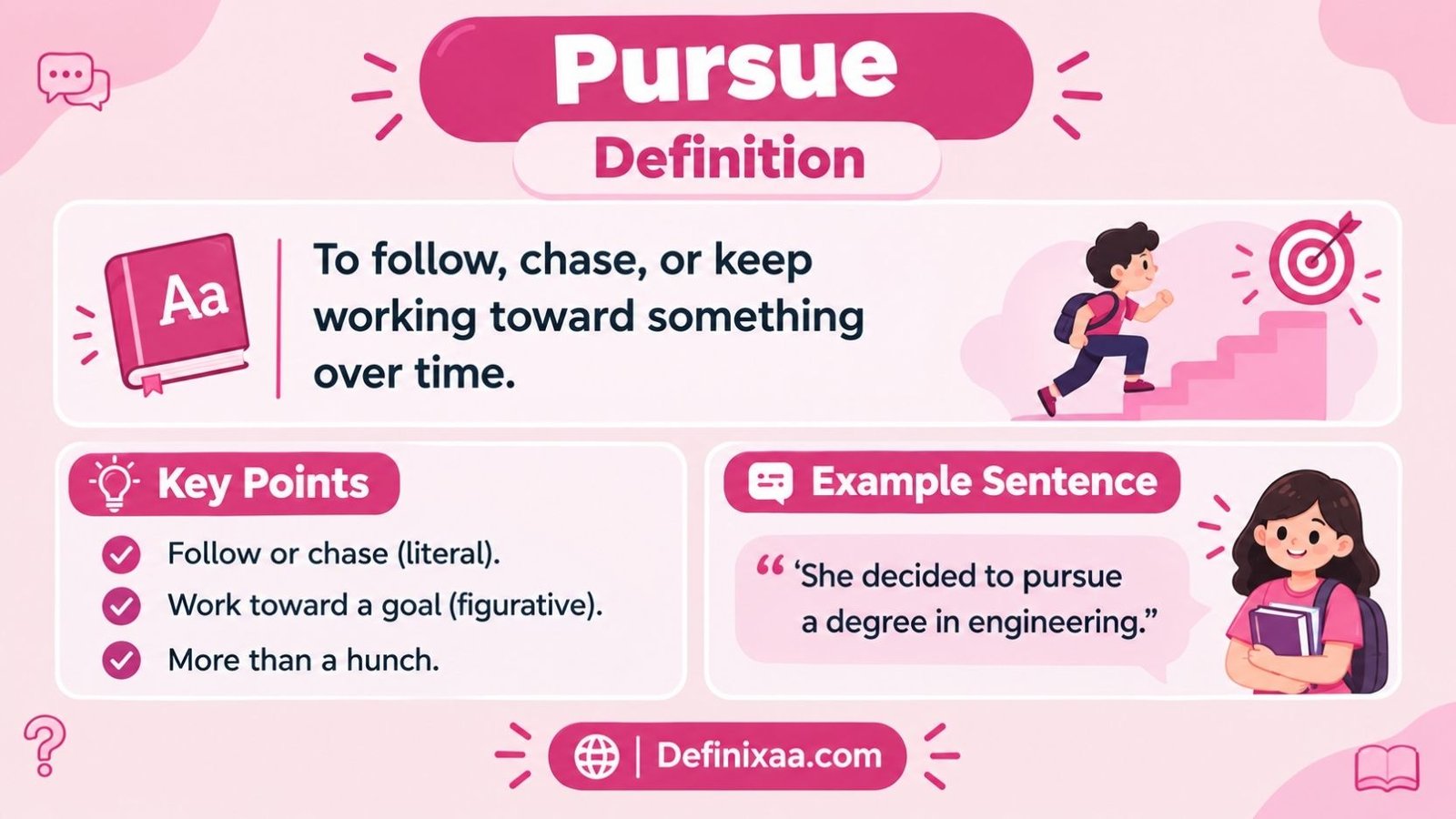
To pursue means to follow someone or something, usually to catch it, or to keep working toward a goal, activity, or interest over time. It can describe a literal chase, such as police pursuing a suspect, or a figurative effort, such as pursuing a career, a degree, or a relationship.
At A Glance
| Detail | Information |
| Word type | Verb |
| Pronunciation | pər-SOO (rhymes with “her too”) |
| Simple meaning | To follow, chase, or keep working toward something |
| Tone | Neutral to formal |
| Common contexts | Careers, goals, hobbies, relationships, law enforcement, legal matters |
| Related words | Chase, follow, seek, strive, pursuit, pursuer |
| Common misspelling | “Persue” (incorrect) |
So, What Does Pursue Actually Mean?
Pursue is a verb with a few closely related meanings, and the correct one depends on context.
The core dictionary meaning of pursue is to follow in order to overtake, catch, kill, or defeat. That is the literal, physical sense of the word, the one used when hounds chase a fox or police chase a suspect.
But pursue is used far more often in a figurative sense. Merriam-Webster also defines pursue as trying to get or do something over a period of time, and as being involved in an activity. This is the meaning behind phrases like “pursue a career” or “pursue a hobby.”
Pursue can also describe moving along a course, such as a ship pursuing a northerly route, or making an effort to investigate something further, such as a lawyer pursuing a legal matter.
In short, pursue almost always means sustained effort directed at a goal, whether that goal is a person, an object, an outcome, or a path.
Formal Meaning Vs Simple Explanation
Formal meaning: To follow someone or something with the intent to catch it, or to continue working toward a goal, activity, or outcome over a period of time.
In simple words: Pursue means going after something and sticking with it. That “something” can be a runaway suspect, a college degree, a business opportunity, a hobby, or even a person you are romantically interested in. The common thread is effort that continues rather than a single, one-time action.
Pursue Can Mean More Than One Thing
Because pursue shows up in so many different settings, it helps to separate the main meanings by context.
- General meaning: To follow something, usually to catch or reach it. Example: The dog pursued the ball across the yard.
- Career or goal meaning: To work toward an objective over time. Example: She decided to pursue a degree in engineering.
- Legal meaning: To continue with a legal claim or investigation. Example: The company chose to pursue the lawsuit rather than settle.
- Relationship meaning: To show consistent romantic interest in someone. Example: He has been pursuing her for several weeks.
- Course or direction meaning: To follow a specific path or route. Example: The ship pursued a northern course.
Most searches for this word are looking for the career, goal, or relationship sense, since those come up constantly in everyday conversation and writing.
How Is Pursue Actually Used in Real Life?
Pursue sounds natural in both spoken and written English, but it leans slightly more formal than everyday alternatives like “go for” or “try.”
It appears often in:
- Career and education contexts, such as job applications, resumes, and school essays
- News writing, especially around legal cases, business decisions, and government policy
- Personal goal-setting, such as pursuing a hobby or passion project
- Dating and relationship conversations, both casual and religious or faith-based contexts
In professional and academic writing, pursue is a common, comfortable word. In casual texting, it can sound slightly more serious or intentional than simpler verbs like “try” or “go for,” which is part of why it stands out in relationship messages.
Note: Pursue is rarely used for small, throwaway actions. People do not usually say they “pursued” a snack. The word implies effort that continues, not something instant.
What Does Pursue Look Like in a Sentence?
- Casual conversation: “I finally decided to pursue photography as more than just a hobby.”
- Professional setting: “Our team will pursue three new partnership opportunities this quarter.”
- Academic context: “After graduation, she plans to pursue a master’s degree in psychology.”
- Legal or formal writing: “The prosecution intends to pursue the case despite the defendant’s plea.”
- Texting or informal messaging: “I really want to pursue this with you, if you’re open to it.”
- Literal, physical sense: “The officer pursued the vehicle for several blocks before it stopped.”
Pursue in a Relationship: What It Really Means
This is one of the most searched meanings of the word, so it deserves its own explanation.
In a relationship context, to pursue someone means to try very hard to persuade that person to have a relationship with you. It describes ongoing romantic interest and effort, not a single date or message.
In everyday and dating-advice contexts, people often distinguish pursuing from chasing. Pursuing is generally described as showing genuine, respectful interest that leaves room for the other person to respond, while chasing is used to describe one-sided effort that continues even without any real interest returned. This distinction is common in relationship discussions online, though it is a cultural usage rather than a strict dictionary rule.
In religious and faith-based writing, particularly Christian relationship content, “pursuing” someone is often framed as intentional, consistent effort paired with honesty and communication, rather than only grand romantic gestures.
Tip: If someone says they want to “pursue” a relationship with you, they are typically signaling serious, ongoing interest rather than a casual or one-time interest.
Is Pursue The Same As Chase?
Not exactly. The two words overlap, but they are not perfect synonyms.
| Term | Meaning | Typical Use | Key Difference |
| Pursue | To follow or work toward something over time, with effort and intent | Careers, goals, relationships, legal matters, formal writing | Broader, more formal, often implies sustained, thoughtful effort |
| Chase | To run after or actively try to catch something quickly | Physical chasing, casual speech, sometimes one-sided romantic effort | Narrower, more casual, can suggest urgency or desperation |
In relationship contexts specifically, many everyday speakers use “chase” to describe effort that feels one-sided or excessive, while “pursue” is used for effort that feels intentional and mutual. This is a usage pattern rather than an official dictionary distinction, so context always matters more than the label.
Persue Or Pursue: Which Spelling Is Correct?
Pursue is the only correct spelling. “Persue” is a common misspelling, not an accepted variant or alternate form in any major dictionary.
The confusion likely happens because of similar-sounding words like “persuade” or “person,” which begin with “per.” Pursue comes from a completely different root and is always spelled with “pur,” not “per.”
If you are unsure while writing, remember: pursue starts the same way as “purpose” and “pursuit,” both of which share its Latin origin.
How Do You Pronounce Pursue?
Pursue is pronounced pər-SOO, with the stress on the second syllable.
- IPA: /pərˈsuː/
- Simple guide: per-SOO
The “ur” sound is soft, similar to the “er” in “her,” and the second syllable rhymes with “too” or “shoe.”
Where Does Pursue Come From?
Pursue comes from Middle English, by way of Anglo-French pursure or pursiure, ultimately from the Latin prosequi, meaning to follow after or pursue. That Latin word breaks down into pro-, meaning forward, and sequi, meaning to follow, which is also the root behind words like “sequel.”
The word entered English in the late thirteenth century, originally meaning to follow with hostile intent or to follow with a view of overtaking someone. The more figurative sense, following a course of action or working toward a goal, developed later, by the late fourteenth century, and this broader sense also existed in the original Latin.
A separate legal sense, meaning to bring something to a court of law or seek to obtain something through legal process, was recorded by the 1570s.
So the modern, mostly non-violent meaning of pursue, chasing a goal rather than a person, actually grew out of a much older sense tied to hunting and hostile chasing.
Is Pursue Formal, Informal Or Technical?
Pursue sits closer to the formal end of everyday English. It is common in:
- Resumes and cover letters
- Academic writing
- Legal and business documents
- News reporting
- Serious or heartfelt personal messages
It is not slang, not offensive, and not regional. It works fine in casual conversation too, but simpler words like “go for,” “try,” or “chase” often sound more relaxed in day-to-day small talk.
Is Pursue Positive, Negative Or Neutral?
On its own, pursue is neutral. The tone depends entirely on what is being pursued and how.
- Pursuing a dream or a career generally sounds positive and motivated.
- Pursuing a lawsuit or a criminal sounds serious or tense, but not inherently negative toward the word itself.
- Pursuing someone romantically can sound positive (genuine interest) or negative (unwanted attention), depending entirely on context and consent.
Because the word can describe both welcome and unwelcome attention in relationship contexts, it is worth being clear about mutual interest when using it that way.
What Words Mean Something Similar to Pursue?
Synonyms: Chase, seek, follow, strive for, work toward, go after, aim for, pursue further
Related concepts: Pursuit (noun form), pursuer (someone who pursues), pursuant (following as a result of)
Words that are related but not interchangeable: Chase implies more urgency or physical movement. Seek implies searching without necessarily following a specific target. Strive emphasizes effort more than direction. Pursue sits in the middle: intentional, ongoing, and goal-directed.
Do not treat these as perfect substitutes. “I am seeking a promotion” and “I am pursuing a promotion” are close, but pursuing suggests a bit more sustained, active effort.
Pursue Definition For Kids
In simple terms for younger readers: to pursue something means to keep trying to reach it or get it, even if it takes a while. If a dog runs after a ball, the dog is pursuing the ball. If a student keeps working hard to become a doctor, the student is pursuing that goal.
Pursue Definition In The Bible
Pursue appears frequently in Bible translations, often describing determined effort, whether chasing an enemy, seeking righteousness, or being followed by blessing or trouble.
One well-known example is Proverbs 28:1 in the King James Version, which says the wicked flee when no one pursues them, but the righteous are as bold as a lion. Here, “pursue” is used in its literal sense of chasing or following someone with intent.
In broader Christian teaching and relationship advice content, “pursue” is also used figuratively to describe God’s consistent, intentional care for people, and this framing is often extended into advice about how people should pursue one another in relationships: with honesty, consistency, and respect rather than pressure.
Pursue In Spanish
The common Spanish translation of pursue is “perseguir.” Like the English word, perseguir can mean to chase physically or to pursue a goal figuratively, though exact translation always depends on sentence context. This is a general translation guide, not a substitute for a full bilingual dictionary entry.
What Does Pursue Not Mean?
It is easy to slightly misuse or overextend this word. A few clarifications:
- Pursue does not always imply success. You can pursue a goal and still not reach it.
- Pursue does not necessarily mean physically running. Most modern uses are figurative.
- Pursue is not the same as “obsess over.” Healthy pursuit involves effort and respect for outcomes, not fixation regardless of response.
- Pursue is not inherently romantic. Most real-world uses relate to careers, goals, or legal matters, not relationships.
Before You Use Pursue: Remember This
Pursue and chase are related but carry a different feel, especially in relationship contexts. Pursue tends to sound more intentional and respectful, while chase can sound more urgent or one-sided. Choose based on the tone you actually want to communicate.
When Should You Use Pursue?
Use pursue when you want to sound clear, intentional, and slightly more formal than casual alternatives. It works well in:
- Resumes: “Pursued a certification in project management.”
- Personal Statements: “I want to pursue a career that combines writing and research.”
- Serious Relationship Conversations: “I’d like to pursue something real with you.”
- News Or Reporting: “Officials will pursue further investigation.”
If you want a more casual, everyday tone, simpler alternatives like “go for” or “try” may fit better in relaxed conversation.
Is Pursue Appropriate To Use?
Yes, pursue is appropriate in virtually every setting, from casual conversation to formal writing. It is not outdated, offensive, or regionally limited.
The only real caution involves its relationship usage: describing unwanted, repeated romantic attention as “pursuing” without acknowledging that it may be unwelcome can minimize a serious boundary issue. When in doubt, pair the word with context about mutual interest.
The Simple Takeaway
Pursue means to follow or keep working toward something, whether that is a career, a goal, a legal matter, or a relationship. Its meaning shifts slightly with context, but the core idea stays the same: sustained effort aimed at reaching something. The correct spelling is always pursue, never “persue,” and the word traces back to a Latin root meaning “to follow forward.”
Frequently Asked Questions
What does pursue mean in simple terms?
Pursue means to follow or keep trying to reach something, whether that is a person, a goal, or an activity, usually over a period of time rather than in a single moment.
Is pursue the same as chase?
They are related but not identical. Pursue tends to sound more intentional and sustained, while chase often implies more urgency or, in relationships, one-sided effort.
How do you spell pursue correctly?
The correct spelling is pursue. “Persue” is a common misspelling and is not accepted in standard dictionaries.
What does it mean when someone wants to pursue you?
It usually means they are interested in developing a relationship with you and intend to show consistent effort and interest over time, not just a single message or date.
Is pursue a formal word?
It leans formal but is not restricted to formal writing. It fits comfortably in resumes, academic writing, news reporting, and everyday conversation alike.
What is the noun form of pursue?
The noun form is pursuit, meaning the act of pursuing something, such as a career pursuit or a police pursuit.
Can pursue be used for hobbies?
Yes. “She pursues painting in her free time” is a natural, common way to describe an ongoing hobby or interest.
What does pursue mean in the Bible?
In biblical usage, pursue often describes determined chasing or following, whether by an enemy, or figuratively, in reference to righteousness, blessing, or God’s ongoing care for people.
Is pursuing someone always romantic?
No. Pursuing is most often used for careers, goals, and legal matters. It only carries a romantic meaning when the context specifically involves dating or relationships.
What is a simple synonym for pursue?
Common simple synonyms include chase, seek, and go after, though each carries a slightly different tone depending on the sentence.

Laiba Rahman is a writer and researcher behind Definixaa, dedicated to exploring words, meanings, terms, concepts, and everyday knowledge. Through clear and well-researched explanations, her goal is to help readers understand unfamiliar ideas quickly and discover useful information with ease.