
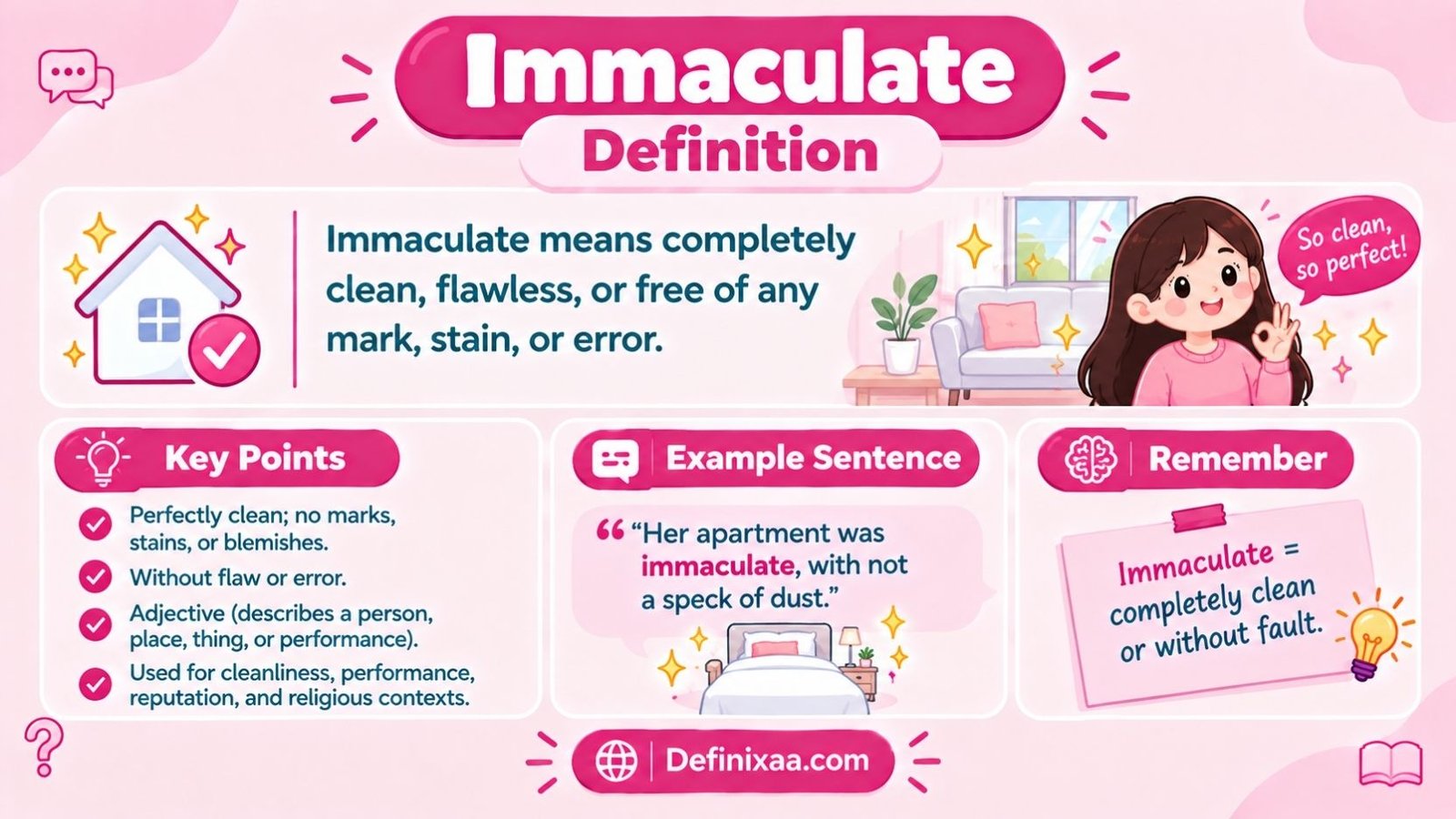
Immaculate is an adjective that describes something completely clean, flawless, or free of any mark, stain, or error. It can describe a spotless room, a flawless piece of work, or a person’s untarnished reputation. In a religious context, it has a specific theological meaning tied to purity from sin.
Quick Definition
Immaculate means perfectly clean or completely without fault. It is used for physical cleanliness, for work or performances with no mistakes, and, in Catholic teaching, for freedom from sin.
At a Glance
| Detail | Information |
| Part of speech | Adjective |
| Core meaning | Perfectly clean; without flaw or error |
| Tone | Positive, often complimentary |
| Register | Formal to neutral; used in everyday speech and writing |
| Common contexts | Cleanliness, performance, reputation, religion, slang |
| Pronunciation | ih-MAK-yuh-lit |
Read More: Ladle Definition
So, What Does Immaculate Actually Mean in Simple Terms?
In plain language, immaculate means “so clean or so well done that nothing is wrong with it.” Picture a hotel room with not a speck of dust, or a report with zero typos. That is the everyday feeling behind the word.
The word carries a sense of near-perfection. Calling something immaculate is stronger than calling it merely clean or good. It suggests there is genuinely nothing left to criticize.
According to dictionary sources, immaculate can describe something spotlessly clean, something with no flaw or error, something with no stain or blemish, or, in botany and zoology, something with no colored spots or marks. These senses all share one idea: total absence of imperfection.
How Do You Pronounce Immaculate?
Immaculate is pronounced ih-MAK-yuh-lit, with the stress on the second syllable. It rhymes loosely with words like “articulate.”
Tip: If you are unsure, break it into three parts: im, MAC, yuh-lit. Say the middle part with the most emphasis.
Immaculate: Word Origin
The word traces back to Latin. According to reference sources, immaculate comes from the Latin immaculatus, formed from the prefix in-, meaning “not,” and maculatus, meaning “spotted” or “stained.”
That Latin root, macula, meaning “spot” or “stain,” is still used today in science. Doctors and biologists use macula to describe a spot on the skin, on an insect’s wing, or on the surface of a planet. The opposite of immaculate, maculate, exists in English too, but it is rarely used outside of literary or academic writing.
Note: Understanding this Latin root helps explain the fourth dictionary sense of immaculate, used in botany and zoology to describe petals, feathers, or fur with no spots or markings.
What Does Immaculate Look Like in a Sentence?
Seeing the word in context makes its meaning easier to grasp. Here are original examples across different settings.
Everyday conversation
“She keeps her apartment immaculate, even with three kids running around.”
Professional setting
“The audit found the company’s financial records to be immaculate, with no discrepancies.”
Describing a person’s reputation
“After thirty years on the force, he retired with an immaculate record.”
Online or social media
“The photos from that wedding are immaculate, every detail was perfect.”
Sports commentary
“The quarterback delivered an immaculate performance, completing every pass in the first half.”
Is Immaculate the Same as Clean?
Not exactly. Clean simply means free of dirt. Immaculate goes further. It implies a standard so high that no fault at all can be found, whether that fault is dirt, disorder, or a mistake.
Comparison Table
| Term | Meaning | Typical Use | Key Difference |
| Clean | Free from dirt or contamination | Everyday tidiness, hygiene | A basic, achievable state |
| Immaculate | Completely free of any flaw, stain, or error | High standards, precision, purity | An elevated, near-perfect state |
| Spotless | Having no visible marks or stains | Physical surfaces, appearances | Very close to immaculate, but usually limited to visible cleanliness |
| Pristine | In an original, untouched, unspoiled condition | New or preserved items | Emphasizes original condition rather than active upkeep |
Quick takeaway: Clean describes an ordinary state. Immaculate describes an exceptional one.
What Words Mean Something Similar to Immaculate?
Several words overlap with immaculate, though none are perfect substitutes in every context.
Immaculate synonyms
- Spotless
- Pristine
- Flawless
- Impeccable
- Faultless
- Unblemished
- Pure
- Perfect
Note: Impeccable and flawless work best for performances, behavior, or work. Spotless and pristine work best for physical cleanliness. Pure and unblemished lean toward the religious or moral sense.
What Are the Antonyms of Immaculate?
Since immaculate means “without fault,” its opposites describe imperfection, dirt, or error.
Immaculate antonyms
- Dirty
- Filthy
- Stained
- Blemished
- Flawed
- Sloppy
- Messy
- Tarnished
Older or more formal English also uses the direct antonym maculate, meaning marked with spots or impure, though this word is rare in modern speech.
Immaculate or Emaculate: Which Spelling Is Correct?
Only immaculate is a real word. Emaculate is a common misspelling, likely caused by how the word sounds when spoken quickly.
Before you use immaculate, remember this: The correct spelling always begins with “im,” not “em.” If a spell checker flags “emaculate,” that confirms the error.
Is Immaculate Positive or Negative?
Immaculate is almost always positive. It is a compliment, whether describing a clean house, a well-written essay, or a person’s integrity.
Quick Detail
| Situation | Tone |
| Describing a clean space | Positive |
| Describing a performance or record | Positive, admiring |
| Describing timing or execution | Positive, impressed |
| Used sarcastically | Can turn negative or ironic depending on context |
The only time immaculate reads as anything other than genuine praise is in sarcasm, such as calling a messy desk “immaculate” as a joke.
What Does Immaculate Person Mean?
Calling a person immaculate usually refers to their appearance, conduct, or reputation rather than literal cleanliness alone. It can mean:
- They dress with flawless style and grooming
- Their moral character has no known faults
- Their professional record has no errors or scandals
Example: “The senator maintained an immaculate public image throughout her career.”
This use blends the “flawless” and “no stain or blemish” senses of the word into a description of a whole person rather than a single object.
What Does Immaculate Feeling Mean?
When people describe a feeling as immaculate, they usually mean it is completely satisfying, pure, or without any negative undertone. This is an extension of the word’s core sense of perfection into emotional or sensory experience.
Example: “Walking into the newly renovated kitchen gave her an immaculate feeling of accomplishment.”
This usage is more common in casual and online writing than in formal contexts.
Read More: Emaculate Definition
What Does Immaculate Vibes Mean?
“Immaculate vibes” is a modern, informal phrase, especially common on social media, meaning the overall mood, atmosphere, or energy of a place, event, or moment is excellent and free of anything off-putting.
Dictionary usage tracking shows this exact phrasing appearing in mainstream sports and entertainment writing, describing a sports team’s positive momentum as having immaculate vibes.
How Is Immaculate Actually Used in Real Life?
- Online, “immaculate vibes” or “vibes are immaculate” usually praises a fun, well-organized, or emotionally satisfying atmosphere
- It appears frequently in casual writing, captions, and commentary, not formal writing
- It carries a light, enthusiastic tone rather than a strict, literal one
Example: “The rooftop party had immaculate vibes, great music, good food, and everyone in a good mood.”
What Does Immaculate Slang Meaning Cover?
Outside of vibes specifically, immaculate has become a general-purpose slang compliment online. People use it to praise:
- Outfits (“Your fit today is immaculate”)
- Timing (“Immaculate timing, I just finished cooking”)
- Skill or execution (“That edit was immaculate”)
This slang use keeps the dictionary meaning of “flawless” but applies it more loosely and enthusiastically than formal writing would.
Should You Use Immaculate Slang Meaning in Formal Writing?
No. Save the casual, exaggerated slang use for texting, captions, and conversation. In professional or academic writing, use immaculate in its literal sense: something genuinely free of flaws.
What Is Immaculate Inning Definition in Baseball?
An immaculate inning is a specific baseball achievement. It happens when a pitcher strikes out all three batters faced in one inning using only nine pitches, the minimum possible.
According to baseball reference sources, an immaculate inning occurs when a pitcher strikes out all three batters faced in one inning using the minimum possible number of pitches, nine. The strikeouts can be swinging or called, and the feat only became a widely used term in the 21st century, even though the plays themselves date back much further.
Quick Facts About the Immaculate Inning
- Requires exactly nine pitches
- All three batters must strike out
- No balls, hits, or errors during the sequence
- Became more common after teams began using single-inning relief pitchers who could throw at full effort
Example: “The closer earned his first immaculate inning of the season, striking out the side on nine straight pitches.”
What Is Immaculate Conception Meaning?
Immaculate Conception is a specific term in Roman Catholic theology. It does not refer to how Jesus was conceived. Instead, it refers to Mary, the mother of Jesus, and the belief that she herself was conceived without original sin.
Immaculate Conception Definition Catholic
According to Catholic dogma, as reflected in standard dictionary sources, the Immaculate Conception refers to the conception of the Virgin Mary in which her soul was preserved free from original sin by divine grace. The Catholic Church also marks December 8 as a feast day commemorating this belief.
Immaculate Conception Simple Definition
In simple terms, Catholics believe Mary was born without the stain of original sin that Christian tradition holds all other humans inherit. This is a belief about Mary’s own beginning, not about how she later became pregnant with Jesus.
Immaculate Conception Definition Bible
The doctrine is not stated explicitly, word for word, in the Bible. It developed over centuries of Catholic theological reflection and was formally declared official Church teaching in 1854. Reference sources note that the phrase itself was already in documented use by 1597.
What Does Immaculate Conception Not Mean?
It does not mean Jesus was conceived without a biological father through Mary’s virginity, that concept is a separate Christian teaching called the Virgin Birth. The Immaculate Conception is specifically about Mary’s own conception by her parents.
What Does Immaculate Heart Definition Mean?
“Immaculate Heart,” most often seen as “the Immaculate Heart of Mary,” is a Catholic devotional title. It refers to Mary’s heart as a symbol of her pure, sinless love and devotion.
It appears in prayer, church names, and religious art, and is closely related to the broader Immaculate Conception belief but focuses on Mary’s inner virtue and compassion rather than her conception specifically.
What Is Immaculate Definition For Kids?
For a younger audience, immaculate simply means “perfectly clean or perfect, without a single mistake.”
Kid-friendly example: “Grandma’s kitchen is immaculate, you could eat off the floor.”
Dictionaries aimed at children generally keep the religious sense of the term limited to naming the December 8 Catholic holiday, without going into full theological detail.
Immaculate Definition In The Crucible
In Arthur Miller’s play The Crucible, the idea of being immaculate, morally spotless, ties into the play’s larger themes of reputation, purity, and hypocrisy. Characters who present themselves as beyond reproach often turn out to be hiding serious flaws, which is part of the play’s commentary on the Salem witch trials.
Note: Students studying the play should treat “immaculate” here in its standard dictionary sense (flawless, unblemished) rather than assuming a special literary definition. The word’s power in the play comes from the contrast between a character’s claimed purity and their actual behavior.
Immaculate Definition Francais
In French, immaculate translates most closely to immaculé (masculine) or immaculée (feminine). The French word carries the same core meaning: spotless, pure, without stain. It is also used in French Catholic contexts for l’Immaculée Conception, the French term for the Immaculate Conception.
Immaculate Definition Food
When used to describe food or a food-related space, immaculate usually praises cleanliness, presentation, or precision rather than taste directly.
Examples:
- “The restaurant’s kitchen was immaculate during the health inspection.”
- “The pastry chef’s plating was immaculate, each element perfectly placed.”
In restaurant reviews and food writing, immaculate often signals a spotless, professional environment or a beautifully precise presentation.
Is Immaculate Formal, Informal Or Slang?
Immaculate works across nearly every register of English.
- Formal writing: Used literally, describing cleanliness, accuracy, or moral purity
- Everyday conversation: Used the same way, just more casually
- Internet slang: Used loosely as an enthusiastic compliment for vibes, outfits, or timing
- Religious and theological writing: Used in its specific Catholic doctrinal sense
Unlike many slang terms, immaculate did not start as slang. It is a long-established formal word that has simply picked up a looser, more casual second life online.
Read More: Persevere Definition
When Should You Use Immaculate?
Use immaculate when you want to emphasize an unusually high standard of cleanliness, accuracy, or moral purity. It works well in:
- Descriptions of homes, hotels, vehicles, and workspaces
- Performance reviews or professional records
- Religious or theological writing
- Casual praise for great timing, style, or atmosphere
Should You Use Immaculate in Professional Writing?
Yes, it reads as polished and precise in formal writing, provided you use its literal meaning rather than the exaggerated slang sense. Avoid phrases like “immaculate vibes” in a business report or academic paper.
Frequently Asked Questions
What does immaculate mean in English?
Immaculate means completely clean or entirely free of flaws, errors, or blemishes. It can also describe moral purity or, in Catholic teaching, freedom from sin.
Is immaculate slang?
No, immaculate is a standard English word with centuries of formal use. It has also picked up a newer, informal slang use online as a general compliment.
How do you use immaculate in a sentence?
Use it to describe something with no visible flaws, such as “Her handwriting was immaculate” or “He kept an immaculate garage.”
What is another word for immaculate?
Common synonyms include spotless, flawless, pristine, and impeccable, though each carries slightly different shades of meaning.
Is immaculate the opposite of dirty?
Yes, in its cleanliness sense, immaculate is essentially the opposite of dirty, messy, or stained.
What does immaculate mean in the Bible or Catholic teaching?
It most often refers to the Immaculate Conception, the belief that Mary was conceived without original sin, not to how Jesus was conceived.
Can immaculate describe a person’s character?
Yes, describing a person as immaculate usually refers to a flawless reputation, appearance, or moral record rather than physical cleanliness.
What does an immaculate inning mean in baseball?
It means a pitcher struck out all three batters in an inning using exactly nine pitches, the minimum possible.
Is emaculate a real word?
No, emaculate is a common misspelling. The correct spelling is always immaculate.
What does “immaculate vibes” mean?
It is an informal phrase meaning the mood or atmosphere of a place or moment is excellent and enjoyable.
The Simple Takeaway
Immaculate means completely clean, flawless, or free of any fault, whether describing a spotless room, an error-free record, a person’s reputation, or Catholic teaching about Mary’s conception.
Online, it has also become a casual compliment for anything from an outfit to a party’s atmosphere. Whatever the context, the word always signals that something meets an unusually high, near-perfect standard.

Laiba Rahman is a writer and researcher behind Definixaa, dedicated to exploring words, meanings, terms, concepts, and everyday knowledge. Through clear and well-researched explanations, her goal is to help readers understand unfamiliar ideas quickly and discover useful information with ease.
One Comment