
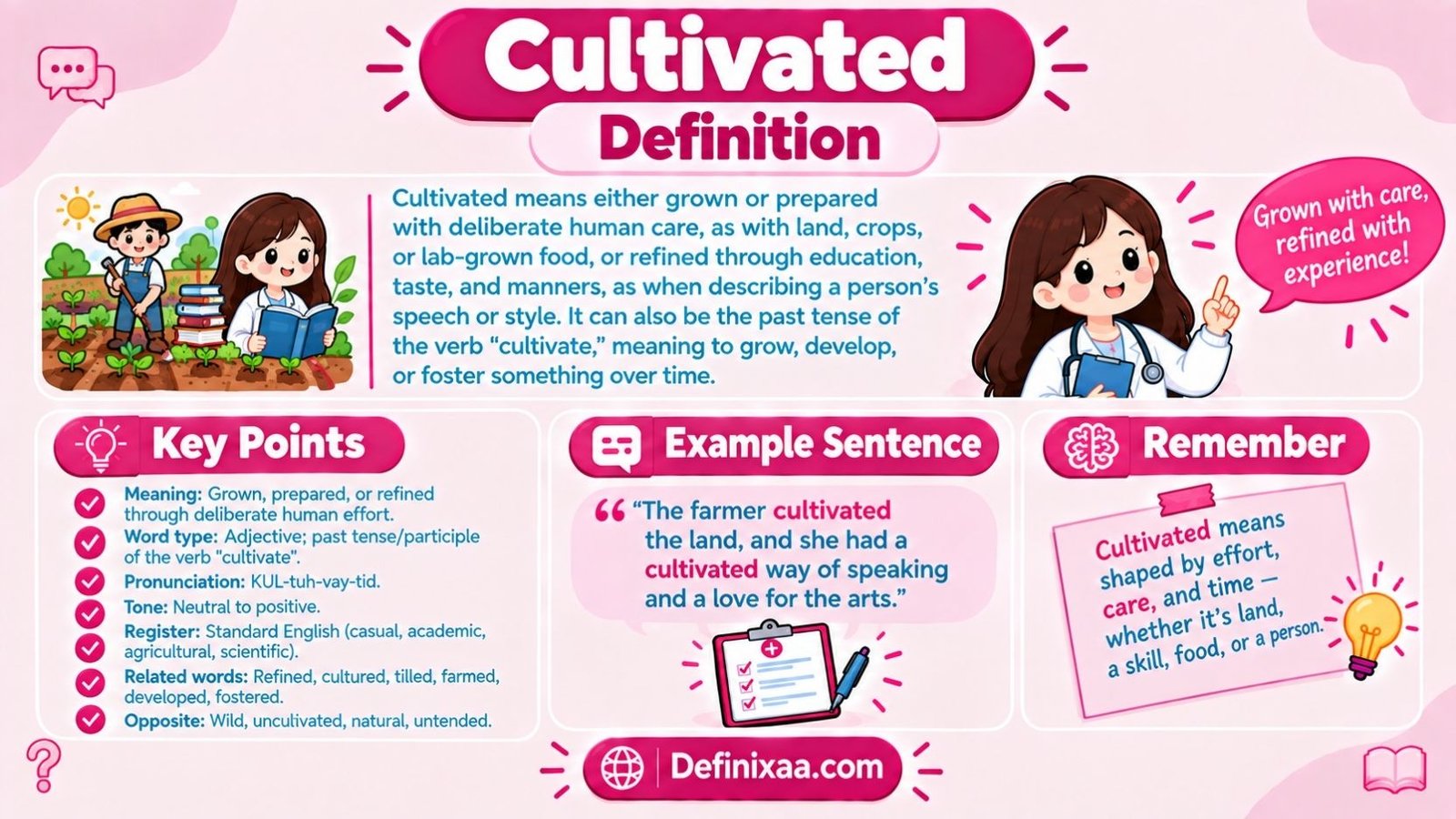
Cultivated means either grown or prepared with deliberate human care, as with land, crops, or lab-grown food, or refined through education, taste, and manners, as when describing a person’s speech or style. It can also be the past tense of the verb “cultivate,” meaning to grow, develop, or foster something over time.
At A Glance
| Detail | Information |
| Word type | Adjective, and the past tense/participle of the verb “cultivate” |
| Core meanings | Farmed or grown land or crops; refined manners or taste; lab-grown food; developed skill, relationship, or reputation |
| Pronunciation | KUL-tuh-vay-tid |
| Tone | Neutral to positive |
| Register | Standard English, used in casual, academic, agricultural, and scientific writing |
| Common related words | Refined, cultured, tilled, farmed, developed, fostered |
| Opposite | Wild, uncultivated, natural, untended |
Read More: Tenant Definition
What Does Cultivated Actually Mean?
At its root, cultivated describes something that did not just happen on its own. A person, a plant, a piece of land, or a piece of meat becomes “cultivated” because someone applied deliberate effort, care, or process to shape it.
The word traces back through Medieval Latin cultivatus, the past participle of cultivare, itself rooted in the Latin cultus, the past participle of colere. That Latin root, colere, is also behind words like “culture” and “cult,” which explains why cultivated so often pairs with the idea of tending, nurturing, or refining.
Modern dictionaries define cultivated land as land prepared for raising crops through plowing or fertilizing, and cultivated plants as ones no longer in their natural state because they have been developed through human care for human use. A separate sense describes a person as cultivated when their speech, taste, or manners show marked refinement.
So, What Is Cultivated In Simple Terms?
Think of the word in two everyday pictures.
- First picture: A farmer plowing a field, planting seeds, watering them, and pulling weeds. The field becomes cultivated land.
- Second picture: A person who has spent years reading, traveling, studying manners, or practicing an instrument. People often call that person cultivated, meaning polished and well developed rather than rough or untrained.
Both pictures share the same idea. Something started in a plain or natural state, and steady effort shaped it into something more refined or more productive.
Merriam-Webster’s kids’ definition keeps this simple, describing cultivated first as raised or produced under cultivation, and second as having or showing good education and elegant taste, speech, and manners. That two-part structure holds up for readers of any age.
Cultivated Can Mean More Than One Thing
The word shifts meaning depending on what it is describing. Here are the main entities cultivated can refer to.
Cultivated Land And Farming
In agriculture and geography, cultivated land is any land that has been prepared and used to grow crops, usually through plowing, sowing, fertilizing, or irrigation. Cultivated land generally covers only twelve to fifteen percent of total land area in most regions, though the share is higher in places like South and Southeast Asia and lower across much of sub-Saharan and Northern Africa. Globally, the world’s net cultivated area has grown by about twelve percent over the past fifty years, largely by converting forest, wetland, and grassland into farmland.
In this sense, cultivated is the opposite of wild or fallow. A cultivated field is actively managed; an uncultivated field has been left to grow naturally or has not been prepared for crops.
Cultivated As A Description Of A Person
When applied to people, cultivated describes someone whose manners, speech, or taste show deliberate refinement, usually built up through education, exposure to the arts, or social experience. A cultivated crowd, for example, is one associated with refined and educated taste rather than simply wealth.
This sense does not require formal wealth or status. A person can be described as cultivated because of how they speak, what they appreciate, or how they carry themselves in conversation.
Cultivated Food And Cultivated Meat
In food science, cultivated has taken on a newer, more technical meaning. Cultivated meat refers to meat produced in a laboratory setting using bioreactors, where a sample of animal cells is grown and multiplied under controlled conditions rather than raised inside a living animal. Because the starting cells come directly from an animal, the resulting product is genetically identical to conventionally raised meat, even though it never involved raising or slaughtering a full animal.
In the United States, the FDA and the USDA’s Food Safety and Inspection Service share regulatory oversight of cultivated meat, with the FDA handling the early cell growth stages and FSIS taking over once cells are harvested and processed into a finished product. The first cultivated chicken products received federal approval for sale in the United States in 2023.
Outside of meat, “cultivated” also appears in phrases like cultivated crops, cultivated grain, or cultivated vegetables, all pointing back to the original farming sense.
Cultivated In Biology And Science
In biology, cultivated plants or organisms are ones grown intentionally under controlled conditions rather than occurring naturally in the wild. This overlaps with the verb “culture,” as in cultivating bacteria in a lab dish for study. The common thread across every scientific use is controlled, intentional growth rather than spontaneous, natural growth.
Cultivated As A Verb Form
Cultivated is also simply the past tense and past participle of the verb to cultivate. As a verb, cultivate covers several related actions:
- To prepare soil and grow crops on it
- To help something grow through labor and attention, such as vegetables, oysters, or grapes
- To improve or develop something through study or care, such as a skill, the mind, or the arts
- To seek out and build a relationship or friendship with someone
Thomas Jefferson, for example, cultivated several varieties of grapes at Monticello in an effort to recreate the European wines he had enjoyed abroad. That sentence uses cultivated in the growing-crops sense. A different sentence, such as “she cultivated a reputation for honesty,” uses the same word to describe deliberately building a quality over time.
How Do You Pronounce Cultivated?
Cultivate is pronounced KUL-tuh-vayt, broken into syllables as cul-ti-vate. Adding the past tense ending gives cultivated, pronounced KUL-tuh-vay-tid, with the stress on the first syllable.
Where Does The Word Cultivated Come From?
The verb cultivate comes from Medieval Latin cultivatus, the past participle of cultivare, which itself derives from cultivus, meaning cultivable, and ultimately from the Latin cultus, the past participle of colere, meaning to till or tend. The first known use of cultivate in English dates to 1588. The adjective form, cultivated, is recorded slightly later, with a first known use in 1645.
This shared Latin root, colere, also produced English words like culture, cult, and colony, all of which carry a similar idea of tending, developing, or settling something over time.
Is Cultivated Formal, Informal Or Technical?
Cultivated is standard English, appropriate in formal writing, casual conversation, academic papers, and technical or scientific documents alike. It is not slang, not regional, and not outdated.
The word does shift register slightly by context:
- In everyday farming or gardening talk, it sounds practical and concrete.
- In social or literary writing, describing a cultivated person can sound slightly formal or old-fashioned, closer to “refined” or “well-bred.”
- In food science and agricultural policy, cultivated is precise, technical vocabulary with legal and regulatory weight, as seen in cultivated meat labeling rules.
Read More: Symptomology Definition
Is Cultivated Positive, Negative Or Neutral?
Mostly positive, occasionally neutral, and rarely negative.
Describing land, crops, or meat as cultivated is neutral and factual. It simply states a process, without praise or criticism.
Describing a person as cultivated is almost always complimentary, suggesting refinement, education, and good taste. It can occasionally sound a little distant or class-conscious if used to draw a contrast with someone considered less refined, but the word itself carries no built-in insult.
How Is Cultivated Actually Used In Real Life?
Cultivated shows up constantly in agriculture, geography, food writing, and character description, but rarely in casual texting or slang.
In farming and land-use contexts, it appears in government reports, geography textbooks, and agricultural statistics, almost always describing measurable land or crops.
In food and science writing, it appears heavily in coverage of cultivated meat, cultivated seafood, and lab-grown food products, especially since regulatory approval began in the United States.
In literature and everyday description, cultivated often appears when a writer wants to contrast something tamed or refined against something wild or natural. In Rudyard Kipling’s short story Rikki-Tikki-Tavi, the family’s garden is described as only half cultivated, a phrase that signals part of the space is tended and part is left in its natural, untamed state. That single word does a lot of work, quietly setting up the story’s contrast between the human-managed world and the wild jungle beyond it.
In religious and academic writing, cultivated occasionally appears in discussions of Genesis 2:15, where God places the first human in the Garden of Eden to work and keep it. Several modern English translations, including the Berean Standard Bible, the New American Standard Bible, and the Lexham English Bible, render this instruction as putting the man in the garden to cultivate it and keep it, while other translations use “work,” “till,” or “tend” instead. The variation exists because the underlying Hebrew word carries a broad range of meanings connected to labor and service.
What Does Cultivated Look Like In A Sentence?
- Casual conversation
“We finally cultivated a little vegetable patch in the backyard this spring.” - Professional or academic writing
“The report tracks how much of the region’s total land area is cultivated versus left as forest or pasture.” - Describing a person
“He had a cultivated way of speaking, the kind you pick up from years of reading and travel.” - Food and science writing
“The company received approval to sell cultivated chicken made from cells grown in a bioreactor.” - Figurative or relationship use
“She spent years cultivating relationships with clients before she ever asked for their business.” - Literary or descriptive use
“The garden was only half cultivated, roses and orange trees pressed up against thickets of wild grass.”
What Does Cultivated Not Mean?
Cultivated does not mean expensive, wealthy, or high-class on its own. A cultivated person can come from any background; the word describes acquired refinement, not money or birth.
Cultivated also does not automatically mean organic, natural, or chemical-free when applied to food or crops. In fact, cultivated usually implies the opposite of purely natural, since it points to human intervention, whether that is plowing a field or growing meat cells in a lab.
Finally, cultivated does not mean illegal or exclusively tied to controlled substances, even though the related word “cultivation” shows up in drug law when describing the growing of regulated plants such as cannabis or opium poppies. The word itself is neutral; legality depends entirely on which plant is being grown and under what jurisdiction.
Cultivated Vs Wild: What Is The Difference?
| Term | Meaning | Typical Use | Key Difference |
| Cultivated | Grown, prepared, or refined through deliberate human effort | Farmland, gardens, refined manners, lab-grown food | Shaped intentionally by human care or process |
| Wild | Growing or existing in a natural state without human management | Forests, untended plants, unpolished behavior | Develops on its own, without direct human control |
Cultivated Vs Cultured: Is There A Difference?
| Term | Meaning | Typical Use | Key Difference |
| Cultivated | Grown or developed through active, ongoing care, often over land or a skill | Farming, personal refinement, cultivated meat | Emphasizes the process of tending or growing something |
| Cultured | Possessing refined taste, or grown in a laboratory culture medium | Describing sophistication, or lab-grown bacteria and cells | Emphasizes a resulting state or a controlled growth medium, rather than the tending process itself |
Note: In food science, “cultivated meat” and “cultured meat” are often used interchangeably by different companies and countries, though “cultivated” has become the preferred industry term in the United States.
What Words Mean Something Similar To Cultivated?
Synonyms for the “refined person” sense
Refined, polished, educated, sophisticated, cultured, well-bred
Synonyms for the “farmed land or crops” sense
Tilled, farmed, worked, tended, developed, improved
Synonyms for the verb sense
Grew, fostered, nurtured, developed, encouraged, built
Opposites
Wild, natural, uncultivated, untended, rough, unrefined, fallow
These groups matter because cultivated is not a perfect stand-in for any single synonym. “Refined” fits a person but sounds odd applied to a field. “Tilled” fits farmland but would sound strange describing someone’s manners.
When Should You Use Cultivated?
Use cultivated when you specifically want to signal that something was shaped through deliberate, ongoing effort rather than occurring naturally or instantly.
- Choose it over “farmed” when you want a slightly more formal or geographic tone, such as in reports or academic writing.
- Choose it over “refined” or “polished” when describing a person if you want to emphasize a long process of development rather than a finished result.
- Choose it in food or science writing specifically when referring to lab-grown products, since “cultivated meat” is now the accepted regulatory term in the United States.
If you simply mean “grew,” “farmed,” or “polished,” those plainer words are often easier for a general reader and can work just as well outside formal or technical writing.
Read More: Allusion Definition
Before You Use Cultivated: Remember This
Cultivated always implies a process, not a single event. Something that happened instantly, by accident, or without any care behind it should not be described as cultivated. Save the word for situations where time, effort, or intentional management is genuinely part of the story.
Frequently Asked Questions
What does cultivated mean in simple words?
Cultivated means something was grown, prepared, or improved through deliberate human care, whether that is a crop, a piece of land, a skill, or a person’s manners.
Is cultivated the same as cultured?
They overlap but are not identical. Cultivated usually emphasizes the process of tending or growing something, while cultured often describes a resulting refined state or a lab growth medium.
What is the difference between cultivated and uncultivated land?
Cultivated land has been prepared and used for growing crops, usually through plowing or fertilizing. Uncultivated land has been left in its natural state without farming activity.
Is cultivated a formal word?
Cultivated is standard English rather than formal or informal slang. It appears comfortably in casual writing, academic papers, and technical or legal documents.
What does cultivated mean when describing a person?
It describes someone whose manners, taste, or speech show refinement, usually developed through education, reading, or social exposure over time.
What is cultivated meat?
Cultivated meat is meat grown from a sample of animal cells inside a bioreactor under controlled laboratory conditions, rather than raised inside a full living animal.
How do you pronounce cultivated?
It is pronounced KUL-tuh-vayt as the base verb, with cultivated pronounced KUL-tuh-vay-tid.
What is the verb form of cultivated?
Cultivated is itself the past tense and past participle of the verb cultivate, meaning to grow, develop, or foster something through ongoing care.
Where does the word cultivated come from?
It comes from Medieval Latin cultivatus, tracing back to the Latin cultus, meaning tilled or tended.
Can cultivated describe a relationship?
Yes. To cultivate a relationship means to deliberately build and maintain it over time, such as cultivating a friendship or a professional connection.
The Simple Takeaway
Cultivated always points back to one idea: deliberate, ongoing effort shaping something into a more developed form. Whether it describes a plowed field, a refined person, lab-grown meat, or a carefully built friendship, the word signals that care and time were involved, not chance or nature alone.

Laiba Rahman is a writer and researcher behind Definixaa, dedicated to exploring words, meanings, terms, concepts, and everyday knowledge. Through clear and well-researched explanations, her goal is to help readers understand unfamiliar ideas quickly and discover useful information with ease.
3 Comments