
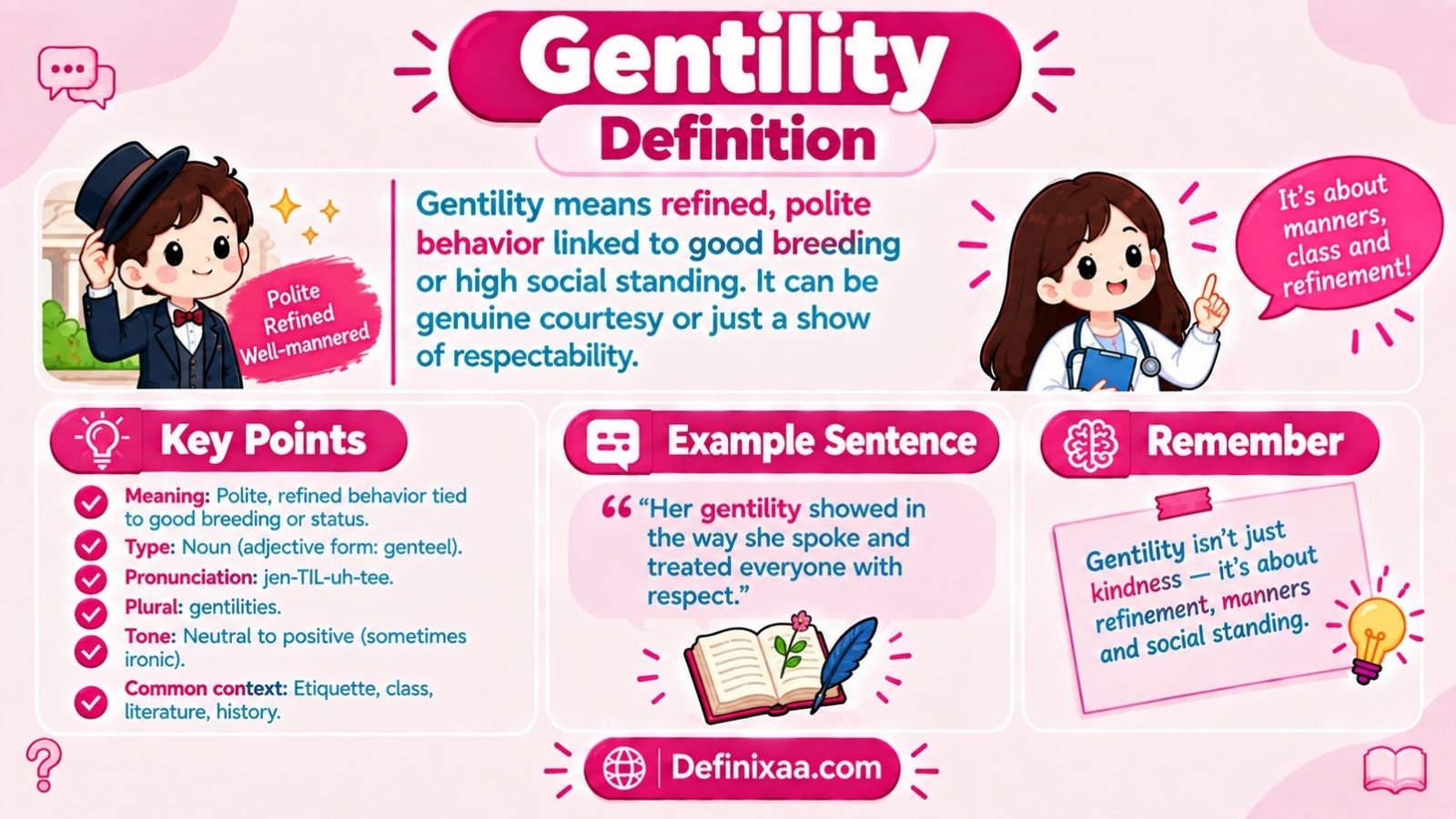
Gentility means polished, well-mannered behavior associated with good breeding or high social standing. It can describe genuine courtesy and refinement, or it can describe a surface-level show of respectability meant to look more genteel than it really is.
The word is a noun, and its adjective form is genteel.
Quick Detail
| Quick Detail | Information |
| Meaning | Refined, polite behavior tied to good breeding or elevated social status |
| Part of speech | Noun |
| Pronunciation | jen-TIL-uh-tee |
| Plural | gentilities |
| Tone | Usually neutral to positive; sometimes ironic or critical |
| Common context | Etiquette, class distinctions, literature, US Southern culture and history |
| Related word | Genteel (adjective) |
Read More: Spondylosis Definition
Gentility Pronunciation
Gentility is pronounced jen-TIL-uh-tee, with the stress on the second syllable. Merriam-Webster represents it phonetically as jen-ˈti-lə-tē.
There is nothing unusual about the pronunciation once you know the stressed syllable, but people who have only read the word sometimes guess wrong and stress the first syllable instead. Saying it aloud a few times, JEN-til-uh-tee versus the correct jen-TIL-uh-tee, is the easiest way to fix that.
Gentility Part Of Speech
Gentility is a noun. It names a quality or condition rather than an action, so it never takes an object and it is not conjugated like a verb.
- Noun form: gentility
- Adjective form: genteel
- Adverb form: genteelly
There is no widely used verb form. If you need a verb, English speakers typically say something like “act with gentility” or “carry herself with gentility” rather than turning the word itself into a verb.
So, What Is Gentility In Simple Terms?
In plain language, gentility is what people mean when they talk about someone who is polite, well-spoken, and carries themselves with a kind of quiet elegance. It suggests good upbringing, careful manners, and a sense that a person (or a place, or a family) belongs to a respectable, cultured world.
It is not the same as simply being nice. Gentility carries a class dimension. It implies a background of education, wealth, or social standing, even if the person displaying it today is not especially wealthy. That is part of why the word still appears in discussions of history, literature, and social class, not just in everyday small talk.
Merriam-Webster’s dictionary definition captures two related but distinct ideas:
- The condition of belonging to the gentry, meaning a family of good birth or elevated social rank.
- Decorum of conduct, or courtesy; and, in a more critical sense, behavior marked by false delicacy, prudery, or affectation.
- Superior social status or prestige shown through manners, possessions, or way of life.
That third sense is important. Gentility is not only an inner quality of politeness. It is also something people display outwardly, through how they dress, speak, decorate their homes, or carry themselves in public.
Gentility Etymology
Gentility entered English in the mid-14th century, originally meaning “nobility of birth” or “gentle birth.” It came from the Old French word gentilité, which in turn came from the Latin gentilitas, meaning membership or relationship within the same family or clan.
That Latin root traces back to gens (genitive gentis), meaning “clan” or “race,” which is also the ancestor of the English words gentle, gentry, genteel, and even, through a very different branch of meaning, gentile.
By the 1640s, gentility had picked up the broader sense of “social superiority” that it still carries today. So the word’s history moves from a narrow legal or genealogical idea, being born into the right family, toward a wider social idea, behaving and presenting yourself the way people from that class supposedly do.
Note: Gentile and gentle share the exact same Latin ancestor, gentilis. They split apart because gentile developed through religious Latin, meaning “not Jewish” or “not Christian,” while gentle and gentility developed through Old French, keeping the sense of noble birth and refined manners. The two words look alike for a reason, but their modern meanings have nothing to do with each other.
Gentility Or Gentleness? What Is The Difference?
People sometimes assume gentility and gentleness are just spelling variations of the same idea. They are related in origin, since both trace back to the Latin gentilis, but their modern meanings are different enough that they are not interchangeable.
| Term | Meaning | Typical Use | Key Difference |
| Gentility | Refined manners or social respectability tied to good breeding or class | Describing a person’s polish, upbringing, or social status; discussions of etiquette or history | Focused on social status, manners, and outward respectability |
| Gentleness | A soft, kind, mild way of acting or treating others | Describing tenderness, kindness, or a mild temperament | Focused on emotional softness and kindness, with no class implication |
A useful shortcut: gentleness is about how softly or kindly you treat someone. Gentility is about how refined and socially polished you appear. A person can be gentle without any gentility at all, and, less often, a person can display gentility, correct manners and an elegant surface, without being especially gentle or kind underneath.
How Is Gentility Actually Used In Real Life?
Gentility shows up most often in three kinds of writing and conversation.
- In literature and cultural commentary, gentility describes a character’s refined manners, social class, or the atmosphere of a setting. Writers use it to signal old money, careful upbringing, or a fading aristocratic world.
- In discussions of etiquette and manners, gentility refers to the practical behaviors, correct speech, gracious hosting, careful dress, that mark someone as well brought up.
- In American historical and regional writing, gentility often appears attached to a specific culture or era, most commonly the antebellum South, where it described the manners and self-image of the wealthy planter class.
The word rarely appears in casual texting or slang. It belongs to formal, academic, journalistic, and literary registers. You are far more likely to encounter it in a magazine profile, a history textbook, or a novel than in a group chat.
Southern Gentility Definition (US History And APUSH Context)
In American history, and especially in AP US History coursework, Southern gentility refers to the code of manners, hospitality, and social refinement that the wealthy planter class of the antebellum South cultivated to define itself as a genteel aristocracy.
This planter elite, generally understood by historians as families owning twenty or more enslaved people, built their social identity around gracious hospitality, formal manners, education, and an elegant lifestyle centered on the plantation house. Southern gentility became a cultural performance of refinement that reinforced the planter class’s claim to social and political leadership across the antebellum South.
Historians note that this image was selective. The idea of Southern gentility, gracious hosts, elegant homes, courtly manners, described only a small slaveholding elite. Most white Southerners were yeoman farmers or poor whites who had no plantation and no part in that genteel lifestyle. The gentility associated with the Old South was, in practice, the self-image of a narrow upper class, later romanticized in postwar literature and film long after the plantation economy itself had ended.
Note: If you are studying this term for a US history class, remember that “gentility” in this context describes a social performance and class ideal, not an accurate picture of how most Southerners actually lived.
Read More: Cultivated Definition
What Does Gentility Not Mean?
Gentility is often misunderstood in a few specific ways.
- It does not simply mean “kindness.” A person can display gentility, correct manners, elegant speech, without being especially kind. The word describes polish and social standing, not moral goodness.
- It does not always describe genuine refinement. One dictionary sense of gentility is explicitly critical: behavior marked by false delicacy, prudery, or affectation. This is sometimes called “shabby gentility,” when someone maintains genteel manners or appearances despite having lost the wealth that once supported them.
- It is not the same as wealth alone. Gentility is about manners and presentation tied to social class, not simply having money. A wealthy person with crude manners would not typically be described as having gentility.
- It does not describe a single fixed historical group. Gentility has applied to English landed gentry, American Southern planters, and modern references to old-fashioned manners. The specific group changes depending on context.
Before You Use Gentility: Remember This
Gentility can carry a subtly negative undertone. In modern writing, it is often used with a hint of irony, describing someone who is performing refinement rather than possessing genuine warmth. Read the surrounding sentence carefully.
If a writer calls something “faded gentility” or “shabby gentility,” they are usually pointing out a gap between appearance and reality, not offering a compliment.
What Does Gentility Look Like In A Sentence?
- Casual conversation: “There was a real gentility to the way she greeted every guest by name.”
- Professional or formal writing: “The hotel’s décor evokes an old-world gentility, with hand-carved furniture and quiet, attentive service.”
- Academic or historical writing: “Southern gentility depended on an economy of enslaved labor that its own social rituals rarely acknowledged.”
- Literary description: “Beneath his gentility was a coldness that no amount of good manners could hide.”
- Everyday observation: “Education was once considered a mark of gentility, a sign that a family had the means and the leisure to send its children to school.”
What Words Mean Something Similar To Gentility?
Synonyms
- Refinement
- Breeding
- Courtesy
- Politeness
- Elegance
- Genteelness
- Decorum
- Culturedness
Related terms
- Gentry (the social class itself, rather than its manners)
- Etiquette (the specific rules of polite behavior)
- Aristocracy (a formal, often hereditary upper class)
These words overlap but are not perfect substitutes. Refinement and elegance emphasize taste and polish. Courtesy and decorum emphasize correct behavior toward others. Gentry names a class of people, while gentility names the qualities associated with that class.
What Are The Antonyms Of Gentility?
- Crudeness
- Vulgarity
- Coarseness
- Boorishness
- Rudeness
These antonyms describe behavior that lacks the polish, manners, or social refinement that gentility implies.
Is Gentility Positive, Negative Or Neutral?
Gentility is usually neutral to positive, describing admirable manners and refinement. But context can shift it toward mild criticism.
When a writer emphasizes gentility as a surface performance, especially phrases like “shabby gentility” or “genteel poverty,” the word takes on an ironic, slightly negative edge, suggesting appearances kept up despite a less impressive reality underneath.
Read More: Neutropenia Definition
Is Gentility Appropriate To Use?
Gentility is a formal, literary word, not slang and not offensive. It fits comfortably in essays, journalism, historical writing, and formal description. It would sound noticeably stiff or old-fashioned in a casual text message or a quick conversation, where a simpler word like “politeness” or “class” would feel more natural.
There is nothing inappropriate about the word itself. The only real caution is tone: because it often carries a class-conscious undertone, using it to describe a real person can sound either complimentary or subtly condescending, depending on the sentence around it.
Frequently Asked Questions
What does gentility mean in simple words?
Gentility means having refined, polite manners associated with good breeding or high social class. It describes both genuine courtesy and the outward appearance of respectability.
Is gentility the same as gentleness?
No. Gentility refers to refined manners and social status, while gentleness refers to a soft, kind, mild way of treating people. They share a Latin root but different modern meanings.
What is the plural of gentility?
The plural form is gentilities, most often used when referring to specific polite behaviors or courtesies, such as “the small gentilities of formal dining.”
Is gentility a formal or informal word?
Gentility is a formal, literary word. It appears often in historical, academic, and journalistic writing, but rarely in casual speech or texting.
What is Southern gentility in US history?
Southern gentility refers to the manners, hospitality, and social refinement cultivated by the wealthy planter class of the antebellum South to present itself as a genteel, aristocratic elite.
What is the opposite of gentility?
Common opposites include crudeness, vulgarity, coarseness, and boorishness, all describing a lack of refined manners.
Where does the word gentility come from?
Gentility comes from the Old French gentilité, from Latin gentilitas, meaning membership in the same family or clan, ultimately from gens, meaning “clan” or “race.”
Can gentility have a negative meaning?
Yes. One dictionary sense describes gentility as false delicacy, prudery, or affectation, an outward show of refinement rather than genuine good character.
What part of speech is gentility?
Gentility is a noun. Its adjective form is genteel, and its adverb form is genteelly.
How do you use gentility in a sentence about history?
Example: “The plantation’s grand architecture was designed to project an image of Southern gentility to visitors and neighbors alike.”
Last Words
Gentility describes refined manners and social respectability, whether that refinement is genuine courtesy, a class marker tied to good breeding, or, in its more critical sense, a polished surface covering something less impressive underneath.
In American history, the term is closely tied to the self-image of the antebellum Southern planter class. Wherever it appears, gentility says less about kindness and more about how a person, family, or era wanted to be seen.

Laiba Rahman is a writer and researcher behind Definixaa, dedicated to exploring words, meanings, terms, concepts, and everyday knowledge. Through clear and well-researched explanations, her goal is to help readers understand unfamiliar ideas quickly and discover useful information with ease.
One Comment