
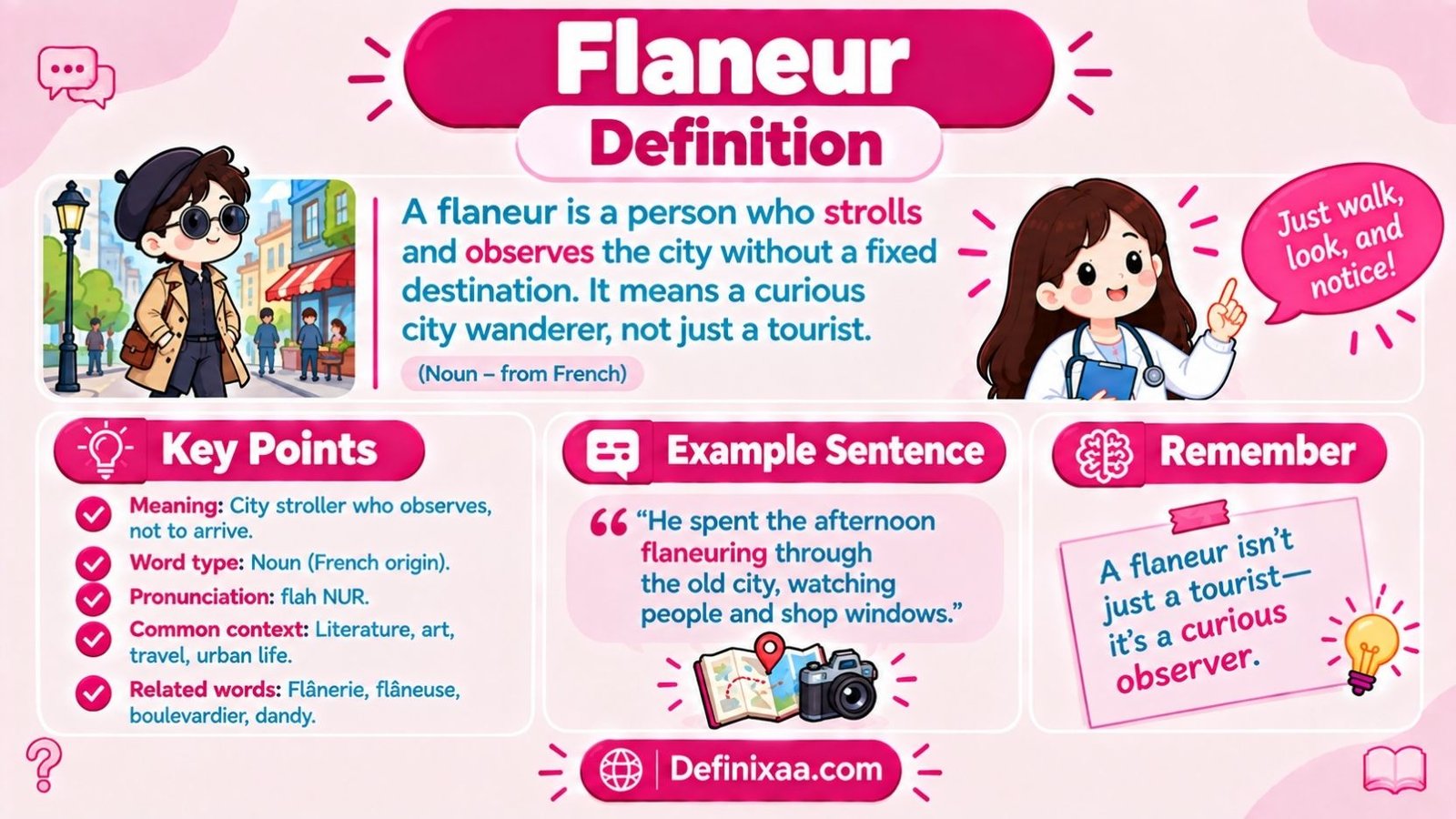
Quick definition: A flaneur (also spelled flâneur) is a person who strolls through a city without a fixed destination, watching people, streets and shop windows for the pleasure of observing. Merriam Webster defines it as an idle man about town. In literature and art history, though, the word means something richer: a detached, curious observer of modern city life.
At A Glance
| Detail | Information |
| Meaning | A leisurely city walker who observes rather than rushes |
| Word type | Noun borrowed from French; related verb use exists |
| Language of origin | French, likely from an older Scandinavian root |
| Register | Literary, cultural, cultivated. Not slang |
| Tone | Neutral to positive, sometimes mildly critical |
| Common contexts | Literature, art history, travel writing, urban studies, photography |
| Related terms | Flânerie, flâneuse, boulevardier, badaud, dandy, passante |
| Pronunciation | flah NUR, stress on the second syllable |
Read More: Gentility Definition
What Does Flaneur Actually Mean?
Start with the formal meaning. A flaneur is a person who wanders an urban area at a slow pace, observing the life around them, with no pressing goal.
The main entry in Merriam Webster is a noun, with “flâneur” listed as a less common spelling. The dictionary definition is short. The cultural meaning is much longer.
So, What Is A Flaneur In Simple Words?
Picture someone who walks through a busy city with no errand to run. They are not sightseeing from a checklist. They are not exercising or commuting.
They stop at a window. They watch a stranger cross a square. They notice a doorway, a sound, a mood. The walking is the point.
One writer in The Atlantic put it plainly: in its narrowest sense, a flaneur is simply someone who wanders. The wider sense adds attention, curiosity and a certain detachment.
Two Layers Of Meaning
The word works on two levels, and mixing them up causes most of the confusion.
- The everyday layer: an idler or stroller who enjoys walking around a city.
- The cultural layer: a symbol of modern city life, used by writers, artists and scholars to talk about how people experience cities.
If you meet the word in a travel article, you are usually in the first layer. If you meet it in an art history lecture, you are usually in the second.
Flaneur Can Mean More Than One Thing
The core meaning stays steady. The emphasis shifts by field. Here are the main uses, so you can tell which one you have in front of you.
1. The general English meaning. A person who saunters through a place for enjoyment and observation. Wiktionary describes it as one who walks to observe and enjoy rather than to get somewhere, and also lists the sense of an idler or loafer.
2. The literary meaning. A figure from nineteenth century French writing, tied to Paris, the boulevards and the poet Charles Baudelaire. This is the meaning most people mean when they search for the flaneur definition in literature.
3. The art history meaning. Tate explains that Baudelaire used the term for an observer of modern urban life, and that such a figure appears in many Impressionist paintings. Later sections cover this in detail.
4. The sociological meaning. A model of the modern city dweller, used to discuss alienation, consumer culture and public space. Walter Benjamin made this use famous.
5. The architecture and planning meaning. The term has also picked up a sense in architecture and urban planning, referring to passers by who feel psychological effects from the design of a structure. This is a narrow, specialist use.
6. The modern casual meaning. Anyone who wanders a city with open eyes and no strict plan. Writers now apply it to travelers, photographers and even people browsing online.
For most searchers, meanings one to three are what matter.
How Do You Pronounce Flaneur?
In English, say flah NUR. Put the stress on the second syllable. Merriam Webster gives the respelling as flä, then stressed ner, matching this sound.
The French pronunciation is close but not identical. Wikipedia gives the French IPA as flɑnœʁ. The final vowel is rounder, and the French “r” is made further back in the throat.
Tip: In casual English, “flah NUR” is perfectly natural. You do not need a French accent, and most listeners will not expect one.
Flaneur Or Flâneur?
Both spellings are correct. The circumflex (â) is the original French form. Merriam Webster lists the unaccented spelling first and treats the accented spelling as a less common variant.
In academic writing, the accented form is common. In newspapers and everyday writing, you will often see it without the accent.
What Does Flâneur Mean In French?
If you searched for the flaneur definition in French (or “flaneur définition”), here is the direct answer. In French, un flâneur is a person who flâne, meaning someone who walks around with no set aim, for the pleasure of looking.
A plain French rendering: Un flâneur est une personne qui se promène sans but précis, pour le plaisir d’observer.
Larousse defines the verb flâner as walking without a goal, at random, for the pleasure of looking. That definition is very close to the English cultural meaning.
A Sometimes Negative Shade In French
French dictionaries also record a less flattering side. Larousse’s English translation of flâner gives “to stroll” first, then a pejorative sense of wasting time, such as hanging about or idling.
So the word carries a small built in tension. The same act can look like refined observation or like laziness, depending on who is judging.
Un Flâneur, Une Flâneuse
The word is grammatically masculine. In French, the article tells you the gender: un flâneur. English scholarship later proposed a feminine version, covered in a separate section below.
Where Did the Word Flaneur Come From?
The path is fairly clear, though the deepest root is uncertain.
- English use: Etymonline dates the English noun to 1854 and gives its meaning as a habitual loafer or idle man about town.
- French source: It comes from French flâneur, from the verb flâner, meaning to stroll, loaf or saunter.
- Older root: The verb probably comes from a Scandinavian source, compared with Old Norse flana, meaning to wander aimlessly. Note the word “probably.” Etymologists are not fully certain.
How the Meaning Changed
Words for strolling and idling date to the sixteenth or seventeenth century in French, often with the idea of wasting time. The flattering, artistic sense came later.
In the nineteenth century, a rich set of meanings formed around the flâneur, and the 1872 Larousse dictionary described him as part curiosity and part laziness.
That dual personality never fully left the word. It explains why people still argue about whether being a flaneur is admirable or self indulgent.
Flaneur Definition In Literature: Baudelaire And The Modern City
This is the section behind searches like “flaneur definition Baudelaire” and “flaneur literary definition.”
Before Baudelaire
The flaneur was already a popular type in Paris before Baudelaire made him famous. Writers had described him for decades, and Honoré de Balzac called flânerie the gastronomy of the eye.
Sainte-Beuve argued that to flâne is the very opposite of doing nothing. The idea was already forming: looking closely is a kind of work.
What Baudelaire Added
Baudelaire identified the flâneur in his essay The Painter of Modern Life, published in 1863, as a dilettante observer. Tate lists the rich associations that came with him: the man of leisure, the idler, the urban explorer and the connoisseur of the street.
The timing matters. In the 1860s, Paris was being rebuilt under Napoleon III and Baron Haussmann. The city was changing fast, and Baudelaire argued that art needed to respond to that new pace.
His flaneur is a spectator who feels at home in the crowd while staying anonymous. He is inside the city and slightly apart from it at once.
One scholar summarizes the aim as finding the eternal within the transitory, and the poetic within the historic. In plain words: the flaneur looks for lasting beauty in passing moments.
Read More: Neutropenia Definition
The Poe Connection
Baudelaire drew on an American source. Edgar Allan Poe’s short story The Man of the Crowd describes a man who seems to stroll through London’s streets and shops, buying nothing and only observing.
Poe does not use the word flâneur, but Baudelaire translated the story into French, and the concept inspired him. So the idea had roots in more than one city.
Later Writers
The figure kept moving through literature. Robert Walser published the novella The Walk in 1917, described as an outcome of flâneur literature. Critics have also applied the label to T. S. Eliot and to the speaker of “The Love Song of J. Alfred Prufrock.”
Not every writer used the word kindly. Oscar Wilde, writing from prison in De Profundis, listed being a flaneur among the empty ways he had spent his life. To Wilde, the word signaled idleness he regretted.
Flaneur Art Definition: How Art History Uses the Word
In art history, a flaneur is a type of observer who appears in and behind the art of modern city life. The definition has three parts.
- The figure in paintings: a stroller or spectator on the boulevard, in the café or at the park. Tate says such a figure can be seen in many Impressionist paintings.
- The artist as observer: the painter or writer who watches the city and turns it into work. This is Baudelaire’s ideal.
- The critical lens: a way for scholars to discuss modernity, spectatorship and urban life.
Impressionism And Modern Life
Baudelaire’s call for art about contemporary life fits the Impressionists closely. Painters moved from mythic and historical scenes to cafés, streets and leisure. The flaneur is the mood of that shift.
The word also links to a specific image. One blog post about the term points to an 1842 image titled Le Flâneur by the artist Paul Gavarni. The type was visual long before it was scholarly.
A Caution From Art Historians
Not everyone accepts the neat link between flaneurs and artists. Baudelaire’s association of the flâneur with artists and the art world has been questioned by scholars.
So treat “the flaneur is the artist” as a powerful idea, not a settled historical fact.
Photography
The flaneur later became a model for the street photographer. The nineteenth century journalist Victor Fournel described a roving observer as a passionate daguerreotype, a camera like recorder of city life.
In On Photography (1977), Susan Sontag described the photographer as a version of the solitary walker, and the camera as the flaneur’s tool. If someone calls a street photographer a flaneur, this is the tradition behind it.
The Situationists
The idea did not stop in the nineteenth century. Tate notes that the flâneur was taken up in the twentieth century by the Situationists. They were a group of artists and thinkers who explored cities through deliberate wandering.
Walter Benjamin And The Flaneur As A Symbol
Most modern scholarship on the flaneur traces back to Walter Benjamin. Drawing on Baudelaire, Benjamin promoted twentieth century scholarly interest in the flâneur as a symbol of urban, modern experience.
For Benjamin, the flâneur was an amateur detective and investigator of the city, and also a sign of the city’s alienation.
Benjamin worked on his unfinished Arcades Project from 1927 to 1940, studying the flâneur through Baudelaire’s poems. The title comes from Paris’s covered shopping passages.
Why Benjamin Found The Flaneur Troubling
Benjamin saw a bittersweet irony. In his view, the department store made use of flânerie itself to sell goods, and the flâneur met his demise with the triumph of consumer capitalism.
The very act of browsing became a commercial tool. The free wanderer turned into a shopper.
Note: This is why some writers describe the flaneur as both a free spirit and a warning sign. The meaning is intentionally double sided.
How Is Flaneur Actually Used In Real Life?
You are most likely to meet the word in reading, not in speech. It shows up in specific places.
- Travel writing: to describe a city built for aimless walking.
- Book and art reviews: to describe a writer or artist who observes.
- Fashion and culture magazines: as a stylish label for someone at leisure in a city.
- Academic writing: in literature, art history, sociology and urban studies.
Recent examples compiled by Merriam Webster include uses in Vogue, Condé Nast Traveler, The Atlantic and The New York Review of Books. That range tells you the word lives in polished, cultivated prose.
A Book Review Example
Reviews use it as shorthand. A 2014 Daily Telegraph review said the author of a book about Dublin was consciously occupying the role of flâneur, gathering aesthetic impressions. The word signals a particular way of looking, without needing a paragraph of explanation.
Does It Sound Natural In Conversation?
Somewhat. Among people who read widely or love cities, it sounds natural. In a casual chat with friends, it may sound a little literary.
A friend might say, “I spent Saturday just flaneuring around the old town.” That works, and it is playful. But most people would say “wandering” or “just walking around” instead.
What Does Flaneur Look Like In A Sentence?
These examples are original. They show different contexts.
Casual conversation
- “I had no plans on Sunday, so I played flaneur and walked across the whole neighborhood.”
Travel writing
- “Lisbon rewards the flaneur, with its steep lanes, tiled walls and small surprises at every corner.”
Book review
- “The narrator is a flaneur at heart, drifting through the city and noting what others miss.”
Academic
- “Benjamin reads the flaneur as both a free observer and a product of commercial modernity.”
Art context
- “The painting places a solitary flaneur at the edge of a crowded boulevard.”
Online or social media
- “Long weekend goal: be a flaneur, no itinerary, just coffee and streets.”
Is A Flaneur The Same As A Tourist, A Dandy Or A Loafer?
People often mix up related terms. The key difference is purpose and attitude.
| Term | Meaning | Typical Use | Key Difference from Flaneur |
| Flaneur | A city stroller who observes for pleasure | Literary, art, travel writing | Wanders without a set aim, stays alert and independent |
| Tourist | A traveler who visits places on a plan | Everyday travel | Follows sights and schedules |
| Badaud | A gawker absorbed by the spectacle | French social writing | Loses individuality in the crowd |
| Dandy | A person who cultivates elegant style | Fashion and culture | Focus is self presentation, not observation |
| Boulevardier | A sophisticated man who frequents fashionable places | Social writing | A near synonym, but centered on the social scene |
| Loafer | Someone who idles with no purpose | Informal, often critical | Lacks the observing, thoughtful element |
Flaneur Vs Tourist
This is one of the most searched comparisons. A tourist usually follows a list of landmarks. A flaneur lets the city set the route.
Benjamin wrote that great historical reminiscences are junk to the flâneur, who leaves them to the tourist. That is a paraphrase of a famous idea: the flaneur wants the living street, not the guidebook.
Flaneur Vs Badaud
The badaud (a gawker) is a less known contrast. Fournel argued that the flâneur keeps full possession of his individuality, while the badaud is absorbed by the outside world and becomes part of the crowd.
Think of it this way: the flaneur watches the crowd. The badaud dissolves into it.
Flaneur Vs Dandy
The two are related but not identical. David Harvey observed that Baudelaire was torn for life between the stances of flâneur and dandy. The flaneur observes. The dandy performs.
Dandies of the mid nineteenth century staged self conscious scenes, such as walking turtles on leashes through Paris streets. That flamboyance is dandy behavior, not typical flaneur behavior.
What Does Flaneur Not Mean?
A few misunderstandings come up again and again.
- It does not mean lazy or lost. The flaneur is aimless in route, not in mind. The whole idea is alert attention.
- It does not mean tourist. A tourist has a plan. A flaneur deliberately avoids one.
- It does not mean a loafer in the negative sense. Some dictionaries include “idler,” but the cultural meaning is more admiring than that.
- It does not require Paris. One writer notes that a true flâneur would argue one can flâne anywhere. Paris made the concept famous, but the practice works in any place with something to see.
- It does not require being a man anymore. The traditional image is male, but modern use is broader, as the next section shows.
Can A Woman Be A Flaneur? The Flâneuse Debate
This is a live scholarly topic. Traditionally the flâneur was depicted as male, with the classic French female counterpart being the passante in the works of Marcel Proust.
Twenty first century scholarship proposed the word flâneuse for the female equivalent, arguing that women experienced public space differently from men in modern cities.
Different Scholarly Views
Scholars disagree about how visible women were in public city life. Janet Wolff argued in 1985 that the flâneuse is absent from the literature of modernity because public space was gendered.
Elizabeth Wilson later pointed to women’s diverse experiences in modern cities, and Lauren Elkin’s book Flâneuse (2017) traces women such as Agnès Varda, Sophie Calle and Virginia Woolf.
What This Means For Everyday Use
In less academic writing, the situation is simpler. Newspaper book reviews often apply the masculine word flâneur to women in essentially the same sense as for men.
So you have two safe choices. Use “flaneur” as a general word, or use “flâneuse” when you want to highlight the female experience of the city.
Flaneuring, Flânerie And Using Flaneur As A Verb
Searchers often ask whether flaneur is a verb. The honest answer is: mostly a noun, with some verb use.
- Flaneur (noun): the person. Plural: flaneurs.
- Flânerie (noun): the act of strolling, with all its accompanying associations.
- Flâner (French verb): to stroll aimlessly, the source of the noun.
- Flaneuring: an informal English form meaning to wander in the manner of a flaneur.
Wiktionary records an English verb use of flaneur, with the forms flaneurs, flaneuring and flaneured. Larger dictionaries such as Merriam Webster list the word only as a noun, so treat the verb as informal.
Some English writers even use the French verb directly, as in the claim that one can flâne anywhere.
Flaneuring definition: to walk around a place slowly and observantly, with no strict destination, for the enjoyment of noticing things.
Is Flaneur Slang, Formal Or Something Else?
It is neither slang nor strictly formal. It is a cultivated loanword. The dictionaries I checked list it as an ordinary noun, not as slang.
If you searched for “flaneurs definition slang,” the short answer is no. People do use it casually and playfully online, but that does not make it slang.
Is Flaneur Positive Or Negative?
It depends on context.
- Positive: admiring, stylish, curious. Common in travel and culture writing.
- Neutral: a plain description of a walking habit in academic work.
- Negative: idle, self indulgent. Wilde’s use and some French dictionary senses lean this way.
Larousse’s 1872 description already split the figure into mindless flâneurs and intelligent ones. Tone has always been part of the word.
When Should You Use The Word Flaneur?
Use it when the sense of attentive, unhurried city walking is the point. It fits well in the following situations.
- Describing a walkable city or neighborhood in travel writing.
- Writing about a character or artist who observes urban life.
- Discussing literature, art history, photography or urban studies.
- Talking playfully about a slow, unplanned day of wandering.
When Another Word Is Better
Choose a simpler word if you want to be clear to everyone. “Stroller,” “wanderer” or “urban walker” works in plain business writing or instructions.
Avoid the word if you only mean someone who is lost, in a hurry or shopping with a purpose. Also avoid it in formal legal or technical text, where it would seem out of place.
Tip: If you use “flaneur” in writing for a general audience, add a brief clue. For example: “a flaneur, or leisurely city wanderer.”
What Words Mean Something Similar To Flaneur?
No single English word matches it exactly. In 1962, writer Cornelia Otis Skinner suggested there was no English counterpart of the term.
Near matches include:
- Stroller and saunterer: simple and close for the walking part.
- Wanderer: broader, not necessarily urban.
- Urban explorer: closer, though it now often means visiting abandoned places.
- Boulevardier: described as a near synonym of the noun.
- Idler and loafer: close to the lazy shade only.
- Connoisseur of the street: a phrase that captures the observing side.
Do not treat “loafer” as a full synonym. It misses the attention and curiosity that give the word its cultural weight.
Read More: Spondylosis Definition
Is There A Modern Or Digital Flaneur?
Yes, the idea has spread beyond physical streets. Nassim Nicholas Taleb has used the word positively for anyone who pursues open, flexible plans, in contrast to what he calls touristification.
Writers also talk about browsing the internet in a flaneur like way. Not every scholar agrees this counts. Critics note that algorithm driven feeds may guide people rather than let them wander freely.
Even so, the core idea is the same: attention without a rigid agenda. That is why the word keeps returning in discussions of city life, photography, travel and technology.
Frequently Asked Questions
What does flaneur mean in English?
A flaneur is a person who strolls around a city at a leisurely pace, observing people and places without a fixed goal. Dictionaries often summarize it as an idle man about town, though the literary meaning stresses observation.
How do you pronounce flaneur?
Say “flah NUR” in English, with stress on the second syllable. The French version is closer to flah NUHR with a softer, rounder vowel and a French “r.”
Is flaneur a noun or a verb?
It is mainly a noun. The French verb is flâner. English speakers sometimes use “flaneuring” informally, and Wiktionary records verb forms, but major dictionaries list the noun only.
What does flânerie mean?
Flânerie is the act or art of strolling and observing, especially in a city. It is the practice that a flaneur carries out, and the term carries associations of leisure, curiosity and urban culture.
What is the difference between a tourist and a flaneur?
A tourist follows planned sights and schedules. A flaneur has no fixed route and lets the city guide the walk. The flaneur values observation and surprise over checking landmarks off a list.
What is the philosophy of the flaneur?
The flaneur’s philosophy values slow, curious attention to everyday city life. Baudelaire saw it as finding lasting beauty in passing moments. Benjamin also saw it as a sign of modern alienation and commerce.
Is flaneur slang?
No. It is a French loanword used in literary, artistic and academic writing. People may use it casually or playfully, but standard dictionaries list it as an ordinary noun, not as slang.
Is flaneur a compliment or an insult?
Usually a compliment in modern writing, suggesting curiosity and style. It can be mildly negative when it implies idleness, as in Oscar Wilde’s regretful use. Context decides the tone.
What does flaneur mean in art history?
In art history, a flaneur is the observer of modern city life described by Baudelaire in 1863. The figure appears in Impressionist scenes and became a lens for discussing modernity, spectatorship and the city.
Can a woman be a flaneur?
Yes. Many English writers apply flaneur to anyone. Scholars have also proposed flâneuse for the female counterpart, arguing that women experienced public city space differently and deserve their own term.
What does un flâneur mean in French?
Un flâneur is a person who strolls with no fixed aim, for the pleasure of looking. The article “un” marks it as masculine. Larousse defines the related verb flâner as walking without a goal, for the pleasure of looking.
Who made the flaneur famous?
Charles Baudelaire gave the figure its artistic identity in The Painter of Modern Life in 1863. Walter Benjamin later made it central to twentieth century thinking about cities, modernity and capitalism.
Last Words
A flaneur is a leisurely city walker who watches and absorbs urban life. In everyday English, it means a stroller or idler. In literature and art history, it means Baudelaire’s detached, curious observer of modern life. Use it when attentive, unplanned wandering is the point.

Laiba Rahman is a writer and researcher behind Definixaa, dedicated to exploring words, meanings, terms, concepts, and everyday knowledge. Through clear and well-researched explanations, her goal is to help readers understand unfamiliar ideas quickly and discover useful information with ease.
One Comment