
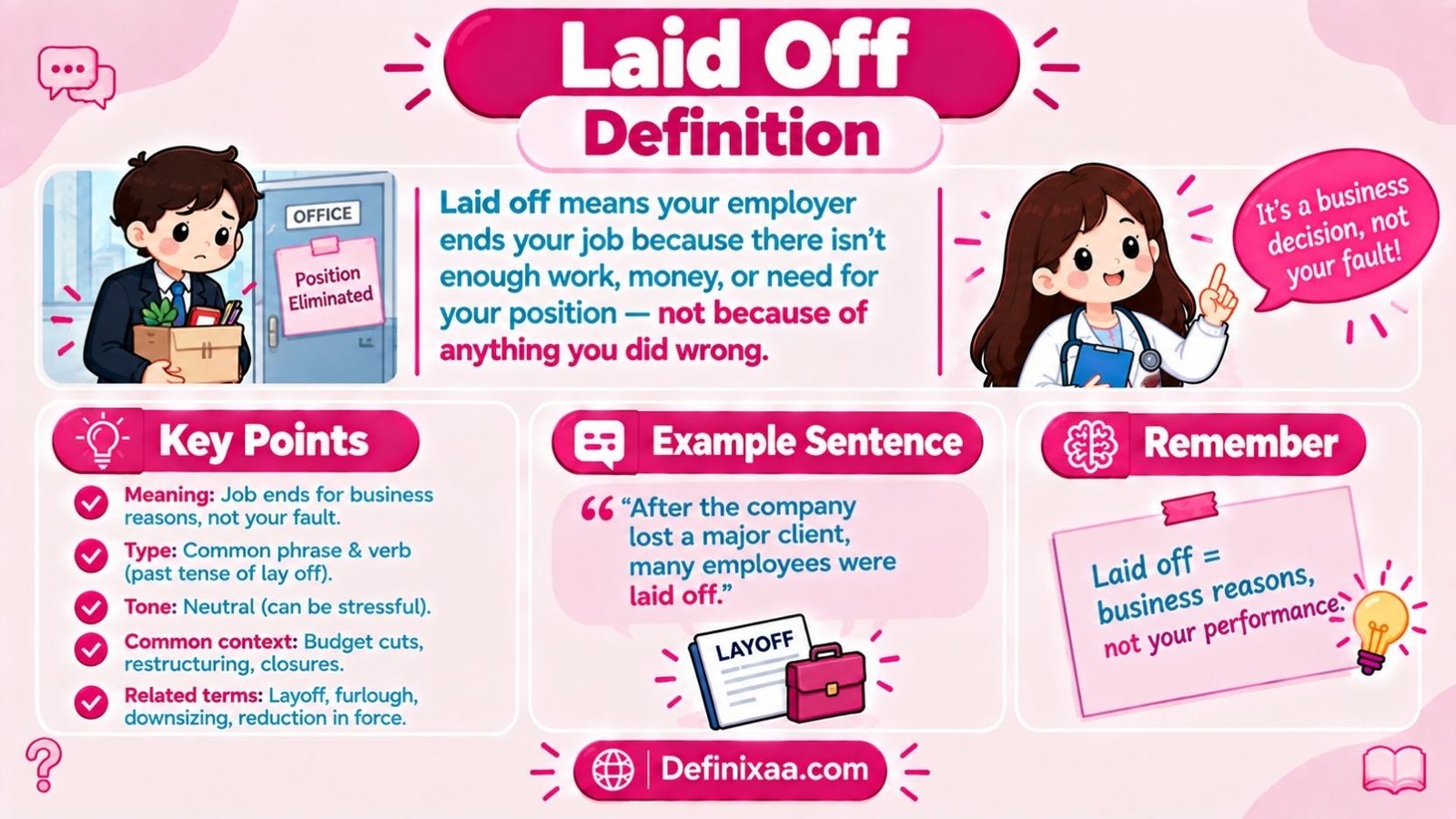
Laid off means an employer has ended your job because there is not enough work, money, or need for your position, not because of anything you did wrong.
It usually happens for business reasons such as budget cuts, restructuring, or a slowdown in demand. Being laid off is involuntary, and in most cases it makes you eligible for unemployment benefits.
At A Glance
| Detail | Information |
| Meaning | Employment ends for business or economic reasons, not employee fault |
| Type | Common workplace phrase and verb form (past tense of lay off) |
| Tone | Neutral, though the experience is usually stressful for the worker |
| Common context | Corporate downsizing, budget cuts, restructuring, closures |
| Related terms | Layoff, furlough, downsizing, restructuring, reduction in force |
| Opposite situation | Fired, terminated for cause |
Read More: Flaneur Definition
So, What Does Laid Off Mean In Simple Terms?
In plain language, being laid off means your employer no longer has a role, budget, or enough work for you, so they end your job. It has nothing to do with your performance.
Think of it this way: if a company loses a client, closes a department, or needs to cut costs, some jobs simply stop existing. The people in those jobs are laid off, even if they were doing excellent work.
This is why being laid off does not usually carry the same stigma as being fired. It signals a business decision, not a judgment about your abilities.
The Formal Meaning Of Laid Off
According to Merriam-Webster, a layoff is the act of ending an employee’s or a workforce’s employment, a term also loosely associated with a period of inactivity. Collins English Dictionary explains that when workers are laid off, their employer tells them to leave their jobs, usually because there is no more work available for them.
Put together, the core idea across dictionaries is consistent: laid off describes an employer ending a job because of a lack of available work, funding, or need, not because of the employee’s conduct or performance.
Laid Off Definition In Labor Law And Unemployment Insurance
Labor law does not use one single national definition of layoff, since employment law in the United States is largely handled at the state level. However, unemployment insurance agencies generally treat a layoff as a separation from work that happens through no fault of the employee, which is why it typically opens the door to benefits.
Washington State’s Employment Security Department explains that if your employer is not replacing you and there is no misconduct involved, you are generally considered laid off, and you may still be able to receive unemployment benefits if you meet basic eligibility requirements.
Note: Some states use the phrase “customarily laid off” in unemployment statutes. This refers to industries or employers that regularly lay off and rehire workers because of seasonal or cyclical demand, such as construction, agriculture, or tourism. It is a narrower, technical term used mainly in unemployment insurance law, not everyday conversation.
Is Laid Off The Same As Fired?
No. Both end your employment, but the reason is different, and that difference has real consequences.
A layoff happens because of the business: budget problems, a closed division, automation, or a company reorganizing its workforce. A firing happens because of the employee: performance issues, policy violations, or misconduct.
Laid Off Vs Fired
| Term | Meaning | Typical Reason | Unemployment Impact |
| Laid off | Job ends because the business no longer needs the role | Budget cuts, restructuring, closures, automation | Usually eligible for unemployment benefits |
| Fired | Job ends because of the employee’s performance or conduct | Poor performance, rule violations, misconduct | May be denied if the state classifies the reason as misconduct |
According to Nolo, a legal information publisher, a layoff usually refers to a permanent termination of employment for business reasons unrelated to the employee’s performance, while being fired usually happens because of poor performance, a policy violation, or behavioral issues.
Unemployment eligibility rules vary by state, but the general pattern holds across sources: workers who are laid off are usually eligible because the separation was not their fault, while workers fired for documented misconduct may be denied benefits for a period of time. Being fired for underperformance alone, without misconduct, often still qualifies for benefits, so it is worth filing a claim regardless of how the separation is labeled.
Furlough Vs Laid Off Definition
These two terms get confused constantly, but they describe very different situations.
A furlough is temporary and unpaid, but the job itself still exists. You remain an employee, often keep your benefits, and are expected to return once conditions improve. A layoff ends the employment relationship completely, with no guarantee of returning to that job.
Furlough Vs Laid Off
| Term | Meaning | Job Status | Benefits |
| Furlough | Temporary, unpaid time off with an expected return | Still employed | Often retained, such as health coverage |
| Laid off | Permanent or indefinite end of employment | No longer employed | Typically lost, though COBRA coverage may be available |
Indeed’s career guidance summarizes the core distinction well: furloughed workers remain employees of their company, while laid off workers are indefinitely or permanently terminated.
How Is Laid Off Actually Used In Real Life?
“Laid off” shows up constantly in news coverage, workplace conversations, LinkedIn posts, and casual small talk. It is standard, neutral, everyday English, used in both professional and informal settings without sounding out of place.
You will typically see it in phrases such as:
- Get laid off
- Was laid off last month
- Company laid off two hundred employees
- Facing a layoff
- Recently laid off from my job
It appears constantly in business journalism covering company downsizing, and just as often in ordinary conversation when someone explains why they left a job. It is equally natural in a formal HR announcement and in a casual text to a friend.
What Does Laid Off Look Like In A Sentence?
Here are original examples across different everyday contexts.
- Casual conversation: “I got laid off last week when the company cut the whole marketing team.”
- Professional setting: “Following the merger, the organization laid off roughly ten percent of its workforce.”
- Texting a friend: “Bad news, I was laid off today. Company is downsizing.”
- Online post: “Open to work after being laid off from my previous role. Reach out if you’re hiring.”
- News style: “The retailer laid off several hundred employees after closing dozens of underperforming stores.”
Read More: Spondylosis Definition
Laid Off Slang Meaning: A Quick Clarification
Some people search for a “laid off slang meaning” because the phrase sounds similar to an unrelated, informal slang expression involving the word “laid” that refers to sexual activity, not employment. These are two completely different expressions that happen to share a word.
“Laid off” always relates to a job ending. If you see the standalone phrase “get laid” without “off,” it belongs to a different, informal expression entirely and has nothing to do with employment. There is no legitimate “relationship” meaning of laid off; the term is strictly a workplace and employment term.
What Does Laid Off Not Mean?
It is worth clearing up a few common misunderstandings.
- Laid off does not mean quitting. It is involuntary. The employer, not the employee, ends the job.
- Laid off does not mean fired for cause. It carries no judgment about the employee’s ability or behavior.
- Laid off is not always permanent. Some layoffs are temporary, with recall rights if business improves, though most modern layoffs are treated as permanent separations.
- Being laid off is not the same as being furloughed. A furlough keeps the employment relationship active; a layoff ends it.
- Laid off is not primarily a romantic or relationship term. It applies to jobs, not personal relationships.
Before you use laid off, remember this: some employers describe a firing as a layoff to soften the message, or in rare cases to disguise an unlawful termination. If a claimed layoff selectively targets one employee rather than eliminating a role or department, it may not be a true layoff at all.
Synonyms For Laid Off
Words and phrases that share a similar meaning include:
- Terminated
- Let go
- Downsized
- Made redundant (more common in British English)
- Released from employment
- Position eliminated
- Part of a reduction in force
These overlap closely but are not always perfect substitutes. “Made redundant,” for example, is the standard British term for what Americans call being laid off, and it specifically means the role itself was eliminated.
When Should You Use the Term Laid Off?
Use “laid off” when a job ends because the employer no longer has the work, budget, or role available, regardless of the employee’s performance. It works equally well in formal writing, a resume explanation, a cover letter, casual conversation, or a text message.
It is generally the clearest and most accurate term to use when:
- A company reduces its workforce for financial or structural reasons
- A department or role is eliminated
- An employee is separated through no fault of their own
Avoid using “laid off” when the actual reason was performance or misconduct. Doing so is inaccurate and can create confusion later, particularly around unemployment claims or reference checks.
Is It Appropriate To Say Laid Off?
Yes. The term is standard, professional, and appropriate in nearly every setting, including job interviews, resumes, and formal correspondence. It carries far less stigma than being fired, since it clearly signals a business decision rather than a personal failing.
There is no need to soften or avoid the phrase. Employers, recruiters, and unemployment agencies all understand it as a routine, neutral description of an involuntary, no fault job separation.
How Do You Pronounce Laid Off?
Laid off is pronounced the way it looks, with two clear syllables: “layd awf.” There is no unusual or hidden pronunciation to worry about.
Word Origin Of Layoff
The phrase “lay off” comes from an older, more literal meaning of temporarily setting workers aside from active duty, often used historically in reference to seasonal or cyclical industrial work, such as factories or mines pausing operations.
Over time, the meaning shifted from a temporary pause to what is now most often a permanent end to employment, though the word “temporary layoff” is still used when recall is genuinely expected.
The Simple Takeaway
Being laid off means your job ended because your employer no longer had the work, budget, or role for you, not because of anything you did. It differs from being fired, which points to performance or conduct, and from being furloughed, which keeps you employed on temporary unpaid leave.
In almost every U.S. state, being laid off makes you eligible for unemployment benefits, and it carries little to no stigma in future job searches.
Read More: Gentility Definition
Frequently Asked Questions
What does laid off mean at work?
It means your employer ended your job because there was not enough work, funding, or need for your position, not because of your performance.
Is being laid off the same as being fired?
No. A layoff happens for business reasons unrelated to the employee. Being fired happens because of performance or conduct issues.
Can you collect unemployment if you are laid off?
In most states, yes. Since a layoff is considered through no fault of the employee, it typically satisfies unemployment eligibility requirements.
Is furlough the same as being laid off?
No. A furlough is temporary and unpaid, but the job still exists, and employees usually keep their benefits. A layoff ends the employment relationship entirely.
What does customarily laid off mean?
It is a specific unemployment insurance term describing industries or employers that regularly and predictably lay off and rehire workers, such as seasonal industries.
Is laid off a formal or informal term?
It is neutral and works equally well in formal writing, resumes, professional conversations, and casual speech.
What is a synonym for laid off?
Common alternatives include terminated, let go, downsized, and made redundant, though each carries slightly different connotations.
Does laid off mean the same thing as a relationship ending?
No. Laid off is strictly an employment term. It does not describe romantic relationships and is unrelated to any unconnected slang expressions that happen to share a similar sounding word.
Can a laid off employee be rehired later?
Yes, some layoffs include recall rights, especially in industries with seasonal demand, though many layoffs are treated as permanent separations with no formal recall guarantee.
Does being laid off look bad on a resume?
Generally, no. Recruiters understand that layoffs reflect business conditions, not individual performance, and rarely penalize candidates for a layoff on their record.
What is the difference between a layoff and a reduction in force?
They describe the same basic outcome. “Reduction in force,” often shortened to RIF, is more commonly used in government, nonprofit, and large corporate settings, while “layoff” is the everyday term used almost everywhere else.

Laiba Rahman is a writer and researcher behind Definixaa, dedicated to exploring words, meanings, terms, concepts, and everyday knowledge. Through clear and well-researched explanations, her goal is to help readers understand unfamiliar ideas quickly and discover useful information with ease.
One Comment