
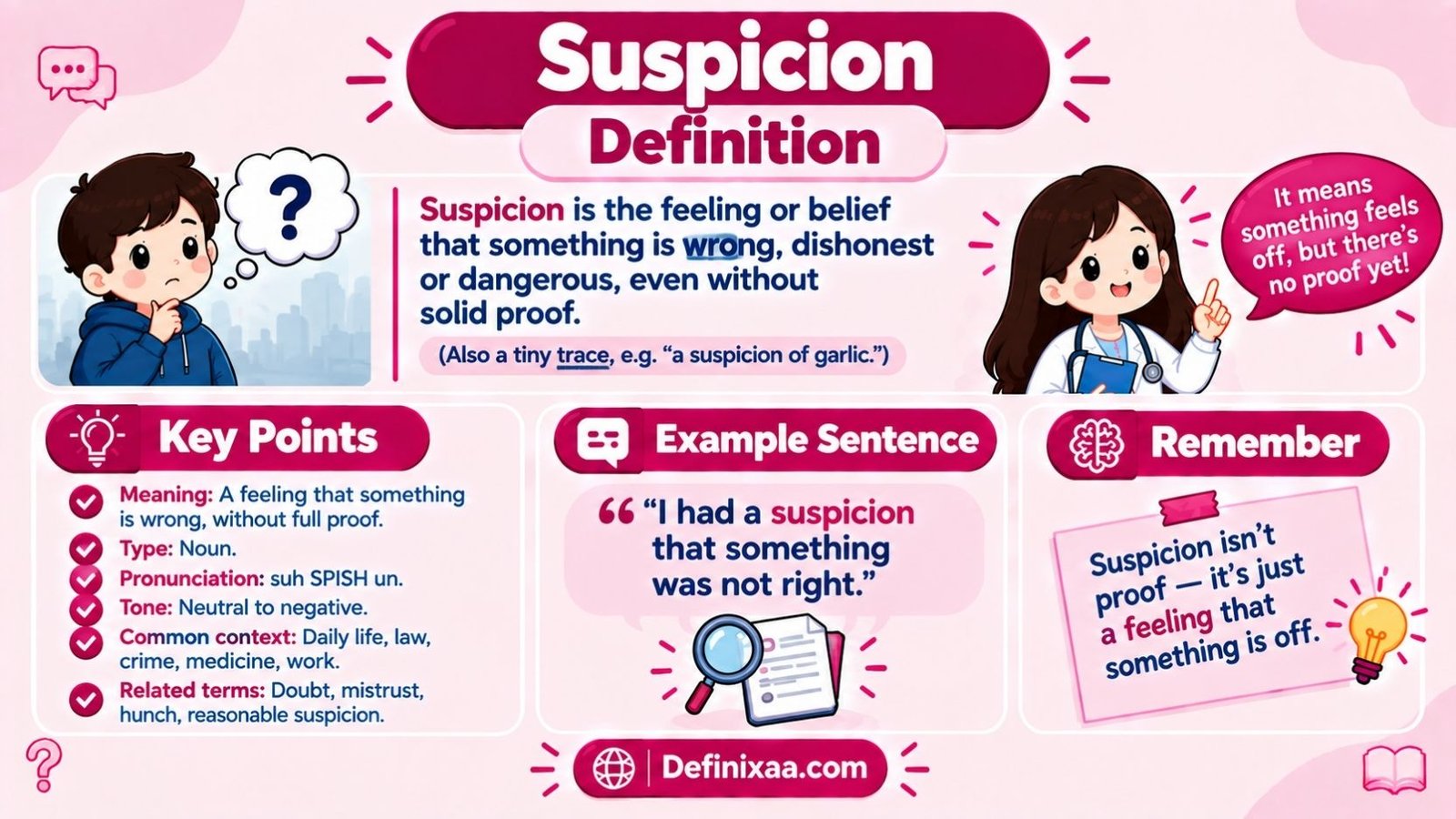
Suspicion is the feeling or belief that something is wrong, dishonest, or dangerous, even without solid proof. It can also mean a very small trace of something, as in “a suspicion of garlic.”
In law, suspicion becomes important when it is backed by specific facts. That version is called reasonable suspicion, and it lets police briefly stop and question someone.
At A Glance
| Detail | Information |
| Meaning | A feeling that something is wrong, without full proof |
| Type | Noun |
| Tone | Neutral to negative, depending on context |
| Common context | Everyday conversation, criminal investigations, medicine, workplace concerns |
| Related terms | Doubt, mistrust, hunch, reasonable suspicion, probable cause |
| Pronunciation | suh SPISH un |
Read More: Laid Off Definition
What Does Suspicion Actually Mean?
Suspicion is a noun for the act of suspecting. It describes a state of mind where someone believes a person or situation is wrong, dangerous, or dishonest, but does not yet have proof.
Merriam-Webster defines it as the act or an instance of suspecting something wrong without proof or on slight evidence, and describes it as a synonym for mistrust. The word also has a secondary, much smaller meaning: a barely detectable amount, or a trace. That is where phrases like “a suspicion of cinnamon” in a recipe come from.
So the same word covers two different ideas. One is emotional or investigative: distrust toward a person or situation. The other is almost the opposite in scale: a tiny hint of something.
So, What Is Suspicion In Simple Terms?
In plain English, suspicion is that uneasy feeling that something is off. You cannot fully prove it yet, but the signs point that way.
Think of a manager who notices cash keeps going missing from the register after a certain employee’s shifts. The manager has no video, no confession, and no witness. What the manager has is suspicion: a belief built on pattern and instinct rather than solid evidence.
Suspicion sits below certainty and below proof. It is stronger than pure curiosity, but weaker than knowledge. That middle position is exactly why the word shows up so often in crime reporting, workplace disputes, relationships, and law.
How Is Suspicion Actually Used in Real Life?
Suspicion appears constantly in news writing, especially in crime coverage. Reports describe someone as “arrested on suspicion of” a crime, which signals that charges are still being formalized and guilt has not been proven.
News examples show phrasing such as an arrest on suspicion of first degree murder, or being charged with suspicion of driving while intoxicated. This phrasing is intentional. It tells readers that police believe a crime may have occurred, without stating it as a confirmed fact.
Outside of crime reporting, suspicion shows up in ordinary situations too:
- A parent senses something is wrong from a teenager’s changed behavior.
- A coworker notices unusual login activity and suspects an account was compromised.
- A shopper feels suspicion toward a deal that seems too good to be true.
- A doctor has a clinical suspicion of a condition before running confirming tests.
In each case, suspicion is the starting point for closer investigation. It is rarely the end point.
What Does Suspicion Look Like In A Sentence?
Different settings call for slightly different tones. Here are original examples across common contexts.
- Casual conversation: “I had a suspicion you’d forget your umbrella again.”
- Workplace setting: “Her suspicion about the invoice led the finance team to audit the vendor.”
- News or crime reporting: “The man was taken into custody on suspicion of burglary.”
- Everyday trust and relationships: “He couldn’t shake the suspicion that something was being kept from him.”
- Small quantity meaning: “Add just a suspicion of lemon zest to brighten the sauce.”
- Academic or analytical context: “The historian approached the newly discovered letters with healthy suspicion.”
How Do You Pronounce Suspicion?
Suspicion is pronounced suh SPISH un, with the stress on the second syllable. In the International Phonetic Alphabet, it is written as /səˈspɪʃən/.
It rhymes with words like “position” and “decision.” The “c” in the middle is silent in the way it looks, but combines with “i” to create the “sh” sound.
How Do You Spell Suspicion?
The correct spelling is suspicion, with the letters s-u-s-p-i-c-i-o-n. A common mistake is writing “suspision” or “suspicsion,” likely because the “sh” sound in the final syllable does not obviously map to the letters “cion.”
Remembering the word’s Latin root, suspicio, can help, since the “c” carries over directly from Latin rather than being replaced with “sh” or “sion” spellings used elsewhere in English.
The adjective form, suspicious, follows the same pattern and is one of the more frequently misspelled words in this family, often losing or misplacing the second “i.”
Where Does The Word Suspicion Come From?
Suspicion has a long history rooted in Latin. It comes from Middle English suspecioun, borrowed through Anglo-French, from the Latin suspicion-, suspicio, which itself comes from suspicere, meaning to suspect.
The Latin root breaks down further. Suspicere combines sub, meaning up to or secretly, with specere, meaning to look at. The original image is someone looking at another person secretly or askance, the way you might glance sideways at someone you do not fully trust. That physical idea of a sideways, secretive look evolved into the abstract sense of mistrust we use today.
The word reached English by around 1300, initially describing the act of suspecting, an unverified conjecture of wrongdoing, or mistrust with only slight proof.
Suspicion Or Suspicious: What Is The Difference?
These two words are related but serve different grammatical jobs, and mixing them up is one of the most common errors with this word family.
| Word | Part of Speech | Meaning | Example |
| Suspicion | Noun | The feeling or belief that something is wrong | “She voiced her suspicion to the manager.” |
| Suspicious | Adjective | Describing something or someone that causes or shows suspicion | “The package looked suspicious.” |
Suspicion is the thing you have or feel. Suspicious describes the person, object, or behavior that triggers that feeling, or a person who tends to distrust others.
Merriam-Webster explains that suspicious can mean tending to arouse suspicion, or being disposed to suspect and distrustful, or expressing suspicion. That third sense covers something like “a suspicious glance,” where the look itself shows distrust rather than causing it.
A simple test: If you can replace the word with “distrust” or “doubt” as a noun, use suspicion. If you can replace it with “questionable” or “distrustful” as a description, use suspicious.
When Should You Use The Word Suspicion?
Suspicion works well any time you want to describe a belief that is grounded in some evidence, but falls short of proof. It is a precise word, and precision is exactly why it fits certain situations better than vaguer alternatives.
Use suspicion when:
- You want to signal that a belief is not yet confirmed, such as “under suspicion of fraud”
- You are describing a professional judgment call, like a doctor’s clinical suspicion
- You want to convey mild, reasonable doubt rather than full accusation
- You are writing formally or in journalism, where careful wording about unproven claims matters legally and ethically
A weaker word like “hunch” works better for casual, low stakes situations, such as guessing which team will win a game. Suspicion carries more formal weight and implies the stakes are somewhat higher, often involving trust, safety, or wrongdoing.
Is Suspicion Appropriate To Use In Formal Writing?
Yes, suspicion is fully appropriate in formal, academic, journalistic, and legal writing. It is a standard, neutral word with no slang associations and no offensive connotations.
The one place to use extra care is when writing about a specific, named person. Saying someone is “under suspicion” implies an ongoing investigation without confirming guilt, which is exactly why journalists rely on this phrasing. Applying the word carelessly to a real, identifiable person, without attribution to an official source, can create legal exposure around defamation, since it implies wrongdoing that may not be proven.
In everyday writing, this caution matters less. Describing your own suspicion about a coworker’s excuse or a stranger’s story carries no such risk.
Suspicion Bias: A Related But Different Idea
Suspicion is occasionally paired with the word bias, as in suspicion bias, most often in medical and statistical research. This describes a distortion that happens when a clinician’s existing suspicion about a diagnosis influences how they interpret test results or select which patients get tested at all.
This is a specialized, technical use rather than an everyday one. It shows up mainly in discussions of diagnostic accuracy studies, where researchers must account for the fact that doctors are more likely to test people they already suspect are sick, which can skew results.
What Words Mean Something Similar To Suspicion?
Suspicion belongs to a small family of words about uncertainty and distrust, but each one carries a slightly different shade of meaning.
Close synonyms include uncertainty, doubt, dubiety, skepticism, and mistrust, all of which describe a lack of sureness about someone or something. Merriam-Webster’s usage notes explain the distinction carefully: suspicion specifically stresses a lack of faith in the truth, reality, fairness, or reliability of something or someone, which sets it apart from general uncertainty.
Common near-synonyms worth knowing:
- Mistrust: general lack of confidence in someone, often ongoing rather than tied to one incident
- Doubt: uncertainty about whether something is true
- Hunch: an informal, instinctive feeling, usually weaker than suspicion
- Skepticism: a habitual, questioning attitude, often more intellectual than emotional
- Wariness: caution based on possible danger, not necessarily wrongdoing
These words overlap, but suspicion specifically implies believing something wrong or dishonest is going on, not just general uncertainty about facts.
Read More: Cultivated Definition
Is Suspicion Positive, Negative Or Neutral?
Suspicion is usually neutral to mildly negative. It is not an insult to say someone has a suspicion, but the word does carry an undertone of distrust or concern.
Context shifts the tone:
- In investigative or protective contexts, such as a nurse having a clinical suspicion of illness, the word is practical and neutral.
- In relationships, ongoing suspicion often signals a breakdown of trust and carries a heavier, more negative weight.
- In casual speech, “I had a suspicion” can be lighthearted, close to saying “I had a feeling.”
The word itself does not moralize. It simply names a mental state. The surrounding sentence usually supplies the emotional weight.
Suspicion In French
For readers researching the French equivalent, the word carries over almost directly. The French noun suspicion is a learned borrowing from the Latin suspiciō, and it is closely related to the French word soupçon, though the two are not exact doublets.
In everyday French, soupçon is more common in casual speech and often means a small trace, similar to the English “a suspicion of” something. Suspicion in French leans more formal, closer to the English legal or investigative sense.
Suspicion For Kids: A Simple Explanation
For a younger reader, suspicion can be explained this way: it is that feeling you get when something seems a little off, but you are not totally sure why.
Imagine a jar of cookies is half empty, and your little brother has crumbs on his shirt. You do not know for certain he took the cookies, but you have a suspicion he did. That feeling might turn out to be right, or it might turn out to be wrong. Suspicion is the guess your brain makes before you have all the facts.
What Is Reasonable Suspicion?
Reasonable suspicion is a legal standard, not just an everyday feeling. It describes the level of belief a police officer needs before briefly stopping and questioning someone.
Merriam-Webster’s Legal Dictionary defines it precisely: an objectively justifiable suspicion that is based on specific facts or circumstances, and that justifies stopping and sometimes searching a person thought to be involved in criminal activity at the time.
Importantly, the officer must be able to point to specific facts or circumstances, though the level of suspicion does not need to rise to the belief required for probable cause, and a reasonable suspicion must be more than a mere hunch.
This standard did not exist as clearly defined law until a landmark Supreme Court case in 1968.
Reasonable Suspicion And Terry v. Ohio
The reasonable suspicion standard comes directly from the U.S. Supreme Court case Terry v. Ohio, decided in 1968. Before this ruling, police generally needed probable cause to stop and search someone under the Fourth Amendment.
In Terry, the Court recognized that officer safety and public safety sometimes justify a brief stop and pat down even without full probable cause. The Court established a lower reasonable suspicion standard for these limited interactions, requiring that the officer have specific and articulable facts leading them to suspect a person’s involvement in criminal activity, and that the person may be armed and dangerous.
The Court was clear that a vague feeling is not enough. As legal analysis of the ruling explains, an officer must be able to point to specific and articulable facts that, combined with reasonable inferences, suggest criminal activity may be happening, and the Court was emphatic that a vague hunch is not sufficient. The standard is objective, meaning the facts must be enough to make a reasonable person believe criminal conduct is occurring or about to occur.
This is why the phrase “articulable suspicion” often appears alongside reasonable suspicion. The officer has to be able to explain, in specific words, what they observed.
Reasonable Suspicion vs. Probable Cause
These two terms get confused constantly, but they sit at different points on the same scale.
| Term | Meaning | Typical Use | Key Difference |
| Reasonable Suspicion | Specific, articulable facts suggesting possible criminal activity | Brief investigative stops, known as Terry stops | Lower bar; more than a hunch, less than certainty |
| Probable Cause | Facts sufficient for a reasonable person to believe a crime has occurred | Arrests, search warrants, full vehicle searches | Higher bar; requires stronger, more specific evidence |
Legal explainers describe the relationship clearly: reasonable suspicion is a lower threshold than probable cause, needing specific articulable facts indicating potential criminal activity, and it allows for brief temporary detentions known as Terry stops. Probable cause, by contrast, is a higher standard that requires sufficient evidence to lead a reasonable person to believe that a crime has been committed, and it is necessary for making arrests and conducting searches.
One helpful way to picture it: reasonable suspicion can escalate into probable cause. Actions taken under reasonable suspicion may lead to discovering evidence that establishes probable cause, but actions taken under probable cause can move a case directly toward arrest, charges, and trial.
Reasonable Suspicion In Texas
Texas follows the federal reasonable suspicion standard set out in Terry v. Ohio, applied through Texas courts and the Texas Court of Criminal Appeals. There is no separate statutory definition in the Texas Penal Code; instead, the standard is shaped by case law.
Texas courts describe it the same way federal courts do. As one Texas legal source summarizes, reasonable suspicion requires specific and articulable facts, coupled with rational inferences, that suggest criminal activity is currently happening, and it is more than a hunch or gut feeling, though it falls below the probable cause needed for a lawful arrest.
Texas case law also stresses timing. Reasonable suspicion must be based on facts known to the officer at the moment the stop begins, not facts discovered afterward, and not a misunderstanding of the law. This means an officer cannot justify a stop using information they only learned after pulling someone over.
Texas courts actively enforce this standard. In late 2025, the Texas Court of Criminal Appeals threw out a conviction because an officer stopped a driver without reasonable suspicion, despite the stop having been upheld at both the trial and intermediate appellate court level. Examples that Texas courts have accepted as reasonable suspicion typically include observed traffic violations, erratic driving, and corroborated witness tips. Presence alone in a high crime area is generally not enough on its own.
What Is An Index Of Suspicion?
Outside of law, suspicion also has a specialized meaning in medicine. An index of suspicion describes how strongly a clinician suspects a particular diagnosis before test results confirm it.
One legal glossary defines it as the degree to which a healthcare provider suspects that a patient may be suffering from a particular illness or injury, based on the provider’s training and experience, the patient’s clinical presentation of signs and symptoms, and the mechanism of injury if applicable.
Doctors often describe this as having a “high index of suspicion” for a condition, meaning they treat it as a strong possibility even before lab work confirms it. A clinical review of the phrase explains that a high index of suspicion is crucial for clinicians to recognize and investigate potential serious conditions, particularly in patients with non-specific symptoms.
A low index of suspicion means the opposite: the clinician does not currently see strong signs pointing toward that diagnosis. This is not a formal score or number. It is a working judgment that shapes which tests get ordered next.
What Does Hermeneutics of Suspicion Mean?
In philosophy and literary theory, suspicion takes on an entirely different, more academic meaning. The hermeneutics of suspicion is a term used to describe a style of reading and interpretation, not a feeling about a person or crime.
The phrase was coined by French philosopher Paul Ricoeur to describe a shared approach found in the writings of Marx, Freud, and Nietzsche. According to literary theorist Rita Felski, it names a distinctively modern style of interpretation that circumvents obvious or self-evident meanings in order to draw out less visible and less flattering truths.
In simpler terms, a hermeneutics of suspicion approaches a text, institution, or belief system by assuming its surface meaning may be hiding something else. Rather than taking a text at face value, the reader looks for what is concealed, denied, or disguised beneath it. Scholars sometimes contrast this with a “hermeneutics of faith,” which instead tries to recover and restore meaning rather than unmask it.
This use of suspicion is technical and mostly confined to academic writing in philosophy, religious studies, and literary criticism. It is not the everyday feeling of distrust, though the two senses share the same root idea of looking past appearances.
What Is A Suspicionless Search?
Back in the legal world, suspicionless search is the near opposite of reasonable suspicion. It describes a search conducted without any individualized suspicion of wrongdoing at all.
One legal glossary defines a suspicionless search as a search conducted without any individualized suspicion of wrongdoing, which may violate the Fourth Amendment’s protection against unreasonable searches and seizures.
These searches are controversial precisely because they skip the reasonable suspicion requirement altogether. Courts have allowed narrow exceptions in specific contexts, such as certain checkpoints, airport security screening, and searches of parolees, where the government’s interest is considered to outweigh individual privacy in that limited setting. Outside those narrow, court-approved categories, a search generally still requires either reasonable suspicion, probable cause, or consent to be constitutional.
Read More: Flaneur Definition
Before You Use Suspicion: Remember This
Suspicion is not the same as proof, and it is not the same as guilt. Someone can be under suspicion and still be entirely innocent. News language reflects this distinction carefully by using phrases like “arrested on suspicion of,” rather than stating that a crime was committed.
In legal contexts specifically, remember that reasonable suspicion is a narrow, fact based standard. It requires specific and articulable facts, not just a feeling, hunch, or general unease.
Frequently Asked Questions
What does suspicion mean in simple words?
Suspicion means believing something might be wrong or dishonest, even without proof. It is a feeling based on partial evidence rather than certainty.
Is suspicion the same as suspicious?
No. Suspicion is a noun describing the feeling itself. Suspicious is an adjective describing a person, object, or behavior that causes or shows that feeling.
What is reasonable suspicion in simple terms?
Reasonable suspicion is the legal standard police need to briefly stop and question someone. It requires specific facts pointing to possible criminal activity, not just a hunch.
What is the difference between probable cause and reasonable suspicion?
Reasonable suspicion is a lower legal standard used for brief stops. Probable cause is a higher standard required for arrests and full searches, based on stronger evidence.
Where does the word suspicion come from?
Suspicion comes from Latin, through Middle English and Anglo-French. Its root is the Latin verb suspicere, meaning to look at secretly or with mistrust.
How do you pronounce suspicion?
Suspicion is pronounced suh SPISH un, or /səˈspɪʃən/ in phonetic notation, with stress on the second syllable.
Can suspicion mean a small amount of something?
Yes. Suspicion can also describe a tiny, barely detectable trace, most often used in cooking, as in “a suspicion of nutmeg.”
What is a synonym for suspicion?
Common synonyms include mistrust, doubt, and skepticism, though each carries a slightly different shade of meaning around uncertainty or distrust.
Is reasonable suspicion the same in every state?
The core standard comes from a federal Supreme Court ruling and applies nationwide, though individual states, including Texas, apply and interpret it through their own court decisions and specific fact patterns.
What does articulable suspicion mean?
Articulable suspicion refers to the requirement that an officer must be able to state specific, concrete facts to justify a stop, rather than relying on an unexplainable feeling.
What does index of suspicion mean in medicine?
It describes how strongly a clinician suspects a particular diagnosis before tests confirm it, based on symptoms, patient history, and clinical experience.
What is the hermeneutics of suspicion?
It is an academic term for reading texts, ideas, or institutions with an assumption that their surface meaning may be hiding a deeper or less flattering truth.
What is a suspicionless search?
It is a search carried out without any individualized suspicion of wrongdoing, which generally raises Fourth Amendment concerns unless a narrow, court-recognized exception applies.
Is mere suspicion enough for police to detain someone?
No. Courts consistently hold that a vague hunch or mere suspicion is not enough; officers need reasonable suspicion supported by specific, articulable facts.
Last Words
Suspicion is the belief that something is wrong, built on partial evidence rather than proof. In everyday life, it is a normal, common feeling. In law, it becomes powerful only when it is reasonable: backed by specific, articulable facts, as established in Terry v. Ohio and applied across states including Texas.
The word sits deliberately between a hunch and certainty, and that middle ground is exactly why it matters so much in both ordinary conversation and the courtroom.

Laiba Rahman is a writer and researcher behind Definixaa, dedicated to exploring words, meanings, terms, concepts, and everyday knowledge. Through clear and well-researched explanations, her goal is to help readers understand unfamiliar ideas quickly and discover useful information with ease.
One Comment