
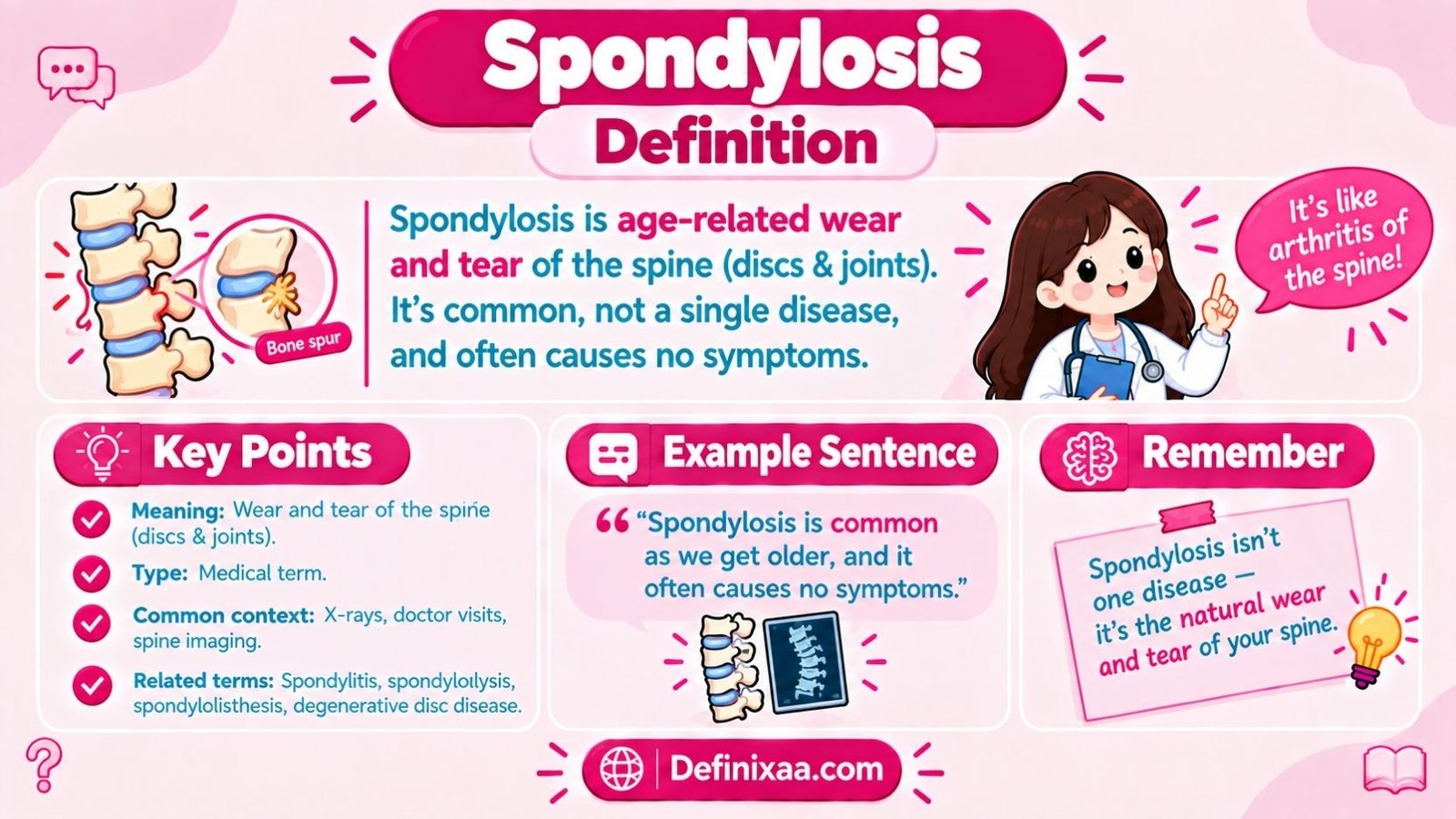
Spondylosis is a general medical term for degeneration of the spine, especially the discs and joints between vertebrae, that develops gradually as a normal part of aging. It is not one disease but a broad label doctors use to describe age-related wear and tear anywhere along the spinal column.
Most people will develop some degree of spondylosis simply by growing older, whether or not they ever feel a symptom.
Quick Detail
| Quick Detail | Information |
| Meaning | Degenerative, age-related wear and tear affecting the spine |
| Type of term | Medical term (from Greek anatomy) |
| Tone | Neutral, clinical |
| Common context | Radiology reports, orthopedic and neurology visits, spine imaging |
| Related terms | Spondylitis, spondylolysis, spondylolisthesis, degenerative disc disease |
Read More: Neutropenia Definition
So, What Does Spondylosis Mean In Simple Words?
Think of spondylosis as the spine’s version of arthritis. Over decades of movement, gravity, and daily use, the discs that cushion your vertebrae dry out and flatten. The joints between vertebrae wear down too.
The body sometimes responds by growing small bony spurs, called osteophytes, along the edges of the bones. Spondylosis is often described as a type of arthritis that affects the spine, causing occasional pain and stiffness and sometimes tingling or numbness.
In plain terms: spondylosis means your spine is showing normal signs of aging, the way skin wrinkles or hair grays. It does not always cause pain, and it is not the same as being seriously injured.
The Formal Medical Definition
Merriam-Webster’s medical dictionary defines spondylosis simply as any of various degenerative diseases of the spine.
A more detailed clinical definition, from an academic orthopedic source, explains it this way: spondylosis refers to the degeneration of the spine, particularly the intervertebral discs and facet joints, often associated with aging.
Note: Some doctors use “spondylosis” loosely to mean almost any age-related back or neck pain. A more precise use of the term, favored by spine specialists, is that spondylosis is essentially osteoarthritis of the spine, sometimes called spinal osteoarthritis.
Where Does The Word Spondylosis Come From?
The word has Greek roots. Spondylacosis comes from the Greek word for vertebrae, combined with the medical suffix indicating a condition or disease process.
Related spine terms share the same root:
- Spondyl- refers to a vertebra or the spine.
- -osis generally indicates a condition, process, or abnormal state, often degenerative rather than inflammatory.
- -itis, by contrast, indicates inflammation, which is why spondylitis is a different kind of condition entirely.
How Do You Pronounce Spondylosis?
According to Merriam-Webster’s Medical Dictionary, spondylosis is pronounced spahn-duh-LOH-sis. The word is written phonetically as spän-də-lō-səs, with the plural forms spondyloses or spondylosises.
Breaking it down syllable by syllable:
- SPON (rhymes with “on”)
- dih
- LOH (stressed syllable)
- sis
Spondylosis Can Affect Different Parts Of The Spine
Spondylosis is not limited to one location. Doctors label it according to where in the spine the degeneration is happening. Spondylosis can occur in the cervical spine in the neck, the thoracic spine in the upper and mid back, or the lumbar spine in the low back, with cervical and lumbar spondylosis being the most common forms.
Cervical Spondylosis Definition
Cervical spondylosis is wear and tear affecting the neck region of the spine. It is sometimes called arthritis of the neck, and it is extremely common: spine changes usually begin in a person’s thirties, and by age 60, roughly nine out of ten people show some signs of cervical spondylosis.
Many people with cervical spondylosis have no symptoms at all. When symptoms do occur, the neck may ache, feel stiff, or hurt, and while there is no outright cure, treatment can prevent the condition from getting worse.
Lumbar Spondylosis Definition
Lumbar spondylosis affects the lower back. It follows the same degenerative pattern: worn discs, worn facet joints, and sometimes bone spurs in the lumbar vertebrae.
Thoracic Spondylosis Definition
Thoracic spondylosis occurs in the mid and upper back. This region is less commonly affected and thoracic spondylosis frequently does not cause noticeable symptoms.
Lumbosacral And Multilevel Spondylosis
Lumbosacral spondylosis affects both the lumbar spine and the sacral spine, the region below the lumbar spine near the tailbone. Multilevel spondylosis simply means the degenerative changes are present at more than one vertebral level rather than being confined to a single joint.
Diffuse And Chronic Spondylosis
“Diffuse spondylosis” describes degeneration that is spread out across several vertebrae rather than concentrated in one spot. “Chronic spondylosis” simply emphasizes that, once degenerative changes set in, they are a long-term, ongoing part of the spine’s aging rather than a short-lived injury.
What Causes Spondylosis?
Spondylosis develops slowly, and age is the single biggest factor.
- Natural aging: the primary cause is ordinary wear and tear on the spine over time.
- Genetics: a genetic predisposition can make some people more prone to spinal degeneration than others.
- Repetitive stress: repeated physical stress on the spine, such as from certain jobs or activities, contributes to degenerative changes.
- Gravity and mechanical load: spondylosis is essentially the natural result of years of the spine being subject to the forces of gravity, and it is likely to affect most people to some degree as they age.
What Are the Symptoms Of Spondylosis?
Many people with spondylosis feel nothing unusual. When symptoms do appear, they typically include:
- Pain and stiffness: common symptoms include pain, stiffness, and reduced flexibility in the affected area of the spine.
- Bone spur effects: degenerative changes can lead to bone spurs that may potentially compress nearby spinal nerves.
- Tingling or numbness: some people experience tingling and a loss of sensation in addition to pain and stiffness.
Note: Not all back or neck pain is spondylosis, and having spondylosis on an imaging report does not automatically explain your pain. Many people with visible spinal degeneration on a scan have no symptoms whatsoever.
When Symptoms Need Urgent Attention
Some symptoms suggest the spine is pressing on nerves and need prompt medical evaluation rather than home care. These include:
- Foot drop or trouble lifting the front of the foot
- New bladder or bowel control problems
- Sudden balance changes
- Numbness that follows a stripe-like pattern down an arm or leg
- Severe, shock-like or electrical pain
- Arm or leg pain that has not improved with physical therapy, medication, or injections
Orthopedists specifically advise seeking more immediate care when these nerve-related warning signs appear.
Read More: Tenant Definition
Is Spondylosis The Same As Spondylitis, Spondylolysis, Or Spondylolisthesis?
These four words look similar but describe very different problems. Confusing them is one of the most common mistakes people make when researching back pain.
| Term | Meaning | Typical Cause | Key Difference |
| Spondylosis | Degenerative wear and tear of spinal discs and joints | Aging, repetitive stress | A degenerative process, not inflammation |
| Spondylitis | Inflammation of one or more vertebrae | Autoimmune or inflammatory disease | Spondylitis, as in ankylosing spondylitis, is an inflammatory form of arthritis and a very different process from spondylosis, which is degenerative rather than inflammatory. |
| Spondylolysis | A defect or incomplete formation in part of a vertebra called the pars interarticularis | Often a stress fracture caused by repetitive loading, sometimes combined with a genetic predisposition | Spondylolysis is a structural defect that predisposes a person to spondylolisthesis because it creates spinal instability. |
| Spondylolisthesis | Forward or backward slipping of one vertebra relative to the one next to it | Can follow spondylolysis, injury, or degeneration | Spondylolisthesis is the forward or backward displacement of the body of one vertebra in relation to an adjacent vertebra, which is a structural slippage rather than general wear and tear. |
Spondylosis Deformans: A Closer Medical Term
“Spondylosis deformans” is a more specific term used especially in radiology and veterinary medicine. It occurs when intervertebral discs begin to degenerate, leading to the formation of bony spurs or bridges around the disc and nearby spinal joints, and severe cases can press on spinal nerves and cause neurological symptoms.
Importantly, older medical writing sometimes mislabeled this condition. Some earlier sources called it spondylitis, but that term is technically incorrect because it wrongly implies the condition is inflammatory, like ankylosing spondylitis.
How Do Radiologists Define Spondylosis?
On imaging reports, spondylosis is usually filed under a broader category. Osteoarthritis of the vertebral column, also called spinal osteoarthritis, is so common that it is widely known simply as spinal degenerative change, and complications such as spinal stenosis are important for radiologists to recognize.
Radiology sources describe two related but distinct radiographic patterns: spondylosis deformans, which involves bony spurs arising from the front and side edges of the vertebral endplates that project outward and are frequently asymptomatic, and intervertebral osteochondrosis, which involves disc space narrowing, vacuum phenomenon, endplate erosion, and reactive bone changes.
In simple words: when a radiology report says “spondylosis,” it usually means the scan shows normal-looking bone spurs and disc wear for the patient’s age, and it is often mentioned even when it is not the cause of the patient’s pain.
How Is Spondylosis Diagnosed?
Doctors typically combine three approaches:
- Medical history and physical exam: a doctor may diagnose spondylosis based on age, symptoms, and medical history, checking spinal alignment along with arm and leg strength, reflexes, and range of motion.
- Imaging when needed: in most cases imaging exams are not strictly necessary, but a doctor may order an X-ray, MRI, or CT scan for more detail on severity, since these tests can show the vertebrae, discs, facet joints, and spinal cord in detail.
- Ruling out other conditions: doctors often check whether a separate issue, such as degenerative disc disease or osteoporosis, is also present alongside spondylosis.
Spondylosis Treatment: What Actually Works?
There is no cure that reverses spinal degeneration, and no treatment permanently undoes it. There are not any treatments that can reverse degeneration in the spine, though many non-surgical therapies can relieve pain and help a person manage symptoms and stay active.
This directly answers a common search: how to cure cervical spondylosis permanently. Based on current medical understanding, a permanent cure is not realistic, because spondylosis is a degenerative process rather than an infection or a single injury. Cervical spondylosis is a chronic condition with no cure, though treatments can keep it from getting worse and can relieve symptoms. The realistic goal is long-term management, not reversal.
Common Non-Surgical Treatments
- Pain relief medication: over-the-counter nonsteroidal anti-inflammatory drugs, such as ibuprofen, may help with pain.
- Staying active: low-impact exercise such as swimming or walking helps maintain flexibility and strengthens the muscles that support the spine.
- Posture correction: poor posture, such as slouching, can worsen spondylosis pain.
- Physical therapy: a physical therapist may recommend specific exercises or massage to relieve symptoms.
- Back support: choosing a chair or mattress that better supports the back can help manage discomfort.
- Rest during flare-ups: resting for a period during inflammation can help when symptoms are especially troublesome.
When Is Surgery Considered?
Surgery is uncommon and reserved for more serious cases. Surgery is reserved for people with nerve or spinal cord compression, and most procedures remove extra bone or disc material to relieve pressure on the nerves; in some cases, spinal fusion is used to stabilize part of the spine. Most people with spondylosis do not need surgery at all.
Tip: If conservative treatment has not helped after several weeks, ask your doctor whether imaging or a specialist referral makes sense, rather than assuming surgery is the next step.
Spondylosis In Dogs: A Veterinary Definition
Spondylosis is not only a human condition. Spondylosis deformans, often just called spondylosis by veterinarians, is a chronic spinal disease in which bone spurs form at the edges of the vertebrae and can sometimes join into bony bridges between segments of the spine.
The lower back is most often affected, though the parts of the thoracic spine closest to the lumbar region are also commonly involved. Middle-aged to older animals and larger dog breeds are more likely to develop it, and while dogs are the most common patients, cats can be affected too.
Interestingly, most affected pets never show signs of pain. Most dogs and cats with spondylosis deformans are asymptomatic, and when signs do appear, they usually correlate with larger body size, larger bone spurs, and older age, showing up as limping, back pain, stiffness, or muscle loss over the affected area.
A veterinary radiology study of 35 dogs found that German Shepherds were most frequently diagnosed with spondylosis deformans, followed by Labrador Retrievers and mixed-breed dogs, with the highest prevalence in dogs aged seven to ten years and the L4 to L6 region most commonly affected.
Spondylosis In Spanish: Espondilosis
The Spanish equivalent of spondylosis is espondilosis. It carries the same medical meaning: degenerative changes in the spine linked to aging, most often affecting the neck (espondilosis cervical) or lower back (espondilosis lumbar).
Spanish-language medical sources use the term the same way English-language sources do, describing wear on the discs and facet joints of the spine.
What Does Spondylosis Not Mean?
Because the term sounds technical, it is easy to misunderstand. A few clarifications:
- Spondylosis is not automatically painful. Many people have it on imaging with zero symptoms.
- Spondylosis is not an infection. It is a degenerative, wear-related process, not something caused by bacteria or viruses.
- Spondylosis is not the same as a herniated disc, although disc degeneration can be part of the same broader picture.
- Spondylosis is not inflammatory, which is the key distinction from spondylitis and ankylosing spondylitis.
- Spondylosis is not a slippage of the vertebra. That description applies to spondylolisthesis, not spondylosis.
Before You Use the Term: Remember This
Spondylosis and spondylolisthesis sound alike but are not interchangeable. Spondylosis is a general term for degenerative changes in the spine, while spondylolisthesis specifically refers to the displacement of one vertebra relative to another. If a report or doctor uses one term, do not assume it means the other.
Read More: Cultivated Definition
Should You Be Worried About A Spondylosis Diagnosis?
In most cases, no. Many cases of spondylosis are effectively treated with physical therapy and pain relief measures, and it is likely to affect most people to some degree as they age. A diagnosis on an imaging report often simply confirms normal age-related change rather than signaling a serious problem.
That said, take it seriously if it comes with the nerve-related warning symptoms listed earlier, since those can indicate the spine is pressing on nerve tissue.
Frequently Asked Questions
What does spondylosis mean in simple terms?
It means age-related wear and tear on the spine, similar to arthritis, affecting the discs and joints between vertebrae.
Is spondylosis the same as arthritis?
Spondylosis changes in the spine are frequently referred to as osteoarthritis, so in practice, spondylosis is essentially arthritis of the spine.
What is the difference between spondylosis and spondylolisthesis?
Spondylosis is general spinal degeneration, while spondylolisthesis is the actual forward or backward slipping of one vertebra over another.
Is spondylosis serious?
Usually not. Most people have mild or no symptoms, though severe cases can compress nerves and require closer monitoring.
Can cervical spondylosis be cured permanently?
No treatment reverses the degeneration. Care focuses on relieving symptoms and preventing the condition from worsening rather than curing it outright.
What are the first signs of spondylosis?
Early signs often include mild stiffness, occasional aching, and reduced flexibility in the neck or back, especially after periods of inactivity.
Does spondylosis show up on X-rays?
Yes. X-rays, along with MRI or CT scans when needed, can reveal disc thinning, joint changes, and bone spurs typical of spondylosis.
Can dogs get spondylosis?
Yes, spondylosis deformans is a well-documented condition in dogs, particularly larger and older breeds, and most affected dogs show no visible symptoms.
Is spondylosis hereditary?
Genetics can play a role, since a genetic predisposition combined with ordinary wear and repetitive stress contributes to how the condition develops.
How do you pronounce spondylosis?
It is pronounced spahn-duh-LOH-sis, with the stress on the third syllable.
The Simple Takeaway
Spondylosis means your spine is aging the way the rest of your body does, through gradual wear on discs and joints rather than injury or infection. It can appear in the neck, mid back, or low back, and most people have some degree of it without ever feeling pain.
There is no permanent cure, but most cases respond well to activity, posture changes, and physical therapy, with surgery reserved for the small number of cases involving real nerve compression.

Laiba Rahman is a writer and researcher behind Definixaa, dedicated to exploring words, meanings, terms, concepts, and everyday knowledge. Through clear and well-researched explanations, her goal is to help readers understand unfamiliar ideas quickly and discover useful information with ease.
One Comment