
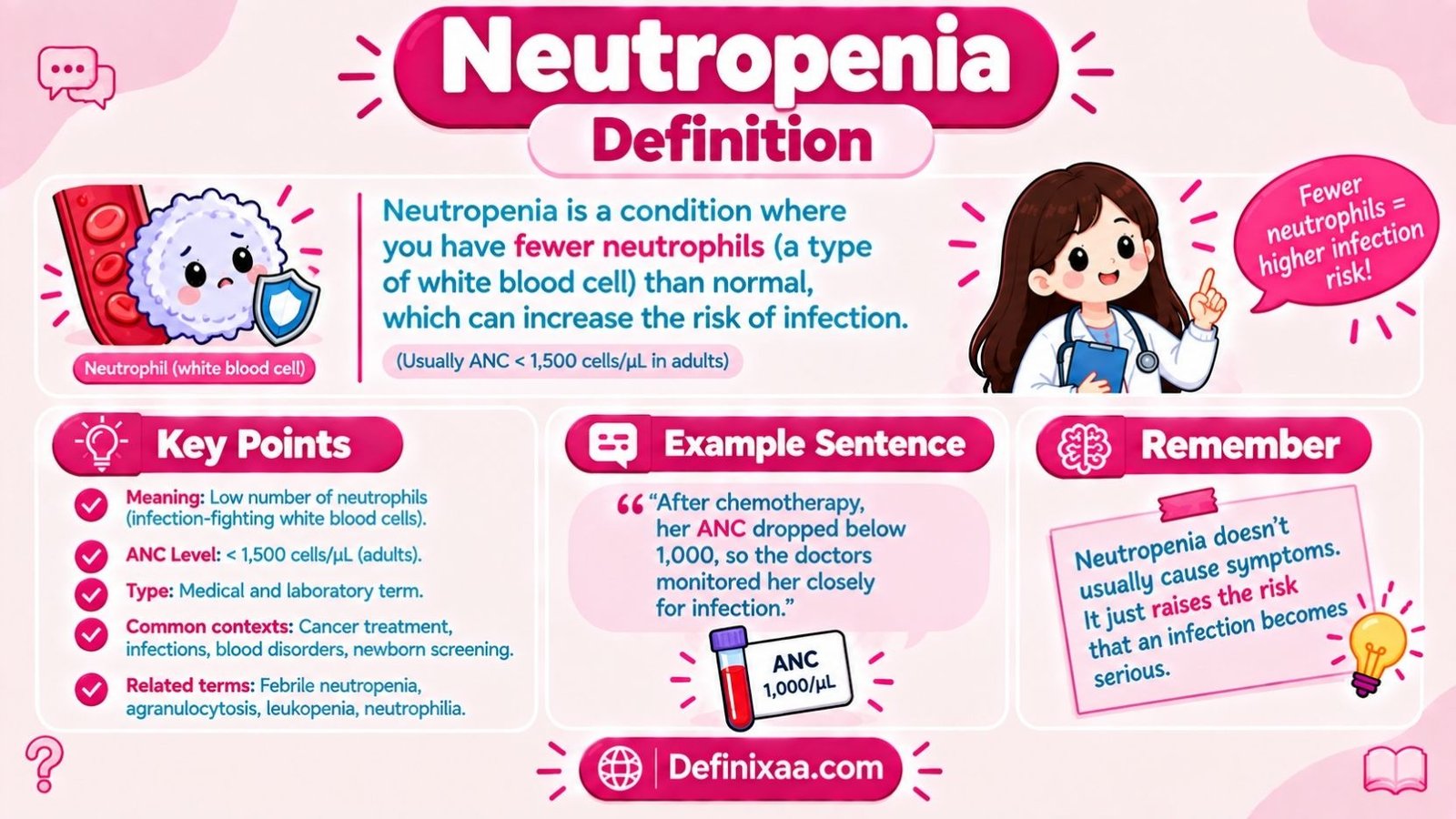
Quick definition: Neutropenia is a blood condition in which a person has an abnormally low number of neutrophils, a type of white blood cell that fights bacterial and fungal infections. In practical terms, most adults are considered neutropenic when their absolute neutrophil count, or ANC, drops below 1,500 cells per microliter of blood.
Neutropenia itself does not usually cause symptoms. What it does is raise the risk that an ordinary infection turns into something serious, because the body has fewer of its front-line defenders on patrol.
At A Glance
| Quick Detail | Information |
| Meaning | A lower than normal count of neutrophils, a bacteria-fighting white blood cell |
| Type | Medical and laboratory term |
| Tone | Neutral, clinical |
| Common context | Cancer treatment, infections, blood disorders, newborn screening |
| Key measurement | Absolute neutrophil count, or ANC, from a complete blood count |
| Related terms | Febrile neutropenia, agranulocytosis, leukopenia, neutrophilia |
Read More: Cultivated Definition
So, What Is Neutropenia In Simple Terms?
Think of neutrophils as the immune system’s first responders. They rush to the site of a bacterial invasion and try to destroy it before it spreads. When neutropenia sets in, there simply are not enough of these cells circulating in the blood.
That shortage does not make a person sick by itself. Instead, it removes a layer of protection. A minor infection that a healthy immune system would clear in a day or two can become dangerous much faster in someone with neutropenia, because the usual defense response is blunted or delayed.
Doctors find neutropenia through a routine blood test called a complete blood count with differential, which reports how many of each type of white blood cell are present.
What Does Neutropenia Definition ANC Actually Mean?
The absolute neutrophil count, or ANC, is the number that turns “neutropenia” from a vague idea into an exact medical diagnosis.
ANC is calculated from two numbers already found on a standard blood test:
- The total white blood cell count
- The percentage of that count made up of neutrophils, including mature neutrophils and immature band forms
Formula: ANC = Total WBC count × (percent neutrophils + percent bands) ÷ 100
Note: Many modern automated lab machines now calculate and print the ANC directly on the report, so patients and clinicians often do not need to do this math themselves.
For example, if a person’s total white blood cell count is 6,000 per microliter and 40 percent of those cells are neutrophils, the ANC is 2,400 per microliter, which falls within the normal range for most adults.
Neutropenia Definition Number: What Counts As Low?
Neutropenia is generally defined as an absolute neutrophil count under 1,500 cells per microliter of blood. That single cutoff is the number most primary care doctors, hematologists, and oncologists use as a starting reference point in the United States.
A typical adult reference range for ANC runs from about 1,500 to 8,000 cells per microliter, and a count below 1,500 is treated as neutropenia because it raises infection risk.
Tip: The exact lower limit of “normal” can shift slightly depending on the lab, the reference population used, and the person’s age or ancestry, so always compare a result to the specific reference range printed on that lab report rather than to a single fixed number found online.
Neutropenia Levels: The Standard Severity Categories
Clinicians typically break neutropenia into three severity tiers based on ANC:
| Severity | ANC Range | What It Generally Means |
| Mild neutropenia | 1,000 to 1,500 per microliter | Slightly increased infection risk, often no symptoms |
| Moderate neutropenia | 500 to 1,000 per microliter | Noticeably higher infection risk |
| Severe neutropenia | Below 500 per microliter | High infection risk, often needs close monitoring or treatment |
Some sources place the severe neutropenia threshold at an ANC under 500 per microliter, describing it as a level associated with a markedly increased risk of serious bacterial and fungal infection.
Profound and Absolute Neutropenia Definition
Profound neutropenia is generally defined as an ANC below 100 cells per microliter. At this level, infection risk is at its highest, and even normally harmless bacteria that live on the skin or in the gut can cause serious illness.
“Absolute neutropenia” is not a separate severity category. It simply refers to the absolute neutrophil count itself, as opposed to the neutrophil percentage alone, since a normal percentage can still hide a dangerously low absolute number if the total white cell count is also low.
A related but distinct term, agranulocytosis, is sometimes used for the most extreme drop in neutrophils. Some clinical references define agranulocytosis specifically as an ANC under 200 cells per microliter. The terms overlap in casual use, but agranulocytosis usually signals an especially severe, often drug-induced drop.
Grade 3 And Grade 4 Neutropenia Definition
In cancer treatment and clinical trials, neutropenia severity is often reported using the National Cancer Institute’s Common Terminology Criteria for Adverse Events, or CTCAE. This grading system standardizes how side effects are recorded during chemotherapy and other treatments.
Under the CTCAE system most widely used through 2025, neutropenia is graded as Grade 1 for an ANC around 1,500, Grade 2 for an ANC between 1,000 and under 1,500, Grade 3 for an ANC between 500 and under 1,000, and Grade 4 for an ANC under 500.
| CTCAE Grade | ANC Threshold (v5, widely used through 2025) |
| Grade 1 | Lower limit of normal down to 1,500/µL |
| Grade 2 | Under 1,500 to 1,000/µL |
| Grade 3 | Under 1,000 to 500/µL |
| Grade 4 | Under 500/µL |
Note: A newer version of this grading system, CTCAE version 6, was released in 2025 with planned use in clinical trials starting in 2026. Under that update, the thresholds shift by roughly one grade level, with Grade 1 becoming under 1,500 to 1,000, and Grade 4 becoming under 100 cells per microliter. If a lab report or clinical trial document references a “grade,” it is worth checking which CTCAE version was used, since the two systems are not identical.
Grade 3 neutropenia is generally treated as a severe, medically significant finding, while Grade 4 is treated as life-threatening and typically prompts urgent intervention.
Febrile Neutropenia Definition
Febrile neutropenia is one of the most important concepts in this topic because it describes a medical emergency, not just a lab value.
Neutropenic fever is generally defined as a single oral temperature at or above 101 degrees Fahrenheit (38.3 degrees Celsius), or a temperature at or above 100.4 degrees Fahrenheit (38 degrees Celsius) sustained for at least one hour, occurring in a person with an ANC below 1,500 cells per microliter.
In practice, most guidelines used in cancer care apply this fever definition specifically to patients whose neutropenia is more severe.
Febrile Neutropenia Definition, IDSA and NCCN Standards
The Infectious Diseases Society of America (IDSA) guideline for managing neutropenic cancer patients defines fever as a single oral temperature above 38.3°C (101°F), or a temperature above 38.0°C (100.4°F) sustained over a one-hour period.
That same guideline defines neutropenia, for the purposes of this fever rule, as an ANC under 500 cells per cubic millimeter, or an ANC expected to fall below 500 within the next 48 hours.
The National Comprehensive Cancer Network (NCCN), which many U.S. oncology centers follow closely, applies essentially the same fever and ANC combination when defining febrile neutropenia for chemotherapy patients.
Quick takeaway on febrile neutropenia:
- Fever: a single oral reading of 101°F (38.3°C) or higher, or 100.4°F (38°C) or higher for a full hour
- Neutropenia: an ANC under 500, or one expected to drop below 500 within 48 hours
- Both conditions must be present together to meet the standard definition
- This combination is treated as a medical emergency requiring prompt evaluation and, usually, immediate broad-spectrum antibiotics
Note: Definitions of fever vary slightly outside the United States. For example, guidelines from parts of Europe and Asia sometimes use a temperature threshold of 38.0°C measured on two separate occasions, or a single reading of 38.5°C, rather than the IDSA’s 38.3°C single-reading standard. The underlying idea, a genuine fever in a neutropenic patient, is the same, but the exact number can shift by guideline.
Read More: Stent Definition
Is Febrile Neutropenia the Same as Neutropenic Sepsis?
The two terms are closely related but not perfectly interchangeable. Febrile neutropenia describes the combination of fever and a low ANC, before the cause of the fever is confirmed. Neutropenic sepsis is used when that fever is accompanied by signs the body’s response to infection has become dangerous, such as a rapid heart rate, low blood pressure, or organ dysfunction.
In everyday clinical conversation, some sources use “febrile neutropenia” and “neutropenic sepsis” loosely as synonyms, but sepsis specifically implies a more severe, systemic illness.
Neutropenia Definition UK And Australia: Does It Differ?
The core laboratory definition of neutropenia, an ANC below approximately 1,500 cells per microliter, is used consistently across the United States, the United Kingdom, Australia, and most other countries with Western medical systems. There is no separate “UK version” or “Australia version” of the basic ANC cutoff.
What can differ slightly between countries and institutions are:
- The exact fever threshold used to define febrile neutropenia (as noted above)
- Local hospital protocols for how quickly antibiotics must be started
- Which risk-scoring tools are used to decide whether a febrile neutropenic patient can be treated at home versus in hospital
Note: If a specific national guideline is needed, such as one from the UK’s National Institute for Health and Care Excellence (NICE) or an Australian oncology body, checking that organization’s current published guidance directly is the most reliable source, since protocols are updated periodically.
What Is The Most Common Cause Of Neutropenia?
Neutropenia is most commonly seen, and even expected, as a side effect of chemotherapy used to treat cancer. Chemotherapy drugs are designed to kill rapidly dividing cancer cells, but they also damage the rapidly dividing neutrophil precursors made in the bone marrow, which lowers the neutrophil count as an anticipated consequence of treatment.
Outside of cancer treatment, several other categories commonly cause neutropenia:
- Infections: Viral, bacterial, and parasitic infections can all cause neutropenia, including common culprits like HIV, hepatitis, tuberculosis, sepsis, and Lyme disease.
- Blood and bone marrow disorders: Cancers and disorders affecting the bone marrow, including leukemia, lymphoma, and myelodysplastic syndromes, can prevent the body from making enough healthy neutrophils.
- Medications unrelated to cancer treatment: Certain medications prescribed for conditions unrelated to cancer can also lower neutrophil levels as a side effect.
- Autoimmune conditions: With certain autoimmune conditions, the body produces antibodies that mistakenly destroy its own healthy neutrophils.
- Nutritional deficiencies: Not getting enough vitamin B12, folate, or copper can also cause neutropenia.
- Autoimmune neutropenia in children: Autoimmune neutropenia is the most common cause of neutropenia in infants and young children, and it occasionally appears in adults between roughly 20 and 40 years old, mostly women.
- Chronic idiopathic neutropenia: Chronic idiopathic neutropenia refers to long-term low neutrophil counts without a clearly identifiable cause.
So while there is no single universal “most common cause” across every population, chemotherapy is the cause most often expected and monitored for in adults, while autoimmune neutropenia is the more typical explanation in young children.
Neonatal Neutropenia Definition
Neonatal neutropenia has its own definition because normal neutrophil counts in newborns differ from those in older children and adults, and change quickly in the first days of life.
Neonatal neutropenia is generally defined as an absolute neutrophil count below the fifth percentile for the baby’s postnatal age, with severe neonatal neutropenia specifically meaning an ANC under 500 per microliter, a level linked to a markedly higher risk of serious bacterial and fungal infection.
Because “normal” shifts hour by hour and day by day in newborns, clinicians compare a baby’s ANC to age-specific reference charts rather than to the flat 1,500 cutoff used for adults.
Common causes in newborns include:
- Isoimmune neonatal neutropenia, where a mother’s antibodies cross the placenta and attack the baby’s neutrophils, usually resolving on its own within about two months
- Neutropenia related to prematurity or low birth weight
- Infection present at or shortly after birth
How Is Neutropenia Actually Treated?
Treatment for neutropenia depends entirely on what is causing it and how severe it is. There is no single treatment that applies to every case.
- Watchful monitoring: Mild neutropenia with no clear dangerous cause, especially chronic or congenital forms that are not raising infection risk, may simply be monitored with regular blood tests.
- Treating the underlying cause: If a medication is responsible, a doctor may lower the dose, switch to a different drug, or pause treatment until the count recovers. If an infection or autoimmune disease is responsible, treating that condition often allows the neutrophil count to rebound.
- Growth factor medications: For neutropenia caused by chemotherapy or certain bone marrow conditions, doctors may prescribe granulocyte colony-stimulating factor (G-CSF) medications, such as filgrastim, which stimulate the bone marrow to produce more neutrophils.
- Antibiotics: When neutropenia is accompanied by fever or a confirmed infection, prompt antibiotic treatment, usually broad-spectrum and started right away, is standard because the usual immune defenses cannot be relied on to control the infection alone.
- Precautionary measures: People with significant neutropenia are often advised to avoid crowds, practice careful hand hygiene, avoid certain raw or undercooked foods, and seek medical care quickly at the first sign of fever rather than waiting to see if it passes.
Note: A so-called “neutropenic diet,” which limits raw fruits, vegetables, and undercooked foods, is still used in some cancer centers, but current evidence has not clearly shown it prevents infections better than standard food safety practices, and it can sometimes make it harder to get enough nutrition.
Is Neutropenia Cancer?
No. Neutropenia is not itself a form of cancer. It is a laboratory finding, a low count of one specific type of white blood cell.
The confusion is understandable because neutropenia is extremely common in people undergoing cancer treatment, and because certain blood cancers, like leukemia, can cause neutropenia as one of their effects on the bone marrow. But plenty of people develop neutropenia from infections, medications, autoimmune conditions, or genetic factors that have nothing to do with cancer.
Before you assume the worst, remember this: A single low neutrophil count on one blood test does not automatically mean cancer. Doctors typically look at the whole clinical picture, repeat testing, and other blood cell lines before drawing that kind of conclusion.
What Does Neutropenia Not Mean?
Because neutropenia is a specific, narrow laboratory term, it is worth being clear about what it does not describe:
- It does not mean the immune system has stopped working entirely. Other parts of immune defense, including lymphocytes that fight viruses, are usually unaffected.
- It does not automatically mean a person is currently sick or infected. Someone can have neutropenia and feel completely well.
- It is not the same as leukopenia, which is a broader term for a low total white blood cell count that can involve any type of white cell, not just neutrophils.
- It is not the same as thrombocytopenia, which refers to low platelets, the cells responsible for blood clotting, not infection fighting.
- It does not automatically require treatment. Many mild or chronic cases are simply monitored.
Neutrophilia: The Opposite Condition
Where neutropenia describes too few neutrophils, neutrophilia describes an elevated count. Neutrophilia indicates a raised neutrophil count and can occur alongside conditions like acute infection or inflammation. The two terms are direct opposites and are never used interchangeably.
What Words Mean Something Similar to Neutropenia?
| Term | Meaning | Key Difference from Neutropenia |
| Leukopenia | Low total white blood cell count | Broader term covering all white cell types, not just neutrophils |
| Agranulocytosis | Extremely severe, near-total absence of neutrophils | A more extreme subset, generally under 200/µL |
| Neutrophilia | Elevated neutrophil count | The direct opposite condition |
| Febrile neutropenia | Fever occurring together with neutropenia | A specific emergency combination, not a synonym for neutropenia alone |
| Bone marrow suppression | Reduced production of multiple blood cell types | A broader process that can cause neutropenia along with anemia or low platelets |
Symptoms And Signs Associated With Neutropenia
Signs and symptoms linked to neutropenia include fever, painful swallowing, gum pain, skin abscesses, and ear infections. It is important to note that these are typically symptoms of an infection occurring because of neutropenia, rather than symptoms of the low count itself.
Neutropenia usually does not cause symptoms on its own, and problems tend to appear only once an infection has developed. This is exactly why regular blood testing, rather than symptom-watching alone, is how most cases are first identified.
Read More: Tenant Definition
When Should You See A Doctor?
Anyone diagnosed with neutropenia, especially at a moderate or severe level, should have a clear plan from their care team about what symptoms mean “seek care immediately.” Fever is generally the single most important symptom to act on right away, since febrile neutropenia can progress quickly.
For someone already receiving chemotherapy, an oral temperature of 100.4°F (38°C) or higher, sustained for an hour, or a single reading of 101°F (38.3°C), is generally treated as a reason to contact a medical team or go to an emergency department without delay, following the same threshold used in the clinical definition above.
The Simple Takeaway
Neutropenia means having fewer neutrophils, an infection-fighting white blood cell, than normal, generally an ANC under 1,500 cells per microliter. Severity ranges from mild to profound, and the combination of neutropenia with fever, known as febrile neutropenia, is treated as a medical emergency.
Chemotherapy is the most common trigger in adults, though infections, autoimmune disease, medications, and nutritional deficiencies can all cause it too. Treatment depends on the cause, ranging from simple monitoring to growth factor injections and urgent antibiotics.
Frequently Asked Questions
What does an ANC number actually tell you?
The ANC tells you how many neutrophils are circulating in a specific volume of blood. A lower number means fewer infection-fighting cells are available, and a higher risk that an infection could become serious quickly.
Is neutropenia the same as a weak immune system?
Not exactly. Neutropenia affects one specific part of the immune system, the neutrophils, which mainly defend against bacteria and fungi. Other defenses, like those against viruses, can still function normally.
Can neutropenia go away on its own?
Yes, in some cases. Neutropenia caused by a temporary infection, a passing viral illness, or isoimmune neonatal neutropenia often resolves once the trigger clears, sometimes within days to a couple of months.
What ANC level is considered dangerous?
An ANC below 500 per microliter is generally considered severe and carries a meaningfully higher infection risk, while a count below 100 is considered profound and carries the highest risk.
Does neutropenia always come with fever?
No. Many people have neutropenia without any fever or symptoms at all. Febrile neutropenia specifically refers to the more urgent combination of fever plus a low ANC, not neutropenia on its own.
How is neutropenia diagnosed?
It is diagnosed through a complete blood count with differential, a standard blood test that reports the total white blood cell count and the percentage of that count made up of neutrophils, from which the ANC is calculated.
Is chronic neutropenia serious?
It depends on the cause and severity. Some chronic cases, such as chronic idiopathic neutropenia, cause little to no increased risk and are simply monitored, while others tied to bone marrow disorders need closer, ongoing management.
Can diet cause neutropenia?
Yes, in a limited way. Deficiencies in certain nutrients, particularly vitamin B12, folate, or copper, can lower neutrophil production, though this is a less common cause than chemotherapy, infection, or medication effects.
What is the difference between neutropenia and leukopenia?
Leukopenia is the broader term for a low total white blood cell count, which can involve any of several white cell types. Neutropenia specifically refers to a low count of just the neutrophil subtype.
Why is fever so important in someone with neutropenia?
Because fever may be the only early warning sign of a serious infection when the usual immune response is blunted. In neutropenic patients, a fever that would be minor in a healthy person is treated as a potential emergency requiring rapid evaluation.

Laiba Rahman is a writer and researcher behind Definixaa, dedicated to exploring words, meanings, terms, concepts, and everyday knowledge. Through clear and well-researched explanations, her goal is to help readers understand unfamiliar ideas quickly and discover useful information with ease.
One Comment