
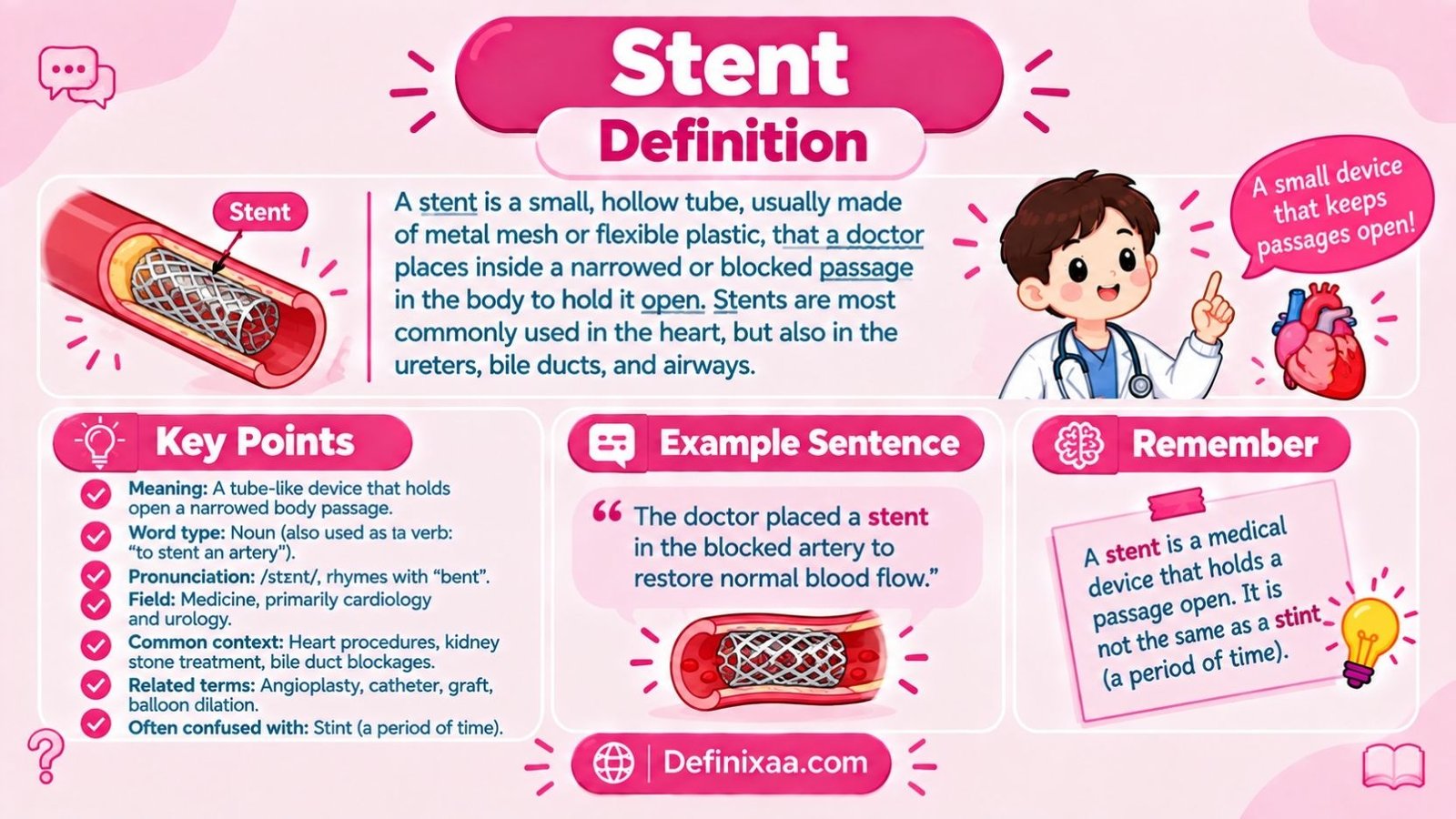
A stent is a small, hollow tube, usually made of metal mesh or flexible plastic, that a doctor places inside a narrowed or blocked passage in the body to hold it open. Most people hear the word in connection with the heart, but stents are also used in the ureters, bile ducts, and airways.
The word is pronounced stent, rhyming with “bent.” It is one syllable: /stɛnt/.
Quick Answer
Stent (noun): A short, tube-shaped medical device, often made of wire mesh, inserted into a blood vessel or other body passage to keep it open so fluid, blood, or air can pass through normally.
That is the core meaning. Everything below fills in the details: how stents work, the different types, how the word is pronounced, why it is sometimes confused with “stint,” and what the related medical terms actually mean.
At A Glance
| Detail | Information |
| Meaning | A tube-like device that holds open a narrowed body passage |
| Word type | Noun (also used as a verb: “to stent an artery”) |
| Pronunciation | /stɛnt/, rhymes with “bent” |
| Field | Medicine, primarily cardiology and urology |
| Tone | Neutral, technical/medical |
| Common context | Heart procedures, kidney stone treatment, bile duct blockages |
| Related terms | Angioplasty, catheter, graft, balloon dilation |
| Often confused with | Stint (a period of time or work), stentorian (loud voice) |
Read More: Prouder Definition
So, What Does Stent Actually Mean In Medicine?
In a medical context, a stent is a device that props open a passage in the body that has become too narrow to function properly. Doctors most often place these tiny, expandable mesh tubes inside an artery so blood can flow through it normally again. That is the meaning most searches for this word are actually looking for.
The narrowing a stent corrects is usually caused by one of a few things:
- A buildup of plaque inside an artery
- Scar tissue from a previous surgery or injury
- A tumor pressing on a duct or tube
- A kidney stone blocking the ureter
Once the stent is in place, it acts like scaffolding. The surrounding tissue eventually grows around it, and in most cases the stent stays there permanently.
In Simple Words
Think of a stent like a small spring that gets tucked inside a garden hose that has started to collapse. Once the spring is inside, the hose can’t pinch shut anymore, and water flows through it normally again.
That is essentially what happens inside a blood vessel. The artery is the hose. Plaque is what’s pinching it. The stent is the spring that holds it open.
Where Does The Word Come From?
The word stent traces back to a 19th-century English dentist named Charles Thomas Stent, who developed a moldable dental compound used to take impressions and hold grafts in place. Major medical dictionaries credit him with the term’s origin. Over time, his name became attached to supportive medical appliances more broadly, and it eventually expanded into the cardiovascular meaning used today.
According to Merriam-Webster, the medical meaning we use today, a tube inserted into a vessel to keep it open, was first recorded in 1961. The cardiovascular use of the word came later, once angioplasty procedures became common in the 1980s.
Note: People sometimes assume “stent” is related to “stentorian” (meaning loud, as in a booming voice). It isn’t. Stentorian comes from Stentor, a Greek herald in Homer’s Iliad known for having the voice of fifty men. The similarity between the two words is a coincidence of spelling, not a shared origin.
How Is A Stent Actually Used In Real Life?
Outside of a hospital setting, most people encounter the word “stent” in one of three situations:
- A family member or friend needs a heart procedure, and the doctor mentions placing a stent.
- Someone has kidney stones, and a ureteral stent is placed temporarily to help urine drain.
- News or health articles discuss “drug-eluting stents” or stent recalls.
The word rarely shows up in casual conversation outside of a health context. It isn’t slang, and it isn’t used metaphorically in everyday English the way some medical words are. When you see “stent” in a sentence, it is almost always literal.
What Does A Stent Look Like In A Sentence?
- Everyday conversation: “My dad had a stent put in last year after his chest pains started.”
- Medical setting: “The cardiologist placed a drug-eluting stent in the patient’s left anterior descending artery.”
- News/health writing: “Doctors say drug-eluting stents have significantly lowered the rate of repeat blockages.”
- Patient instructions: “You’ll need to take a blood thinner for several months after your stent placement.”
What Is A Stent Used For?
A stent is used any time a doctor needs to keep a body passage open after clearing a blockage or widening a narrowed area. The most common uses include:
- Restoring blood flow in a narrowed coronary artery
- Preventing re-narrowing after a balloon angioplasty
- Keeping the ureter open so urine can drain from the kidney to the bladder
- Clearing a blocked bile duct, often caused by gallstones or a tumor
- Supporting an airway that has narrowed due to disease or a tumor
- Reinforcing a weakened section of the aorta, using a stent-graft
Stent Meaning In The Heart: Coronary Stents Explained
When most people search “stent meaning in heart,” they are asking about coronary stents, which are placed during a procedure called coronary angioplasty (also known as percutaneous coronary intervention). This procedure is used specifically to reopen clogged heart arteries.
Here’s the basic sequence:
- A doctor threads a thin catheter with a deflated balloon to the blocked section of the artery.
- The balloon is inflated, widening the narrowed section from the inside.
- A stent, mounted on the balloon, expands along with it and locks against the artery wall, holding the vessel open once the balloon is gone.
- The balloon and catheter are removed. The stent stays behind, permanently.
Coronary stents are small. A typical one runs somewhere between 8 and 48 millimeters long, shorter than a golf tee, with an opening only 2 to 5 millimeters wide, roughly the width of a crayon tip.
Bare Metal Vs. Drug-Eluting Stents
There are two main categories of coronary stents used today.
Bare metal stents are plain mesh tubes with no coating. They were the original type used but have largely been replaced by drug-eluting versions for most patients.
Drug-eluting stents (DES) are coated with a medication that releases slowly over time, which helps stop scar tissue from building up and re-narrowing the artery. This has become the most common type of stent used for heart artery blockages today.
Tip: If a doctor mentions a “DES,” they mean a drug-eluting stent, not a different device entirely.
How Long Does A Stent Stay In? (Stent Definition, Time)
This is one of the most common follow-up questions once someone understands what a stent is. The answer depends on where the stent is placed.
Coronary (heart) stents are meant to be permanent. Once placed, tissue grows around the mesh and it becomes part of the artery wall. There is no plan to remove it later.
Ureteral stents are usually temporary. They are typically left in place for a few weeks to a few months, depending on why they were placed, then removed or exchanged during a follow-up procedure.
Biodegradable stents are a newer, less common option designed to dissolve on their own over a period of months.
Airway stents are frequently temporary as well, used as a bridge until a more permanent surgical solution is possible.
Note: A stent staying in place permanently does not mean the underlying condition is cured. The artery can still narrow elsewhere, which is why long-term medication and lifestyle changes remain part of treatment even after a successful stent placement.
Read More: Recurring Definition
Stent Procedure: What Actually Happens
A stent procedure, most often coronary angioplasty with stenting, generally follows these steps:
- Local anesthesia is applied at the catheter insertion site, usually the wrist or groin.
- A thin catheter is guided through the blood vessel to the blocked area, using X-ray imaging for guidance.
- Dye is injected so the doctor can see exactly where the blockage is.
- A balloon-tipped catheter is inflated to widen the narrowed section.
- The stent, which is mounted on the balloon, expands and locks into place against the artery wall.
- The balloon and catheter are removed. The stent remains.
The procedure typically takes about one to two hours, and most patients go home within a day or two.
Ureteral Stent Definition
A ureteral stent is a thin, flexible tube placed inside the ureter, the duct that carries urine from the kidney to the bladder. It is used when a kidney stone, tumor, or scar tissue is blocking normal urine flow.
Ureteral stents are commonly called double-J stents, or DJ stents, because both ends curl inward, each forming a loose loop shaped like the letter J, which keeps the stent from slipping out of position. This is also the correct answer to searches for “DJ stent definition.” It has nothing to do with a music DJ; it refers to the double-curled shape of the device.
Ureteral stents are usually left in place only temporarily and removed or replaced once the underlying blockage has been treated.
Dental Stent Definition
In dentistry, a stent has a different but related meaning. A dental or surgical stent is a mold or template, often made from a resinous material, used to hold a skin graft, tissue graft, or dental appliance in place while it heals.
This is actually the original historical use of the word, going back to Charles Stent’s dental compound. Modern usage in cardiology grew out of this earlier, narrower dental and surgical meaning.
Stent Definition in Biology or GCSE Science
Students encountering “stent” in a GCSE biology or general science course are typically learning about the circulatory system and heart disease.
In that context, a stent is described simply as a small tube inserted into a narrowed artery to hold it open and restore normal blood flow, usually taught alongside angioplasty as a treatment for coronary heart disease.
Stent Thrombosis, Underexpansion, Malapposition And Strut: What These Terms Mean
These are more advanced, clinical terms that come up in cardiology, particularly when discussing stent complications.
- Strut: The individual metal wires or segments that make up the mesh structure of a stent. The struts are what give the stent its shape and strength.
- Stent thrombosis: A blood clot forming inside a previously placed stent, which can suddenly block blood flow. This is a serious, though uncommon, complication.
- Stent underexpansion: A situation where the stent did not fully open to its intended diameter during placement, which can increase the risk of future complications.
- Stent malapposition: A condition where the stent struts are not sitting flush against the artery wall, leaving a small gap. This can sometimes resolve on its own or may need monitoring.
These terms are unlikely to come up outside of a medical setting, but they are useful to understand if you are reading a cardiology report or discharge summary.
Is X The Same As Y? Stint vs. Stent
This is one of the most common points of confusion tied to this word, largely because the two words sound almost identical in some accents.
| Term | Meaning | Typical Use | Key Difference |
| Stent | A tube-shaped medical device that holds a body passage open | Medical, especially cardiology and urology | Refers to a physical object |
| Stint | A fixed period of time spent doing a particular job or activity | Everyday English, work and career contexts | Refers to a duration or assignment, not an object |
Example with stent: “She had a stent placed after her angioplasty.” Example with stint: “He did a two-year stint in the Navy before college.”
Interestingly, older dictionary entries do list “stint” as a historical variant spelling of “stent” in its now-archaic sense of “an allotted portion.” That older, unrelated meaning has essentially disappeared from modern English. Today, the two words function as completely separate terms with separate meanings.
Stent Vs Graft: What’s The Difference?
Another common point of confusion is the difference between a stent and a graft, especially since the term “stent-graft” combines both.
| Term | Meaning | Typical Use | Key Difference |
| Stent | A mesh tube that holds a vessel open from the inside | Coronary arteries, ureters, bile ducts | Provides structural support only |
| Graft | A section of tissue or fabric used to replace or reinforce a damaged vessel wall | Aortic aneurysm repair, bypass surgery | Replaces or covers damaged tissue |
| Stent-graft | A combination device: a stent frame covered in fabric | Aortic aneurysms | Both supports the vessel and creates a new inner lining |
Is A Stent The Same In Spanish? (Stent Definition In Spanish)
The medical term transfers almost directly into Spanish. In Spanish, a stent is typically called “stent” or “endoprótesis”, and the procedure is often referred to as “colocación de stent” (stent placement).
Spanish-language medical sources use the English-derived word “stent” so widely that it functions as a loanword rather than being fully translated.
Should You Use The Word “Stent”? Practical Guidance
Because “stent” is a precise medical term, it is appropriate any time you’re discussing a real medical device or procedure. A few practical notes:
- In medical or health writing: Use “stent” specifically when referring to the device itself, not the procedure. The procedure is “angioplasty” or “stent placement.”
- In casual conversation: It’s completely natural and commonly understood, especially among adults, since heart procedures involving stents are widespread.
- In formal writing: The word is standard medical vocabulary and appropriate in reports, articles, and patient materials without needing to be simplified or replaced.
There is nothing informal, slang, or inappropriate about the word. It is a neutral, technical term used the same way across formal and casual contexts.
What Words Mean Something Similar To Stent?
- Catheter: A general term for a thin tube inserted into the body, often used to deliver the stent rather than being the stent itself.
- Endoprosthesis: A broader medical term for any device implanted inside the body to replace or support a structure; a stent is one type of endoprosthesis.
- Balloon dilation / angioplasty: The procedure often performed alongside stent placement, not a synonym for the stent itself.
- Scaffold: Sometimes used informally to describe what a stent does, though it isn’t a formal medical synonym.
None of these terms are fully interchangeable with “stent.” Each refers to a related but distinct part of the same overall procedure or device category.
Read More: Symptomology Definition
Before You Use “Stent,” Remember This
A stent is the device, not the procedure, and not the condition it treats. Saying “I had a stent” typically means a device was placed, while “I had a stenting procedure” refers to the process of placing it. Keeping this distinction clear avoids confusion, especially in medical writing or when explaining a diagnosis to someone else.
Frequently Asked Questions
What does stent mean in medical terms?
A stent is a small tube, usually mesh, placed inside a blood vessel or other passage to hold it open and restore normal flow of blood, urine, or other fluids.
How do you pronounce stent?
Stent is pronounced /stɛnt/, one syllable, rhyming with “bent” or “sent.”
What is a stent used for?
A stent is used to keep an artery, ureter, bile duct, or airway open after it has narrowed or become blocked, most often due to plaque, scar tissue, a tumor, or a kidney stone.
How long does a stent stay in the body?
Coronary stents are generally permanent. Ureteral and some other types of stents are often temporary and removed after weeks or months, depending on the reason they were placed.
Is a stent the same as a stint?
No. A stent is a physical medical device. A stint refers to a period of time spent doing a job or activity. The words are unrelated in modern usage despite sounding similar.
What is a drug-eluting stent?
A drug-eluting stent is a coronary stent coated with medication that slowly releases over time to help prevent scar tissue from re-narrowing the artery.
What does DJ stent mean?
DJ stands for double-J, describing the two curled, J-shaped ends of a ureteral stent that keep it anchored in place between the kidney and bladder.
Is getting a stent a major surgery?
No. Stent placement is usually a minimally invasive procedure performed through a small incision, often in the wrist or groin, rather than open surgery.
What is stent thrombosis?
Stent thrombosis is a blood clot that forms inside a previously placed stent, which can suddenly block blood flow and is considered a serious complication.
Where does the word stent come from?
The word comes from Charles Thomas Stent, a 19th-century English dentist whose name became attached to a dental compound, later extended to describe medical devices that hold tissue or vessels in place.
Last Words
A stent is a small tube, usually mesh, that holds open a narrowed or blocked passage in the body, most commonly an artery, but also ureters, bile ducts, and airways. Coronary stents are typically permanent, while ureteral stents are often temporary.
The word is unrelated to “stint” or “stentorian” despite the similar spelling, and it functions as a precise, neutral medical term in both formal and everyday English.

Laiba Rahman is a writer and researcher behind Definixaa, dedicated to exploring words, meanings, terms, concepts, and everyday knowledge. Through clear and well-researched explanations, her goal is to help readers understand unfamiliar ideas quickly and discover useful information with ease.
2 Comments