
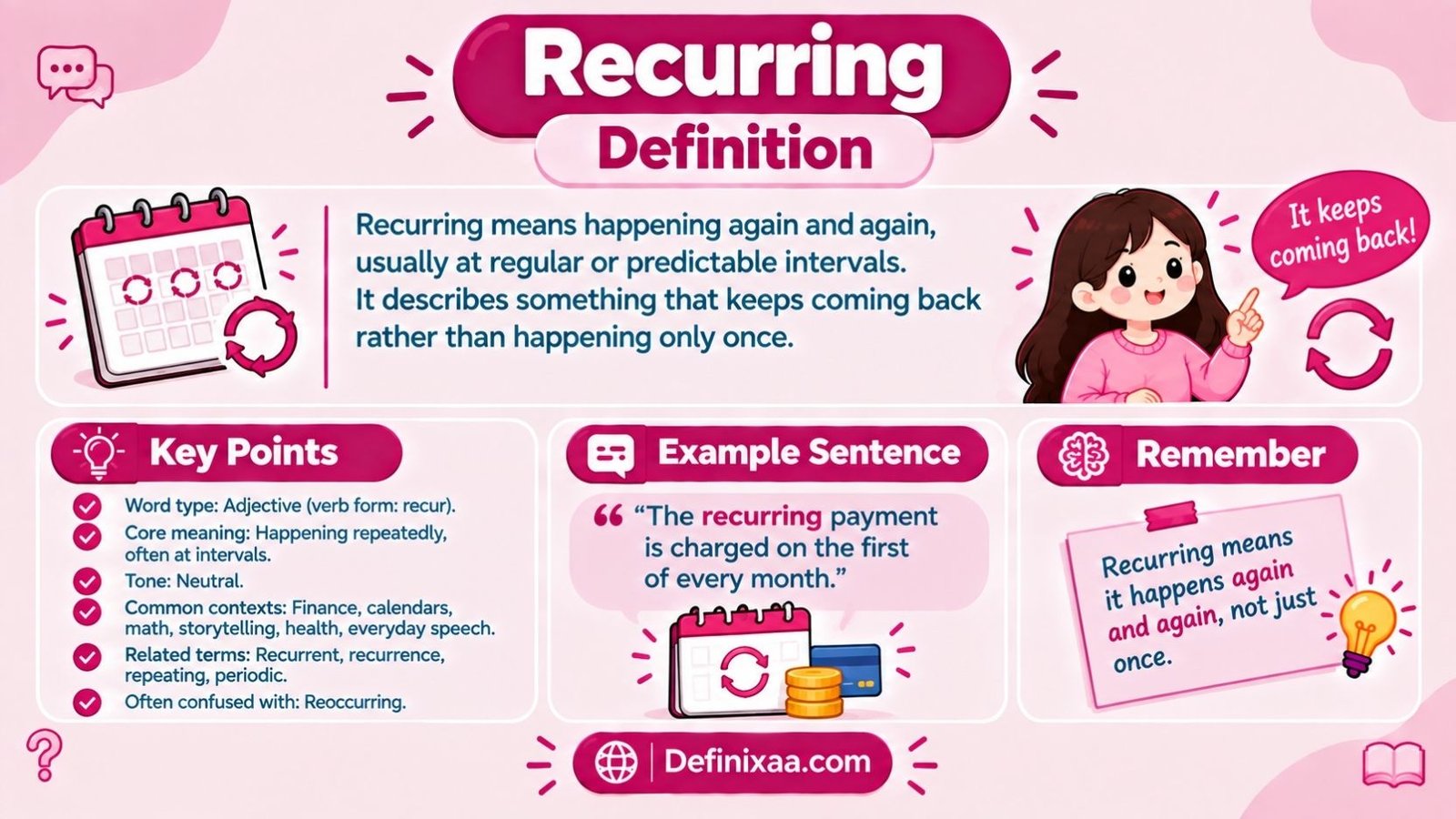
Recurring means happening again and again, usually at regular or predictable intervals. It describes something that keeps coming back rather than happening only once.
The word shows up everywhere: bank statements, calendar invites, math class, and everyday conversation. But its exact meaning shifts slightly depending on where you see it, which is why so many people search for clearer examples rather than a single dictionary line.
Quick Definition
Recurring is an adjective that describes an event, payment, feeling, or pattern that repeats over time. It can refer to something that happens on a fixed schedule, like a monthly subscription, or something that simply keeps returning, like a recurring dream or a recurring theme in a story.
At a Glance
| Detail | Information |
| Word type | Adjective (verb form: recur) |
| Core meaning | Happening repeatedly, often at intervals |
| Tone | Neutral |
| Common contexts | Finance, calendars, math, storytelling, health, everyday speech |
| Related terms | Recurrent, recurrence, repeating, periodic |
| Often confused with | Reoccurring |
Read More: Arial Definition
So, What Does Recurring Actually Mean In Simple Terms?
In plain language, recurring just means “it keeps happening.” If a bill is recurring, it comes back every month. If a dream is recurring, you have had it more than once, and it tends to keep returning in a similar form.
The word doesn’t say how often something repeats, only that repetition is expected or ongoing. A recurring event could happen daily, weekly, monthly, yearly, or on no fixed schedule at all, as long as the pattern of returning is clear.
Think of it this way: something that happens once is a one time event. Something that comes back is recurring.
How Do You Pronounce Recurring?
Recurring is pronounced rih-KUR-ing, with the stress on the second syllable. In IPA, it is written as /rɪˈkɜːrɪŋ/ in American English.
If you say it out loud, it should rhyme roughly with “occurring,” since both words share the same Latin root and syllable pattern.
Where Does the Word Recurring Come From?
Recurring comes from the verb recur, which traces back to the Latin word recurrere, meaning “to run back” or “to return.” The prefix re means “again,” and currere means “to run.”
Over time, the word moved from a literal sense of physically running back to a broader meaning of anything that returns or repeats, whether that is an idea, a payment, a symptom, or an event. The ing ending simply turns the verb into a descriptive adjective, similar to how “repeat” becomes “repeating.”
How Is Recurring Actually Used in Real Life?
Recurring is a common, everyday word. It is not slang, and it is not overly formal. You will hear it in casual conversation, read it in financial paperwork, and see it in calendar apps and software menus.
A few patterns stand out in real usage:
- In finance and billing, recurring almost always describes a payment or charge that repeats automatically.
- In calendars and scheduling tools, recurring describes an event set to repeat, such as a weekly team meeting.
- In storytelling and literature, recurring describes a character, symbol, or theme that reappears across a book or show.
- In health and medicine, recurring often describes a symptom or condition that keeps coming back, though recurrent is more common in clinical writing.
- In casual speech, recurring can describe anything repetitive, from a recurring argument with a sibling to a recurring joke among friends.
Note: The word rarely sounds awkward in any of these settings. It works equally well in a text message, a business email, or an academic paper.
What Does Recurring Look Like In A Sentence?
Seeing the word in context often helps more than any definition. Here are original examples across different situations.
- Casual conversation: “We have this recurring joke about who forgets their umbrella first.”
- Professional setting: “Please set up a recurring meeting every Monday at nine for the project team.”
- Finance and billing: “Check your bank app for any recurring charges you may have forgotten to cancel.”
- Academic or literary context: “Loneliness is a recurring theme throughout the second half of the novel.”
- Texting: “Ugh, this recurring reminder keeps popping up even though I already did the task.”
Recurring Can Mean More Than One Thing
The core idea stays the same across contexts: something that repeats. But the specific meaning shifts depending on the field.
Recurring In Finance
In finance, recurring describes any payment, charge, deposit, or revenue stream that repeats on a set schedule. A recurring payment might be a phone bill charged every month. Recurring revenue refers to income a business can expect to receive again in future periods, such as subscription fees.
A recurring deposit is a specific banking product, common in countries like India, where a customer deposits a fixed amount every month for a set term and earns interest on the total at the end.
Recurring expenses are costs that show up repeatedly in a budget, such as rent, utilities, or software subscriptions, as opposed to one time purchases.
Recurring In Math
In mathematics, a recurring decimal, also called a repeating decimal, is a decimal number in which one or more digits repeat infinitely. A well known example is one third written as a decimal, which produces the digit three repeating forever.
Recurring decimals are typically shown with a small dot or a line over the repeating digit or digits to indicate that the pattern continues without end. A non recurring decimal, by contrast, either ends after a fixed number of digits or continues without any repeating pattern.
Read More: Feed Definition
Recurring In Meetings And Calendars
A recurring meeting is a meeting scheduled to repeat automatically at set intervals, such as every day, every week, or every month, without needing to be recreated each time. Most calendar tools, including Outlook and Google Calendar, offer a recurring event option so users can set the pattern once.
Recurring In Storytelling
A recurring character or recurring theme appears more than once across a book, film, or television series. Unlike a main character, a recurring character may not be present in every scene or episode but returns often enough to feel familiar.
For example, in The Outsiders, certain minor characters and themes, such as class conflict and loyalty, are treated as recurring elements that reappear throughout the story to reinforce its message.
Recurring In Health
In medical contexts, a recurring symptom or condition is one that returns after a period of absence. Writers and clinicians sometimes prefer the word recurrent in this setting, since it carries a slightly more formal, clinical tone, though both words are understood the same way by most readers.
Is Recurring The Same As Reoccurring?
This is one of the most searched comparisons involving this word, and the answer is: not exactly.
Both words describe something happening again, but they carry a subtle difference in emphasis. Recurring tends to imply a pattern, something that happens repeatedly, often at intervals, and that is expected to continue. Reoccurring simply means something is happening again, without necessarily implying a repeating pattern or future repetition.
| Term | Meaning | Typical Use | Key Difference |
| Recurring | Happening again and again, often on a pattern | Bills, meetings, symptoms, themes | Suggests an ongoing or expected pattern |
| Reoccurring | Happening again after a gap | A one time repeat of a past event | Does not necessarily suggest a future pattern |
Example: If your car breaks down for the second time ever, that is a reoccurring problem. If it breaks down every few months like clockwork, that is a recurring problem.
In practice, many English speakers use the two words interchangeably, and most readers will understand either version. But if precision matters, such as in technical writing or medical documentation, recurring is the safer choice when you mean an established repeating pattern.
Recurring Vs Recurrent: Is There A Difference?
Recurring and recurrent are close cousins, and both come from the same root verb, recur. Recurring is generally the more common word in everyday English, while recurrent appears more often in medical and technical writing, as in “recurrent fevers” or “recurrent cancer.”
Recurrent also has a specialized anatomical meaning, describing certain nerves or blood vessels that curve back in the opposite direction from their original course. Recurring does not carry this specialized sense.
For most everyday writing, recurring is the natural choice. Save recurrent for clinical or scientific contexts where that tone fits better.
What Words Mean Something Similar to Recurring?
Several words overlap with recurring, though none are perfect substitutes in every context.
- Repeating: A close, everyday synonym, especially for schedules and patterns.
- Periodic: Suggests repetition at regular, measured intervals.
- Recurrent: A more formal or clinical alternative.
- Habitual: Implies repetition through habit rather than schedule.
- Chronic: Used mainly in health contexts for long lasting, repeated conditions.
- Cyclical: Suggests repetition that follows a cycle, such as seasons or economic patterns.
None of these are true synonyms in every sense. Chronic, for example, implies persistence and severity, which recurring does not always suggest.
What Does Recurring Not Mean?
It is worth clarifying what the word does not imply, since people sometimes stretch its meaning.
- Recurring does not mean permanent or constant. Something recurring goes away and comes back, rather than staying present the whole time.
- Recurring does not require an exact schedule. A recurring dream, for instance, may not follow any set timing at all.
- Recurring is not automatically negative. While it often describes problems, such as recurring expenses or recurring pain, it is just as often neutral or positive, such as a recurring tradition or a recurring highlight of someone’s week.
Before You Use Recurring: Remember This
Recurring describes a pattern of repetition, not a single event and not something that never stops. If you mean something that happens only once more, reoccurring may fit better. If you mean something ongoing without a break, words like constant or continuous are more accurate.
When Should You Use Recurring?
Recurring works well any time you want to describe something set up to repeat, or something that keeps happening in a noticeable pattern.
It is appropriate in professional writing, financial documents, calendar settings, casual conversation, and creative writing. There is no register where the word sounds out of place, which is part of why it appears so often across different types of content.
Use recurring when:
- Describing a bill, subscription, or payment that repeats automatically.
- Setting up a meeting or event on a repeating schedule.
- Describing a theme, character, or pattern that returns across a story.
- Talking about a symptom, problem, or habit that keeps coming back.
Is Recurring Appropriate To Use?
Yes. Recurring is a standard, neutral English word with no offensive or outdated connotations. It fits naturally in formal writing, business communication, academic work, and everyday speech.
There is no need to avoid it in any professional context. Unlike slang or internet shorthand, recurring has been part of standard English for centuries and continues to be used the same way today.
How Do You Spell Recurring?
Recurring is spelled with two Rs: r, e, c, u, r, r, i, n, g. A common misspelling drops one of the Rs, writing it as “recuring,” which is incorrect.
Doubling the final consonant before adding ing is a standard English spelling pattern, seen in similar words like “occurring” and “referring.”
Recurring In Other Languages
For readers who searched for the term in another language, here are two quick translations for context.
In Spanish, recurring is generally translated as recurrente or, depending on context, periódico when describing something happening at regular intervals.
In Hindi, recurring is often translated as आवर्ती (aavarti) or बार-बार होने वाला (baar baar hone waala), both of which capture the sense of something happening repeatedly.
These translations are general guides. The best translation can shift slightly depending on whether the context is financial, medical, or conversational.
Read More: Ocher Definition
What Does Recurring Mean For Kids?
For a younger reader, recurring simply means something that keeps happening again and again, almost like a pattern you can predict.
A recurring chore is one you do every week, like taking out the trash. A recurring dream is one you have had more than once. It is the same word adults use, just applied to simpler, everyday examples.
Frequently Asked Questions
What does recurring mean in simple terms?
Recurring means something happens again and again, often following a pattern, rather than occurring only once.
Is recurring the same as reoccurring?
Not quite. Recurring suggests a repeating pattern, while reoccurring usually just means something is happening again without implying future repetition.
What is a recurring payment?
A recurring payment is a charge that repeats automatically on a set schedule, such as a monthly subscription or utility bill.
What is a recurring decimal in math?
A recurring decimal, or repeating decimal, is a decimal number where one or more digits repeat forever, such as the decimal form of one third.
What is a recurring deposit?
A recurring deposit is a banking product where a person deposits a fixed amount every month for a set period and earns interest on the total at maturity.
Is recurring formal or informal?
Recurring is neutral. It works comfortably in formal writing, professional communication, and casual conversation alike.
What is the opposite of recurring?
Non recurring is the most direct opposite, describing something that happens only once rather than repeatedly.
What is a recurring meeting?
A recurring meeting is a meeting scheduled to repeat automatically at fixed intervals, such as weekly or monthly, without being recreated each time.
Is recurring a positive or negative word?
Recurring is neutral on its own. Its tone depends entirely on context, such as a recurring problem versus a recurring tradition.
How do you spell recurring correctly?
Recurring is spelled with two Rs, as in r, e, c, u, r, r, i, n, g.
The Simple Takeaway
Recurring describes anything that happens again and again, usually following a noticeable pattern, whether that is a monthly bill, a weekly meeting, a repeating decimal, or a theme that keeps appearing in a story.
It is a neutral, everyday word that fits comfortably in almost any setting. The main point to remember is the difference from reoccurring: recurring implies an ongoing pattern, while reoccurring simply means something has happened again.

Laiba Rahman is a writer and researcher behind Definixaa, dedicated to exploring words, meanings, terms, concepts, and everyday knowledge. Through clear and well-researched explanations, her goal is to help readers understand unfamiliar ideas quickly and discover useful information with ease.
One Comment