
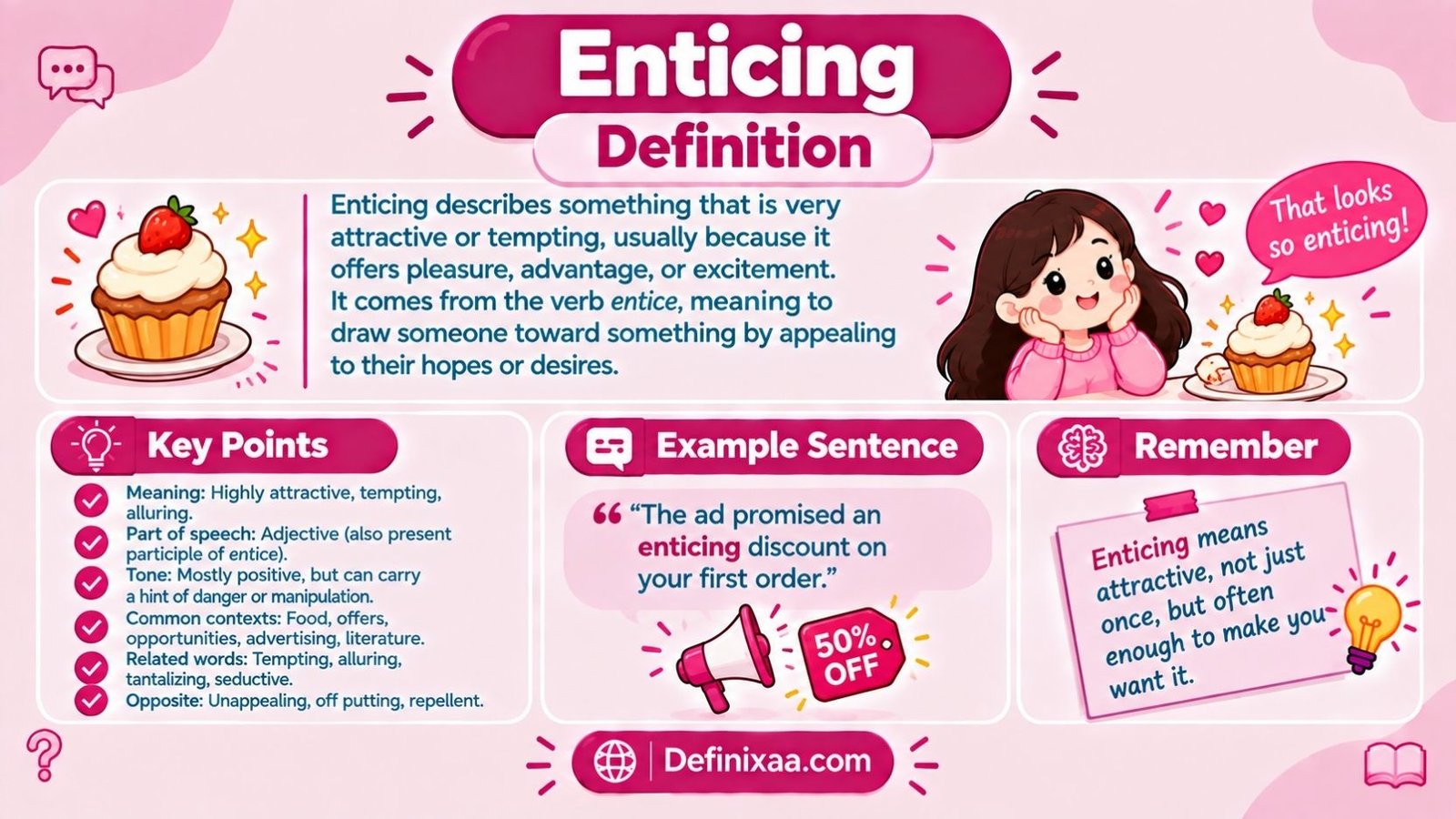
Quick definition: Enticing describes something that is very attractive or tempting, usually because it offers pleasure, advantage, or excitement. An enticing meal, offer, or idea is one that makes you want it, sometimes strongly enough to overcome hesitation.
It comes from the verb entice, meaning to draw someone toward something by appealing to their hopes or desires.
At A Glance
| Detail | Information |
| Meaning | Highly attractive, tempting, alluring |
| Part of speech | Adjective (also the present participle of the verb entice) |
| Tone | Mostly positive, but can carry a hint of danger or manipulation |
| Common contexts | Food, offers, opportunities, advertising, literature |
| Related words | Tempting, alluring, tantalizing, seductive |
| Opposite | Unappealing, off putting, repellent |
Read More: Recurring Definition
So, What Does Enticing Mean In Simple Terms?
Something enticing pulls your attention and interest almost automatically.
Merriam-Webster defines enticing as arousing strong attraction or interest, essentially the same idea as alluring. Think of a menu, a job offer, or an aroma that makes you want to move closer.
Oxford Languages describes enticing the same way: attractive or tempting, in the sense of alluring.
In plain English: if something is enticing, it makes you want it, sometimes before you’ve thought it through.
Where Does The Word Enticing Come From?
Enticing comes from the verb entice. It traces back to Middle English, where it was also spelled “intice,” borrowed from the Old French “enticier.” That French word probably comes from a root meaning “to set on fire,” related to the Latin “titio,” meaning firebrand.
That origin fits the modern meaning surprisingly well. Something enticing “lights a spark” of interest or desire.
How Do You Pronounce Enticing?
Merriam-Webster pronounces enticing as in-TĪ-sing (en-tic-ing), with the stress on the second syllable. The “ic” rhymes with “eye.”
If you say it out loud slowly: en, then TICE, then ing.
What Does the Dictionary Say About Enticing?
Formal meaning: Enticing is an adjective meaning highly attractive or tempting, often because it arouses hope, desire, or curiosity.
In simple words: It’s the feeling you get when something looks so good you almost can’t say no.
Reliable dictionaries agree closely on this. The related verb, entice, means to attract someone artfully or adroitly, or by arousing hope or desire, and is close in meaning to “tempt”. Cambridge Dictionary similarly explains that something enticing attracts you by offering advantages or pleasure, giving examples like an enticing smile or an enticing job offer.
How Is Enticing Actually Used In Real Life?
Enticing shows up constantly in everyday and professional English, not just in dictionaries.
It’s common in:
- Food and restaurant writing (“an enticing menu”)
- Advertising and marketing (“an enticing discount”)
- Travel writing (“an enticing destination”)
- Business and sports journalism (“an enticing matchup,” “an enticing investment”)
- Literature, where it can describe a person, idea, or temptation
News writers regularly use “enticing” to describe things that pull people toward action, such as safe investment climates enticing international investors, or coaching credentials enticing a front office to make a hire. That confirms it’s an active, current word in professional and journalistic English, not an old-fashioned one.
Note: Enticing is almost always written form. In casual speech, people often reach for simpler words like “tempting” instead, even though the meanings overlap closely.
What Does Enticing Look Like In A Sentence?
Here are original examples across different contexts.
Everyday conversation
“That bakery has such an enticing smell every morning.”
Professional writing
“The proposal included an enticing bonus structure for early adopters.”
Advertising
“The ad promised an enticing discount on your first order.”
Descriptive or literary writing
“The old bookstore had an enticing, dusty quiet that pulled her inside.”
Texting or casual online use
“That job posting looks enticing, might apply tonight.”
Read More: Ocher Definition
Enticing Can Mean Slightly Different Things Depending on Context
The core idea stays the same, but the shade of meaning shifts depending on where the word appears.
General everyday meaning
In most everyday use, enticing simply means attractive or tempting, with no negative judgment attached. An enticing vacation package is just a very appealing one.
Enticing In The Bible
In some older Bible translations, “enticing” carries a more cautionary tone.
The King James Version of 1 Corinthians 2:4 says Paul’s preaching was “not with enticing words of man’s wisdom, but in demonstration of the Spirit and of power.” Modern translations like the ESV and NLT render the same phrase as “plausible words of wisdom” or “clever and persuasive speeches” instead of “enticing.”
In this context, “enticing words” refers to clever, persuasive rhetoric used to win people over through style rather than substance. It’s a warning against being swayed by smooth talk instead of truth, not a description of something being pleasant.
Enticing In Law
In legal contexts, “entice” and “enticement” take on a much more serious and specific meaning.
Child enticement is a defined criminal offense in U.S. state and federal law. In general legal usage, it refers to conduct, or an attempt at conduct, that would amount to a criminal sexual offense against a child, such as luring a child toward a vehicle or secluded place for that purpose.
Individual states define it with their own statutory language. For example, Colorado law defines enticement of a child as inviting or persuading, or attempting to invite or persuade, a child under fifteen to enter a vehicle, building, room, or secluded place with intent to commit a sexual offense against that child, and it is a felony.
Massachusetts law separately defines “entice” in this context as meaning to lure, induce, persuade, tempt, incite, solicit, coax, or invite a child under a specified age for an unlawful purpose, also carrying serious criminal penalties.
Note: This legal definition is unrelated to the everyday, positive sense of “enticing.” In law, “enticement” describes a serious crime, not an attractive quality. If you or someone you know needs help related to child safety concerns, contacting local law enforcement or a child protection hotline is the appropriate step.
“Enticing Me” Meaning
When someone says “you’re enticing me,” they mean you are making them want something, usually playfully or persuasively. It implies gentle persuasion rather than pressure.
Enticing person Or enticing woman meaning
Describing a person as “enticing” usually refers to their charm, charisma, or attractiveness, in a way that draws others’ attention or interest. It’s a compliment about magnetism rather than a comment on character.
What Enticing Does Not Mean?
People sometimes assume enticing always implies dishonesty or trickery. That’s not quite accurate.
- Enticing does not automatically mean deceptive. An enticing offer can be completely genuine.
- Enticing is not the same as forceful. It describes attraction, not coercion.
- Enticing is not inherently negative, except in specific contexts like law or older religious writing, where it can suggest manipulation.
Before you use “enticing,” remember this: the word is neutral-to-positive in everyday English, but shifts toward a cautionary or serious meaning in legal and some religious contexts.
Is Enticing The Same As Tempting?
Not exactly. They’re close, but reliable usage guides draw a distinction.
| Term | Meaning | Typical Use | Key Difference |
| Enticing | Attracting someone by artful or appealing means | Menus, offers, opportunities, descriptions | Focuses on skillful, appealing presentation |
| Tempting | Presenting an attraction strong enough to challenge judgment or restraint | Desserts, indulgences, risky choices | Implies a pull against better judgment |
| Alluring | Highly attractive, often with charm or mystery | People, places, aesthetics | Leans more toward charm than persuasion |
Merriam-Webster’s usage notes explain that “entice” suggests drawing someone in by artful or adroit means, while “tempt” implies an attraction strong enough to test someone’s restraint or conscience.
What Are Other Words For Enticing?
Close synonyms: tempting, alluring, tantalizing, inviting, appealing, seductive, captivating, irresistible, magnetic
Related but distinct words: lure (implies danger), inveigle (implies flattery), decoy (implies entrapment), seduce (implies persuasion toward something unwise)
Wiktionary lists enticing as meaning “that entices, alluring, attractive, charming,” and also notes it functions as a noun form meaning enticement or temptation.
Is Enticing Positive, Negative Or Neutral?
In most everyday writing, enticing is positive. It’s used to make something sound appealing on purpose, such as in marketing or food writing.
It becomes more neutral to cautionary in:
- Legal contexts (enticement as a crime)
- Older religious texts (enticing words as manipulative rhetoric)
- Warnings about scams (“an enticing offer that turned out to be fake”)
Should You Use the Word Enticing?
Yes, in the right setting. It works well in:
- Marketing and advertising copy
- Food, travel, and lifestyle writing
- Formal or literary writing
It can feel slightly too formal for casual texting, where “tempting” often sounds more natural. There’s nothing outdated or inappropriate about the word itself; it’s simply a bit more polished than everyday slang.
Enticing Definition For Kids
Enticing means something makes you really want it, like a delicious smell coming from the kitchen or a fun-looking toy in a store window. It describes anything so appealing that you feel drawn toward it.
Read More: Arial Definition
How Do You Say Enticing In Spanish?
The Spanish adjective forms most often used for enticing are “tentador” (masculine) and “tentadora” (feminine), along with “atractivo/atractiva.”
Example: “Un descuento tentador” means “an enticing discount.”
Frequently Asked Questions
What does enticing mean?
Enticing means highly attractive or tempting, describing something that draws strong interest or desire.
Is enticing a compliment?
Usually yes. Calling something or someone enticing highlights appeal and charm, though tone and context still matter.
Is enticing slang?
No. It’s standard English, common in formal, journalistic, and everyday writing alike.
What is another word for enticing?
Tempting and alluring are the closest common alternatives, though each carries a slightly different shade of meaning.
Is enticing the same as seductive?
Not quite. Seductive usually implies romantic or sexual persuasion, while enticing is broader and can describe food, offers, or ideas.
What does “enticing words” mean in the Bible?
In some translations, it describes persuasive, polished rhetoric used to win people over through style rather than substance or truth.
What does child enticement mean legally?
It refers to a specific criminal offense involving luring or attempting to lure a minor for an unlawful purpose, defined and punished under state and federal law.
How do you use enticing in a sentence?
You can use it to describe anything highly appealing, such as “The job offer was too enticing to turn down.”
Is enticing formal or informal?
It leans slightly formal or literary, though it’s widely understood and used in professional writing.
Can enticing be negative?
It can carry a cautionary tone in legal or older religious contexts, but in everyday English it’s typically positive.
The Simple Takeaway
Enticing means strongly attractive or tempting, whether describing a meal, an offer, or a person’s charm. In everyday English, it’s a positive, polished word. In legal contexts, “enticement” refers to something far more serious: a defined criminal offense. Knowing the context tells you exactly which meaning applies.

Laiba Rahman is a writer and researcher behind Definixaa, dedicated to exploring words, meanings, terms, concepts, and everyday knowledge. Through clear and well-researched explanations, her goal is to help readers understand unfamiliar ideas quickly and discover useful information with ease.
One Comment