
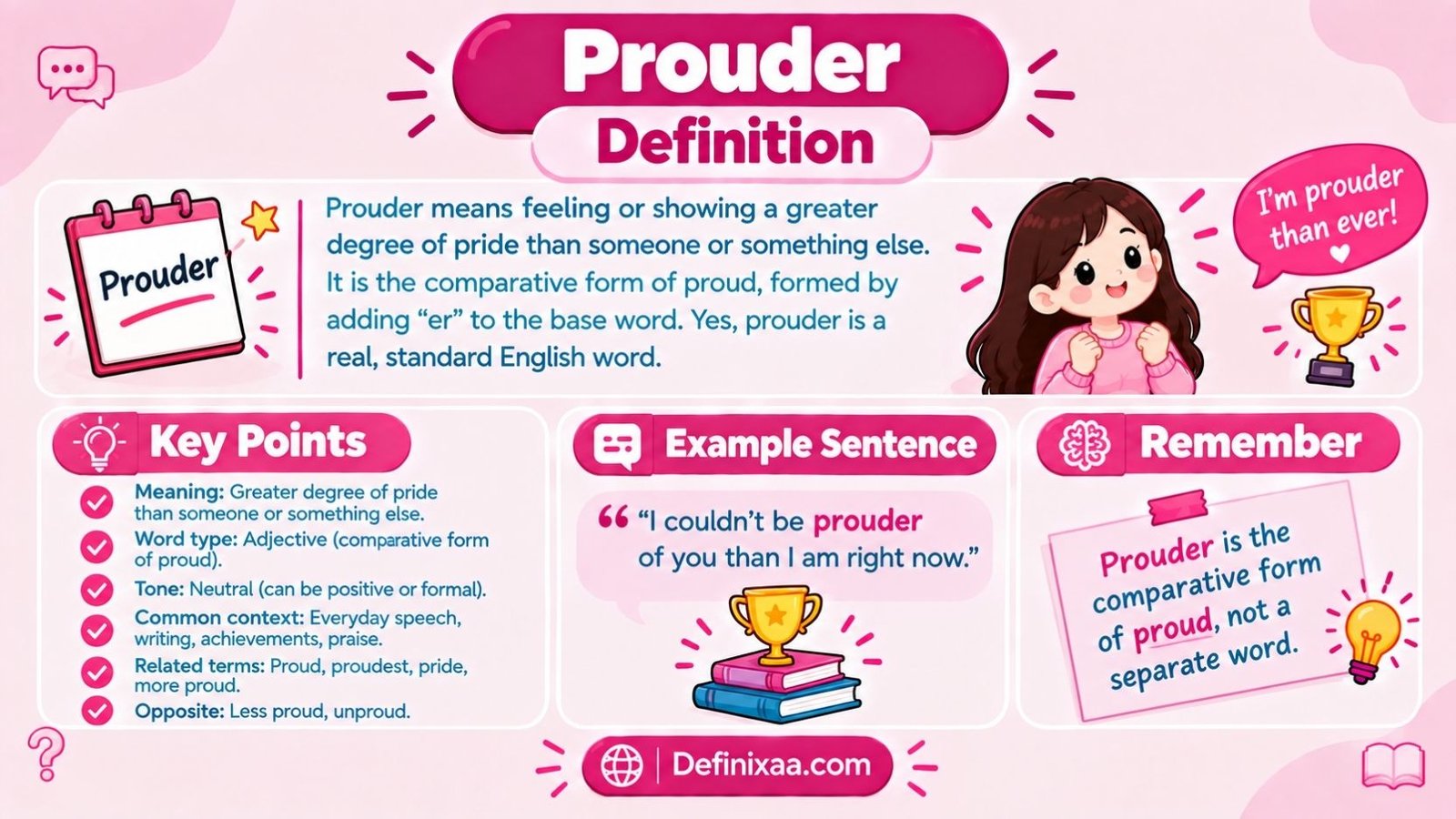
Prouder means feeling or showing a greater degree of pride than someone or something else. It is the comparative form of the adjective proud, formed by adding “er” to the base word, the same way bigger comes from big or faster comes from fast.
Yes, prouder is a real, standard English word. It appears in Oxford, Merriam Webster, Cambridge, and Collins dictionaries as the accepted comparative form of proud.
Quick Definition
Prouder describes a stronger or increased sense of pride compared to another person, thing, or an earlier point in time. Example: “I could not be prouder of my daughter today than I was yesterday.”
At A Glance
| Detail | Information |
| Meaning | Comparative form of proud, meaning more proud |
| Type | Adjective, comparative degree |
| Tone | Neutral, can be warm or formal depending on context |
| Common context | Everyday speech, writing, congratulations, achievements |
| Related terms | Proud, proudest, pride, more proud |
Read More: Symptomology Definition
What Does Prouder Actually Mean?
Prouder is used whenever someone wants to compare levels of pride. It shows that one feeling of pride is greater than another feeling of pride, whether that comparison is between two people, two moments in time, or two situations.
For example, a parent might say they feel prouder of their child’s effort than of the final result. A coach might say the team could not have made him prouder. In both cases, prouder signals a rise in the same emotion that proud describes.
Dictionaries consistently list prouder alongside proudest as the standard comparative and superlative forms of proud. Oxford Advanced Learner’s Dictionary lists the adjective proud with comparative prouder and superlative proudest as its official grammatical pattern.
Prouder In Simple Words
Think of prouder as a way to say “more proud” using a single word instead of two. If proud means you feel good about something you or someone else did, prouder means that feeling is stronger than it was before, or stronger than someone else’s pride in the same situation.
It is not a slang term, not an internet abbreviation, and not a regional variation. It follows a normal English grammar rule that many short adjectives follow.
Is Prouder A Word?
Yes. This question comes up often because some English learners assume that longer or more formal adjectives cannot take an “er” ending, and instead need “more” placed in front of them, as in more beautiful or more intelligent.
Proud, however, is a short adjective with one syllable, so it follows the same pattern as words like tall, becoming taller, or fast, becoming faster. According to standard English comparative rules, one syllable adjectives typically add “er” for the comparative form rather than pairing with “more.”
Prouder has been recorded in English dictionaries for well over a century, including in historical dictionary entries that already listed proud with the comparative prouder and superlative proudest.
Prouder Or More Proud: What Is The Difference?
Both prouder and more proud are grammatically accepted in modern English, but they are not always used the same way by careful writers and speakers.
| Term | Meaning | Typical Use | Key Difference |
| Prouder | Comparative form of proud, meaning a higher degree of pride | Everyday speech, casual and formal writing, direct comparisons | Preferred by most style guides as the standard comparative form |
| More proud | An alternative comparative phrasing using more plus proud | Sometimes used for emphasis or rhythm in a sentence | Less traditional, occasionally seen as less standard by grammar guides, though still understood and used |
Some dictionary entries, including Wiktionary, list proud as having both comparative prouder and comparative more proud, which shows that both forms exist in real usage, even though prouder is the more traditional and more commonly recommended choice.
Note: If you are unsure which one to use, prouder is the safer choice in both formal and everyday English, since it follows the standard rule for short adjectives.
How Do You Pronounce Prouder?
Prouder is pronounced PROW der, with the stress on the first syllable. It rhymes with louder and chowder. The base word proud is pronounced the same way as the first syllable, following the same vowel sound found in words like cloud and loud.
Where Does Prouder Come From?
The word proud traces back to Old English prūd and prūt, which carried meanings related to being stately, arrogant, or gallant. Historical dictionary research also links these forms to Old Norse prúðr, meaning brave or magnificent, showing that the root idea of proud has long combined dignity with a strong sense of self.
Prouder simply reflects the natural comparative form that developed alongside the base word, following the standard grammatical pattern for short English adjectives.
Read More: Enticing Definition
How Is Prouder Actually Used in Real Life?
Prouder shows up constantly in everyday conversation, family life, sports, education, and workplace communication. People use it whenever they want to express that their pride has grown or that it is greater than someone else’s.
It appears naturally in:
- Parenting and family conversations, such as praising a child’s growth
- Graduation speeches and achievement announcements
- Sports commentary about teams or athletes
- Workplace recognition, such as praising an employee’s progress
- Personal reflection, comparing how someone feels now versus before
It is common in both spoken and written English, and it does not carry any negative or unusual connotation. It sounds natural in casual conversation and equally natural in a formal speech or a written letter.
What Does Prouder Look Like In A Sentence?
Here are original examples showing prouder in different everyday situations.
- Casual conversation: “I don’t think I could be prouder of you right now.”
- Family setting: “Her parents grew prouder with every report card she brought home.”
- Workplace setting: “The manager said he felt prouder of the team this quarter than any quarter before.”
- Academic context: “No professor could have been prouder of a graduating class than she was that morning.”
- Text message: “So prouder of you today, seriously, you did amazing.”
- Sports commentary: “The coach admitted he had never felt prouder of a comeback win.”
These examples show that prouder works the same way across formal and informal settings, since it simply expresses a comparison in the strength of pride.
Proud Of Someone: What Does It Mean?
Being proud of someone means feeling pleased and satisfied because of something that person achieved, showed, or represents. It reflects admiration connected to another person’s actions, growth, character, or accomplishments.
When someone becomes prouder of another person, it means that admiration or satisfaction has increased, often because of continued effort, improvement, or a new achievement.
What Are Synonyms For Prouder?
Several words and phrases can express a similar comparative meaning, depending on tone and context.
- More proud
- More gratified
- More pleased
- More satisfied
- More honored
- Feeling greater pride
These are near synonyms rather than exact matches, since prouder specifically compares levels of the same emotion, while some alternatives shift the tone slightly toward satisfaction or honor rather than pride itself.
What Doesn’t Prouder Mean?
Prouder does not mean arrogant or boastful on its own, even though the base word proud can sometimes carry a negative sense of excessive self importance in certain contexts. In most everyday use, especially in phrases like prouder of you or prouder than ever, the word carries a warm, positive tone rather than a negative one.
Prouder also does not function as a noun or a verb. It only works as a comparative adjective, describing a quality, not an action or a thing.
Before You Use Prouder: Remember This
Prouder compares two levels of the same feeling. It does not replace the word proud entirely, since proud is still correct when no comparison is being made. Use prouder only when you are comparing one level of pride to another.
When Should You Use Prouder Versus More Proud?
Use prouder in almost every situation where you want to describe an increase or comparison in pride, since it is the standard, widely accepted comparative form recognized by major dictionaries.
Use more proud only in specific situations, such as when it improves the rhythm of a sentence or when it is being paired with another “more” phrase for stylistic balance, for example, “more proud and more relieved than she had ever been.”
For clear, natural, and widely accepted English, prouder remains the safer and more traditional choice in both speech and writing.
Read More: Symptomatology Definition
Is Prouder Appropriate To Use?
Yes, prouder is appropriate in nearly every setting, including casual conversation, professional writing, academic writing, public speeches, and creative writing. It is not slang, not outdated, and not considered incorrect by any major dictionary or style guide.
There is no tone of disrespect or informality attached to the word itself. It remains one of the more emotionally warm comparative adjectives in English, often associated with encouragement, celebration, and recognition.
Last Words
Prouder is the correct comparative form of proud, used to show that one level of pride is greater than another. It is grammatically standard, dictionary confirmed, and appropriate in both casual and formal English. When comparing feelings of pride, prouder is almost always the better choice over more proud.
Frequently Asked Questions
What does prouder mean?
Prouder means feeling or showing a greater degree of pride compared to another person, situation, or an earlier moment in time.
Is prouder a real word?
Yes, prouder is a real, standard English word listed in major dictionaries as the comparative form of proud.
Is it correct to say more prouder?
No, saying more prouder is incorrect, since it doubles the comparative form. Use either prouder or more proud, but never both together.
Can you say prouder in formal writing?
Yes, prouder is grammatically correct and widely accepted in formal writing, speeches, and professional communication.
What is the difference between prouder and more proud?
Prouder is the traditional, single word comparative form of proud, while more proud is an alternative phrasing that is less commonly recommended but still understood.
What is the superlative form of proud?
The superlative form of proud is proudest, used when comparing three or more things or describing the highest possible level of pride.
Does prouder have a negative meaning?
No, prouder is usually positive or neutral in tone, especially in common phrases like prouder of you or prouder than ever.
How do you pronounce prouder?
Prouder is pronounced PROW der, rhyming with louder and chowder.
What is a synonym for prouder?
Common near synonyms include more proud, more gratified, and more pleased, though none carry the exact same meaning as prouder.
Is prouder used in everyday English?
Yes, prouder is commonly used in everyday conversation, family life, workplace praise, and public speaking.

Laiba Rahman is a writer and researcher behind Definixaa, dedicated to exploring words, meanings, terms, concepts, and everyday knowledge. Through clear and well-researched explanations, her goal is to help readers understand unfamiliar ideas quickly and discover useful information with ease.
One Comment