
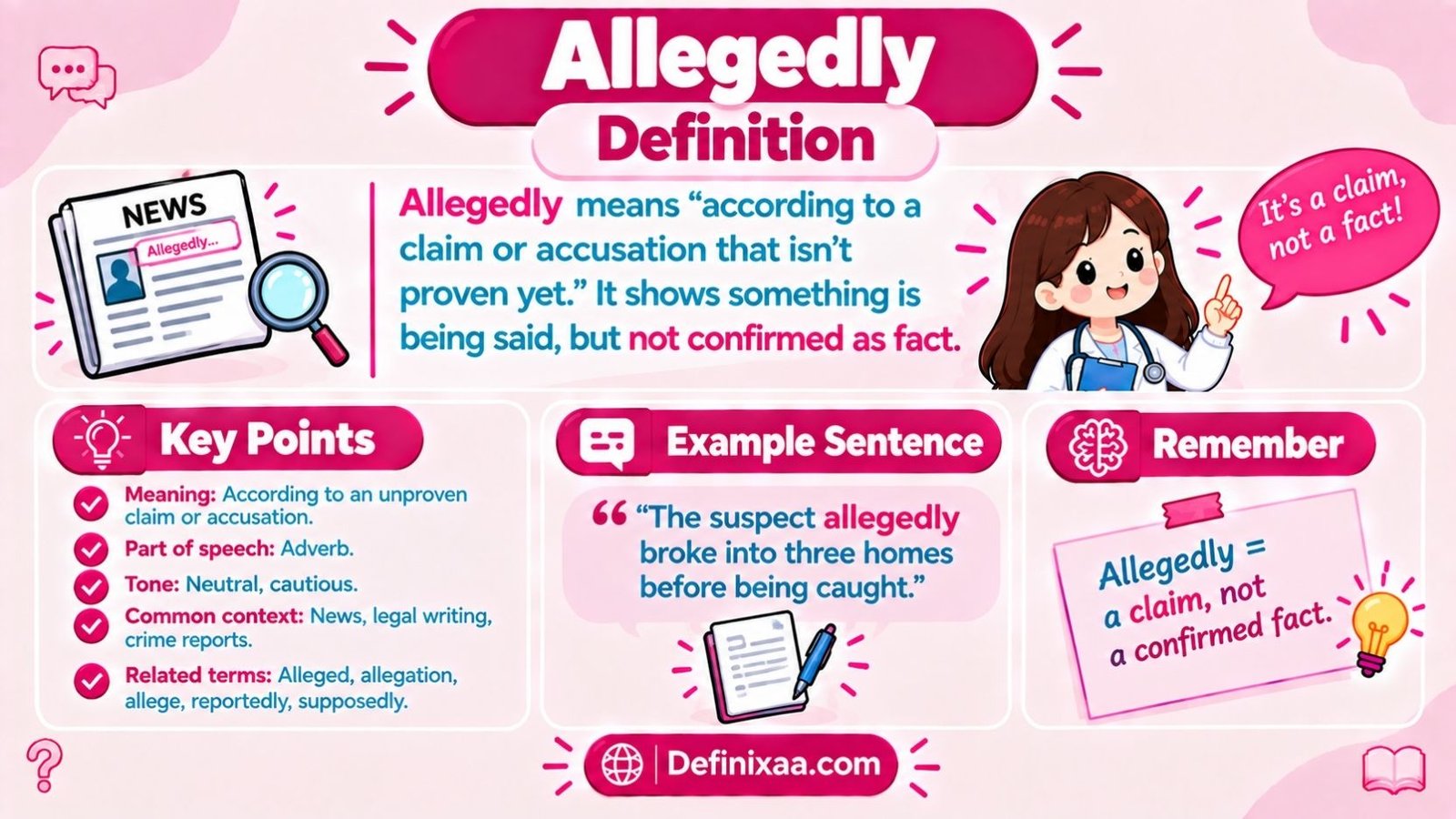
Allegedly means “according to an accusation or claim that has not yet been proven.” It signals that something is being said or reported, but no court, investigation, or reliable evidence has confirmed it as fact.
At A Glance
| Quick Detail | Information |
| Meaning | According to an unproven claim |
| Part of speech | Adverb |
| Type | Everyday word with a strong legal and journalistic use |
| Tone | Neutral, cautious, non-committal |
| Common context | News reports, legal writing, criminal accusations |
| Related terms | Alleged, allegation, allege, reportedly, supposedly |
So, What Does Allegedly Actually Mean?
According to Merriam-Webster’s Legal Dictionary, allegedly simply means by or according to an allegation. In plain terms, it tells the reader: someone has made this claim, but it has not been proven or established as fact.
The word comes from alleged, the adjective describing something accused but not proven or convicted. Allegedly is the adverb version, used to modify an action or event rather than a person.
Read More: Suspicion Definition
In Simple Words
Think of allegedly as a verbal disclaimer. It lets a writer or speaker describe an accusation without saying it’s true.
If someone says, “He allegedly took the money,” they mean: this is what people are claiming, but nobody has proven it in court yet. The word protects the writer from stating guilt as settled fact.
Why Allegedly Matters So Much In Law And News
Allegedly is not just a filler word. According to Dictionary.com, the term is most commonly used in a legal context, especially in journalism in reports about a person who has been accused of a crime or other wrongdoing but who has not been convicted. Journalists lean on this word constantly, and for a very specific reason.
Using allegedly lets reporters talk about allegations without seeming to presume guilt, which also helps them avoid legal risk. A newspaper that flatly states “Jones stole from his company” without proof could face a defamation lawsuit if that claim turns out to be false. Adding allegedly keeps the statement accurate: it reports that a claim exists, not that guilt is established.
Note: In the American legal system, a person is presumed innocent until proven guilty. Allegedly is one of the main tools writers use to respect that principle in print.
How Is Allegedly Actually Used In Real Life?
Allegedly shows up constantly in crime reporting, court coverage, and legal documents, almost always attached to an accusation that hasn’t been resolved.
According to Vocabulary.com, the word is used almost entirely in a legal sense, referring to a potentially criminal action that is being or will shortly be decided in court. It’s the word you’ll see in a headline about an arrest, a lawsuit, or an ongoing investigation, before any verdict exists.
Outside of formal law, people also use allegedly loosely and even sarcastically in casual conversation, often to describe smaller, less serious claims. But when the topic turns lighthearted, English speakers usually switch to a softer word instead.
Tip: Vocabulary.com notes that for smaller, non-criminal disputes, such as whether a friend told a lie, supposedly is generally used rather than allegedly, since allegedly carries a heavier, more legal weight.
Read More: Flaneur Definition
What Does Allegedly Look Like In A Sentence?
Here are original examples showing allegedly in different everyday contexts.
- News reporting:
“The suspect allegedly broke into three homes before being caught on camera.” - Legal writing:
“The defendant allegedly signed the contract under a false name.” - Workplace context:
“An employee allegedly took confidential files before resigning.” - Casual conversation:
“He allegedly ate the entire cake and blamed the dog.” - Text message:
“lol she allegedly ‘forgot’ she owed me $20”
Each example shares the same pattern: a claim is stated, but nothing is confirmed as fact.
Allegedly Definition In Law
In legal writing, allegedly carries precise meaning. It describes an act that one party claims happened, as part of a formal allegation, but which a court has not yet verified through evidence or a ruling.
Legal dictionaries define the related noun allegation as a formal accusation that a fact is true, made without offering proof at the time it’s stated. FindLaw’s legal dictionary entry, sourced from Merriam-Webster’s Dictionary of Law, confirms this same core legal meaning of allegedly.
Quick Takeaway For Legal Use
- Allegedly signals an unproven accusation, not a confirmed fact
- It protects writers and speakers from asserting guilt prematurely
- It’s common in police reports, indictments, and court filings
- It disappears once a verdict or confirmed fact replaces the accusation
How Do You Pronounce Allegedly?
Allegedly is pronounced uh-LEJ-id-lee.
The IPA pronunciation, as listed by Merriam-Webster, is ə-ˈle-jəd-lē. The stress falls on the second syllable, “LEJ.”
Word Origin
Allegedly comes from the adjective alleged, which itself derives from the verb allege. Merriam-Webster traces allege back to Old French alegier and alleguer, which passed into Medieval Latin as allegare, meaning to bring forward as evidence or justification.
Over time, the meaning shifted from simply “presenting a claim” toward the modern sense: asserting something as fact before, or without, offering actual proof.
Is Allegedly Formal, Informal Or Legal Language?
Allegedly sits comfortably in formal, legal, and journalistic writing, but it also appears in everyday informal speech.
- Formal and legal use: Court documents, police statements, legal contracts
- Journalistic use: News articles, headlines, crime reporting
- Informal use: Everyday conversation, texting, casual storytelling, often with a joking or sarcastic tone
It is never considered slang, offensive, or outdated. It’s simply a precise, neutral qualifier.
Is Allegedly Positive, Negative Or Neutral?
Allegedly itself is neutral. It doesn’t assign blame or express an opinion. Its entire purpose is to withhold judgment while still describing a claim.
That said, because allegedly is so often attached to crimes or wrongdoing, it can feel serious or tense depending on the sentence around it. In casual use, it can also sound playful or sarcastic, especially when applied to a harmless exaggeration.
What Words Mean Something Similar To Allegedly?
According to Merriam-Webster’s thesaurus, close synonyms include:
- Reportedly
- Supposedly
- Purportedly
- According to what has been said
These words share the same core function: reporting a claim without confirming it as true.
Is Allegedly The Same As Reportedly Or Supposedly?
Not exactly. While the three words overlap, there are subtle differences worth knowing.
| Term | Meaning | Typical Use | Key Difference |
| Allegedly | According to an unproven accusation | Legal and criminal claims | Strongest legal weight, tied to formal accusation |
| Reportedly | According to a report or source | News summaries, general claims | Focuses on the source of information, not guilt |
| Supposedly | According to what people assume or say | Casual, everyday claims | Lightest tone, often used for minor or trivial matters |
Vocabulary.com draws this exact distinction, noting that for smaller matters people tend to reach for supposedly, while allegedly is reserved for claims tied to potential crimes headed toward a legal decision.
What Is The Opposite Of Allegedly?
There isn’t a single perfect opposite, since allegedly describes uncertainty rather than a fact on its own. But in context, the natural contrasts include:
- Confirmed
- Proven
- Undeniably
- Definitely
- Certainly
If a claim moves from “allegedly true” to fully proven, writers typically drop the qualifier entirely and simply state the fact.
Before You Use Allegedly: Remember This
Allegedly does not mean something is false. It means the claim is unconfirmed, not disproven.
It’s a common misunderstanding to treat “allegedly” as a hint of guilt, or as sarcasm implying the writer doesn’t believe the claim. In legal and journalistic writing, it’s simply neutral, careful language, not a signal of suspicion either way.
What Does Allegedly Not Mean?
Allegedly does not mean:
- The claim is definitely true
- The claim is definitely false
- The person is guilty
- The person is innocent
It only signals that a claim exists and remains unproven. Nothing more, nothing less.
Read More: Laid Off Definition
Allegedly In Spanish And French
Allegedly translates most commonly as presuntamente or supuestamente in Spanish, according to Cambridge Dictionary and Collins Dictionary. Both carry the same “unproven claim” meaning as the English word.
In French, according to Collins Dictionary and Cambridge Dictionary, allegedly is most often translated as prétendument.
Frequently Asked Questions
What does allegedly mean in simple terms?
It means something is claimed or accused, but not yet proven true. The word signals caution about an unconfirmed statement.
Is allegedly the same as accused?
Not quite. Accused describes the person facing a claim. Allegedly describes the unproven action itself, often used alongside an accusation.
How do you pronounce allegedly?
It’s pronounced uh-LEJ-id-lee, with stress on the second syllable, matching the IPA spelling ə-ˈle-jəd-lē from Merriam-Webster.
What is a simple definition of allegedly for kids?
Allegedly means people are saying something happened, but nobody has proven it’s true yet, so we can’t be completely sure.
What is the legal definition of allegedly?
In law, allegedly describes an act claimed in a formal accusation, which has not yet been confirmed by evidence or a court ruling.
What is a synonym for allegedly?
Common synonyms include reportedly, supposedly, and purportedly, all describing an unverified claim.
What is the opposite of allegedly?
There’s no exact single opposite, but words like confirmed, proven, or definitely capture the contrast in meaning.
Can allegedly be used in a sentence about everyday life?
Yes. For example: “She allegedly forgot to return my book,” used casually rather than legally.
Why do journalists use the word allegedly so often?
Because it allows them to report accusations accurately without stating guilt as fact, which also helps protect news outlets from defamation claims.
Is allegedly a formal or informal word?
It works in both. It’s standard in legal and news writing, but also common in relaxed, everyday speech.
Last Words
Allegedly means a claim exists, but proof does not, yet. It’s the word journalists and legal writers reach for to describe accusations fairly, without declaring guilt or innocence. Once understood, it becomes one of the clearest tools in English for reporting responsibly.

Laiba Rahman is a writer and researcher behind Definixaa, dedicated to exploring words, meanings, terms, concepts, and everyday knowledge. Through clear and well-researched explanations, her goal is to help readers understand unfamiliar ideas quickly and discover useful information with ease.
One Comment