
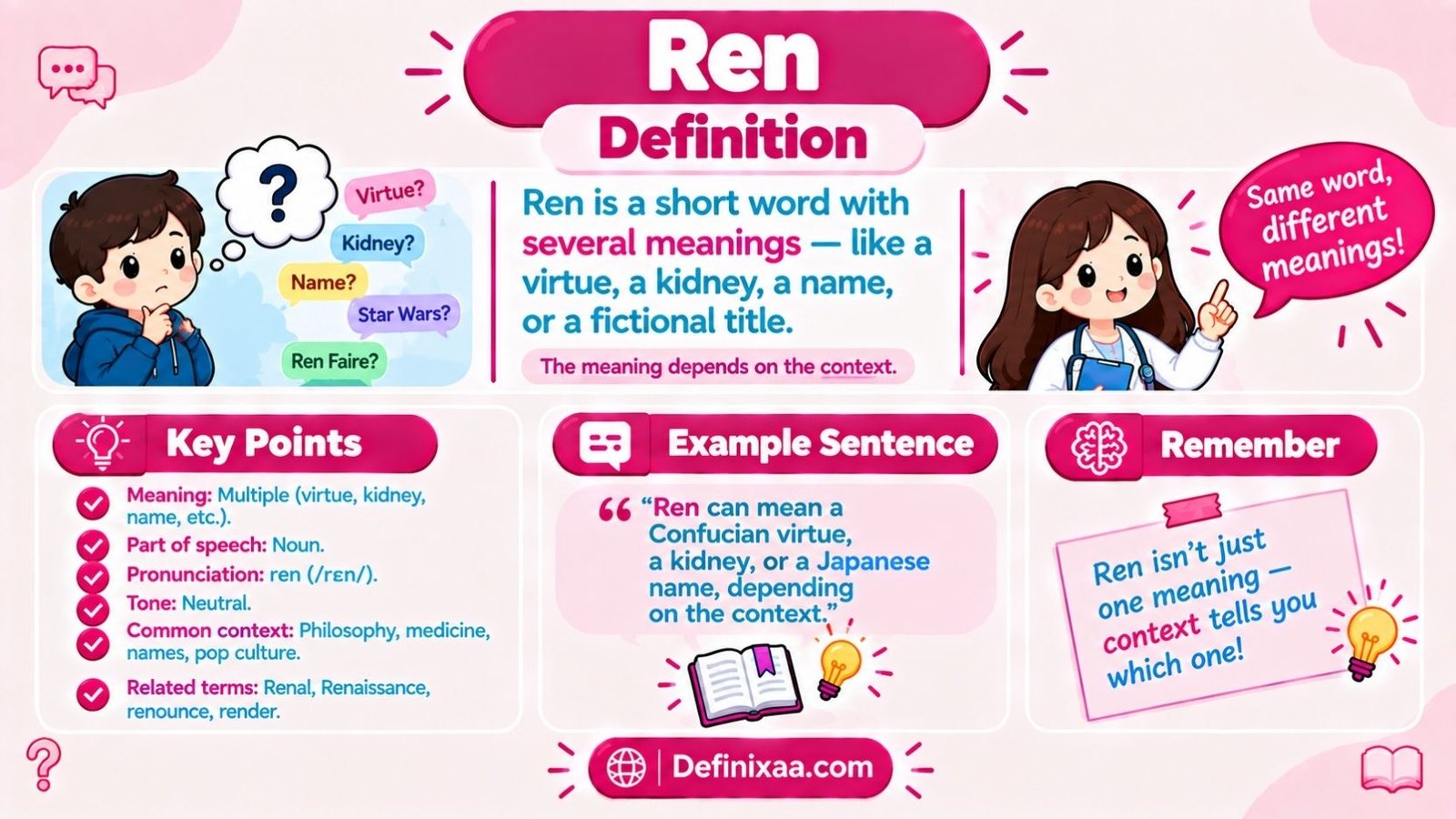
Ren is a short word with several unrelated meanings across different languages and fields. In Confucian philosophy, ren refers to benevolence or humaneness, the central virtue a person should cultivate.
In Latin and medical anatomy, ren means kidney. In Japanese, Ren is a popular given name meaning lotus or love, depending on the character used. There is also a niche, older English word ren, and Ren appears as a fictional name in Star Wars and as shorthand for a Renaissance Faire.
Because Ren means different things in different contexts, the rest of this guide breaks each meaning down clearly, so you can find the definition you actually need.
At A Glance
| Detail | Information |
| Word type | Noun (multiple unrelated meanings); also a proper name |
| Main meanings | Confucian virtue (benevolence), Latin/medical term for kidney, Japanese given name, older English word, fictional Star Wars name |
| Pronunciation | /rɛn/, rhymes with “hen” |
| Tone | Neutral; meaning depends entirely on context |
| Common contexts | Philosophy, anatomy and medicine, Japanese names, Scrabble, pop culture |
| Related terms | Renal, Renaissance, renounce, renege, render |
So, What Does Ren Actually Mean?
There is no single definition of Ren. It is best understood as five or six separate words and names that happen to share the same three letters.
The two meanings people search for most often are the Confucian philosophical concept and the Japanese given name. Beyond those, Ren also functions as a Latin-derived medical term, a rare English dictionary word, and a name used in fiction and at Renaissance festivals.
Read More: Allegedly Definition
Ren Can Mean More Than One Thing
Because so many keyword variations point to different entities, it helps to see the full picture in one place before going deeper into any single meaning.
- Ren in Confucianism: the foundational virtue of humaneness or benevolence.
- Ren in anatomy and medicine: the Latin word for kidney, still used in medical roots like “renal.”
- Ren as a Japanese name: a unisex given name usually meaning “lotus” (蓮) or “love” (恋).
- Ren in English dictionaries: a rare, mostly archaic or dialectal word, and an abbreviation for “registered enrolled nurse” in some British usage.
- Ren in Scrabble: a valid three-letter word in Collins Scrabble Words (used internationally), though not in the standard American Merriam-Webster Scrabble dictionary.
- Kylo Ren / Knights of Ren: a fictional title in the Star Wars franchise.
- Ren Faire: shorthand for a Renaissance Faire or Renaissance Festival.
Each of these is explained in detail below.
How Do You Pronounce Ren?
Ren is pronounced /rɛn/, one syllable, rhyming with “hen,” “pen,” or “ten.”
Note: As a Japanese name, Ren keeps roughly the same pronunciation in English, though the original Japanese vowel is slightly shorter and crisper than the English “eh” sound.
Ren in Confucianism: The Core Virtue Explained
Quick Definition
In Confucian philosophy, ren (仁) is the foundational virtue of humaneness, benevolence, or goodness. It describes the quality of a person who treats others with genuine care and moral integrity.
Formal Meaning
According to Britannica, ren was originally used to describe the kindness a ruler showed toward subjects, and Confucius later elevated the concept into the most basic of all virtues, often translated as humaneness or benevolence. Confucius treated ren as the highest form of moral character, while the later philosopher Mencius treated it as the trait that defines humanity itself.
In Simple Words
Ren is basically the Confucian idea of being a genuinely good person toward others. It is not just politeness. It is real concern for people’s wellbeing, shown through your actions, not just your words.
Where the Character Comes From
The Chinese character for ren combines the symbol for “person” (人) with the symbol for “two” (二). Many popular explanations suggest this represents how two people should treat each other, though scholars note that these character-based explanations are often folk etymologies rather than confirmed history.
How Ren Connects to Other Confucian Ideas
Ren does not exist in isolation. It works alongside other core Confucian concepts:
- Li — proper ritual and social conduct, through which ren is expressed
- Zhong — loyalty to one’s true nature
- Shu — reciprocity, or treating others as you would want to be treated
- Xiao — filial piety, respect for parents and family
Confucius reportedly described a ren person as someone who could remain composed through both hardship and success, and who could clearly tell right from wrong without bias.
Why Ren Still Matters Today
Ren remains the central term used in Western academic discussions of Confucian ethics. Students of philosophy, comparative religion, and Asian studies frequently encounter it when studying the Analects or Confucian political theory, where a ruler’s legitimacy was tied to demonstrating ren toward the people.
Why You Might See It Spelled “Jen”
Older English-language books on Chinese philosophy sometimes spell this word “jen” instead of “ren.” This is not a different word. It reflects the older Wade-Giles romanization system, which was gradually replaced by the pinyin system now used in most modern scholarship. If you come across “jen” in an older philosophy textbook, it refers to the exact same Confucian concept discussed here.
Multiple Translations: One Core Idea
Because ren carries so much philosophical weight, translators have never fully agreed on a single English equivalent. You will see it rendered as “benevolence,” “humaneness,” “goodness,” “human-heartedness,” or simply “virtue,” depending on the translator and the century the translation was written in.
None of these English words captures the term perfectly on its own, which is part of why scholars often simply keep the original word “ren” untranslated in academic writing.
How Later Thinkers Expanded Ren
Confucius treated ren as the highest personal virtue, but later Confucian thinkers built on the idea in different directions. Mencius argued that ren was part of innate human nature, something every person is born with the capacity for rather than something imposed from outside. Centuries later, Neo-Confucian philosophers described ren as a moral quality imparted by Heaven itself, tying the personal virtue to a larger cosmic order.
This layered history is part of why ren is often introduced to students first as “benevolence,” then gradually explained as something closer to the full expression of what it means to be genuinely, ethically human.
Ren As A Medical And Anatomical Term
Quick Definition
In Latin, ren (plural: renes) means kidney. This root survives in modern English medical vocabulary, most visibly in the word “renal.”
Formal Meaning
The Oxford Latin Dictionary lists ren as a third-declension noun meaning kidney, usually used in the plural. Wiktionary confirms that English also once borrowed ren directly as a learned anatomical term, defining it simply as a kidney, with documented use in eighteenth and nineteenth century medical writing.
In Simple Words
You will rarely hear a doctor say “your ren” today. Instead, the Latin root shows up inside other medical words. If a term starts with “reno-” or ends in “-renal,” it is almost certainly related to the kidneys.
Where the Term Shows Up
| Medical Term | Meaning |
| Renal | Relating to the kidneys |
| Renopathy | Any disease of the kidneys |
| Renovascular | Relating to the blood vessels of the kidneys |
| Renoprival | A condition caused by loss of kidney function |
Note: English has two separate word roots for the kidney: “ren-” from Latin and “nephr-” from Greek. Both appear throughout anatomy and medicine, so “nephrology” and “renal medicine” describe the same general area of the body.
A Note on Etymology
This Latin root also produced the everyday words “kidney” descendants in other Romance languages: rein in French, rene in Italian, and riñón in Spanish, all tracing back to the same Latin ren.
Should You Use “Ren” Instead of “Kidney”?
No, not in everyday writing. Modern English speakers, including most doctors, say “kidney,” not “ren.” The word survives almost entirely as a hidden building block inside longer medical terms rather than as a word you would use on its own in a sentence or in patient-facing medical writing.
If you are writing clinical or scientific material, “renal” is the standard, professional adjective to reach for. Writing the bare word “ren” on its own would read as unusual or outdated to a medical audience, even though it is technically correct in origin.
How Ren Is Actually Used in Real Life
In practice, almost nobody encounters the standalone word “ren” in this sense outside of etymology discussions, Latin coursework, or historical medical texts from the 1700s and 1800s.
Its real, everyday presence is invisible: it lives inside words like “renal function,” “renal failure,” and “renogram,” which appear constantly in hospitals, lab reports, and medical journals without most readers ever connecting them back to the Latin root.
Ren As A Japanese Name
Quick Definition
Ren (レン) is a popular unisex Japanese given name. Depending on the kanji character used, it most commonly means “lotus” (蓮) or “love” (恋).
In Simple Words
Japanese names are often written with characters chosen for their meaning and sound together, so the same spoken name “Ren” can carry different written meanings depending on the family’s choice of kanji.
The Lotus Meaning
Written as 蓮, Ren refers to the lotus flower. In Japanese and Buddhist symbolism, the lotus grows up through muddy water to bloom clean and beautiful above the surface, which is why the name is often chosen to represent resilience and purity. This version of the name has consistently ranked among the more popular boys’ names in Japan.
The Love Meaning
Written as 恋, Ren instead means “love” or “longing,” giving the name a softer, more romantic connotation. Some families also use characters meaning “clever,” “honest,” or “to practice,” since Japanese given names can be built from many different kanji that share the same pronunciation.
Read More: Laid Off Definition
Real-World Usage
Ren is used for both boys and girls in Japan, and it has also become a common gender-neutral name choice in English-speaking countries, partly because it is short, easy to pronounce, and carries a pleasant meaning in its Japanese form.
As a first name, Ren has ranked within the top twenty boys’ names on Japan’s Meiji Yasuda baby name survey in various years, and it also appears as a compound element inside longer names, such as Renji, which combines Ren with additional characters to add meanings like “govern” or “samurai.”
Ren In Western Pop Culture
Outside Japan, English speakers may recognize “Ren” first from unrelated pop culture sources rather than from its Japanese meaning. The 1984 film Footloose features a lead character named Ren McCormack, played by Kevin Bacon, and the 1990s animated series Ren and Stimpy features a character named Ren Höek. Neither of these usages has any connection to the Japanese or Confucian meanings; they are simply English-language character names that happen to use the same short, punchy sound.
This is a good example of how a name can carry entirely different cultural weight depending on where and how it is encountered, from a quiet philosophical concept in one context to a cartoon character’s name in another.
Is Ren A Word In English?
Quick Answer
Yes, but only barely. Ren appears in some English dictionaries as an old or specialized word, not as a term in everyday modern use.
Ren Definition: Oxford
The Oxford Advanced Learner’s Dictionary lists REN as an entry meaning registered enrolled nurse, a British nursing qualification. This usage is mostly limited to UK healthcare and nursing contexts, and most general readers outside that field would not recognize it.
Ren Definition: Anatomy
As covered above, Wiktionary also lists ren as a learned English borrowing from Latin, defined simply as a kidney, though this sense is now considered archaic or purely technical.
Ren Definition: Scrabble
For word game purposes, Ren is a valid three-letter word in Collins Scrabble Words, the dictionary used in international and UK Scrabble play. It is not currently valid in the Merriam-Webster-based dictionary used for official Scrabble play in the United States and Canada. Because letter values are R = 1, E = 1, N = 1, Ren scores 3 points before any board bonuses.
Tip: If you are playing Scrabble in the US and want to be safe, treat Ren as a name rather than a playable common word, and check your specific word list before relying on it.
Ren In Star Wars: Kylo Ren And The Knights of Ren
Quick Definition
In the Star Wars franchise, Ren is both a fictional title used by the villainous Knights of Ren and part of the name Kylo Ren, the character played by Adam Driver.
In Simple Words
Kylo Ren’s birth name is Ben Solo, son of Han Solo and Leia Organa. When he turns to the dark side, he takes the name Kylo Ren after joining the Knights of Ren, a group of dark warriors. Within the story, “Ren” functions less like a surname and more like a title tied to the group’s identity and their crossguard lightsabers.
Real-World Usage
Fans frequently search for what “Ren” means within the Star Wars universe itself, separate from any real-world definition. This is a purely fictional, invented use of the word created for the franchise, unrelated to the Confucian, Latin, or Japanese meanings above.
What Is A Ren Faire?
Quick Definition
“Ren Faire” is a common shortened form of Renaissance Faire (also spelled Renaissance Fair or Renaissance Festival), an outdoor event that recreates a historical period, usually the English Renaissance.
In Simple Words
At a Ren Faire, performers and vendors dress in period costumes and recreate a village atmosphere from roughly the 16th century, often set during the reign of Elizabeth I. Visitors can watch jousting, music, and theatrical performances, browse craft vendors, and sometimes dress up themselves.
Real-World Usage
“Ren Faire,” “Ren Fest,” and “Renaissance Faire” are used interchangeably in casual conversation in the United States, where these events are especially popular as seasonal, recurring festivals in many states.
What Does Ren Look Like In A Sentence?
Because Ren has so many different meanings, context always makes clear which one is intended.
- Confucian philosophy: “Her professor spent the entire lecture explaining how ren shapes Confucian ideas about leadership.”
- Medical or anatomical: “The medical student learned that the root ‘ren’ refers to the kidney, as in the word ‘renal.'”
- Japanese name: “They named their son Ren, choosing the kanji for ‘lotus’ to symbolize strength through difficulty.”
- Scrabble: “She played REN on a double letter score for three points.”
- Star Wars fandom: “After finishing the trilogy, he wanted to understand what Ren actually meant to the Knights of Ren.”
- Ren Faire: “We’re heading to the Ren Faire this weekend to watch the jousting and eat turkey legs.”
Where Does the Word Ren Come From?
Ren does not have one shared origin because it developed independently in different languages.
- Confucian ren (仁) comes from classical Chinese and appears as early as the Book of Documents, one of the oldest Chinese historical texts, where it originally described fine moral character.
- Latin ren is a third-declension Latin noun meaning kidney, with an uncertain deeper etymology, according to Latin dictionary sources.
- Japanese Ren is a modern Japanese given name built from kanji such as 蓮 (lotus) or 恋 (love), each with its own separate origin within the Japanese writing system.
- English ren (the nursing abbreviation and the rare kidney term) developed as a direct borrowing from Latin into specialized English vocabulary.
These are not variations of one word. They are separate words from separate language families that simply happen to be spelled the same way once transliterated or borrowed into English.
Before You Use Ren: Remember This
Ren does not automatically mean “kidney,” “benevolence,” or “lotus.” The correct meaning depends entirely on the subject you are discussing.
If you are writing about Confucian philosophy, always specify that you mean the virtue, since simply writing “Ren” without context could be mistaken for a name. Likewise, if you are discussing anatomy, use “renal” rather than the standalone word “ren,” since the bare word is now considered archaic in English medical writing.
Is Ren the Same as Renaissance, Renounce, or Render?
No. Despite sharing the same first three letters, none of these longer words are actually built from the word Ren. They come from different Latin prefixes and roots that happen to start with “ren-” purely by coincidence of spelling.
| Term | Meaning | Typical Use | Key Difference From Ren |
| Ren | Confucian virtue, Latin word for kidney, or a name | Philosophy, medicine, names | Standalone word or name; multiple unrelated meanings |
| Renaissance | A historical period of cultural and artistic rebirth in Europe | History, art, “Ren Faire” events | From French/Italian roots meaning “rebirth,” unrelated to Ren |
| Renounce | To formally give up a right, title, or belief | Legal, religious, personal decisions | From Latin “renuntiare,” meaning to protest or disclaim |
| Render | To provide, cause to become, or represent something | Everyday and technical use, design | From Latin “reddere,” meaning to give back |
| Renegade | A person who deserts a group for another, often seen as a traitor | Describing rebellious or disloyal individuals | From Spanish “renegado,” someone who renounced their faith |
None of these words descend from the Confucian virtue, the Latin kidney term, or the Japanese name. The overlap is coincidental spelling, not shared meaning.
Read More: Suspicion Definition
What Words Mean Something Similar To Ren?
Because Ren covers several unrelated meanings, “synonyms” only make sense within each specific context.
For the Confucian virtue, related or overlapping concepts include:
- Benevolence
- Humaneness
- Compassion
- Virtue (in the broader Confucian sense)
For the medical term, related roots include:
- Nephr- (the Greek equivalent root, as in “nephrology”)
- Renal (the adjective form still in active use)
For the Japanese name, similar short, nature-inspired Japanese names include:
- Sora (“sky”)
- Yui (“connection” or “tie”)
- Hana (“flower”)
Frequently Asked Questions
What does Ren mean?
Ren has several meanings depending on context: the Confucian virtue of benevolence, the Latin word for kidney, a Japanese given name usually meaning “lotus” or “love,” and a rare English word.
Is Ren a real word in English?
Yes, though rarely used. Ren appears in some dictionaries as an old borrowing from Latin meaning kidney, and separately as an abbreviation for “registered enrolled nurse” in British usage.
Is Ren a valid Scrabble word?
Yes, in Collins Scrabble Words, used in international and UK play. It is not currently valid in the standard US Merriam-Webster-based Scrabble dictionary.
What does Ren mean in Confucianism?
In Confucianism, ren means humaneness or benevolence. It is considered the most fundamental virtue a person can cultivate, especially in how they treat others.
What does Ren mean in Japanese?
As a Japanese name, Ren most commonly means “lotus” (written 蓮) or “love” (written 恋), depending on which kanji character the family chooses.
Is Ren a boy’s name or a girl’s name?
Ren is a unisex name in both Japan and Western countries. It is used for boys, girls, and non-binary individuals.
What does Ren mean in anatomy or medicine?
In Latin and older medical English, ren means kidney. The root survives today mainly inside words like “renal,” “renopathy,” and “renovascular.”
What does Ren mean in Star Wars?
In Star Wars, Ren is a title associated with the Knights of Ren, a group of dark side warriors, and forms part of the name Kylo Ren, played by Adam Driver.
What is a Ren Faire?
A Ren Faire is a shortened way of saying Renaissance Faire, an outdoor festival that recreates the look and feel of a historical period, usually the English Renaissance under Elizabeth I.
How do you pronounce Ren?
Ren is pronounced /rɛn/, rhyming with “hen” or “ten,” in both its English and Japanese-derived uses.
The Simple Takeaway
Ren is not one word with one meaning. It is several different words and names that share the same spelling by coincidence: a foundational Confucian virtue, a Latin medical root for the kidney, a popular Japanese given name, a rare English dictionary entry, and a fictional title from Star Wars. The right definition always depends on the context you are reading or writing about, so it helps to identify which “Ren” you mean before looking any further.

Laiba Rahman is a writer and researcher behind Definixaa, dedicated to exploring words, meanings, terms, concepts, and everyday knowledge. Through clear and well-researched explanations, her goal is to help readers understand unfamiliar ideas quickly and discover useful information with ease.
One Comment