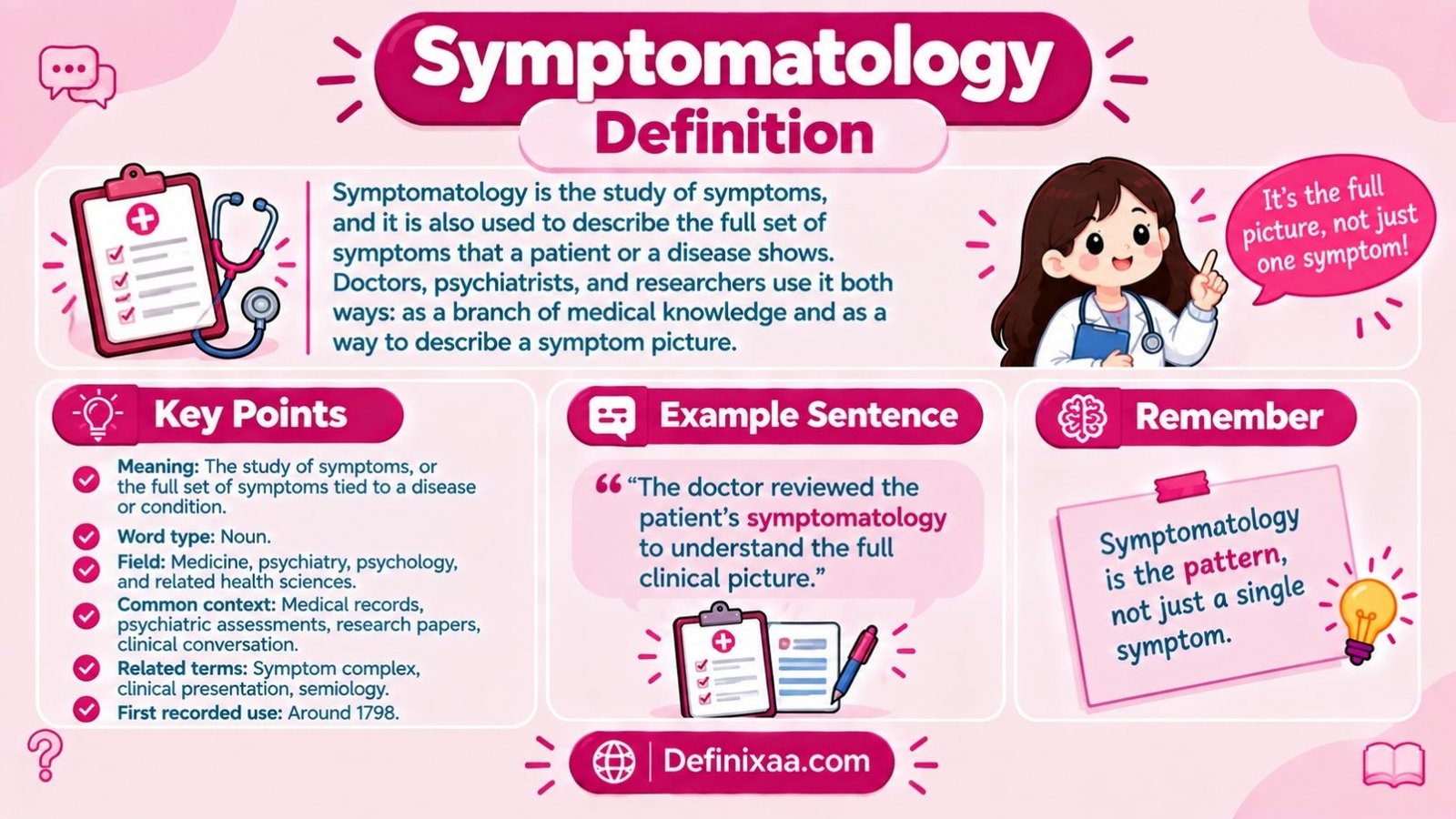
Quick definition: Symptomatology is the study of symptoms, and it is also used to describe the full set of symptoms that a patient or a disease shows. Doctors, psychiatrists, and researchers use it both ways: as a branch of medical knowledge and as a way to describe a symptom picture.
What Does Symptomatology Actually Mean?
Symptomatology has two closely related meanings, and reliable dictionaries such as Merriam Webster and Collins English Dictionary confirm both.
The first meaning is a branch of medical science. In this sense, symptomatology is the area of medicine concerned with studying, classifying, and interpreting symptoms of disease.
The second meaning is more common in everyday medical writing. Here, symptomatology simply means the collective symptoms of a patient or a disease. When a doctor writes about a patient’s symptomatology, they mean everything the patient is experiencing that points toward a diagnosis.
Both meanings come from the same root idea: symptoms, studied and organized in a systematic way.
Read More: Enticing Definition
So, What Is Symptomatology In Simple Terms?
Think of symptomatology as the full symptom picture, not just one symptom.
If someone has a fever, that is a single symptom. If a doctor describes their symptomatology, they are describing the fever plus every other sign appearing alongside it, and how those signs relate to each other.
In plain English, symptomatology answers one question: what does this condition actually look like in a real patient?
Note: A single symptom is not symptomatology. Symptomatology refers to the pattern, not one isolated sign.
At A Glance
| Detail | Information |
| Meaning | The study of symptoms, or the full set of symptoms tied to a disease or condition |
| Word type | Noun |
| Field | Medicine, psychiatry, psychology, and related health sciences |
| Tone | Formal, clinical |
| Common context | Medical records, psychiatric assessments, research papers, clinical conversation |
| Related terms | Symptom complex, clinical presentation, semiology |
| First recorded use | Around 1798, according to Merriam Webster |
Symptomatology Definition In Medicine
In a medical context, symptomatology describes everything a patient reports or displays that a clinician uses to understand a condition.
This includes physical complaints, observable signs, and the timing and pattern of those signs. A doctor reviewing a patient’s symptomatology is essentially reviewing the full clinical picture, not a single data point.
Medical literature often uses the word this way. For example, one Reuters report about an animal disease outbreak described the case’s symptomatology as consistent with a specific, less dangerous strain, based on how the symptoms presented.
This matters because two diseases can share individual symptoms while having very different symptomatology overall. A cough alone means little. The cough combined with fever, fatigue, and a specific pattern of onset tells a much more complete story.
Tip: When you see “symptomatology” in a medical report, read it as “the overall symptom pattern,” not as a single complaint.
Symptomatology Definition In Psychology And Psychiatry
Symptomatology is also a core term in mental health.
Psychiatric symptomatology refers to the set of symptoms associated with a mental health condition, such as anxiety, depression, or a thought disorder. Clinicians use this term when describing the presentation of a diagnosis, not the diagnosis label itself.
Psychotic symptomatology specifically refers to symptoms tied to psychosis, such as delusions, hallucinations, or disorganized thinking. Diagnostic frameworks used by psychiatrists, including the American Psychiatric Association’s Diagnostic and Statistical Manual of Mental Disorders, describe these symptom clusters in detail, even though the manual itself does not use the word symptomatology as a formal diagnostic label.
Depressive symptomatology is another common phrase. It describes the specific combination of symptoms, such as low mood, fatigue, or sleep disturbance, that a person with depression is experiencing, rather than the diagnosis of depression as a single category.
In everyday psychological writing, you will also see psychological symptomatology, a broader phrase covering symptoms tied to emotional or behavioral conditions rather than only clinical psychiatric diagnoses.
Quick takeaway: In mental health, symptomatology usually means the specific symptoms present, separated from the diagnostic label attached to them.
Types Of Symptomatology
Symptomatology is not one fixed category. It changes depending on the field applying it.
- Medical symptomatology: physical signs tied to a disease, injury, or physiological condition.
- Psychiatric symptomatology: symptoms tied to a mental health diagnosis.
- Clinical symptomatology: a general term covering symptoms observed in any clinical setting, medical or psychiatric.
- Neurological symptomatology: symptoms connected to the nervous system, such as numbness, tremor, or cognitive changes.
- Homeopathic symptomatology: in homeopathy, practitioners use detailed symptomatology, including physical, emotional, and situational symptoms, to select a remedy. This use of the term is specific to homeopathic practice and differs from how conventional medicine applies it, since homeopathy treats the full symptom picture as the basis for remedy selection rather than as evidence pointing toward a single diagnosis.
Each type shares the same underlying idea: a structured collection of symptoms tied to a specific condition or field.
What Does Symptomatology Look Like In A Sentence?
Original examples, across different contexts, help show how naturally the word fits into real writing.
Clinical setting
“The patient’s symptomatology included fatigue, joint pain, and a low grade fever lasting more than a week.”
Research writing
“The study measured changes in depressive symptomatology before and after treatment.”
Academic discussion
“Understanding the symptomatology of early stage Parkinson’s disease can help with earlier diagnosis.”
Professional conversation
“Her symptomatology doesn’t quite match the usual presentation, so we’re running further tests.”
General health writing
“Long Covid research has struggled because the symptomatology varies so much from patient to patient.”
Notice that symptomatology almost never appears in casual conversation. It belongs to clinical, academic, or research contexts.
Read More: Immaculate Definition
What Words Mean Something Similar to Symptomatology?
Several related terms overlap with symptomatology, though none are perfectly interchangeable.
- Symptom complex: a close synonym, referring to a group of symptoms occurring together.
- Clinical presentation: the way a condition appears in a specific patient, including symptoms and observable signs.
- Semiology or semeiology: an older medical term for the study of signs and symptoms of disease, closely related historically to symptomatology.
- Symptom profile: a more modern, informal alternative used in research writing.
None of these terms are exact substitutes in every sentence. Symptomatology carries a slightly more formal, academic tone than “symptom profile,” for example.
Is Symptomatology The Same As Symptomology?
Not exactly, though the words are frequently confused.
Symptomatology is the older, dictionary standard spelling, dating back to the late 1700s. Symptomology is a more recent variant spelling that has become common in casual and even some professional writing, largely because it is easier to say and type.
| Term | Meaning | Typical Use | Key Difference |
| Symptomatology | The study or full pattern of symptoms | Formal medical writing, academic literature, dictionaries | Standard, dictionary recognized spelling |
| Symptomology | Used the same way, informally | Everyday health writing, casual clinical conversation | Common variant, not the traditional dictionary form |
Both are understood to mean the same thing in practice. If you are writing formally, especially for academic or clinical publication, symptomatology is the safer, dictionary supported choice.
Before you use this word, remember this: symptomatology and symptomology are treated as equivalent in casual use, but style guides and academic journals generally expect the traditional spelling, symptomatology.
How Is Symptomatology Actually Used In Real Life?
Symptomatology rarely shows up outside of professional and academic contexts.
It appears often in:
- Medical charts and clinical notes
- Psychiatric evaluations and case reports
- Peer reviewed research papers
- Public health reporting, especially during disease outbreaks
- Homeopathic practice, where full symptom pictures guide remedy choice
It appears rarely in:
- Everyday spoken conversation
- Text messages or social media
- Casual writing aimed at a general audience
When people search for a simpler alternative, they usually mean “symptoms” or “symptom pattern.” Symptomatology signals a more technical, structured discussion, often used by professionals speaking to other professionals or writing for a research audience.
What Symptomatology Does Not Mean?
Symptomatology does not mean a diagnosis. A diagnosis is the conclusion a clinician reaches. Symptomatology is the evidence that leads there.
It also does not mean a single symptom. One symptom, on its own, is just a symptom. Symptomatology refers to the whole picture.
It is not a synonym for treatment, prognosis, or cause. Symptomatology describes what is observed, not what caused it or what should be done about it.
Note: Two patients can share a diagnosis while having noticeably different symptomatology, since the same condition can present differently from person to person.
How Do You Pronounce Symptomatology?
Symptomatology is pronounced sim tuh muh TOL uh jee, with the main stress falling on the fourth syllable. Standard dictionaries such as Dictionary.com list this as the accepted American pronunciation, with a very similar pattern used in British English.
Where Does The Word Symptomatology Come From?
Symptomatology comes from New Latin, built from the Late Latin word symptomat, meaning symptom, combined with the Greek derived suffix logia, meaning the study of.
Etymology sources, including Dictionary.com and the Oxford English Dictionary, date the word to roughly 1790 to 1800, with the earliest confirmed use around 1798. It entered medical English directly from academic Latin, at a time when many clinical terms were being formalized this way.
Should You Use The Word Symptomatology?
Symptomatology is appropriate in medical, academic, and clinical writing. It is not the right word for casual conversation, general audience health articles, or informal writing, where “symptoms” communicates the same idea more naturally.
If you’re writing for patients or a general reader, consider using “symptoms” or “symptom pattern” instead. If you’re writing for clinicians, researchers, or an academic audience, symptomatology is the accurate, expected term.
Research note: This explanation was checked against established dictionary sources, medical etymology references, and real published usage in medical and news writing, to separate the standard clinical meaning from casual variant spellings.
Read More: Recurring Definition
Frequently Asked Questions
What does symptomatology mean in simple terms?
It means the full set of symptoms tied to a disease or condition, or the branch of medicine that studies symptoms.
What is the difference between a symptom and symptomatology?
A symptom is one individual sign. Symptomatology is the entire pattern of symptoms considered together.
Is symptomatology the same as symptomology?
They are used interchangeably in casual writing, but symptomatology is the traditional, dictionary preferred spelling.
What is psychiatric symptomatology?
It refers to the specific symptoms tied to a mental health condition, such as mood changes, anxiety, or disordered thinking.
What is psychotic symptomatology?
It describes symptoms linked to psychosis, including hallucinations, delusions, and disorganized thought or speech.
Is symptomatology a formal or informal word?
It is a formal, clinical term used mainly in medical, psychiatric, and academic writing.
How is symptomatology used in homeopathy?
Homeopathic practitioners record a detailed symptomatology, including physical and emotional symptoms, to help select an appropriate remedy.
Can symptomatology refer to mental health as well as physical illness?
Yes. It applies equally to physical conditions and psychological or psychiatric conditions.
What is an example of symptomatology in a sentence?
“The patient’s symptomatology included persistent fatigue, joint pain, and low grade fever.”
Where did the word symptomatology come from?
It comes from New Latin, combining the Latin root for symptom with the Greek suffix meaning the study of, first recorded around 1798.
The Simple Takeaway
Symptomatology means the full pattern of symptoms tied to a disease or condition, and in a narrower sense, the branch of medicine that studies symptoms.
It shows up mainly in medical, psychiatric, and research writing, where the whole symptom picture matters more than any single complaint. If you’re writing for a general audience, “symptoms” usually says the same thing more naturally.

Laiba Rahman is a writer and researcher behind Definixaa, dedicated to exploring words, meanings, terms, concepts, and everyday knowledge. Through clear and well-researched explanations, her goal is to help readers understand unfamiliar ideas quickly and discover useful information with ease.