
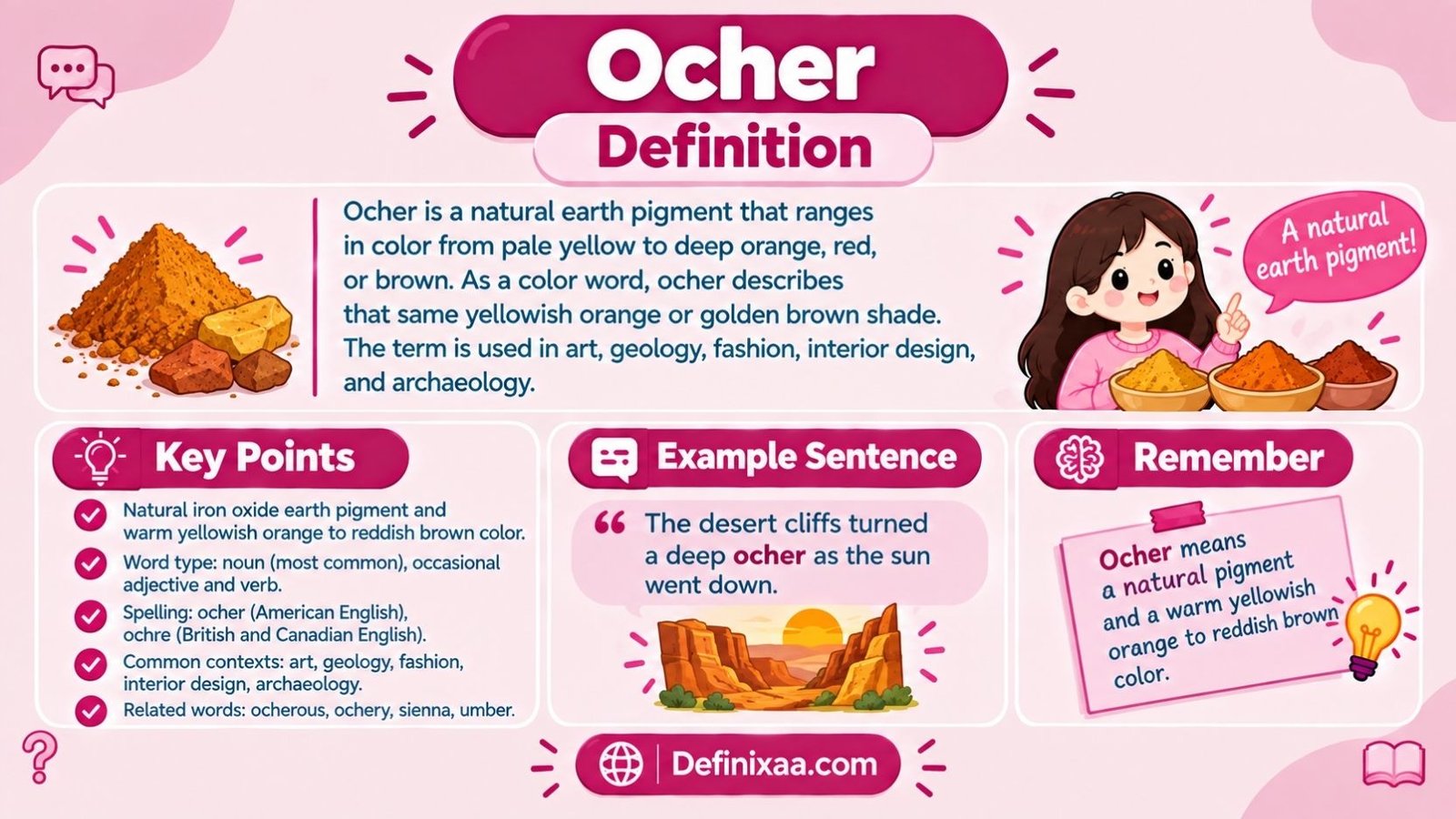
Ocher is a natural earth pigment that ranges in color from pale yellow to deep orange, red, or brown. As a color word, ocher describes that same yellowish orange or golden brown shade. The term is used in art, geology, fashion, interior design, and archaeology.
Ocher is the American spelling. Ochre is the British and Canadian spelling. Both are pronounced the same way and mean the same thing.
Quick Answer
Ocher means two closely related things. It is a natural mineral pigment made from iron rich clay, and it is the yellowish orange to reddish brown color that pigment produces. You will see it used as a noun for the substance and the color, and sometimes as a verb meaning to color something with it.
At A Glance
| Detail | Information |
| Meaning | A natural iron oxide earth pigment, and the yellowish orange to reddish brown color it produces |
| Word type | Noun (most common), occasional adjective and verb |
| Spelling | Ocher in American English, ochre in British and Canadian English |
| Pronunciation | OH ker, rhymes with poker |
| Tone | Neutral, descriptive |
| Common contexts | Art, painting, interior design, fashion, geology, archaeology |
| Related words | Ocherous, ochery, sienna, umber |
Read More: Feed Definition
So, What Is Ocher In Simple Terms?
Think of ocher as one of the oldest paint colors that people still use today. It comes from the ground, not a factory.
Ocher forms when iron oxide mixes with clay and sand in the earth. Depending on how much iron and moisture is present, it can look pale yellow, golden brown, burnt orange, or brick red.
Painters, historians, and interior designers use the word ocher in two ways.
- As the physical pigment: the crushed, colored earth used to make paint or dye.
- As the color itself: a warm, muted yellowish orange, similar to mustard or dried clay.
Merriam Webster defines ocher as an earthy usually red or yellow and often impure iron ore used as a pigment. Britannica describes ocher as a native earth colored with hydrated iron oxide, varying in color from pale yellow to deep red, brown, and violet, and notes that there are two main kinds, one with a clayey base and one that is a chalkier earth.
Note: Ocher is not a single fixed shade. It is a family of closely related earthy colors, which is why you will see “yellow ocher” and “red ocher” treated almost as separate colors in art supply stores.
Ocher Or Ochre: Is There A Real Difference?
No. Ocher and ochre are the same word with two accepted spellings.
- Ocher is standard in American English.
- Ochre is standard in British, Canadian, and most Commonwealth English.
Both spellings trace back to the same French and Latin roots, and both are pronounced the same way. If you are writing for a United States audience, ocher is the safer choice. If you are writing for a British or Canadian audience, ochre fits local style better.
Tip: Style guides in the United States, including Merriam Webster and the American Heritage Dictionary, list ocher as the primary American entry, while ochre remains the primary entry in the Oxford English Dictionary and Cambridge Dictionary.
How Do You Pronounce Ocher?
Ocher is pronounced OH ker, with two syllables. The stress falls on the first syllable.
In IPA, American dictionaries transcribe it as roughly /ˈoʊkər/, while the Oxford English Dictionary gives the British pronunciation as /ˈəʊkə/ for ochre.
A simple way to remember it: it rhymes with “poker” and “soaker.”
Where Does The Word Ocher Come From?
The Oxford English Dictionary traces ochre (and its American spelling ocher) to multiple origins, partly borrowed from French and partly from Latin, with etymons in French ocre and Latin ochra. The Oxford English Dictionary records that the earliest known use of the word in English dates to the Middle English period, with evidence appearing as early as 1364 in exchequer accounting records.
Further back, the Latin and French forms descend from the ancient Greek word for pale yellow. The color meaning came first. The use of the word for the mineral pigment followed naturally, since the pigment was named after the color it produced.
Note: This is a case where the color word and the material word grew up together. Ocher was never invented as slang or a marketing term. Its roots are genuinely ancient, and people have mined and used the actual pigment for tens of thousands of years, long before the English word existed.
Going back further, Wikipedia’s reference entry on the color traces ochre to the Ancient Greek word ὤχρα, itself derived from ὠχρός, meaning pale. That root sense of “pale” is a useful memory hook. The earliest meaning of the word was closer to a description of a faded, sandy tone, and it gradually narrowed to describe the specific earthy pigment family we associate with the word today.
What Color Is Ocher, Exactly?
Ocher is not one exact shade, but there is a widely used reference point. Digital color references commonly list ocher with the hex code CC7722, which corresponds to an RGB value of 204 red, 119 green, and 34 blue. That specific value sits closer to a deep golden orange than a pale yellow, which is why “ocher” can sound different depending on whether someone pictures the lighter or darker end of the family.
In practice, three variants come up most often.
- Yellow ocher: the lightest and most common form, closer to a warm mustard yellow.
- Golden ocher: a mid tone between yellow and orange, often described as a rich amber.
- Red ocher: the deepest variant, leaning toward rust, brick, or dried clay.
Note: If a paint chip, fabric swatch, or design brief simply says “ocher” without specifying a variant, yellow ocher is the safest default assumption, since it is the most widely referenced form of the color.
What Does Ocher Look Like In A Sentence?
Ocher shows up most naturally when describing color, landscape, art, or historical pigment use. Here are original examples across different contexts.
Everyday conversation
- “I painted the hallway a warm ocher instead of plain beige.”
- “The desert cliffs turned a deep ocher as the sun went down.”
Art and design
- “The muralist mixed yellow ocher with white to soften the tone.”
- “Her palette leaned heavily on ocher, sienna, and burnt umber.”
Professional or academic writing
- “Archaeologists found traces of red ocher pigment on the cave wall.”
- “The report described the soil as an ocher colored clay with high iron content.”
News style usage
- “The tour leader will wear the race’s ocher jersey during the mountain stage.”
- “Evening light gave the old cathedral stone a burnished ocher glow.”
These patterns match how the word appears in real published writing. Dictionary.com’s citation examples include a description of a burnished ocher illuminating a cathedral at sunset and a reference to the crumbly ocher cliffs of a coastal town, both used as straightforward color and material description rather than slang.
Ocher In Art: How Painters And Historians Use The Word
Ocher is one of the oldest pigments used by humans. Cave painters used it tens of thousands of years before synthetic paints existed, and it remains a standard color on artist palettes today.
In art contexts, ocher usually appears in two specific forms.
- Yellow ocher, a warm golden yellow used for skin tones, sand, and light foliage.
- Red ocher, a deeper rust or brick tone used for earth, brick, and warm shadow areas.
Art historians also use ocher as a shorthand color description for paintings, pottery, and textiles that show that warm earthy family of hues. Collins Dictionary notes that something described as ocher is a yellowish orange color, which is exactly how the word functions in most art writing.
Tip: If you are choosing paint for a home and see “ocher” or “ochre” on a swatch, expect a muted, warm yellow gold rather than a bright, clean yellow. It behaves more like a neutral than a bold accent color.
Ocher’s role in art history goes back further than most pigments still in common use. Britannica points to one striking example, an engraved piece of ocher found at Blombos Cave in South Africa, marked with a crosshatch design created by early humans at least seventy thousand years ago. That single object is often cited as some of the earliest known evidence of deliberate, symbolic mark making by humans, and it happens to be made from ocher.
Because ocher occurs naturally in accessible deposits across most continents, it became one of the first pigments available to nearly every early human culture, independent of trade routes or advanced technology. That wide, ancient availability is part of why the word still carries an earthy, foundational feel in art writing today, even in contexts that have nothing to do with archaeology.
Read More: Ladle Definition
How Is Ocher Actually Used In Real Life?
Beyond dictionary definitions, ocher tends to cluster around a few real, observable contexts rather than appearing evenly across all writing.
- Home and interior design: ocher regularly appears in paint names, upholstery descriptions, and tile or ceramic finishes, almost always describing a warm, muted yellow gold rather than a bright primary color.
- Fashion writing: clothing descriptions use ocher for mustard toned garments, particularly in autumn and winter collections, where it reads as a sophisticated neutral rather than a bold statement color.
- Travel and nature writing: ocher frequently describes cliffs, canyons, deserts, and old stone buildings, especially where sunlight or mineral content gives the landscape a golden or rust toned look.
- Academic and scientific writing: geology, archaeology, and anthropology papers use ocher as a precise technical term for the mineral itself, not just a loose color description.
Ocher appears far more often in written, edited text, such as design copy, journalism, and academic papers, than in unscripted spoken conversation. Most people are more likely to encounter the word while reading than while speaking casually, which is part of why some readers assume, incorrectly, that it must be a newer or trendier term than it actually is.
Ocher In Archaeology: What Ocher Bone And Ocher Pelvis Usually Mean
Searches for phrases like ocher bone or ocher pelvis almost always trace back to archaeology and prehistoric burial research, not a separate slang meaning.
Red ocher has been used in burial rituals for tens of thousands of years across many cultures. Researchers frequently find ocher powder or ocher stained bone in ancient graves, and specific bones, including the pelvis, are commonly mentioned in these studies because ocher was placed on or around them during burial.
For example, research on Bronze and Iron Age burials in Thailand recorded a case of an adult female buried with two pieces of red ocher placed by the pelvis. Analysis of Stone Age burials in southwestern China similarly involved soil samples collected from the burial fill, left radius, pelvis, and skull of a human skeleton to study ocher use. Coverage of the Dolni Vestonice triple burial in the Czech Republic describes how powdered red ochre was sprinkled over the head and, notably, over the pelvis of one individual.
Researchers studying these patterns note that ocher can also physically stain skeletal remains over time. As one archaeological summary puts it, it seems likely that ancient people colored their bodies with red ocher, and the pigment then impregnated their bones during decomposition in the grave.
So, an ocher bone is simply a bone that shows this red or orange staining from ancient ceremonial or ritual pigment use, and an ocher pelvis refers to a pelvis bone found with this same coloring in a burial context. Neither phrase has a separate modern slang meaning.
Ocher In Kenya And East African Culture
Ocher also has a well documented cultural meaning connected to East Africa, which explains searches for ocher definition Kenya.
Among the Maasai and Samburu communities of Kenya, red ocher is traditionally mixed with animal fat and applied to hair, skin, and clothing, particularly by young warriors known as morans. Ethnographic research describes this as a longstanding practice, noting that red ocher is almost universally used across Africa, though detailed ethnographic descriptions of its sourcing and traditional use have historically been limited.
Descriptions of Samburu warrior culture note that young men apply red ocher to their heads, necks, and shoulders, and spend hours braiding each other’s ocher colored hair as part of ceremonial preparation. Among the Maasai, red also carries symbolic weight, since the color is associated with kinship, life, and vitality, and ocher is traditionally mixed with cow fat and applied during certain rituals.
This usage is cultural and historical, not slang. It reflects a genuine, long practiced tradition rather than an internet trend.
Note: Ocher’s connection to burial and ceremonial tradition is not limited to Kenya. Archaeologists use the term ocher grave for a category of ancient burials, particularly across parts of Northern and Eastern Europe, where red ocher was deliberately placed with the dead. A well known Bronze Age archaeological culture is even referred to in some sources as the Ochre Grave culture, reflecting how central the pigment was to burial customs across widely separated regions and time periods.
How Does Ocher Pigment Actually Form?
Ocher is not manufactured from scratch. It occurs naturally wherever iron rich minerals weather and mix with clay, sand, or silt over long periods.
The process generally works like this.
- Iron bearing rock or soil gradually breaks down through weathering and exposure to water.
- Iron oxide, essentially rust, forms within that broken down material.
- The iron oxide binds with surrounding clay and sand, producing a soft, crumbly, colored earth.
- Depending on the exact mineral form of the iron oxide and the amount of moisture involved, the resulting color shifts from pale yellow through gold, orange, and into deep red or brown.
This is why ocher deposits appear naturally on every inhabited continent, and why the pigment was independently discovered and used by unrelated ancient cultures with no contact with one another. It did not need to be traded or invented. It simply needed to be dug up.
Is Ocher Slang? What The Word Actually Means Online
This is where accuracy matters. A number of low quality blog posts online claim that ocher is trending internet slang, but these claims do not hold up under scrutiny.
Several of these articles contradict each other. One claims ocher means something “unique, authentic, and deeply rooted in cultural significance.” Another claims it means the opposite, describing something that “lacked energy or vibrancy.” A third claims the word became slang purely by accident, as a typo for “other” or “okay” on chat platforms. One of these pages even openly states that its content was generated with AI assistance.
No major dictionary, including Merriam Webster, Oxford, Cambridge, Collins, or Dictionary.com, lists a slang definition for ocher. There is no consistent evidence in real conversation, news writing, or established slang references such as widely used slang glossaries that ocher carries an established informal meaning.
Before you use ocher, remember this: treat ocher as a standard color and pigment word, not as internet slang. If someone claims it has a secret trendy meaning, that claim is not supported by reliable sources.
Other Meanings You May Encounter
Ocher shows up in a few related and technical forms.
- Ocherous and ochery: adjectives meaning resembling ocher in color, or containing ocher. Both describe something with that yellowish orange, earthy tone.
- Ochre as a stop codon: in genetics, “ochre” is the informal name for one of the three stop codons in the genetic code, which signal the end of a protein sequence. This is an unrelated, technical use of the same word, confirmed in general genetics reference material and Wikipedia’s disambiguation entry for the term.
- Ocher as a color name in branding or fashion: some product listings and clothing brands use “ocher” simply as a marketing name for a mustard or golden brown shade, which is consistent with the standard color meaning rather than a separate definition.
What About Ocher Trope, Ocher Platitude And Ocher Gusher?
These specific phrases do not correspond to any established idiom, literary trope, or figure of speech. There is no recognized “ocher trope” in storytelling, no common expression called an “ocher platitude,” and no meaningful compound term “ocher gusher” in any dictionary or reputable reference source.
In each case, the individual words are real. Gusher, for instance, is a well documented word on its own, referring to an oil well with a copious natural flow or, in a figurative sense, a person who expresses excessive, insincere praise or emotion. However, pairing these words with “ocher” does not create a recognized combined term.
If you encountered one of these phrases in a specific context, such as a book, song, or particular article, the meaning likely comes from that specific source rather than general English usage. Treat any page that confidently defines these exact phrases as an established idiom with caution.
Ocher Compared To Similar Color Words
Ocher belongs to a family of warm, earthy color terms that are often confused with one another.
| Term | Meaning | Typical Use | Key Difference |
| Ocher | Yellowish orange to reddish brown natural pigment and color | Art, interior paint, landscape description | The broadest term, covering both yellow and red variants |
| Sienna | A reddish brown pigment, named after Siena, Italy | Art, particularly “burnt sienna” and “raw sienna” | Generally more reddish brown and less yellow than typical ocher |
| Umber | A darker brown pigment with more black and less warmth | Art, especially deep shadow tones | Darker and cooler than ocher, closer to true brown |
| Mustard | A dull, muted yellow, often with a slight green or brown undertone | Fashion, interior design | A modern fashion color name, not a mineral pigment |
Note: Ocher, sienna, and umber are all traditional earth pigments with genuine mineral origins. Mustard is purely a descriptive color name used mainly in fashion and design.
What Words Mean Something Similar To Ocher?
A few related words and phrases show up alongside ocher, though not all of them are true synonyms.
- Golden brown: a plain language equivalent for readers unfamiliar with ocher.
- Yellow ocher and red ocher: not synonyms but named variants within the ocher family itself.
- Amber: closely related in warmth and tone, though amber leans slightly more orange and glassy, without the same earthy, matte quality as ocher.
- Terracotta: shares the earthy, mineral feel of ocher, but usually reads as more red and less yellow.
- Buff: a paler, more neutral tan, generally lighter and less saturated than ocher.
None of these words are interchangeable with ocher in a technical, art historical sense. Sienna and umber, in particular, refer to genuinely distinct mineral pigments with their own separate compositions, not simply alternate names for ocher.
Is Ocher Formal Or Informal? Positive Or Negative?
Ocher is a neutral, descriptive word. It is not slang, not offensive, and not tied to strong emotion.
- It fits comfortably in formal writing, academic papers, and professional design descriptions.
- It also works naturally in casual conversation when describing color, such as paint, clothing, or scenery.
- It carries no inherent positive or negative tone. Any feeling attached to it, such as “warm” or “earthy,” comes from the color itself rather than the word.
When Should You Use Ocher?
Use ocher when you want a more specific and evocative word than “yellow” or “orange.” It works well in:
- Interior design and home renovation writing
- Art criticism, painting descriptions, and gallery text
- Travel and landscape writing, especially deserts, cliffs, and old buildings
- Historical, archaeological, or anthropological writing about ancient pigment use
- Fashion copy describing a warm, muted golden brown shade
If you are writing for a general audience and worry the word may be unfamiliar, you can briefly clarify it, for example: “a warm, ocher, or golden brown, tone.”
Read More: Immaculate Definition
Frequently Asked Questions
What does ocher mean in simple terms?
Ocher is both a natural earth pigment and the yellowish orange to reddish brown color that pigment produces. It is commonly used in art, design, and descriptions of landscape or historical artifacts.
Is ocher the same as ochre?
Yes. Ocher is the American spelling, and ochre is the British and Canadian spelling. They mean the same thing and are pronounced the same way.
How do you pronounce ocher?
Ocher is pronounced OH ker, with the stress on the first syllable. It rhymes with words like “poker” and “soaker.”
Is ocher a color or a material?
Both. Ocher refers to the natural mineral pigment itself, and also to the color that pigment creates when used as paint or dye.
Is ocher slang for something else?
No credible dictionary supports a slang definition for ocher. Several low quality online articles claim otherwise, but their explanations contradict each other and are not backed by real evidence of common usage.
What does ocher bone or ocher pelvis mean?
These phrases refer to archaeological finds where ancient human bones, including the pelvis, show staining or coverage from red ocher pigment used in prehistoric burial rituals.
Why is ocher connected to Kenya?
Red ocher has a long, documented tradition among the Maasai and Samburu peoples of Kenya, who mix it with animal fat and apply it to hair and skin, particularly among young warriors, as part of cultural and ceremonial practice.
What is the difference between ocher and sienna?
Ocher tends to be more yellow, while sienna, especially burnt sienna, leans more reddish brown. Both are traditional earth pigments used in painting.
Is ocher formal or informal language?
Ocher is neutral. It works in both formal writing, such as art history or academic text, and everyday conversation about color.
Does ocher have a negative meaning?
No. Ocher does not carry a negative or offensive connotation. It is a straightforward descriptive color and material term.
What is the hex code for ocher?
Ocher is commonly referenced with the hex code CC7722, which corresponds to an RGB value of 204 red, 119 green, and 34 blue, sitting toward the deeper, golden orange end of the color family.
Where does the word ocher come from?
Ocher traces through French and Latin to the Ancient Greek word ochra, itself related to ochros, meaning pale. The word originally described a pale, sandy tone before narrowing to the specific pigment family known today.
Is ocher used as a verb?
Rarely, but yes. To ocher something means to color or stain it with ocher pigment, most often seen in older or historical writing, such as descriptions of hair or fabric that has been ochered.
The Simple Takeaway
Ocher is a natural earth pigment and the warm yellowish orange to reddish brown color it produces. Ocher and ochre are the same word, split only by American and British spelling.
Beyond color and art, the word appears in genuine archaeological and cultural contexts, including ancient burial practices and East African tradition, but claims that ocher is trendy internet slang are not supported by reliable sources.

Laiba Rahman is a writer and researcher behind Definixaa, dedicated to exploring words, meanings, terms, concepts, and everyday knowledge. Through clear and well-researched explanations, her goal is to help readers understand unfamiliar ideas quickly and discover useful information with ease.

3 Comments