
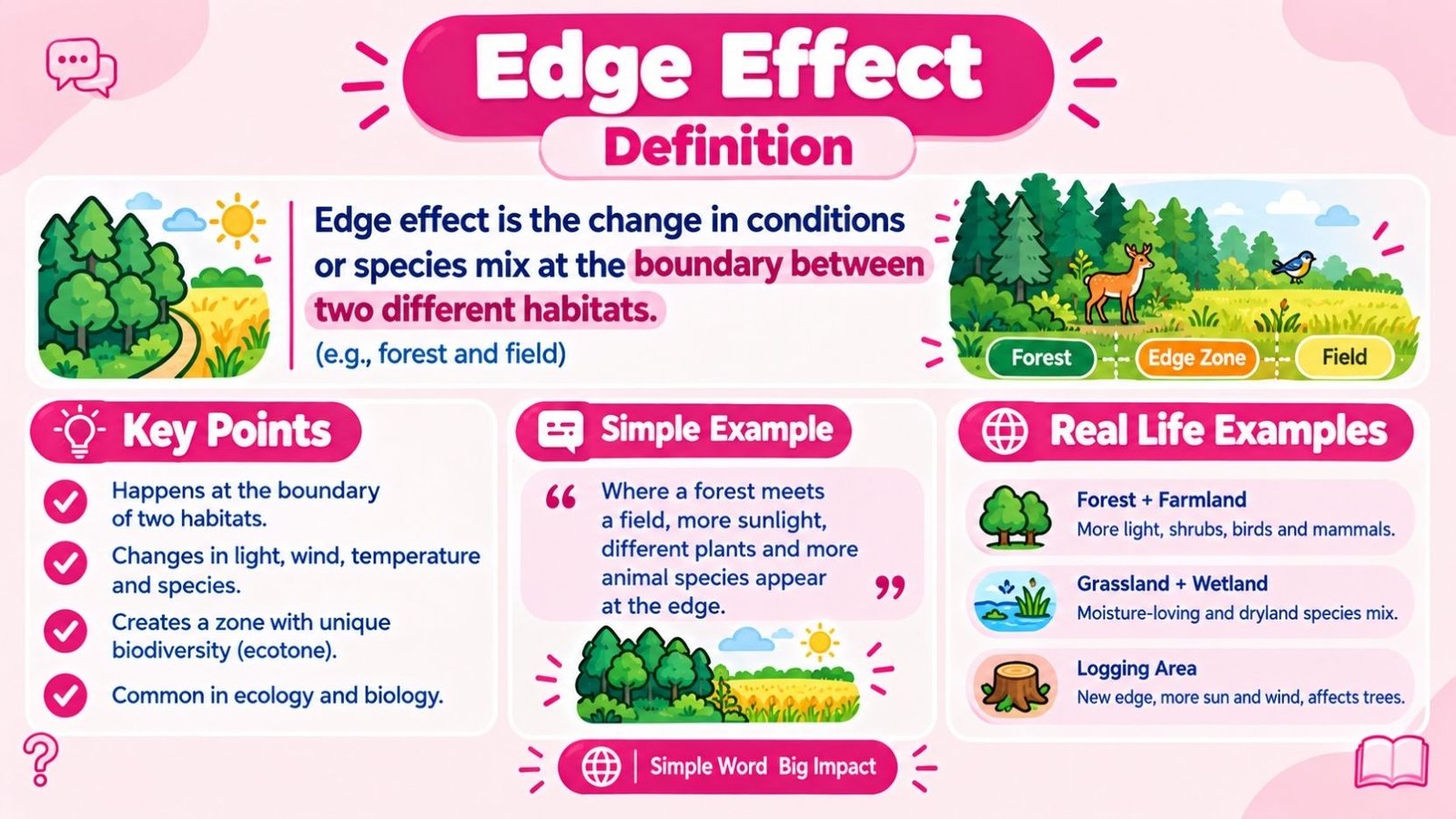
Quick definition: Edge effect is the change in environmental conditions, species diversity, or population density that happens at the boundary between two different habitats or environments. It is most often discussed in ecology, where the border between a forest and a field, for example, has its own mix of light, wind, and species that differs from either habitat’s interior.
The term also shows up outside biology, in chromatography, microscopy, lab testing, and even as a brand name for a hair styling gel. This article focuses mainly on the ecological meaning, since that is the meaning almost everyone searching this term actually wants, and then covers the other uses so you are not caught off guard if you meet the phrase somewhere unexpected.
At A Glance
| Quick Detail | Information |
| Meaning | Change in conditions or species mix at a habitat boundary |
| Type | Scientific concept, used mainly in ecology and biology |
| Tone | Neutral, descriptive term |
| Common context | Biology classes, ecology research, wildlife management, AP Environmental Science |
| Related terms | Ecotone, habitat fragmentation, ecological gradient |
| Also used in | Chromatography, microscopy, lab plate testing, hair care branding |
Read More: Automatic Definition
So, What Is Edge Effect In Simple Terms?
Picture a forest that borders a farm field. Right where the trees stop and the crops begin, something different happens. More light reaches the ground. Wind blows through more easily. Temperatures swing more than they do deep in the forest.
Because conditions are different at that boundary, different species tend to show up there too. Some plants that need full sun grow only at the edge. Some animals, like deer and many songbirds, use that mixed zone for food and cover. The edge effect describes how environmental conditions and species composition change along this boundary between two contrasting habitats.
That boundary zone is sometimes called an ecotone, and the changes that happen inside it are the edge effect itself.
How Is Edge Effect Actually Used In Ecology And Biology?
In ecology, the term is used constantly, and it usually points to one of two things.
First, it describes abiotic change: shifts in nonliving conditions like light, wind, humidity, and temperature near a boundary. Habitat boundaries experience conditions such as increased wind exposure, more light, and greater temperature fluctuation compared with the interior of either habitat.
Second, it describes biotic change: shifts in which species live there and how they interact. Researchers separate these effects into abiotic changes in nonliving conditions and biotic changes in living organisms and their interactions, such as increased predation and competition near edges.
A classic textbook definition frames it this way: an edge effect is the effect of a prevailing boundary between contrasting spatial environments within an ecosystem or landscape, where the edges between habitat patches shape ecological processes both between patches and within them.
Edge Effect And The Ecotone
Many students first meet this term through the word ecotone. An ecotone is the transition zone itself. Edge effect is the pattern of change that happens inside that zone.
In a community that borders another, the boundary zone often has a higher density of organisms from one species and a greater number of species overall than either of the two flanking communities. Some organisms even depend on that in between space for specific activities such as courtship, nesting, or foraging.
Note: Not every source uses “edge effect” and “ecotone” interchangeably. The ecotone is the place. The edge effect is what happens in that place.
What Does Edge Effect Look Like In Real Life?
Real world examples make this concept far easier to hold onto than a textbook line alone.
Example 1: Forest meets farmland.
Where woods border a crop field, the edge strip gets more sunlight than the forest interior. Shrubs and vines that need light grow thick there, and species like rabbits, quail, and deer use the cover and food together.
Example 2: Grassland meets wetland.
Where dry grass gives way to marsh, moisture loving plants mix with drier grassland species. Frogs, wading birds, and insects that need both water and open ground often cluster in that strip.
Example 3: Logging clears a strip of forest.
When part of a forest is cut, the newly exposed trees at the new boundary face sudden sun and wind they were never built for. Trees that adapted to conditions inside a closed forest can be affected when clear cutting nearby suddenly exposes them to new temperature and light conditions at the new edge.
Example 4: Farm plots and crop rows.
Plants growing along the sides and ends of an agricultural plot are often larger than plants in the middle, because they have access to more available water or fertilizer. This is sometimes called an edge effect in an agricultural sense.
Why Hunters And Wildlife Managers Talk About Edges
If you have ever heard a hunter mention “hunting the edges,” this is the same underlying idea, applied practically. Deer, turkey, and many game species use the boundary between forest and field far more than the deep interior of either.
Edges tend to support more diverse and abundant wildlife than the interior of either adjacent habitat, a pattern known as the edge effect, and predators often concentrate their hunting activity near edges because prey is more abundant and varied there.
Wildlife managers even create edges on purpose, cutting strips of forest to encourage this mix of plants and animals for hunting or conservation goals.
Read More: Lavage Definition
Edge Effect And Habitat Fragmentation
This is where the concept becomes important in AP Environmental Science and conservation biology, not just as trivia.
When a large habitat, like a forest, gets broken into smaller pieces by roads, farms, or development, that process is called habitat fragmentation. Fragmentation creates far more edge relative to the total area.
As landscapes are increasingly fragmented, especially through urbanization, edge effects increase, and this shift has real consequences for the species living there. Generalist species, particularly invasive ones, tend to benefit from this kind of landscape change, while specialist species that need deep interior habitat tend to suffer.
A small forest patch can end up almost entirely edge, with no true interior habitat left at all. That matters because some species, sometimes called interior or core species, cannot survive without deep, undisturbed habitat away from any boundary.
Core Species Versus Edge Species
| Term | Meaning | Typical Behavior |
| Edge species | Thrive at habitat boundaries | Use both habitats, often generalists, examples include deer and many songbird generalists |
| Core or interior species | Need deep, undisturbed habitat | Avoid boundaries, often specialists sensitive to disturbance |
Edge species such as deer prefer habitats where forest and field boundaries meet, while core species such as many forest interior warblers prefer the inner areas of a forest and rarely venture into edge zones.
This is also why edge effect is not automatically good news for biodiversity overall, even though it can locally increase the number of species in one spot. A landscape with too much edge and too little interior habitat can quietly lose the very species that depend on undisturbed cores, even while showing more total species at any single boundary line.
Is Edge Effect Positive Or Negative?
The honest answer is: it depends on the situation, and this is a point worth sitting with rather than rushing past.
When it tends to look positive:
Local species diversity often rises at the boundary itself, since organisms from both habitats, plus a few edge specialists, can be found there together.
When it tends to look negative:
Edge effects can also produce abiotic and biotic conditions that reduce natural variation and threaten the original ecosystem, and detrimental edge effects appear in physical and chemical conditions too, such as fertilizer runoff from a farm field contaminating a bordering forest.
Excess edge from fragmentation can also increase nest predation, invasive species access, and stress on interior species, even while making the edge zone itself look lively and diverse.
Tip: In an essay or classroom answer, avoid calling edge effect simply “good” or “bad.” The stronger answer explains that it increases diversity at boundaries while sometimes harming the broader ecosystem through fragmentation.
What Does Edge Effect Not Mean?
A few mix ups are common enough to flag directly.
Edge effect does not automatically mean more biodiversity everywhere. It means more change and often more diversity right at the boundary line, which is a different, narrower claim.
Edge effect is not the same thing as the economic term sometimes called a benefit cliff or cliff effect, where a small income increase causes a sudden loss of public assistance benefits. That is an unrelated concept from social policy, and confusing the two in a school assignment would be a real error.
Edge effect in ecology is also a different concept from edge effect in a laboratory setting, in electron microscopy, or in a chromatography plate, even though all of these uses share the same root idea: something behaves differently right at a boundary or border position. The sections below cover those separately so the differences stay clear.
Edge Effect Outside Ecology: Other Meanings You Might Encounter
If your search brought you here from a chemistry class, a lab report, or a product page, the ecological meaning above is probably not what you need. Here are the other real uses of this phrase.
Edge Effect In Chromatography And Instrumental Analysis
In thin layer chromatography, a technique used to separate and identify chemical compounds on a coated plate, the edge effect refers to distortion that happens near the sides of the plate.
Solvent tends to evaporate faster at the outer edges than in the middle, which can cause the solvent front to curve and can make compound spots near the edges travel a different distance than the same compound would in the center of the plate. Chemists typically apply samples away from the very edges of a plate for exactly this reason.
In related laboratory separation methods, such as gel electrophoresis, edge effects at the surfaces or boundaries of the separation medium can create disadvantages, including interactions between sample fractions and the surrounding boundary surfaces along with unwanted thermal effects.
Edge Effect In Lab Plates And Biological Assays
Researchers running large batches of lab tests on multiwell plates, common in drug and chemical safety testing, also deal with an edge effect. Wells located at the edge of a testing plate can show abnormal response readings compared with wells in the center, an issue researchers have specifically studied and tried to detect using statistical tests. Two common causes are faster evaporation in edge wells and edge wells reaching the target incubation temperature sooner than inner wells during long experiments.
This is treated purely as a technical artifact to correct for, not a meaningful biological result.
Edge Effect In Physics And Electron Microscopy
In scanning electron microscopy, a tool used to image extremely small surfaces, sharp physical edges on a sample can distort the image. Electron penetration into the sample can create bright fringes near sharp edges in the resulting secondary electron image, and these fringes can make it hard to see fine details close to that edge. Engineers use specific hardware fixes, such as an added control electrode near the sample, to reduce this distortion.
Edge Effect Gel: A Product Name, Not a Scientific Term
If your search led you here because of a hair product, you are likely thinking of Edge Effect, a branded edge control gel used to smooth and hold hairline edges in place. This is simply a product name that borrows the phrase, and it has no connection to the ecological or scientific meanings covered above.
Is Edge Effect The Same As An Ecotone Or Habitat Fragmentation?
These three terms travel together constantly, and mixing them up is one of the most common small errors in student writing.
| Term | Meaning | Typical Use | Key Difference |
| Edge effect | The change in conditions or species mix at a habitat boundary | Describing what happens at a border | Refers to the pattern of change itself |
| Ecotone | The transition zone or boundary area between two habitats | Naming the physical location | Refers to the place, not the pattern |
| Habitat fragmentation | The breaking of one large habitat into smaller, separated pieces | Describing landscape level change from development or land use | Refers to a cause that increases edge effect overall |
A simple way to keep these straight: fragmentation creates more ecotones, and ecotones are where edge effect happens.
Read More: Mood Congruent Memory Psychology Definition
When Should You Use the Term Edge Effect?
This phrase belongs almost entirely in scientific, academic, or technical writing rather than everyday conversation.
It fits naturally in a biology or environmental science paper, a wildlife management report, a conservation planning document, or a classroom discussion of habitat fragmentation. It also fits in a chemistry lab report if you are discussing chromatography results, or in a technical write up about microscopy or lab plate design.
It would sound out of place in casual conversation, since almost nobody uses “edge effect” outside of a scientific or technical context. If you are writing an essay for AP Environmental Science, using this term correctly alongside habitat fragmentation and ecotone signals real understanding of the concept, not just memorized vocabulary.
Frequently Asked Questions
What is the simplest definition of edge effect?
Edge effect is the change in environmental conditions or species mix that happens at the boundary between two habitats, such as where a forest meets a field.
Is edge effect the same as habitat fragmentation?
No. Habitat fragmentation is the breaking up of a large habitat into smaller pieces, and this process increases the total amount of edge effect across a landscape.
Does edge effect increase or decrease biodiversity?
It often increases species diversity locally at the boundary itself, but excessive edge from fragmentation can reduce overall ecosystem health by harming species that need undisturbed interior habitat.
What causes edge effects in a forest?
Sudden exposure to more light, wind, and temperature swings at the boundary causes edge effects, along with changes in which plants and animals can tolerate those new conditions.
What is an example of a negative edge effect?
Fertilizer runoff from a farm field entering a bordering forest is a commonly cited negative edge effect, since it changes soil chemistry along the forest border.
Is edge effect used outside biology?
Yes. The phrase also appears in chromatography, where solvent behaves differently near plate edges, in laboratory plate testing, and in electron microscopy imaging.
What is the difference between edge effect and ecotone?
An ecotone is the physical transition zone between two habitats. Edge effect describes the pattern of environmental and species changes that occur within that zone.
Why do hunters talk about hunting the edges?
Because many game species concentrate near habitat boundaries, where food and cover from two different habitats are both available nearby.
Is Edge Effect Gel related to the ecology term?
No. Edge Effect is a brand name for a hair edge control gel and has no scientific connection to the ecological or lab based meanings of the term.
Why does edge effect matter in conservation biology?
Because too much edge relative to interior habitat, usually caused by fragmentation, can threaten species that depend on undisturbed core habitat, even while making individual edges look diverse.
Last Words
Edge effect describes what happens at the boundary between two habitats: shifts in light, wind, temperature, and which species show up there. It usually raises local diversity, but too much of it, driven by habitat fragmentation, can quietly threaten species that need deep, undisturbed habitat.
Outside ecology, the same phrase pops up in chromatography, lab testing, microscopy, and even hair care branding, so context always decides which meaning applies.

Laiba Rahman is a writer and researcher behind Definixaa, dedicated to exploring words, meanings, terms, concepts, and everyday knowledge. Through clear and well-researched explanations, her goal is to help readers understand unfamiliar ideas quickly and discover useful information with ease.
One Comment