
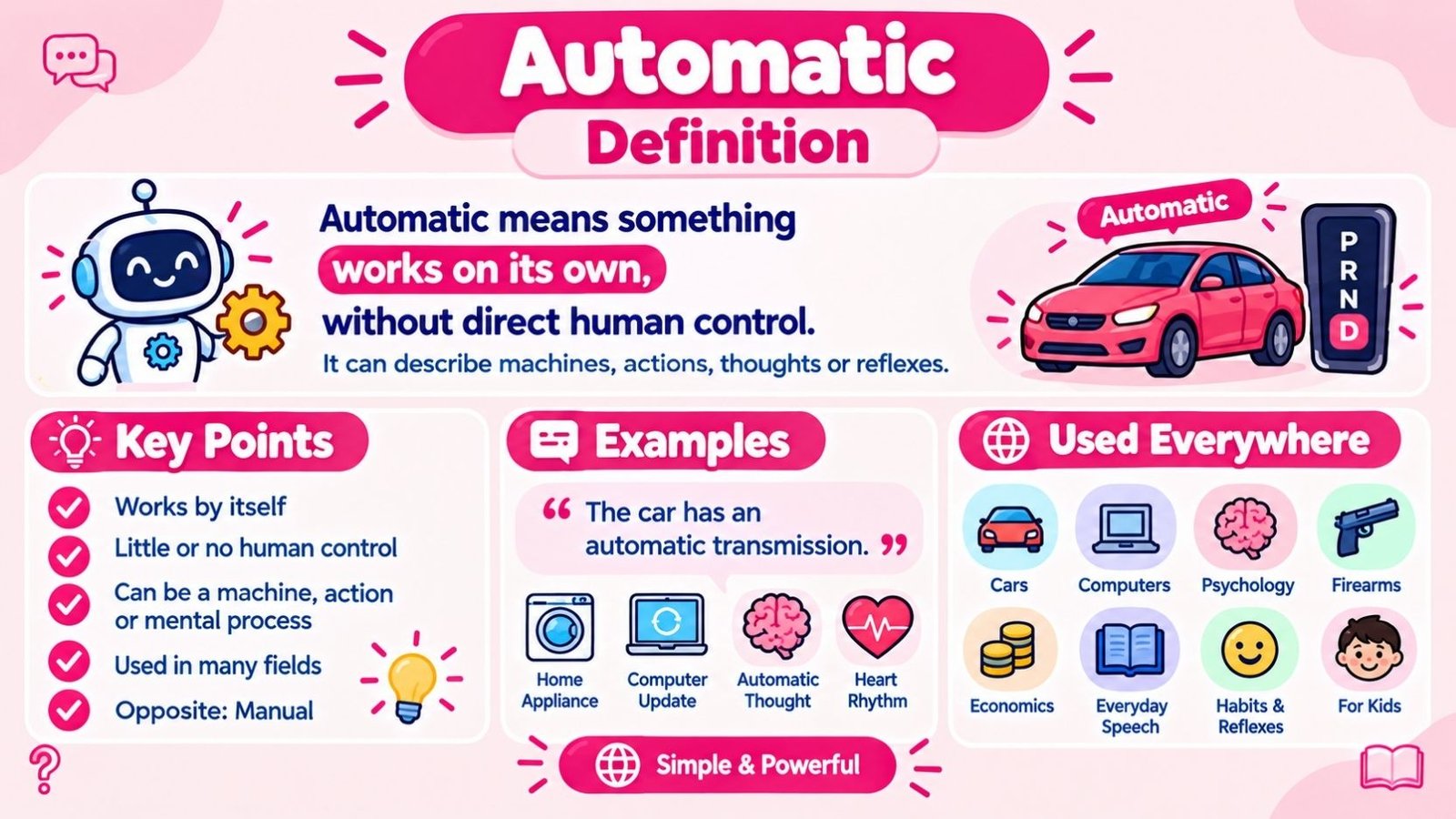
Automatic describes something that works, happens, or responds on its own, without a person actively controlling it in the moment. It applies to machines that run without manual operation, and to actions, thoughts, or reflexes that happen without conscious effort.
That single idea, something happening without direct human control, stretches across a surprising number of fields. A car transmission, a computer script, a knee-jerk reflex, and a government tax rule can all be called automatic, but each context adds its own twist.
This guide breaks the word down by meaning, shows how it is actually used, and clears up the confusion that shows up most often, especially around cars, firearms, and psychology.
Quick Definition
Automatic (adjective): acting, moving, or operating by itself, with little or no direct human control once it has been started or set up.
It can also work as a noun. An automatic is a machine, device, or product, such as a car or firearm, that has this self-operating quality built in.
At A Glance
| Detail | Information |
| Word type | Adjective, and also a noun |
| Register | Neutral, used in everyday, technical, and formal writing |
| Tone | Neutral, sometimes implies convenience or lack of conscious thought |
| Common contexts | Cars, computers, psychology, firearms, economics, everyday speech |
| Opposite | Manual |
Read More: Mood Congruent Memory Psychology Definition
So, What Does Automatic Mean in Simple Terms?
Think of anything that just does its job without you having to push, click, or think about it each time. A porch light that turns on at dusk is automatic. So is blinking when dust hits your eye.
The word covers two related ideas. One is mechanical: a machine that runs itself once switched on. The other is behavioral: an action your body or mind performs without deliberate thought.
Both share the same core meaning. Nobody is actively steering the process step by step.
How Is Automatic Actually Used in Real Life?
People use this word constantly, and mostly without thinking twice about which sense they mean, because context usually makes it obvious.
In casual conversation, it often describes convenience. “The dishwasher is automatic” simply means you load it and walk away. In technical writing, it describes a system property, such as automatic backups in software or automatic braking in a car.
In psychology and everyday self-talk, it describes mental shortcuts. People say a reaction was “automatic” when they did not consciously choose it, like flinching or answering a familiar question without thinking.
In some contexts, mechanical and automatic overlap closely, though mechanical tends to stress a dull, machine-like quality rather than pure self-operation. That distinction matters more in formal writing than in daily speech.
What Does Automatic Look Like In A Sentence?
- Casual conversation:
“Just leave it, the sprinklers are automatic.” - Professional setting:
“We switched to automatic invoicing to cut down on manual errors.” - Online or texting:
“lol my reply was so automatic I didn’t even read the message first” - Academic context:
“Reading fluency depends partly on automatic word recognition.” - Technical writing:
“The system performs an automatic restart after each update.”
Automatic Can Mean More Than One Thing
The word shifts meaning depending on the field. Here are the meanings people search for most.
Automatic As A General Word
The everyday meaning: something that operates by itself, without a person manually running each step. This covers home appliances, software features, and simple daily language.
Automatic Car
An automatic car has a transmission that changes gears by itself. The driver does not operate a clutch pedal or manually shift gears, unlike a manual transmission vehicle.
Some modern automatics, often called shiftable automatics, still let the driver manually select gears when wanted. A five speed shiftable automatic or six speed shiftable automatic offers this hybrid control, automatic by default, manual on demand.
Manual Vs Automatic
| Term | Meaning | Typical Use | Key Difference |
| Automatic | Transmission shifts gears on its own | Everyday driving, most US vehicles | No clutch pedal, less driver input |
| Manual | Driver shifts gears using a clutch | Performance driving, some trucks, some regions abroad | Full driver control over gear changes |
Automatic In Computers
In computing, automatic describes a process, setting, or program that runs without a person triggering each action manually. Automatic updates, automatic saves, and automatic backups are common examples.
The word signals that the system, not the user, decides when the task happens, based on a schedule or trigger someone set up in advance.
Automatic Definition In Psychology
In psychology, automatic describes mental processes that happen quickly, without conscious effort or intention. Researchers generally split cognitive processing into automatic and controlled categories, based mainly on how much attention and effort a process requires.
Automatic processes need little or no attention, take low effort, and can run alongside other mental tasks at the same time. Reading a familiar word, recognizing a friend’s face, or reacting to a loud noise are common examples.
This concept is closely tied to automaticity, the noun form. Automaticity is the ability to carry out a skill using very few attention and working memory resources, and it is considered a hallmark of expert performance built through learning and repeated practice.
Note: Early psychology treated automatic and controlled processing as an all-or-nothing split. That strict, all-or-none view has been repeatedly challenged, since features of automatic and controlled processing often mix together rather than falling neatly into one category or the other.
Automatic Processing In AP Psychology
Students studying AP Psychology usually meet this term as a contrast to controlled, effortful thinking. Automatic processing covers unconscious mental shortcuts, like instantly recognizing a stop sign’s shape, that require no deliberate attention.
Controlled processing, by contrast, involves focused, step-by-step thought, such as solving an unfamiliar math problem.
Automaticity In Reading
In reading research, automaticity describes the point where a reader recognizes words instantly, without sounding them out. This frees up mental effort for understanding the meaning of a sentence rather than decoding individual letters.
Automaticity Of The Heart
In medicine, automaticity describes the heart’s ability to generate its own electrical signal and beat rhythmically without input from the nervous system. Certain heart cells trigger this rhythm on their own, which is why a heart can keep beating briefly even outside the body.
Automatic Reinforcement In ABA
In Applied Behavior Analysis, automatic reinforcement describes reinforcement that a behavior produces for itself, with no other person involved. It is reinforcement that occurs in the absence of social consequences.
A simple everyday example is scratching an itch. The relief itself reinforces the scratching, with nobody else needed to deliver a reward. This concept is often illustrated with everyday actions like scratching an itch to relieve discomfort. Clinicians use this idea to understand repetitive behaviors that persist even when nobody is around to notice them.
Automatic Stabilizers In Economics
In economics, automatic stabilizers are government spending and tax rules that adjust on their own as the economy changes, without new laws or votes. Automatic stabilisers are taxes and government spending that change automatically, without deliberate government action, to help offset swings in a country’s economic output.
Common US examples include progressive income tax and corporate tax rates, along with government transfer programs like unemployment benefits. When people lose jobs in a downturn, they pay less tax and may receive more benefits, which cushions the wider economy automatically.
Read More: Clothe Definition
Semi Automatic And Fully Automatic Firearms
This is one of the most searched, and most misunderstood, uses of the word. The distinction matters for legal, forensic, and everyday accuracy.
Semi-automatic firearms fire one bullet per trigger pull, and the weapon automatically reloads the chamber afterward, unlike fully manual firearms that require loading each round by hand.
A fully automatic firearm is designed to fire more than one shot from a single, sustained pull of the trigger. As long as the trigger stays pressed and ammunition remains available, the weapon keeps firing.
Semi Automatic vs Fully Automatic
| Term | Meaning | Typical Use | Key Difference |
| Semi-automatic | One shot per trigger pull, self-reloading | Common civilian handguns and rifles | Trigger must be pulled again for each shot |
| Fully automatic | Continuous fire from one trigger pull | Military and law enforcement weapons, heavily restricted for civilians | Fires repeatedly until trigger release or ammunition runs out |
Before you use these terms, remember this: semi-automatic does not mean fully automatic, even though both involve self-loading. Semi-automatic firearms are designed to fire one bullet per trigger squeeze and do not include a switch to make them fire fully automatically. Mixing up the two terms is one of the most common factual errors in gun-related news coverage and casual conversation.
Fully automatic firearms continue to load and fire ammunition until the trigger is released, the ammunition runs out, or the gun jams. This is what forensics and ballistics reports mean when they classify a weapon as fully automatic, based on its mechanical firing behavior, not its appearance.
What Does Automatic Not Mean?
A few common mix-ups are worth clearing up directly.
- Automatic does not mean unlimited or effortless in every context. In psychology, automatic processes still use some mental resources, even if they feel effortless.
- Semi-automatic does not mean fully automatic. This distinction is legally and technically important, not just a matter of wording.
- Automatic does not always mean “good” or “convenient.” A negative habit can also be described as automatic, such as an automatic negative thought pattern.
- An automatic car is not the same as a self-driving car. An automatic transmission only removes manual gear shifting. It has nothing to do with autonomous driving technology.
How Do You Pronounce Automatic?
Automatic is pronounced ˌȯ-tə-ˈma-tik, roughly “aw-tuh-MAT-ik,” with the main stress on the third syllable.
Where Does the Word Automatic Come From?
Automatic was borrowed from the New Latin word automaticus, which traces back to the Latin automatum, meaning a contrivance with a hidden mechanism that appears to operate on its own, itself borrowed from the Greek autómaton.
The adjective form of the word was first recorded in English in 1686, while the noun form appeared later, in 1870. The Greek root, meaning “self-acting,” explains why the word has always centered on the idea of something operating without outside help.
Is Automatic Formal, Informal Or Technical?
Automatic works comfortably in every register. It appears in casual speech, technical manuals, legal documents, and academic psychology papers without sounding out of place in any of them.
The tone shifts slightly by field. In everyday speech it often implies convenience. In psychology and behavior analysis, it is a precise technical term with a specific meaning. In firearms law, it carries serious legal weight and should be used carefully.
Is Automatic Positive, Negative Or Neutral?
The word itself is neutral. Whether “automatic” sounds good or bad depends entirely on what it is describing.
- Positive: an automatic backup that saves your work without you remembering to click save.
- Neutral: an automatic transmission, simply a mechanical feature.
- Negative: an automatic assumption or automatic bias, which can suggest a lack of critical thought.
What Words Mean Something Similar To Automatic?
Close synonyms include self-acting, self-regulating, and mechanical, though each carries a slightly different shade of meaning. Mechanical stresses a lifeless, often perfunctory quality in a response, while automatic simply implies action without conscious thought.
In the behavioral sense, related words include involuntary, reflexive, and instinctive. Instinctive stresses action that involves neither judgment nor deliberate will, similar to blinking as a reflex.
The clearest opposite across nearly every context is manual, meaning operated by hand or requiring direct human control at each step.
When Should You Use The Word Automatic?
Use automatic when you want to describe a process, machine, or reaction that runs without someone actively managing each step. It fits naturally in product descriptions, technical writing, casual conversation, and academic explanations of behavior or cognition.
Be more careful with it in firearms contexts. Since “automatic” and “semi-automatic” carry different legal meanings, precision matters more than convenience there. Using the wrong term can misrepresent how a weapon actually functions.
Read More: Lavage Definition
Automatic Definition For Kids
For younger readers, automatic simply means something that works by itself, without a person doing each step, like an automatic washer that runs on its own once it is turned on. It can also describe something a person does without thinking, like giving an automatic smile.
The Simple Takeaway
Automatic describes anything, a machine, a habit, or a reflex, that operates without someone directly controlling it moment by moment. The core meaning stays consistent, but the details shift by field: a transmission in cars, a mental shortcut in psychology, a firing mechanism in firearms, and a fiscal rule in economics.
When precision matters, especially with cars, guns, or clinical terms, check which specific meaning applies before using the word casually.
Frequently Asked Questions
What does automatic mean in simple terms?
It means something works or happens on its own, without a person actively controlling each step. This applies to machines, habits, and reflexes alike.
Is automatic the same as automated?
They are closely related but not identical. Automatic usually describes a built-in, self-operating quality, while automated often refers to a process that was deliberately set up to run without manual input.
Is automatic a formal or informal word?
It is neutral and fits both casual conversation and formal or technical writing without sounding out of place.
What is automaticity?
Automaticity is the ability to perform a skill using very little conscious attention or mental effort, usually developed through practice. It applies to reading, heart rhythm, and expert physical skills.
Can automatic describe a person’s behavior?
Yes. A reaction, habit, or thought can be called automatic when it happens without conscious decision-making, such as an automatic response to a familiar question.
What does automatic mean for a car?
An automatic car shifts gears on its own, so the driver does not need to operate a clutch or manually change gears.
Why is automatic sometimes confused with self-driving?
Because both involve reduced driver effort. But an automatic transmission only removes manual gear shifting, while self-driving technology controls steering, braking, and navigation.
What does automatic mean in economics?
It refers to taxes and spending that adjust on their own as the economy changes, without new legislation or a policymaker’s direct action.
Is fully automatic legal to own in the United States?
Ownership of fully automatic weapons manufactured after May 19, 1986, is illegal for private civilians in the United States, though earlier registered models can still be owned under strict federal regulation. This is a general summary, not legal advice, and rules vary by situation.

Laiba Rahman is a writer and researcher behind Definixaa, dedicated to exploring words, meanings, terms, concepts, and everyday knowledge. Through clear and well-researched explanations, her goal is to help readers understand unfamiliar ideas quickly and discover useful information with ease.
One Comment