
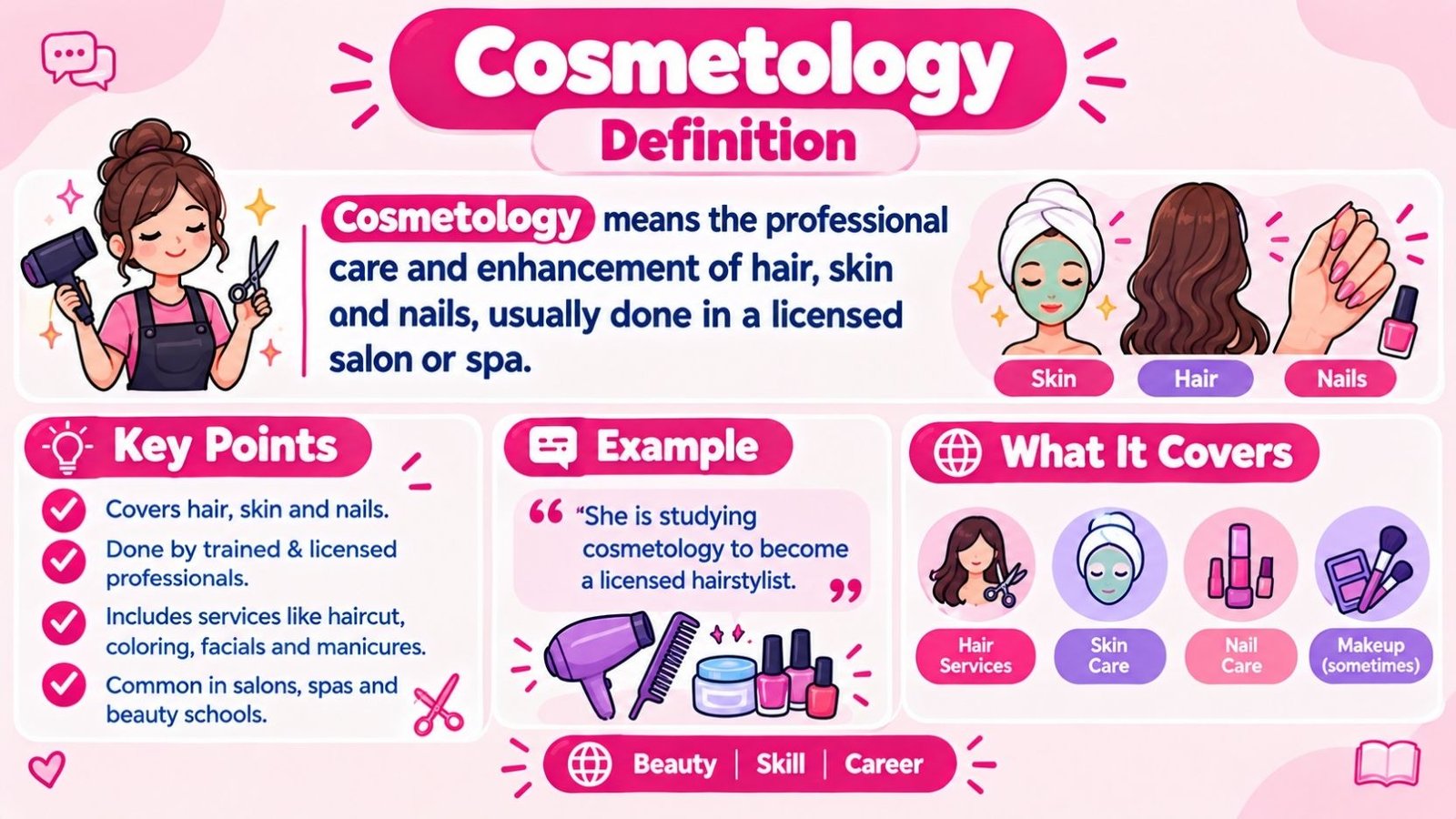
Quick Definition: Cosmetology means the professional art and science of caring for and enhancing a person’s hair, skin, and nails, usually performed in a licensed salon or spa setting.
Cosmetology is the professional study and practice of beautifying hair, skin, and nails. It covers services such as haircutting, hair coloring, styling, skin care, and manicures, performed by a trained and licensed cosmetologist.
That is the short answer. The rest of this guide explains where the word comes from, how it is used in medical, legal, and classroom settings, what a cosmetology course actually teaches, and the technical vocabulary students run into once they start training.
So, What Is Cosmetology In Simple Terms?
Think of cosmetology as the umbrella term for the beauty profession. It is not one single service. It is a whole field of training that includes cutting and coloring hair, giving facials, doing manicures and pedicures, and sometimes applying makeup.
Merriam-Webster defines it plainly as the cosmetic treatment of the skin, hair, and nails. Dictionary.com’s more traditional entry describes it as the art or profession of applying cosmetics, while its Collins entry frames it more broadly as the work of beauty therapists, including hairdressing, facials, and manicures.
In everyday use, “cosmetology” almost always refers to the licensed profession, not just the act of putting on makeup. If someone says they are “going to cosmetology school,” they mean they are training to become a licensed hairstylist, esthetician, or nail technician, not that they are studying how to apply lipstick.
Read More: Edge Effect Definition
At A Glance
| Detail | Information |
| Meaning | The professional practice of beautifying hair, skin, and nails |
| Type | Technical or vocational term |
| Tone | Formal, professional, neutral |
| Common context | Beauty schools, salons, state licensing boards, medical or dermatology writing |
| Related terms | Esthetics, barbering, electrology, nail technology, trichology |
How Do You Pronounce Cosmetology?
Cosmetology is pronounced kahz muh TAHL uh jee, with the stress on the third syllable, “tol.” In IPA, the American pronunciation is written /ˌkɑːzməˈtɑːlədʒi/. Most learners find it easier once they break it into four parts: cos, meh, tol, uh, jee.
Where Does the Word Cosmetology Come From?
The word has a fairly recent history for something that sounds ancient. Merriam-Webster traces it to French cosmétologie, itself built from cosmétique (cosmetic) plus the suffix logie, meaning “the study of.” Its first recorded English use dates to 1926, and Dictionary.com places the root further back in Greek kosmētos, meaning “adorned” or “arranged.”
So at its core, cosmetology literally means “the study of adornment.” That lines up neatly with how the word is used today: it is the formal, studied version of beauty work, not just casual grooming.
What Does Cosmetology Mean in a Medical Context?
In medical dictionaries, the definition barely changes. Merriam-Webster’s medical entry defines cosmetology the same way as its general entry: the cosmetic treatment of the skin, hair, and nails. This matters because “cosmetology” is sometimes confused with “cosmetic surgery” or “dermatology.” It is not the same thing.
Note: Cosmetology is a non-medical, cosmetic profession. It focuses on appearance and grooming, not on diagnosing or treating skin disease. A cosmetologist who notices a mole or rash that looks concerning is trained to refer the client to a doctor, not to treat it.
What Is the Legal Definition of Cosmetology?
Every U.S. state defines cosmetology by law, since it is a licensed profession. The wording varies by state, but the pattern is consistent. Iowa’s statute, for example, defines cosmetology as arranging, dressing, curling, waving, shampooing, cutting, and coloring hair, along with massaging and beautifying the scalp, face, neck, and upper body, plus manicuring nails. Texas law similarly defines cosmetology as treating a person’s hair through methods like cutting, coloring, styling, and shaping, plus related preparatory services such as trimming.
These legal definitions exist so state boards can decide who needs a license and what services fall under it. If you ever see “cosmetology” written in a state law or licensing document, it is describing this regulated scope of practice, not a casual hobby.
What Is the Milady Definition of Cosmetology?
Milady is the leading textbook publisher used in U.S. cosmetology schools, so “the Milady definition” usually means the version taught in that curriculum. Milady materials describe cosmetology as the broad professional field that includes hair services, skin care through esthetics, nail services through nail technology, and permanent hair removal through electrology, all performed under state licensing rules.
Students studying for state board exams will recognize Milady’s language throughout continuing education materials, including terms like hair porosity, elasticity, and density, which are covered later in this guide.
How Is Cosmetology Actually Used in Real Life?
People use the word “cosmetology” in a few consistent, everyday ways.
- In education: “She’s studying cosmetology” means she is enrolled in a licensed beauty program.
- In career contexts: “He has a cosmetology license” means he passed a state exam after completing required training hours.
- In business: “We run a cosmetology school” refers to a state approved vocational training center.
- In casual conversation: People rarely say “I did some cosmetology today.” The word stays formal, tied to schools, licenses, and professions rather than everyday small talk.
It sounds natural in resumes, job postings, school brochures, and state regulations. It sounds slightly stiff in casual conversation, where people usually just say “hair,” “nails,” or “beauty school” instead.
What Are the Branches of Cosmetology?
Cosmetology is not one job. It is a family of related, separately licensed specialties. The main branches include hairstyling, skin care, cosmetics, manicures and pedicures, non-permanent hair removal methods like waxing, and permanent hair removal methods like electrology.
Here is how the branches typically break down in U.S. licensing:
- Hairstyling and hairdressing: Cutting, coloring, chemical texturizing, and styling hair.
- Esthetics: Beautifying, massaging, and cleansing the skin, applying makeup, and tinting eyebrows and eyelashes.
- Nail technology: Cutting, trimming, polishing, and coloring fingernails and toenails, plus applying artificial nails.
- Barbering: Shaving, cutting, trimming, arranging, and coloring hair, including beards.
- Electrology: Removing unwanted hair through a needle or probe that conducts electric current.
Tip: A full cosmetology license usually covers hair, skin, and nail services together. Esthetics, nail technology, and electrology can also be licensed on their own, as separate, narrower careers.
What Does a Cosmetology Course Actually Teach?
A cosmetology course is built around both hands-on technique and classroom science. Based on state curriculum requirements, a typical program covers infection control and safety standards, the science of hair and skin, general anatomy and physiology, and basic chemistry, alongside practical training in cutting, coloring, and styling.
Most programs combine:
- Theory classes: anatomy, chemistry, sanitation law, and business basics.
- Technical skills: haircutting, coloring, chemical services, skin treatments, and nail care.
- Supervised clinic hours: working on real clients under an instructor’s supervision.
- State board exam prep: written and practical tests required for licensing.
How Long Does a Cosmetology Degree or Program Take?
There is no single national cosmetology degree. Instead, most people complete a certificate or diploma program at a licensed cosmetology school, and a smaller number pursue an associate degree at a community college.
State boards require between 1,000 and 2,100 clock hours of training before a student can sit for the licensing exam, with California and Texas near the low end and Iowa near the high end. Most programs fall between 1,000 and 1,600 hours, which usually takes about nine months to two years depending on whether a student attends full time or part time. An associate degree route through a community college typically takes about two years.
Quick Takeaway
- Diploma or certificate programs: roughly 9 to 18 months, full time.
- Associate degree programs: about 2 years.
- All 50 states require passing a licensing exam after training.
Read More: Mood Congruent Memory Psychology Definition
Cosmetology School: What to Expect
A cosmetology school is a state licensed institution, not a casual class. Programs must meet a state’s minimum hour requirements and cover an approved curriculum before graduates can apply for a license. Costs vary widely, with private beauty schools sometimes reaching $20,000 or more once tuition, kits, and fees are included, while community college programs are often less expensive.
Before You Enroll, Remember This: A cosmetology school and a cosmetology license are not the same thing. Finishing school qualifies you to take the state licensing exam. You still need to pass that exam to legally practice as a cosmetologist.
Cosmetology Terms You Will Hear in Class or in a Salon
Students searching “cosmetology definition” are often looking up specific technical vocabulary from a textbook or exam, not just the general word. Here is a plain-language glossary of the most searched terms.
| Term | What It Means in Cosmetology |
| Porosity | The hair’s ability to absorb moisture, based on how tightly the cuticle scales lie against the hair shaft |
| Density | The number of hairs per square inch on the scalp, ranging from thin to thick |
| Elasticity | The hair’s ability to stretch and return to its normal length without breaking |
| Texture | The diameter of an individual hair strand, described as coarse, medium, or fine |
| Cuticle | The outermost layer of the hair, which protects the cortex and contributes up to 20 percent of the hair’s strength |
| Cortex | The middle layer of the hair, which provides most of its strength and elasticity |
| Medulla | The innermost layer of the hair, sometimes absent, which does not affect hair coloring |
| Apex | The highest point on the head, used as a reference in haircutting |
| Sanitation | The lowest level of infection control, involving basic cleaning to reduce germs on surfaces and tools |
| Disinfection | The process of killing specific microorganisms on tools or surfaces using chemical agents |
| Sterilization | The most effective level of decontamination, removing all bacterial life, typically through a steam autoclave |
| Decontamination | The overall process of removing germs from tools and surfaces, ranging from sanitation to full sterilization |
| SDS | Safety Data Sheet, a document that must be kept on premises for every product used, explaining hazards and safe handling |
| OSHA | Occupational Safety and Health Administration, the federal agency that regulates workplace safety, including salons |
| EPA | Environmental Protection Agency, the agency that registers disinfectants used in U.S. salons |
Note: Porosity, density, elasticity, and texture are collectively called hair characteristics. Cosmetologists assess all four before recommending a color, cut, or chemical service, since each one affects how hair reacts to treatment.
Why Is Cosmetology Important?
Cosmetology matters for two connected reasons: public health and personal presentation.
On the health side, licensing exists because cosmetologists work directly with skin, hair, and nails, sometimes with chemicals, sharp tools, and heat. Training in sanitation, disinfection, and sterilization protects both the client and the practitioner from infection.
On the personal side, cosmetology gives people practical ways to care for their appearance, mark occasions like weddings, and build careers that do not require a four-year degree. For many students, it is also a faster, lower-cost route into steady employment compared with traditional college paths.
Is Cosmetology the Same as Esthetics, Barbering, or Dermatology?
These terms overlap but are not interchangeable. The table below separates them clearly.
| Term | Meaning | Typical Use | Key Difference |
| Cosmetology | Broad license covering hair, skin, and nail beauty services | Full-service salons | Widest scope of the group |
| Esthetics | Focused license for skin care and makeup | Facials, waxing, skin treatments | Skin only, not hair or nails |
| Barbering | Focused license for men’s hair and beard grooming | Barbershops | Hair and beard cutting, shaving, and trimming only |
| Dermatology | Medical specialty treating skin disease | Medical clinics | Requires a medical degree; diagnoses and treats disorders |
What Does Cosmetology Not Mean?
A few common mix-ups are worth clearing up directly.
- Cosmetology is not the same as cosmetic surgery. Cosmetology does not involve surgical procedures.
- Cosmetology is not just “wearing makeup.” It is the licensed profession and training behind beauty services, not the casual act of applying products yourself.
- Cosmetology is not automatically the same as dermatology, even though both deal with skin. Dermatology is medical; cosmetology is cosmetic and non-medical.
- A cosmetology license is not the same as an esthetics or barbering license, though a full cosmetology license typically includes hair, skin, and nail services together.
Read More: Automatic Definition
What Does Cosmetology Look Like In A Sentence?
- Academic: “Her thesis examined how cosmetology programs affect local employment rates.”
- Professional: “The salon only hires stylists with an active cosmetology license.”
- Everyday: “She’s finishing her final hours of cosmetology school this month.”
- Regulatory: “State law defines cosmetology as any combination of hair, skin, and nail beautification services.”
Frequently Asked Questions
What does cosmetology mean in simple terms?
Cosmetology means the professional practice of caring for and beautifying a person’s hair, skin, and nails, usually through licensed training.
Is cosmetology the same as being a hairdresser?
Not exactly. A hairdresser typically focuses only on hair. A full cosmetology license usually covers hair, skin, and nail services together.
Is cosmetology a medical term?
No. Cosmetology is a cosmetic, non-medical field. Medical dictionaries define it the same way as general dictionaries: the cosmetic treatment of skin, hair, and nails, not a treatment for medical conditions.
How long does cosmetology school take?
Most programs take about 9 months to 2 years, depending on required hours and whether a student attends full time or part time.
What is the difference between cosmetology and esthetics?
Esthetics focuses only on skin care and makeup. Cosmetology is broader and typically includes hair and nail services as well.
What does porosity mean in cosmetology?
Porosity describes how well hair absorbs moisture, based on how tightly the cuticle layer lies against the strand.
Why do cosmetologists need to know about OSHA and the EPA?
OSHA regulates workplace safety in salons, while the EPA registers the disinfectants cosmetologists are required to use. Both protect workers and clients from infection risks.
What is the apex in a haircut?
The apex is the highest point on the head, used as a reference point when shaping and layering hair.
Where does the word cosmetology come from?
It comes from French cosmétologie, built from the word cosmetic plus the suffix logy, meaning “study of,” and first appeared in English around 1926.
Last Words
Cosmetology is the licensed, professional practice of beautifying hair, skin, and nails, built on real training in technique, sanitation, and science. It covers several branches, including hairstyling, esthetics, nail technology, and electrology, each with its own scope and rules.
Whether you’re checking a definition for school, a job, or a research project, the core idea stays the same: cosmetology is skilled, regulated beauty work, not just applying makeup.

Laiba Rahman is a writer and researcher behind Definixaa, dedicated to exploring words, meanings, terms, concepts, and everyday knowledge. Through clear and well-researched explanations, her goal is to help readers understand unfamiliar ideas quickly and discover useful information with ease.
One Comment