
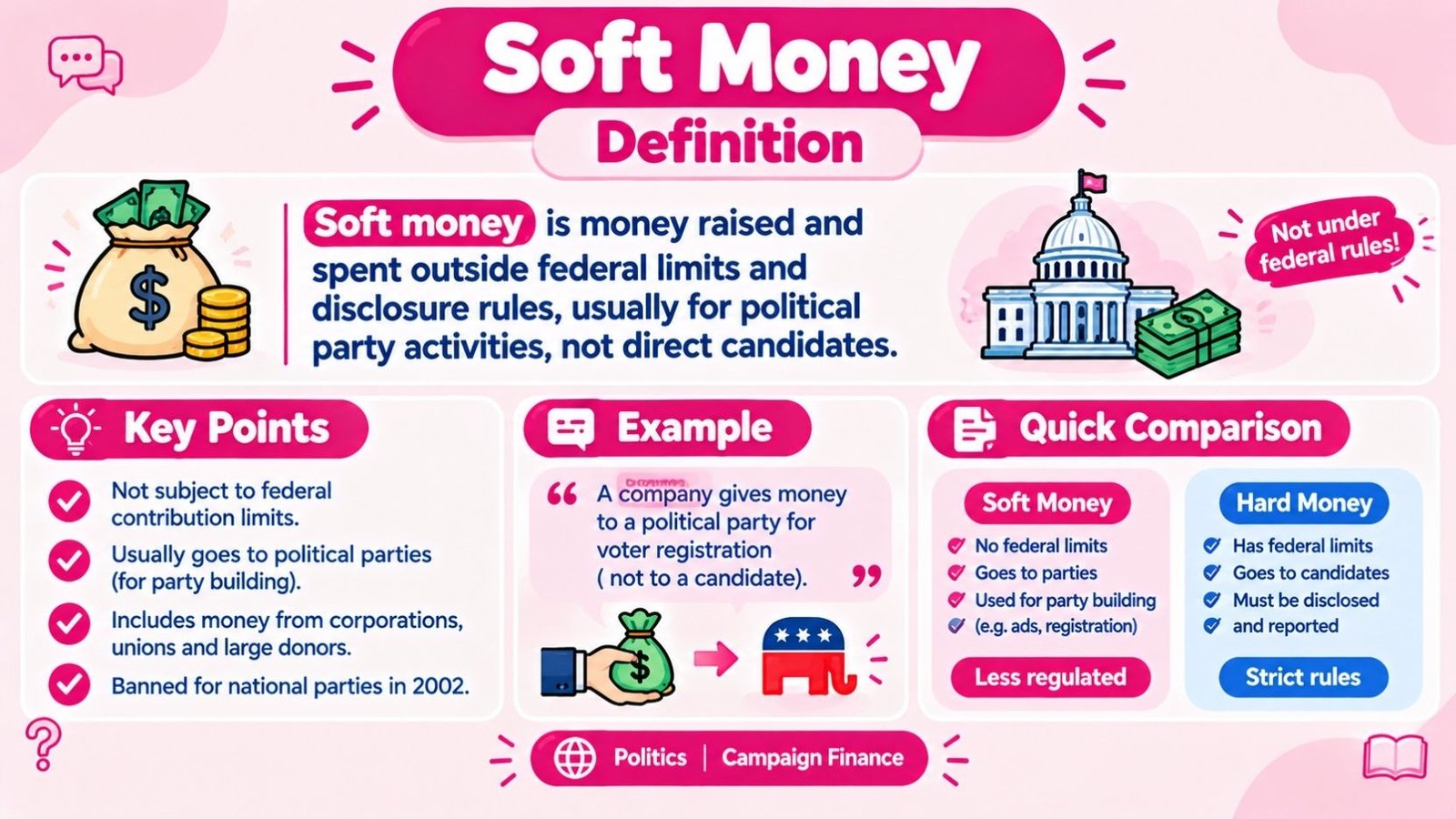
Quick Definition: Soft money is money raised and spent outside the limits and disclosure rules of federal election law. Historically, it went to political parties for “party building” activities like voter registration and issue ads, rather than directly to a candidate. Most soft money to national parties was banned in 2002.
At A Glance
| Detail | Information |
| Meaning | Unregulated political money not subject to federal contribution limits |
| Type | Political and government term, campaign finance concept |
| Tone | Neutral term, but often used critically |
| Common context | US politics, government classes, campaign finance law, AP Gov and APUSH |
| Related terms | Hard money, dark money, Super PAC, BCRA, McCain-Feingold |
Read More: Cosmetology Definition
So, What Is Soft Money In Simple Terms?
In plain language, soft money is money that flows into politics without following the strict rules that apply to campaign donations. Instead of going straight to a candidate, it usually went to a political party, and it wasn’t capped the way ordinary donations are.
Think of it as a side door. Regular (“hard money”) donations to a candidate have to be small, disclosed, and reported to the government. Soft money, before 2002, could be much larger, come from sources like corporations or labor unions, and didn’t have to follow those same limits.
Soft Money Definition: Government Context
In the language of US campaign finance law, soft money refers to contributions raised by national and state parties that are not regulated by federal campaign finance law because they aren’t given directly to a candidate but to a party committee for general “party building” activities, such as get out the vote drives or voter registration programs.
These funds are sometimes called non federal money, because they fall outside federal contribution limits. Soft money means contributions made outside the limits and prohibitions of federal law, including direct corporate and union money and large individual or PAC contributions.
Note: The word “soft” doesn’t describe the money itself. It describes how loosely it was regulated compared with “hard” money, which follows strict federal rules.
Soft Money Definition: AP Gov And APUSH
Students usually meet this term in a unit on campaign finance, political parties, or elections. For AP Gov and APUSH purposes, the core idea is the same as the legal one, just simplified for a course.
Soft money refers to contributions to political parties or outside groups for party building, voter registration, and generic issue ads, and before the Bipartisan Campaign Reform Act of 2002, it was largely unlimited and unregulated. That single sentence covers most of what an exam question expects.
A useful way to remember it for a test: hard money follows the rules, soft money used to avoid them.
Is Soft Money Illegal?
This is one of the most searched follow up questions, and the honest answer has two parts.
Soft money itself, as a category, was never automatically illegal. The problem regulators worried about was that it let large, unlimited sums into politics with far less transparency than direct candidate donations. It was loosely defined as unlimited donations to political parties from individuals, organizations, or unions meant to fund party building activities or state elections, first allowed by the FEC in the late 1970s.
That changed with reform. The Bipartisan Campaign Reform Act of 2002, also known as the McCain Feingold Act, was one of the most significant changes to campaign finance law. It banned national political parties from raising or spending traditional soft money.
So today, raising unlimited, undisclosed soft money for a national party in the old style is against the law. But related practices haven’t disappeared entirely, which is why the topic still comes up in current news.
Tip: If someone asks “is soft money illegal,” the safest short answer is: national party soft money was banned by federal law in 2002, though some soft money style loopholes involving state parties and outside groups are still debated.
How Soft Money Actually Worked: Historically
Before the 2002 reform, soft money quietly became one of the biggest sources of political spending. Soft money raised by the national party committees grew from about 86 million dollars in 1992 to roughly 495 million dollars in 2000, making it a major source of political television advertising.
That growth is exactly why reformers pushed for change. Large donors, including corporations and unions that were barred from giving directly to candidates, could still give substantial sums to parties instead.
The 1974 Federal Election Campaign Act first put contribution limits on hard money given directly to candidates, while soft money for parties faced far fewer restrictions on amount. That gap between the two systems is what soft money exploited for decades.
Soft Money Vs Hard Money
People often search “soft money vs hard money” because the two terms only make sense side by side. Here is the core distinction.
| Term | Meaning | Typical Use | Key Difference |
| Hard Money | Contributions given directly to a candidate’s campaign | Individual and PAC donations to a specific candidate | Strictly limited and fully disclosed to the FEC |
| Soft Money | Funds raised for parties or general political activity, historically outside federal limits | Party building, voter registration, generic issue ads | Far less regulated; most national party soft money was banned in 2002 |
Hard money is money donated directly to a candidate, while soft money is funds donated to political parties to support the party at large, and soft money isn’t subject to the same FEC regulations as hard money.
Hard money contributions can go directly to a candidate’s campaign and make an immediate difference, and their biggest strength is transparency thanks to FEC reporting requirements, while soft money offered less transparency since it wasn’t subject to the same reporting rules.
What Does Soft Money Not Mean?
A few common mix ups are worth clearing up directly.
- Soft money does not mean “small” or “minor” donations. It can involve very large sums; the word “soft” refers to weak regulation, not a small amount.
- Soft money is not the same as a bribe. It refers to a legal funding category as it existed under older rules, not a criminal payment.
- Soft money is not the same thing as dark money, even though people sometimes confuse the two. The next section explains why.
Read More: Automatic Definition
Soft Money Vs Dark Money
These two terms are related but describe different problems, and mixing them up is a common mistake.
Soft money, historically, was about unlimited donations to political parties that avoided federal contribution limits. Dark money instead refers to election related spending by groups that are not required to disclose their donors, with a 501(c)(4) “social welfare” nonprofit as the classic example.
When the source of political money isn’t known, that is dark money, and the two most common vehicles for it are politically active nonprofits and corporate entities such as limited liability companies. So the key difference is this: soft money was mainly about unlimited amounts, while dark money is mainly about hidden sources.
Before you use these terms, remember this: Soft money is about the limit on the money. Dark money is about the transparency of who gave it. A donation can technically be legal, limited, and still be “dark” if the donor’s identity is shielded.
Soft Money Example
Concrete examples make this concept much easier to picture. Here are a few original, illustrative examples based on how soft money historically worked.
Example 1 (party building): A corporation that could not legally donate directly to a Senate candidate instead gave a large sum to a national party’s “non federal account,” which the party used for get out the vote mailers.
Example 2 (issue advocacy): A political party ran a television ad encouraging people to “call your representative about healthcare” without directly saying “vote for” or “vote against” a specific candidate, funded through party soft money.
Example 3 (modern echo): After the 2002 ban on national party soft money, some of that same unlimited, less regulated fundraising activity shifted toward state party accounts and outside groups, an issue watchdog organizations still track closely.
What Does Soft Money University Mean?
Some searches include the phrase “soft money university,” which usually points to something different from campaign finance. In academic and research funding, “soft money” describes a researcher’s salary that is paid from grants rather than the university’s own permanent budget.
Soft money is primarily known as a lightly regulated form of financing electoral campaigns in the United States, but the phrase also appears in other economic and academic contexts, so it’s worth confirming which meaning a source is using before assuming it means political fundraising.
How Is Soft Money Actually Used in Real Life Today?
Even though the classic form of national party soft money was banned in 2002, the underlying idea of “less regulated political money” is still very relevant to how people talk about elections.
Journalists, watchdog groups, and political science courses use “soft money” mainly in a historical and comparative sense now, to explain how campaign finance rules evolved. It appears constantly in:
- Academic and classroom settings: AP Gov, APUSH, and college political science courses use it to teach the arc of campaign finance reform.
- Political journalism: Reporters use it when explaining the history behind current debates over Super PACs and dark money.
- Watchdog and advocacy organizations: Groups tracking money in politics use it to compare today’s rules with the pre 2002 system.
It rarely appears in casual conversation, texting, or social media outside of political discussion, because it’s a specialized, formal term.
When Should You Use the Term Soft Money?
Use “soft money” when you specifically mean money that historically bypassed federal contribution limits by going through party committees rather than candidates. It’s most appropriate in:
- Academic writing about campaign finance or American government
- Journalism explaining the history of election law
- Policy discussions comparing pre and post 2002 fundraising rules
It is less appropriate as a casual stand in for “corruption” or “shady political money” in general, since more specific terms like dark money or Super PAC spending usually fit modern situations better.
Related Terms Worth Knowing
A few related concepts come up constantly alongside soft money, and knowing them sharpens your understanding of the whole topic.
- Hard money: Directly regulated contributions to a specific candidate, capped and disclosed.
- Bipartisan Campaign Reform Act (BCRA), or McCain Feingold: The 2002 campaign finance law that banned so called soft money at the national party level.
- Dark money: Political spending where the donor’s identity is legally shielded from the public.
- Super PAC: A committee that can raise and spend unlimited money independently of a candidate, but must still disclose its donors.
- Federal Election Commission (FEC): The federal agency that enforces campaign finance law and disclosure rules.
Read More: Edge Effect Definition
Soft Money and the 2002 Reform, Briefly
The 2002 law is the single most important turning point in this term’s history, so it deserves its own short explanation.
Under BCRA, federal candidates are legally prohibited from raising or spending soft money, including funds raised or spent by an entity a candidate established, financed, maintained, or controlled. That rule specifically closed the door on candidates using state level committees to bring in money that wouldn’t meet federal standards.
Even so, questions about workarounds haven’t disappeared. Legal observers have pointed to cases where money moved from state level political committees into federal Super PACs shortly after a candidacy was declared, raising fresh concerns about soft money style arrangements. This is part of why the term still matters in current political reporting, not just history classes.
Frequently Asked Questions
What does soft money mean in simple terms?
Soft money is political money that historically avoided federal contribution limits by going to parties instead of candidates, usually for party building or issue ads rather than direct candidate support.
Is soft money the same as hard money?
No. Hard money goes directly to a candidate and is strictly limited and disclosed, while soft money historically went to parties and faced far fewer restrictions before 2002.
Is soft money illegal today?
Traditional unlimited soft money to national parties was banned by the Bipartisan Campaign Reform Act of 2002, though related fundraising practices at the state level are still debated.
What is the difference between soft money and dark money?
Soft money is mainly about unlimited amounts of political money, while dark money is about donors whose identities are legally hidden from the public.
Why was soft money banned?
Lawmakers banned it because unlimited, loosely regulated party donations from corporations, unions, and wealthy donors raised concerns about corruption and unequal influence in federal elections.
What is a soft money example?
A classic example is a corporation donating a large, uncapped sum to a political party’s non federal account, which the party then used for voter registration drives or issue based television ads.
Does soft money still exist in any form?
The original national party version was banned in 2002, but critics argue that similar unlimited fundraising has shifted toward state parties, Super PACs, and certain nonprofit groups.
What does soft money mean in an AP Gov class?
In AP Gov, soft money refers to unregulated contributions to parties for party building activities, contrasted with strictly limited hard money given directly to candidates.
Who created the soft money loophole?
The loophole developed gradually after the FEC allowed party building donations in the late 1970s, and it grew for decades until BCRA closed most of it in 2002.
Last Words
Soft money is unregulated political money, historically given to parties instead of candidates to avoid federal contribution limits. The 2002 Bipartisan Campaign Reform Act banned most of it at the national level, though the underlying tension between money and election rules continues through newer categories like Super PACs and dark money. Understanding soft money is really about understanding one chapter in the ongoing story of how the United States tries to regulate money in politics.

Laiba Rahman is a writer and researcher behind Definixaa, dedicated to exploring words, meanings, terms, concepts, and everyday knowledge. Through clear and well-researched explanations, her goal is to help readers understand unfamiliar ideas quickly and discover useful information with ease.
2 Comments