
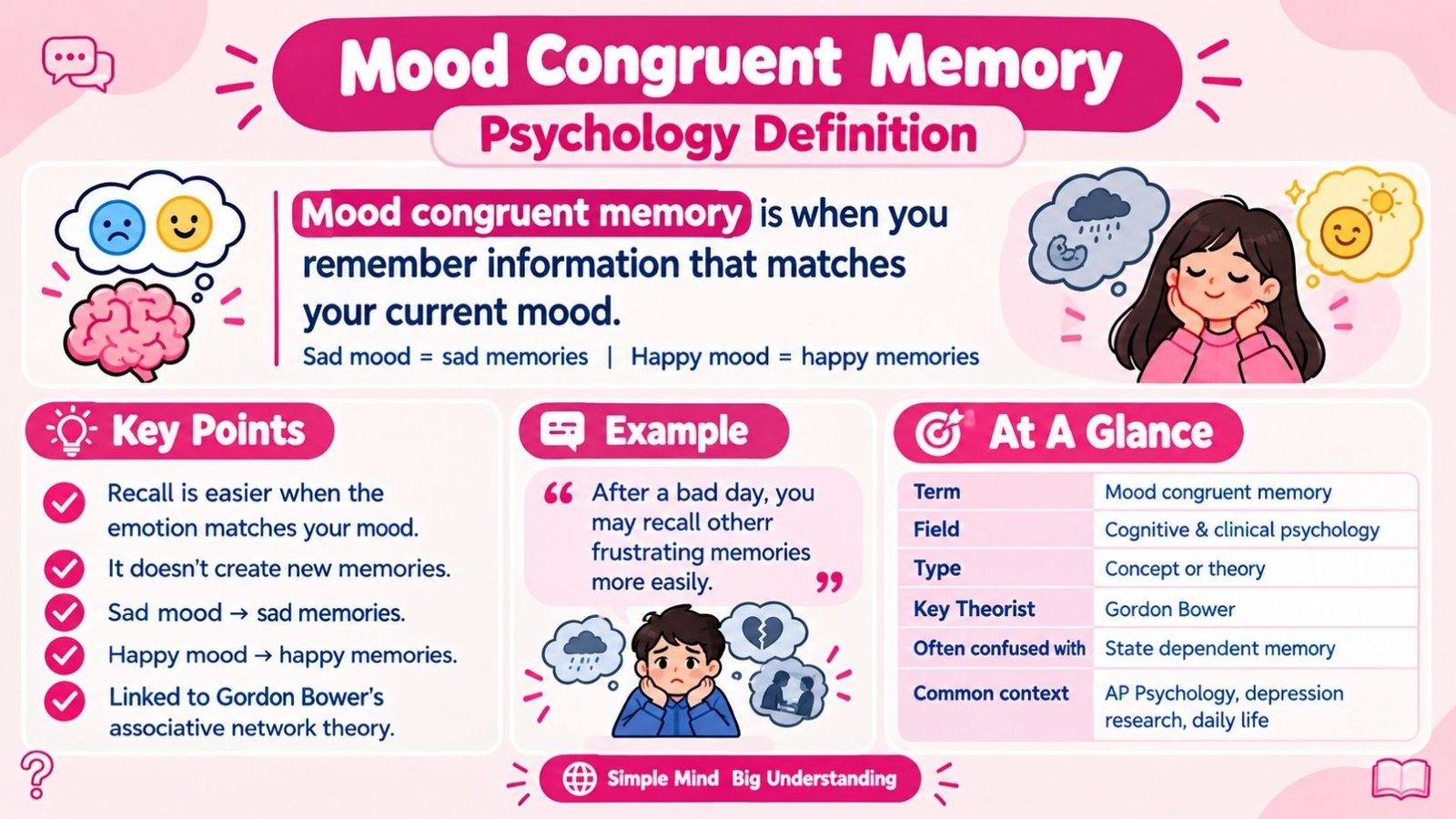
Quick definition: Mood congruent memory is a psychological phenomenon in which a person is more likely to remember information that matches their current emotional state. If someone feels sad, they recall sad memories more easily. If someone feels happy, happy memories come to mind faster. The current mood acts like a filter that favors emotionally matching content.
This idea comes from decades of memory research, most notably the work of psychologist Gordon Bower in the early 1980s. It shows up in psychology courses, clinical discussions of depression, and everyday conversations about why a bad mood seems to “bring back” other bad memories.
At A Glance
| Detail | Information |
| Term | Mood congruent memory |
| Field | Cognitive and clinical psychology |
| Type | Concept or theory |
| Core idea | Current mood biases which memories get recalled |
| Key theorist | Gordon Bower, associative network theory |
| Often confused with | State dependent memory |
| Common context | AP Psychology courses, depression research, everyday self reflection |
Read More: Lavage Definition
So, What Does Mood Congruent Memory Actually Mean?
Mood congruent memory describes a recall bias. It is not about creating new memories. It is about which existing memories surface more easily depending on how someone feels right now.
Researchers define it in a fairly consistent way. Mood congruent memory is the enhanced encoding and recall of information whose emotional tone matches a person’s current mood. Sad moods pull up sad content. Happy moods pull up pleasant content. The match between the emotion in the memory and the emotion in the moment is what matters.
This is different from simply “remembering more when upset.” It is specifically about the emotional content lining up with the emotional state.
In Simple Words
Think of your memory as a filing cabinet with folders labeled by feeling. Some folders hold happy memories. Others hold sad, angry, or anxious ones.
When you feel a certain way, your brain tends to open the folder that matches. Feeling down makes the “sad memories” folder easier to reach. Feeling good makes the “happy memories” folder easier to reach.
You are not inventing memories. You are simply retrieving the ones that already fit your emotional tone at that moment.
Where Did This Idea Come From?
The concept is closely tied to Gordon Bower’s 1981 paper “Mood and Memory,” published in American Psychologist. Bower proposed an associative network theory of emotion and memory.
In his model, emotions function like nodes in a mental network, similar to how concepts and words are linked in semantic memory. Each emotion node connects to related thoughts, words, and past experiences that share that emotional tone.
When a mood is activated, Bower argued, activation spreads outward through the network. Related concepts and memories connected to that emotion become easier to access. This spreading activation is the mechanism many psychologists still use to explain mood congruent recall.
Note: Bower’s original research also found something researchers did not fully expect. Participants who were in a neutral mood, neither happy nor sad, still tended to recall more positive material than negative material. This suggests a mild positivity bias exists outside of pure mood congruence.
How Is Mood Congruent Memory Actually Used in Real Life?
This is not just a laboratory concept. It shows up in ordinary emotional experience and in clinical settings.
- Everyday life: After a stressful day, people often report that other frustrating memories from the week resurface unprompted. A single bad mood can make several unrelated negative memories feel closer to the surface.
- Clinical psychology: Researchers studying depression have looked closely at mood congruent memory because it may help explain why negative thinking patterns persist. A depressed mood can make negative memories easier to retrieve, which can reinforce the negative mood itself.
- Academic settings: The term appears frequently in AP Psychology and introductory cognitive psychology courses, usually alongside state dependent memory and Bower’s network model.
- Social psychology: The broader idea of mood congruence also appears in discussions of how emotional states shape judgment, attention, and interpretation of ambiguous situations, not just memory retrieval.
In academic and clinical writing, mood congruent memory is usually discussed as stable and reproducible across many studies, not a fringe or one-off finding.
What Does Mood Congruent Memory Look Like In A Sentence?
Original examples, written for clarity:
- Everyday context:
“After the breakup, she kept thinking about every other disappointing relationship she’d had, a clear case of mood congruent memory.” - Academic context:
“Bower’s research on mood congruent memory showed that sad participants recalled a higher proportion of negative words from a list.” - Clinical context:
“Therapists sometimes address mood congruent memory directly, since a depressed mood can make it harder for a client to recall anything positive about their week.” - Casual conversation:
“I was already annoyed, so of course every annoying thing that ever happened to me came flooding back.”
Read More: Honing Definition
Mood Congruent Memory Versus State Dependent Memory
These two terms are commonly confused, and many students mix them up in psychology classes. They are related but not the same thing.
| Term | Meaning | Typical Focus | Key Difference |
| Mood congruent memory | Recall is easier when the emotional content of the memory matches your current mood | The emotional tone of the information itself | Depends on content matching mood, regardless of mood during encoding |
| State dependent memory | Recall is easier when your current physical or emotional state matches the state you were in when the memory was formed | The internal state during encoding versus retrieval | Depends on matching your state at encoding and retrieval, not the emotional content |
Tip: A simple way to separate them: mood congruent memory asks “does this memory’s feeling match my current feeling?” State dependent memory asks “was I in the same state when I learned this as I am now?”
According to research summarized in academic reviews, one important distinction is that mood congruent memory does not require knowing or matching the mood present during the original encoding of the memory. State dependent memory specifically relies on that encoding to retrieval state match.
Mood Congruent Versus Mood Incongruent
Mood incongruent memory or experience is essentially the opposite pattern. It happens when someone’s emotional reaction or the content they recall does not match their current mood or situation.
In broader psychology, mood incongruence is also discussed in the context of psychotic symptoms. For example, delusions can be described as mood congruent, such as feelings of worthlessness during a depressive episode, or mood incongruent, when the content of a delusion does not match the emotional tone of the episode at all.
For everyday memory, mood incongruent recall is simply less common. Bower’s associative model predicts that congruent recall should generally be stronger than incongruent recall, because the spreading activation favors matching emotional nodes.
What Does Mood Congruent Memory Not Mean?
There are a few common misunderstandings worth clearing up.
- It does not mean memories are fabricated. Mood congruent memory affects which real memories are retrieved more easily. It does not create false memories on its own, though mood can influence how a memory feels when it is recalled.
- It does not mean every memory becomes accessible. The effect specifically favors memories whose emotional tone matches the current mood, not all memories in general.
- It is not the same as state dependent memory. As shown above, one is about content matching mood, the other is about internal state matching between encoding and retrieval.
- It does not require a diagnosed mood disorder. While it is heavily studied in depression research, mood congruent memory is a normal cognitive process that happens in everyday, non-clinical moods too.
The Mood Congruent Effect: Explained Simply
“Mood congruent effect” and “mood congruent memory” are generally used to describe the same underlying phenomenon. The effect is the observable outcome: better recall of mood matching material compared to mismatched material.
Researchers have also linked this effect to mood congruent processing, a related idea proposed by Bower. This describes how a current mood does not only affect what is remembered later. It can also affect what a person pays attention to and elaborates on while an event is happening, which then shapes what gets encoded into memory in the first place.
In short, the effect works at two points: while information is being taken in, and later when it is being recalled.
Mood Congruent Theory: The Associative Network Model
When people refer to “mood congruent theory,” they are usually referring to Bower’s associative network theory of emotion, sometimes called the network theory of affect.
Its central claims, in simple terms:
- Emotions are represented as nodes within a broader memory network.
- Each emotion node connects to thoughts, words, and past experiences carrying that same emotional tone.
- Activating an emotion spreads activation through the network to linked, emotionally similar material.
- This spreading activation makes mood congruent material easier and faster to retrieve than mismatched material.
This theory does not claim mood is the only factor influencing memory. Other researchers have pointed out that boundary conditions still are not fully understood, including how attention, individual differences, and the intensity of the mood interact with this basic mechanism.
Mood Congruent Memory In AP Psychology
For AP Psychology students, mood congruent memory typically appears in the unit covering memory, alongside related concepts such as state dependent memory, encoding, and retrieval cues.
A concise AP style definition: mood congruent memory is the tendency to recall experiences that are consistent with one’s current mood, more readily than experiences that are inconsistent with it.
Exam style example: A student who is anxious before a test might find it easier to recall other anxious experiences, such as a previous stressful exam, rather than calm or confident memories, even if those calmer memories are more common overall.
This is a useful distinction for exam preparation, since state dependent memory and mood congruent memory are frequently tested against each other in multiple choice and free response formats.
When Should You Think About Mood Congruent Memory?
This concept becomes practically useful in a few specific situations.
- When reflecting on why a bad mood feels self reinforcing. Recognizing mood congruent recall can explain why one frustration seems to summon many others.
- When studying for psychology exams. Clearly separating it from state dependent memory prevents a very common mix up.
- When thinking about mental health patterns. Clinicians studying depression often reference this concept to explain how negative mood and negative memory can maintain each other over time.
- When trying to make a fair decision while emotional. Since mood can bias which information comes to mind, being aware of this effect can be a reason to pause before making judgments while in a strong mood state.
Is Mood Congruent Memory a Bias I Should Try to Correct?
Mood congruent memory is not inherently harmful. It is a normal part of how emotion and cognition interact. However, in the context of persistent low mood, this bias can become a maintaining factor rather than a helpful one, since it keeps pulling attention back toward negative material.
Some cognitive approaches, including cognitive restructuring techniques used in therapy, are partly aimed at interrupting this cycle by helping someone deliberately access mood incongruent, more balanced memories and interpretations.
This is not a moral judgment about the phenomenon itself. It is simply useful to know that mood congruent recall can, in some cases, work against emotional regulation if left unexamined.
Read More: Enjoined Definition
Related Terms Worth Knowing
- State dependent memory: Recall improves when physical or emotional state at retrieval matches the state during encoding.
- Mood congruent processing: The tendency for current mood to shape what a person pays attention to and elaborates on while an event happens.
- Associative network theory: Bower’s broader model explaining how emotion nodes connect to memory content.
- Encoding specificity: A related memory principle stating that retrieval works best when cues at recall match cues present during encoding.
- Mood incongruence: The opposite pattern, where recalled content or emotional reaction does not match current mood or situation.
These terms are often taught together, since they all describe different ways that emotional and physical context shape memory performance.
The Simple Takeaway
Mood congruent memory means your current mood makes it easier to recall memories that share the same emotional tone. Feeling sad brings sad memories closer to the surface. Feeling happy does the same for pleasant ones.
The idea traces back to Gordon Bower’s associative network theory from 1981, and it remains a stable, well studied finding in psychology. The most important distinction to remember is that mood congruent memory is about matching content to mood, while state dependent memory is about matching internal state between encoding and retrieval. Keeping that difference clear will help both in coursework and in understanding your own emotional patterns.
Frequently Asked Questions
What is mood congruent memory in simple terms?
It is the tendency to remember things more easily when their emotional tone matches how you currently feel. A sad mood makes sad memories easier to recall.
Who came up with the theory of mood congruent memory?
Psychologist Gordon Bower proposed the associative network theory behind this effect in his 1981 paper, Mood and Memory.
What is the difference between mood congruent memory and state dependent memory?
Mood congruent memory depends on matching the emotional content of a memory to your current mood. State dependent memory depends on matching your internal state during encoding to your state during retrieval.
Is mood congruent memory the same as a false memory?
No. It affects which real memories are retrieved more easily. It does not create memories that never happened.
Does mood congruent memory only apply to sad moods?
No. It applies to any mood, including happiness, anger, or anxiety. The effect favors whichever memories match the current emotional tone.
Why is mood congruent memory important in psychology?
It helps explain how emotion and cognition interact, and it is often discussed in research on depression, since it may help sustain negative thinking patterns.
Is mood congruent memory tested in AP Psychology?
Yes, it commonly appears in the memory unit, often paired with state dependent memory as a comparison concept.
Can mood congruent memory affect decision making?
Yes. Because it biases which memories and associations come to mind, it can subtly influence judgments made while in a strong emotional state.
Is mood congruent memory a mental health disorder?
No. It is a normal cognitive process. It becomes clinically relevant mainly when discussing how it may reinforce mood disorders like depression.
What is mood congruent processing?
It refers to how a current mood shapes what a person notices and thinks about deeply while an event is happening, which affects what later gets remembered.

Laiba Rahman is a writer and researcher behind Definixaa, dedicated to exploring words, meanings, terms, concepts, and everyday knowledge. Through clear and well-researched explanations, her goal is to help readers understand unfamiliar ideas quickly and discover useful information with ease.
2 Comments