
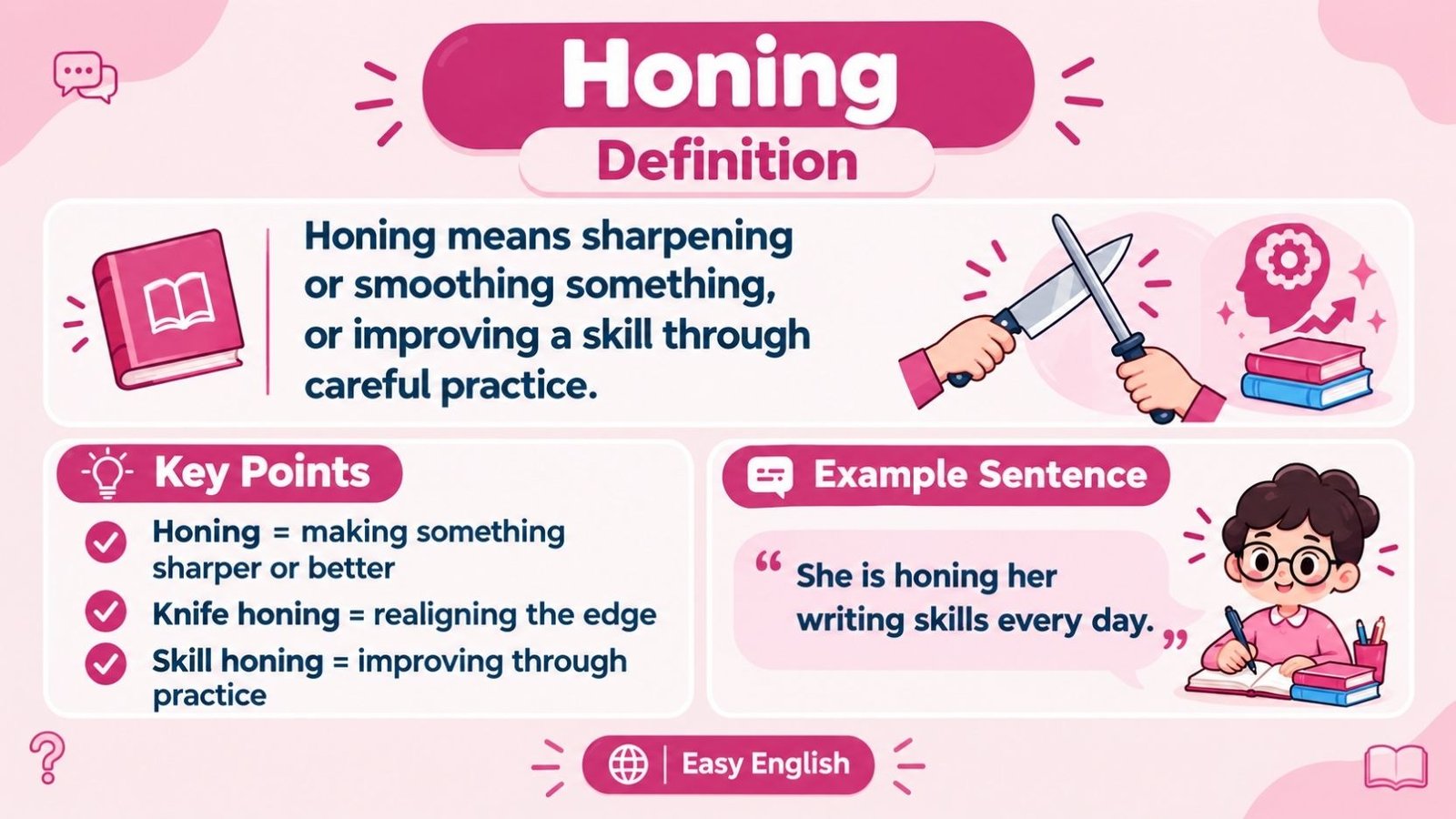
Quick definition: Honing means sharpening or smoothing something, usually a blade, on a fine abrasive stone. It can also mean improving a skill gradually and carefully, such as honing your writing or instincts. In machining, honing is a precision process that finishes metal surfaces, such as engine cylinders.
That short version covers the core idea, but honing carries several distinct meanings depending on where you encounter it. Below is a full breakdown of each one, drawn from established dictionaries and industry sources, along with pronunciation, examples, and the common mix-ups people run into.
At A Glance
| Detail | Information |
| Word type | Verb (present participle of hone), also used as a noun and adjective |
| Core meaning | Sharpening with a stone, or improving something gradually |
| Pronunciation | HOHN ing, rhymes with “own ing” |
| Tone | Neutral, used in formal and informal English |
| Common contexts | Cooking, machining, medicine, everyday skills, figurative speech |
| Common confusion | “Honing in on” versus “homing in on” |
So, What Does Honing Actually Mean?
At its root, honing is the present participle of the verb hone, and Merriam Webster defines hone as sharpening or smoothing with a whetstone, or making something more acute, intense, or effective, essentially a more formal way of saying “whet.” That second sense is why people talk about honing a skill the same way they talk about honing a blade.
Dictionary.com adds a second useful angle: honing can refer to the literal act of sharpening on a hone or whetstone, or to the process of improving or perfecting a skill, program, or idea over time. So even a single dictionary entry already splits the word into a physical meaning and a figurative one, and both are equally standard.
In simple words: if you are honing something, you are making it sharper or better through careful, repeated effort. That applies whether “it” is a kitchen knife, a cylinder bore in an engine, or your public speaking.
Read More: Clothe Definition
Where Does the Word Honing Come From?
The verb hone traces back to Middle English and Old English hān, meaning “stone,” and it is related to the Old Norse word for whetstone and to ancient Sanskrit and Latin words connected to sharpening. Merriam Webster records the noun form of hone going back to the fifteenth century, with the sharpening sense of the verb documented from 1788 onward.
Dictionary.com dates the specific noun form “honing” to somewhere between 1790 and 1800, formed simply by adding the ing ending to hone. So the etymology is straightforward: hone always meant stone or sharpening stone, and honing is just that idea turned into an ongoing action.
Note: There is also a completely unrelated, much rarer verb “hone” found in some dictionaries, borrowed from Middle French hoigner, meaning to grumble or moan, used only in certain regional dialects. It has nothing to do with sharpening and almost never appears in modern writing, so it is not the meaning anyone searching this term is looking for.
How Do You Pronounce Honing?
Honing is pronounced HOHN ing, with two syllables: the first rhymes with “own,” and the second is the familiar “ing” ending. In IPA, it is written roughly as ˈhoʊnɪŋ. It is a straightforward word for English speakers, with no silent letters and no regional pronunciation split worth noting.
Is Honing a Word?
Yes. Honing is a fully standard English word, listed in every major dictionary, including Merriam Webster, Cambridge, Collins, and Dictionary.com. It functions as the present participle of the verb hone (honing a blade, honing his craft), and it can also work as a noun (the honing of the edge) or an adjective (a honing experience). There is nothing informal, slang, or nonstandard about the base word itself, though one popular phrase built from it, discussed below, is considered incorrect by most usage guides.
Honing Can Mean Different Things Depending on Context
Honing is not a single narrow term. It shifts meaning across everyday language, cooking, machining, and medicine. Here is how those contexts break down.
General and Figurative Meaning: Honing Skills
In everyday conversation, honing usually describes sharpening an ability rather than a blade. People talk about honing their writing, honing their leadership skills, or honing their instincts.
This is the sense behind common search phrases such as honing skills meaning, honing your powers, and honing power. In each case, the underlying idea is the same: something (a skill, a talent, a power, an ability) is being refined and made more effective through practice or deliberate effort, the same way friction against a stone refines a blade. “Honing power” is not a separate technical term; it simply applies that figurative sense to power or ability, as in someone honing their power of persuasion.
Example sentences:
- Casual: “I have been honing my cooking skills all year by trying a new recipe every week.”
- Professional: “The training program is designed to help managers hone their decision making.”
- Academic: “Her thesis describes years spent honing a single research question.”
Culinary Meaning: Honing a Knife
In the kitchen, honing refers specifically to using a honing rod (also called a honing steel) to maintain a knife’s edge between full sharpenings. This is one of the most searched, and most misunderstood, uses of the word.
The key distinction, confirmed across multiple culinary sources: honing does not remove metal or create a new edge. Sharpening removes material to form a new cutting edge, while honing simply realigns the microscopic edge that has bent or rolled out of true during normal cutting. A blade that feels dull is often not actually worn down, it is just bent, and a few light passes on a honing rod can restore it without any grinding at all.
| Term | Meaning | Typical Use | Key Difference |
| Honing (rod or steel) | Realigns a bent cutting edge | Quick maintenance before or during cooking | Removes little to no metal |
| Sharpening (stone or sharpener) | Grinds a new cutting edge | Restoring a truly dull or damaged blade | Removes metal to reshape the edge |
Tip: If a few passes on a honing rod do not restore the edge, the knife likely needs actual sharpening on a whetstone instead.
Some honing rods, particularly ceramic or diamond coated ones, do remove a very small amount of metal through mild abrasive action, so they blur the line slightly, but their main job is still realignment rather than reshaping.
Read More: Allegedly Definition
Machining And Engineering Meaning: The Honing Process
In manufacturing, honing is an abrasive machining process that produces a precision surface on a metal workpiece by moving an abrasive stone against it along a controlled path, mainly to improve the geometric accuracy of a surface, and secondarily its finish.
This is the meaning behind search terms like honing process, honing definition machining, cylinder honing definition, and honing device definition.
How it works in practice:
- A honing tool holds one or more abrasive stones under pressure against the inside of a bore or cylinder.
- The tool both rotates and moves back and forth, which creates a distinctive crosshatch pattern on the surface.
- That crosshatch pattern is not accidental. It helps the surface hold a thin film of oil, which improves lubrication and reduces wear.
Where it is used: The most common application is finishing cylinder bores in internal combustion engines after boring, which corrects tiny imperfections in roundness and straightness so that piston rings seat properly. Cutting Tool Engineering also notes that honing is grouped with grinding and lapping as one of the three primary finishing processes in most machine shops, though it runs at far lower speeds than grinding. Beyond engines, honing is also used to finish gears, hydraulic components, air bearing spindles, and aerospace and medical parts.
A “non honing” surface, in this context, generally just describes a surface finish that has not gone through the honing step, rather than a distinct, formally defined term of its own; it is a plain description, not an established industry category the way “honing” itself is.
Medical And Laboratory Meaning: Honing In Histopathology
Inside histopathology and histotechnology labs, honing has a specific, narrower meaning tied to microtome knife maintenance. This is what people are usually looking for with search terms like honing definition medical and honing and stropping in histopathology definition.
A microtome knife has to be extremely sharp to cut clean, undistorted tissue sections for examination under a microscope, and its edge is maintained through two separate steps:
- Honing: the harder, coarser step that removes nicks, blemishes, and irregularities from a damaged cutting edge, typically using a natural stone such as Belgian yellow or Arkansas stone, done in a heel to toe motion.
- Stropping: the finishing step that follows honing, polishing the edge and removing the fine burr that honing leaves behind, done in the opposite, toe to heel direction.
Note: In this specific field, honing is the rougher repair step and stropping is the finer polishing step, which is the reverse of how a home cook might think about a honing rod being the “gentle” maintenance tool. Context really does change the meaning here.
What Does Honing Look Like In A Sentence?
- Casual conversation: “Give the knife a couple of swipes on the honing rod before you carve the turkey.”
- Professional (workshop): “The technician spent the afternoon honing the cylinder bores to bring them within tolerance.”
- Professional (career): “She has spent a decade honing her skills as a negotiator.”
- Academic or clinical: “The technologist honed the microtome knife before stropping it and returning to sectioning.”
- Online or social: “Been honing my photography all summer, finally feels like the shots are coming together.”
Honing In On Something: Is That Actually Correct?
This is one of the most common points of confusion tied to the word, and it deserves its own answer.
The traditional, “correct” phrase is home in on, not hone in on. Home comes from an entirely different root, related to a homing pigeon or a homing missile finding its way toward a target with precision, and it originally described guided aircraft or missiles moving toward a destination before it was extended to mean focusing attention on something.
Merriam Webster’s own usage guide states that most commentators consider hone in a mistake for home in, likely arising from the “m” sound softening into an “n” sound, or from the influence of hone’s own sense of narrowing focus through sharpening.
Before you use this phrase, remember this: hone in on has become extremely common, especially in American English, and Merriam Webster now lists it as its own entry with the meaning “to move toward or focus attention on an objective.” Language data cited by usage writers shows hone in on is actually used more often than home in on in the United States, even though home in on remains dominant internationally and is still considered the technically correct form.
Practical guidance:
- In casual speech, either phrase will be understood, and hone in on will not sound out of place.
- In careful or formal writing, home in on (or the simpler alternative zero in on) is the safer, traditionally correct choice.
Honing Versus Sharpening: What Is the Real Difference?
Because these two words get used almost interchangeably in casual speech, it helps to see them side by side.
| Term | Meaning | Typical Use | Key Difference |
| Honing | Refining, realigning, or finishing an existing edge or surface | Knife maintenance, engine cylinder finishing, skill development | Removes little or no material; corrects form and alignment |
| Sharpening | Creating a new edge by removing material | Restoring a genuinely dull or damaged blade | Physically grinds away metal to reshape the edge |
This distinction holds fairly consistently across the culinary and general senses of the word, though it loosens a bit in the machining sense, where honing does remove material, just very precisely and for a different purpose (accuracy and finish rather than creating an edge).
What Does Honing Not Mean?
A few clarifications help avoid common mix ups:
- Honing a knife with a rod is not the same as sharpening it. A rod realigns; a stone or grinder actually reshapes the edge.
- Honing in on is not the historically correct phrase, even though it is now widely used. Home in on is the traditional form.
- Honing in machining is not the same procedure as honing a knife at home. Both involve abrasion, but industrial honing is a controlled, measured process aimed at precise dimensions, not a quick maintenance swipe.
- Honing is not primarily about grumbling or yearning. That secondary, dialectal sense of hone technically exists in some dictionaries, but it is archaic and essentially never intended in modern usage.
- A “non honing” material or surface is not a standardized technical category with its own fixed definition; it simply describes something that has not been through a honing process.
Is Honing Formal, Informal Or Technical?
Honing sits comfortably across registers. It is neutral enough for everyday conversation (“honing my baking skills”), professional enough for business or academic writing (“honing our strategy”), and precise enough to serve as an exact technical term in machining and histopathology. It carries no slang connotation and no negative or offensive charge in any of its established senses.
The one place to be careful is the phrase hone in on, which many editors and style guides in the United States and, even more so, internationally still flag as an error in formal writing.
What Words Mean Something Similar to Honing?
Synonyms for the figurative “improve” sense:
- Refine
- Perfect
- Polish
- Sharpen (figuratively)
- Improve
- Cultivate
Synonyms for the literal “sharpen a blade” sense:
- Sharpen
- Whet
- Strop (a related but distinct finishing step, not a true synonym)
- Grind
Related but not interchangeable terms:
- Sharpening: removes material to create an edge, unlike honing’s realignment or finishing role.
- Stropping: a polishing step that follows honing, especially in blade and histopathology contexts.
- Lapping and superfinishing: related abrasive machining processes, similar to honing but using slightly different methods to achieve a fine surface.
Read More: Ren Definition
When Should You Use the Word Honing?
- Use it when you mean gradual, careful improvement of a skill, plan, or ability: “honing her pitch,” “honing the marketing strategy.”
- Use it in cooking contexts specifically for the maintenance step with a rod or steel, not for full sharpening on a stone.
- Use it in technical or manufacturing writing when referring to the specific abrasive finishing process, not as a general synonym for “polishing” or “machining.”
- Avoid “hone in on” in formal documents, reports, or edited writing; choose “home in on” or “zero in on” instead.
Frequently Asked Questions
What does honing mean in simple terms?
Honing means sharpening or smoothing something, usually with a fine stone, or gradually improving a skill or ability through careful effort. Both meanings come from the same root idea of refining something over time.
Is honing the same as sharpening?
Not exactly. Sharpening removes material to create a new edge, while honing, especially with a rod or steel, mainly realigns an edge that has bent, without removing much metal.
Is “honing in on” correct English?
Historically, no, the traditional phrase is “home in on.” However, “hone in on” is now so common in American English that Merriam Webster lists it as an accepted variant, even though many style guides still prefer “home in on.”
How do you pronounce honing?
Honing is pronounced HOHN ing, two syllables, with the first rhyming with “own.”
What is honing in machining?
In machining, honing is an abrasive process that finishes metal surfaces, most often engine cylinder bores, using rotating and reciprocating abrasive stones to correct shape and improve surface finish.
What is a honing rod used for?
A honing rod, also called a honing steel, is a metal or ceramic rod used to realign the microscopic edge of a knife between full sharpenings, restoring cutting performance without grinding away metal.
What does honing mean in histopathology?
In histopathology, honing is the coarser step in maintaining a microtome knife, removing nicks and irregularities from the cutting edge before a finer stropping step polishes it.
What is another word for honing?
Depending on context, close alternatives include refining, sharpening, perfecting, and polishing, though none carries the exact same nuance as honing in every situation.
Does “hone down” mean anything specific?
“Hone down” is an informal, non standard variation sometimes used to mean narrowing or refining something, similar to “narrow down,” though it is not a fixed phrase recognized by major dictionaries the way “hone in on” is.
Is honing a formal or informal word?
Honing itself is neutral and standard, used comfortably in formal, technical, and casual writing alike. Only the phrase “hone in on” carries a mild informality flag in careful writing.
Last Words
Honing means sharpening or refining, whether that is a knife edge, an engine cylinder, or a personal skill. The core idea never really changes: something is being made more precise or effective through careful, repeated attention, even as the specific technique shifts across the kitchen, the workshop, the lab, and everyday conversation. The main pitfall to remember is “honing in on,” which, despite its popularity, is still technically a stand in for “homing in on.”

Laiba Rahman is a writer and researcher behind Definixaa, dedicated to exploring words, meanings, terms, concepts, and everyday knowledge. Through clear and well-researched explanations, her goal is to help readers understand unfamiliar ideas quickly and discover useful information with ease.
One Comment