
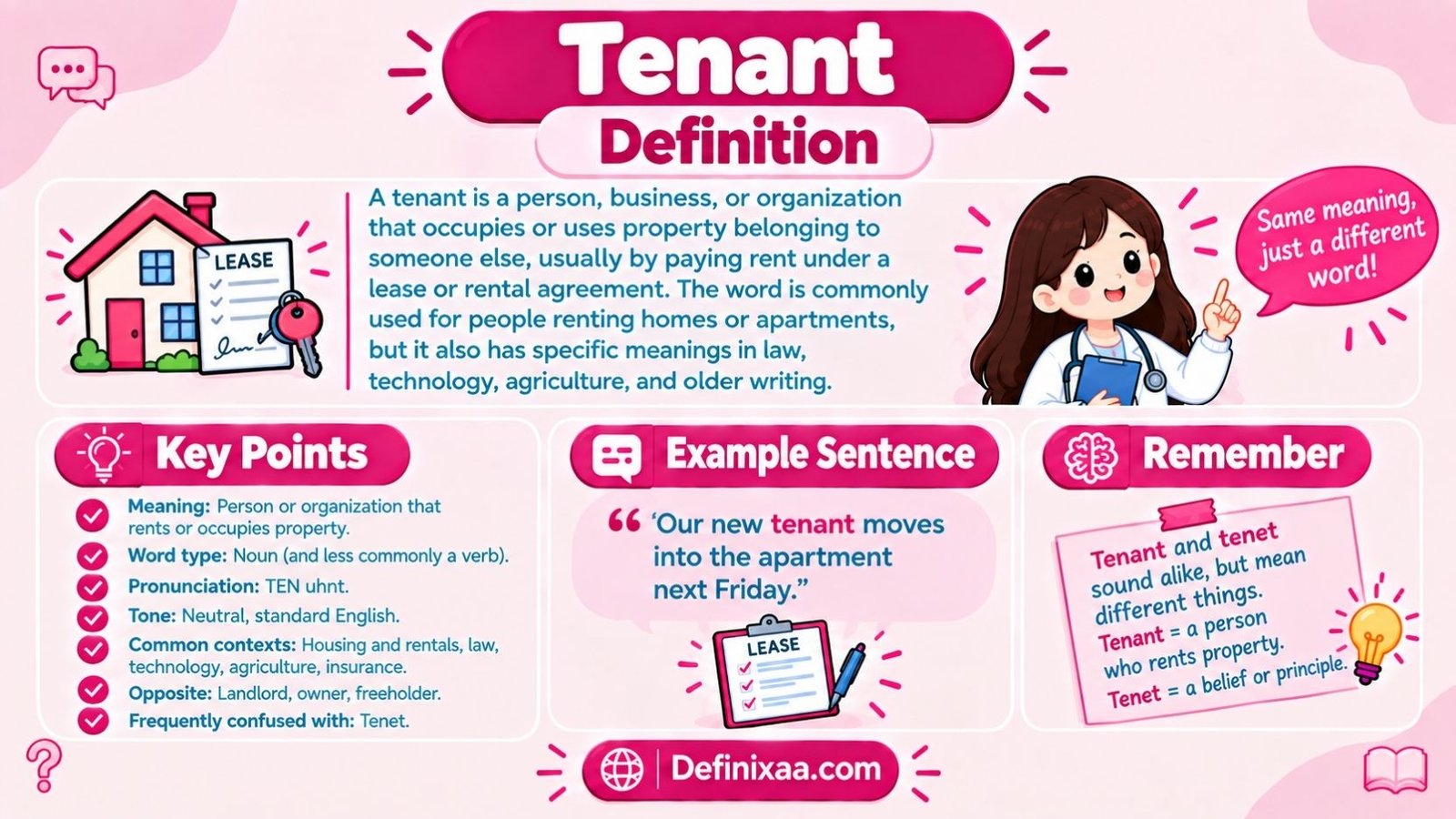
Quick definition: A tenant is a person, business, or organization that occupies or uses property belonging to someone else, usually by paying rent under a lease or rental agreement. The most common use describes someone renting a home or apartment from a landlord, though the word also has specific meanings in law, technology, agriculture, and older literary writing.
That covers the core idea. The rest of this guide breaks down each meaning in plain language, shows how the word is actually used, and clears up the mix up people most often run into with a very similar sounding word.
At A Glance
| Detail | Information |
| Meaning | Someone who rents or occupies property owned by another party |
| Word type | Noun, and less commonly a verb |
| Pronunciation | TEN uhnt |
| Tone | Neutral, standard English |
| Common contexts | Housing and rentals, law, technology and software, agriculture, insurance |
| Opposite | Landlord, owner, freeholder |
| Frequently confused with | Tenet |
Read More: Allusion Definition
So, What Is A Tenant In Simple Terms?
In everyday speech, a tenant is the person living in a rented apartment or house. The landlord owns the property. The tenant pays rent for the right to live there or use it, usually under a written or verbal lease.
The word extends beyond housing. A business can be a tenant in a shopping mall. A farmer can be a tenant on land owned by someone else. In technology, an organization can be a tenant inside a shared piece of software. Each of these uses shares the same underlying idea: one party holds or uses something that legally belongs to another.
Where Does The Word Come From?
Tenant entered English in the fourteenth century through Anglo-French, from the Old French present participle of tenir, meaning to hold. That word traces back to the Latin verb tenere, which also means to hold or possess.
The connection makes sense once you see it: a tenant is, at the root level, simply someone who holds property, even though that holding is temporary and belongs to another owner.
Merriam-Webster records the noun’s first known use in the fourteenth century, with a specific citation from 1634 for the sense most people use today.
How Do You Pronounce Tenant?
Tenant is pronounced TEN uhnt, with the stress on the first syllable. Merriam-Webster lists the pronunciation as ˈte-nənt. It is not pronounced like the actor’s surname Tennant, which is spelled with a double N and generally pronounced the same way but refers to a different word entirely, discussed further down.
Tenant Or Tennant: Are They The Same Word?
No, and this is one of the most searched confusions around this term.
- Tenant (one N) is the everyday English word meaning someone who rents or occupies property.
- Tennant (two Ns) usually appears as a proper name. It is most familiar as the surname of actor David Tennant, and it is also the source of the mineral name tennantite, a copper arsenic sulfide first described in Cornwall, England, and named after the English chemist Smithson Tennant.
If your writing is about renting an apartment, a lease, or property law, the correct spelling is tenant. If you are referring to a person’s surname or the mineral, the double N spelling applies.
Tip: When typing quickly, autocorrect sometimes changes tenant into Tennant because it recognizes the surname more readily. Double check before publishing.
Tenant vs. Tenet: The Real Confusion To Watch For
This is the mix up dictionaries actually warn about, because the two words sound alike but mean completely different things.
- Tenant: a person who rents or occupies property.
- Tenet: a core belief or principle that a person, religion, or philosophy holds to be true.
| Word | Meaning | Typical Use | Key Difference |
| Tenant | Someone who rents or occupies property belonging to another | Housing, leases, real estate, business space | Refers to a person or entity |
| Tenet | A principle or belief held as true | Religion, philosophy, organizational values | Refers to an idea, not a person |
Merriam-Webster specifically notes that tenant is sometimes mistakenly written where tenet is meant, because of the similar pronunciation. A helpful memory trick: tenant and occupant both end in “ant,” and both describe a person. Tenet, on the other hand, refers to a belief someone holds onto, not a place someone occupies.
What Does Tenant Mean In Law?
In a legal context, a tenant is defined more broadly and more precisely than in casual speech.
Merriam-Webster’s legal definition describes a tenant as one who holds or possesses property by any kind of right, and specifically as one who possesses property in exchange for paying rent. This is the definition courts, leases, and statutes generally rely on.
A few legal points worth understanding:
- A tenant’s right to occupy the property comes from a lease or rental agreement, whether written or oral.
- The landlord retains ownership of the property throughout the tenancy.
- A tenant has legal responsibilities, such as paying rent and following the lease terms, and legal protections, such as the right to habitable housing and protection from unlawful eviction.
- The related legal term lessee is close in meaning to tenant, though lessee is used more often in formal contracts, especially for commercial leases.
Read More: Prouder Definition
Does the Legal Definition Change By Location?
The basic meaning of tenant, someone who occupies property under a lease in exchange for rent, stays consistent across the United States, the United Kingdom, and Canada. What changes from place to place is the surrounding law: how much notice a landlord must give, how security deposits are handled, and what protections a tenant has if something goes wrong.
- In places like California, state and local law adds specific tenant protections, including rules around rent increases in certain cities and required notice periods before eviction.
- In the United Kingdom, tenant rights are shaped by tenancy types such as assured shorthold tenancies, which set out notice periods and deposit protection rules.
- In Ontario, the Residential Tenancies Act governs the landlord and tenant relationship, including rules on rent increases and the eviction process through the Landlord and Tenant Board.
Note: Tenant law varies by jurisdiction and changes over time. If you need to know your specific rights as a tenant, check your local or provincial housing authority rather than relying on a general definition.
What Does Tenant Mean In Technology And Software?
Outside of housing and law, tenant has become a standard term in cloud computing and enterprise software, and this meaning trips up a lot of people searching for the word.
In this context, a tenant is an organization, account, or group of users that shares a piece of software with other tenants, while keeping its own data, users, and settings completely separate from everyone else using that same software.
A widely cited technical definition describes multitenancy as a single software installation that serves multiple tenants, where a tenant can be one individual user or an entire organization, and each tenant’s data stays isolated from the others even though they share the same underlying system.
Microsoft uses the term this way for its cloud services. A Microsoft 365 tenant is an organization’s own dedicated space inside Microsoft’s cloud, created when a business signs up for a Microsoft 365 subscription. It includes its own users, security settings, and a unique tenant ID, and it is kept separate from every other organization’s tenant, even though many organizations are running on the same overall Microsoft infrastructure.
Why This Matters For Readers Outside IT
If a coworker in IT mentions “our tenant” or “the client’s tenant,” they are talking about the organization’s dedicated account and settings inside a cloud platform, not a person renting an apartment.
The core idea still lines up with the original meaning of the word: a tenant is a distinct occupant of a shared space, kept separate from other occupants, even though someone else owns and runs the overall structure.
What Is A Tenant Farmer?
A tenant farmer is someone who farms land owned by another person, usually paying the landowner through rent, a share of the harvest, or both.
Historically, tenant farming was distinct from sharecropping, even though the two are closely related and often confused:
- A tenant farmer typically rented the land and supplied their own tools, seed, and livestock, which gave them somewhat more independence and a larger share of the crop.
- A sharecropper usually supplied only labor, while the landowner provided the land, tools, seed, and housing, and took a much larger share of the harvest in return.
Tenant farming has existed across many cultures and time periods, including forms known as sharecropping and métayage. In the United States, it became especially widespread across the South after the Civil War, as freed people and poor landless farmers worked land they did not own.
Is There A Medical Meaning Of Tenant?
Tenant is not a recognized medical term. If you have seen “tenant” used in a health or anatomy context, it is very likely one of two things:
- A misspelling or autocorrect substitution for tenet, as in a guiding principle of a medical practice or treatment approach.
- A confusion with a different, similarly spelled medical or anatomical word specific to the material you were reading.
If you came across the phrase in a medical document and it did not make sense, it is worth rereading the sentence with tenet in place of tenant, since that substitution error is common enough that dictionaries specifically call it out.
Does Tenant Ever Refer To The Body Or A Soul?
Yes, though this use is literary and older rather than something you would hear in daily conversation. For centuries, English writers used tenant as a metaphor for the soul living inside the human body, with the body described as a house, and the soul as its temporary occupant.
Writers going back to the seventeenth and eighteenth centuries used this image to suggest that the soul, like a renter, only occupies the body for a limited time before eventually moving on.
You are unlikely to encounter this usage outside of poetry, religious writing, or older literature, but it explains why the phrase occasionally turns up in searches about the word’s meaning in relation to the body.
What Does Tenant Look Like In A Sentence?
- Everyday conversation
“Our new tenant moves into the apartment next Friday.” - Professional or real estate context
“The property management company screens every tenant before approving a lease.” - Legal or formal writing
“Under the terms of the agreement, the tenant is responsible for all utility payments.” - Technology context
“Each customer gets its own tenant, so their data never mixes with another company’s.” - Agricultural or historical context
“After the war, many former sharecroppers became tenant farmers, renting land instead of working purely for a share of the crop.”
What Words Mean Something Similar To Tenant?
Close synonyms
- Renter
- Occupant
- Lessee
- Leaseholder
- Resident (in a rental context)
Related but not identical terms
- Boarder, which usually implies renting a room rather than a full unit
- Subtenant, someone who rents from an existing tenant rather than directly from the owner
Opposite terms
- Landlord
- Landlady
- Owner
- Freeholder (more common in UK property law)
Not every one of these words is fully interchangeable. A leaseholder, for example, sometimes refers to someone who holds a long term lease with more ownership like rights, particularly in UK property law, which is a stronger position than a typical short term renter.
Before You Use Tenant: Remember This
Tenant does not always mean a person renting an apartment. In law it can include anyone who holds property by right, not only renters.
In technology it usually refers to an organization, not an individual. And it is never a substitute for tenet, even though the two words sound almost identical when spoken quickly.
Is Tenant Formal, Informal Or Technical?
Tenant is a standard, neutral English word appropriate in casual conversation, professional writing, legal documents, and technical documentation alike. It carries no slang connotation and is not considered outdated or offensive.
The word simply shifts in precision depending on the field: casual in daily speech, tightly defined in leases and statutes, and specialized in software and cloud computing contexts.
Is Tenant a Positive, Negative Or Neutral Word?
On its own, tenant is neutral. It states a legal and practical relationship to a property without implying anything good or bad about the person. Any negative tone usually comes from surrounding context, such as a news story about tenant disputes or eviction, rather than from the word itself.
Read More: Stent Definition
When Should You Use The Word Tenant?
Use tenant when you specifically mean the person or organization occupying property that belongs to someone else. It is the correct and expected word in leases, rental listings, property management communication, tenant rights discussions, and technology documentation describing shared software accounts.
If you are talking about a belief, principle, or core value instead of a person or organization occupying space, you want tenet, not tenant.
Frequently Asked Questions
What does tenant mean in one sentence?
A tenant is a person or organization that rents or occupies property owned by someone else, typically under a lease.
Is tenant the same as renter?
Yes, in everyday use tenant and renter mean essentially the same thing. Tenant is the more formal term used in leases and legal writing.
What is the difference between a tenant and a lessee?
They are very close in meaning. Lessee is the more formal, contract based term, often used in commercial real estate and equipment leasing, while tenant is more common in residential and general usage.
What does tenant mean in a software or Microsoft context?
It refers to an organization’s own isolated account and settings within a shared cloud platform, such as Microsoft 365, kept separate from every other organization’s data on the same system.
Is tennant with two Ns a different word?
Yes. Tennant with two Ns is typically a surname or the name of a copper arsenic mineral, tennantite, not the everyday word for a renter.
What is the opposite of tenant?
Landlord is the most common opposite, since the landlord owns the property while the tenant occupies it.
Is a tenant farmer the same as a sharecropper?
They are related but not identical. A tenant farmer generally rents land and supplies their own tools and seed, while a sharecropper relies on the landowner for tools, seed, and housing in exchange for a larger share of the crop.
How do you pronounce tenant?
It is pronounced TEN uhnt, with stress on the first syllable.
Is tenant sometimes confused with tenet?
Yes, and this is a well documented mix up. Tenet means a core belief or principle, while tenant refers to a person occupying property. The two words sound alike but are unrelated in meaning.
Does tenant law differ between the US, the UK, and Canada?
The basic definition stays the same everywhere, but the specific rights, notice periods, and eviction rules differ by country, state, or province, so local housing law should be checked for exact rules.
The Simple Takeaway
At its core, tenant means someone who occupies or uses property that belongs to another party, most often in exchange for rent. The everyday housing meaning is the most common, but the same underlying idea, holding something owned by someone else, carries through its legal definition, its technology meaning, and its use in agriculture. The one word to keep separate is tenet, which describes a belief rather than a person.

Laiba Rahman is a writer and researcher behind Definixaa, dedicated to exploring words, meanings, terms, concepts, and everyday knowledge. Through clear and well-researched explanations, her goal is to help readers understand unfamiliar ideas quickly and discover useful information with ease.
One Comment