
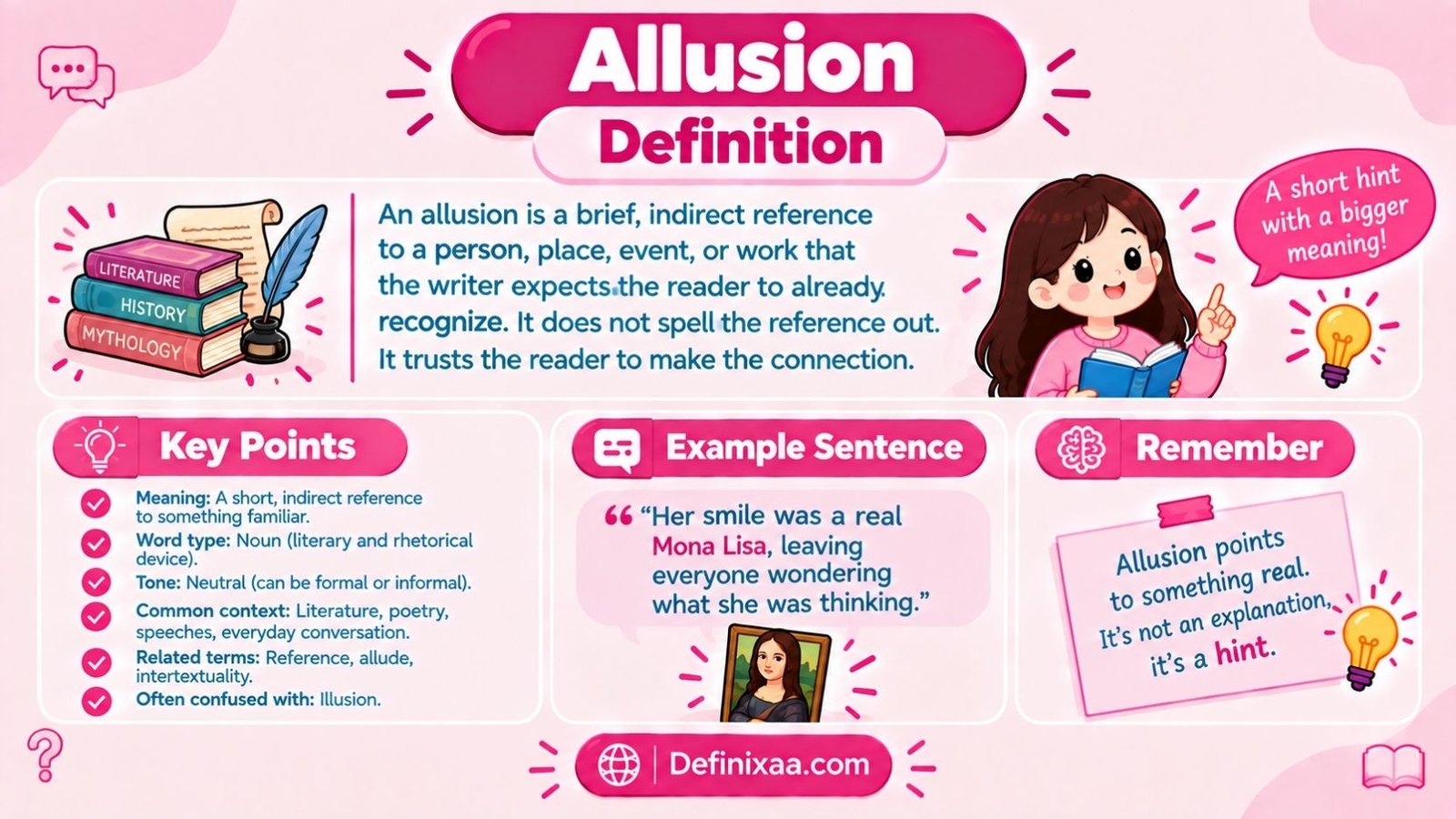
An allusion is a brief, indirect reference to a person, place, event, or work that the writer expects the reader to already recognize. It does not spell the reference out. Instead, it trusts the reader to make the connection.
You will see this word most often in literature classes, poetry analysis, and writing guides. But allusion also shows up constantly in everyday speech, in song lyrics, in headlines, and in casual conversation, whether or not anyone calls it by name.
Quick Detail
| Detail | Information |
| Meaning | A short, indirect reference to something the audience is expected to recognize |
| Type | Literary and rhetorical device (noun) |
| Tone | Neutral; formal or informal depending on context |
| Common context | Literature, poetry, speeches, song lyrics, everyday conversation |
| Related terms | Reference, allude (verb form), intertextuality |
| Often confused with | Illusion |
Read More: Stent Definition
So, What Is An Allusion In Simple Terms?
Think of an allusion as a shortcut. Instead of explaining an entire idea, a writer mentions something familiar, and the reader fills in the meaning on their own.
For example, if someone says a plan is “his kryptonite,” they are not explaining what kryptonite is. They are counting on you to already know it weakens Superman, and that the plan will weaken this person the same way.
That is the core of an allusion: point at something the audience already knows, and let that shared knowledge do the work.
Allusions can point to:
- Mythology, such as Greek or Roman gods
- The Bible or other religious texts
- Historical events or figures
- Other works of literature
- Pop culture, movies, or music
- Current events
The reference is almost never explained in full. If it were, it would stop being an allusion and would just become a direct statement or explanation.
Where Does The Word Allusion Come From?
Allusion traces back to the Latin word alludere, meaning “to play with” or “to hint at.” The related Latin verb ludere means “to play,” which is also the root shared with the unrelated but similarly spelled word illusion (from illudere, “to mock” or “to deceive against”).
That shared root explains why the two words look and sound alike, even though their meanings have moved in very different directions over time.
How Is Allusion Actually Used In Real Life?
Allusion is not limited to poetry assignments. Writers, speakers, comedians, songwriters, and everyday people use it constantly, often without labeling it.
- In literature and poetry, allusion is used to add depth without lengthy explanation. A single phrase can call up an entire story, myth, or historical moment, letting the writer build meaning economically.
- In speeches, public figures often allude to historical events or well-known documents to borrow their emotional weight. Referencing “a house divided” calls up Abraham Lincoln’s famous speech without quoting it directly.
- In everyday conversation, people make allusions casually. Calling a difficult task “a real David and Goliath situation” or describing a betrayal as “a real Judas move” are both allusions, even in ordinary talk.
- In music and pop culture, songwriters frequently allude to mythology, other songs, or historical moments to add layers of meaning for listeners who catch the reference.
Allusion tends to work best when writer and audience share cultural background. A reference to a well-known Bible story will land differently depending on the audience’s familiarity with it, which is part of why writers choose their allusions carefully.
What Does An Allusion Look Like In A Sentence?
Seeing the device in context makes it easier to recognize.
- “Their office had turned into a real Wild West, with no rules and no one in charge.” (Historical and cultural allusion)
- “She smiled like the Mona Lisa, giving nothing away.” (Allusion to a famous artwork)
- “After the scandal, his reputation became his own personal Waterloo.” (Historical allusion to Napoleon’s final defeat)
- “He was tempted, but he knew that apple was probably a bad idea.” (Biblical allusion, without naming the Garden of Eden directly)
- “The startup’s launch was a total Titanic, sinking within weeks.” (Allusion to the ship’s famous disaster)
Notice that none of these sentences stop to explain the reference. That silence is intentional. Explaining it would remove the effect.
Are There Different Types Of Allusion?
Yes. Allusions are usually grouped by where the reference comes from.
- Historical allusion: A reference to a real historical event or figure, such as calling a defeat “his Waterloo.”
- Mythological allusion: A reference to gods, heroes, or stories from mythology, such as calling someone’s one weakness their “Achilles’ heel.”
- Literary allusion: A reference to another book, poem, or play, such as naming a novel Brave New World after a line from Shakespeare’s The Tempest.
- Biblical or religious allusion: A reference to scripture or religious stories, such as describing an act of betrayal as “a Judas kiss.”
- Cultural or pop culture allusion: A reference to movies, music, or modern public figures that a contemporary audience would recognize.
The type of allusion often signals the tone the writer is going for. A biblical allusion can carry moral weight, while a pop culture allusion can feel light or comedic.
Read More: Symptomology Definition
What Is The Purpose Of Allusion?
Allusion is not decoration. Writers use it deliberately, and it serves several practical purposes.
- Compression: It packs a complex idea into a short phrase.
- Connection: It links the current work to a larger tradition or shared cultural memory.
- Tone and emotion: It borrows the emotional charge of the original reference.
- Depth: It rewards readers who catch the reference with an extra layer of meaning.
- Persuasion: In speeches or arguments, it can lend authority by invoking something respected or well known.
The purpose only succeeds if the audience recognizes the reference. If they do not, the allusion falls flat, and the sentence reads as strangely specific rather than meaningful.
What Does Allusion Not Mean?
Because allusion sounds like several other words, it gets mixed up often. Here is what it is not.
- It is not a direct quotation. Quoting a source word for word is not an allusion; it is a citation.
- It is not a full explanation. If a writer stops to explain the reference in detail, it functions more like an analogy or comparison than a true allusion.
- It is not the same as symbolism, although the two can overlap. A symbol represents an idea within the text itself; an allusion points outward, to something outside the text.
- It is not the same as illusion, despite the nearly identical spelling.
Before You Use Allusion: Remember This
Allusion and illusion are two completely different words that happen to look and sound alike.
| Term | Meaning | Typical Use | Key Difference |
| Allusion | An indirect reference to something the audience is expected to recognize | Literature, speeches, conversation, song lyrics | Points outward to real people, events, or works |
| Illusion | A false or deceptive impression of reality | Magic tricks, optical tricks, false beliefs | Describes something that misleads the senses or mind |
A simple way to remember the difference: an allusion alludes to something real, while an illusion deceives the eye or the mind. Some writers also use the memory trick that “illusion” contains the letters “ill,” which pairs naturally with the queasy feeling an optical illusion can cause.
Is Allusion The Same As A Metaphor?
Not quite, though the two are often confused. A metaphor describes one thing by directly calling it another thing within the text itself, such as “time is a thief.” An allusion instead points to something entirely outside the text, expecting the reader to bring in outside knowledge to complete the meaning.
Many allusions work through metaphor. Calling a weakness someone’s “Achilles’ heel” is both an allusion, because it references the myth of Achilles, and a metaphor, because it equates a personal flaw with that physical vulnerability. The two devices frequently overlap rather than compete.
What Words Mean Something Similar To Allusion?
A few related terms are close in meaning but not identical.
- Reference: A more general and often direct mention of something. Every allusion is a kind of reference, but not every reference is indirect enough to count as an allusion.
- Intertextuality: A broader academic term describing how texts relate to and influence one another. Allusion is one specific technique within that larger idea.
- Callback: A more casual term, often used in comedy, for referencing something mentioned earlier in the same piece.
- Nod: An informal way to describe a small, intentional reference, as in “a nod to the original film.”
None of these terms are perfect substitutes. Allusion specifically implies indirectness and an expectation that the audience will recognize the source without help.
How Do You Pronounce Allusion?
Allusion is pronounced uh-LOO-zhun, with the stress on the second syllable. In the International Phonetic Alphabet, it is written as /əˈluːʒən/.
This is different from illusion, which is pronounced ih-LOO-zhun, or /ɪˈluːʒən/. The two words differ mainly in that first vowel sound, which is one reason they are so easy to mix up when spoken aloud.
Is Allusion Formal Or Informal?
Allusion itself, as a term, is a neutral, standard English word. It is used in academic writing, literary criticism, and everyday conversation without sounding overly formal or overly casual.
The allusions people make, however, can range widely in tone. A biblical or classical allusion in a formal speech will read as elevated and serious. A pop culture allusion in casual conversation will read as light and familiar. The word itself does not carry a fixed tone; the reference chosen does.
When Should You Use An Allusion?
Allusion works best when you can reasonably expect your audience to recognize the reference. Using an allusion your reader does not understand does not add depth. It just adds confusion.
Consider using allusion when:
- You want to say something complex briefly, without over-explaining.
- Your audience shares a common cultural, religious, historical, or literary background with you.
- You want to add emotional resonance by connecting your point to something already meaningful.
- You are writing creatively and want to reward attentive readers with extra layers of meaning.
Consider avoiding allusion when:
- Your audience is unlikely to know the reference, such as in cross-cultural or highly technical writing.
- Clarity matters more than style, such as in instructions or legal writing.
- The reference could be seen as obscure, exclusionary, or distracting from the main point.
Read More: Prouder Definition
What Is A Real Example Of Allusion In Literature?
Aldous Huxley’s novel Brave New World takes its title from a line spoken by the character Miranda in Shakespeare’s play The Tempest: “O brave new world, that has such people in’t.”
Huxley’s title works as an allusion because readers familiar with Shakespeare’s line bring an extra layer of irony to Huxley’s story about a controlled, dystopian society, even though the novel never quotes the line directly.
This kind of allusion is common in literary titles and opening lines, where a single phrase can connect a new work to an older, well-known one.
Frequently Asked Questions
What does allusion mean in literature?
In literature, an allusion is a brief, indirect reference to a person, place, event, or another text that the writer expects readers to recognize without explanation.
Is allusion the same as illusion?
No. Allusion means an indirect reference to something real, while illusion means a false or deceptive impression of reality. They only sound alike.
What is a simple definition of allusion?
An allusion is a short mention of something familiar, like a myth, story, or event, used to bring extra meaning into a sentence without spelling it out.
What is an example of allusion in a sentence?
Saying someone’s ambition “was his Achilles’ heel” is an allusion, because it references the Greek myth of Achilles without explaining the story.
What is the purpose of allusion in writing?
Allusion lets writers add depth, emotion, and shared meaning to their work quickly, by connecting their sentence to something the reader already understands.
Is allusion formal or informal language?
Allusion is a neutral, standard term used in both formal writing and everyday conversation. The tone depends on the specific reference being made, not the word itself.
What is a synonym for allusion?
Reference is the closest general synonym, though it is broader and can be direct. Intertextuality is a more academic, related term.
How do you pronounce allusion correctly?
Allusion is pronounced uh-LOO-zhun, or /əˈluːʒən/, with stress on the second syllable.
Can allusion be used outside of literature?
Yes. Allusion appears in speeches, everyday conversation, song lyrics, advertising, and journalism, not only in novels and poems.
What is the difference between allusion and metaphor?
A metaphor directly equates two things within the same text. An allusion points outward to something outside the text and relies on the reader’s outside knowledge.
Is allusion always indirect?
Generally, yes. Once a reference becomes fully explained or directly quoted, it typically functions as a citation or direct reference rather than a true allusion.
What is the best definition of allusion for a student?
For students, the clearest definition is: a short, indirect reference in a text to something outside it, such as a myth, historical event, or another book, that the reader is expected to recognize.
The Simple Takeaway
An allusion is a short, indirect reference to something familiar, used to add meaning without spelling everything out. It shows up constantly in literature, speeches, and everyday conversation, not just in poetry class.
The word is easy to confuse with illusion, but the two describe very different ideas. Allusion points toward something real that the reader is meant to recognize; illusion describes something that deceives the eye or the mind.

Laiba Rahman is a writer and researcher behind Definixaa, dedicated to exploring words, meanings, terms, concepts, and everyday knowledge. Through clear and well-researched explanations, her goal is to help readers understand unfamiliar ideas quickly and discover useful information with ease.
One Comment