
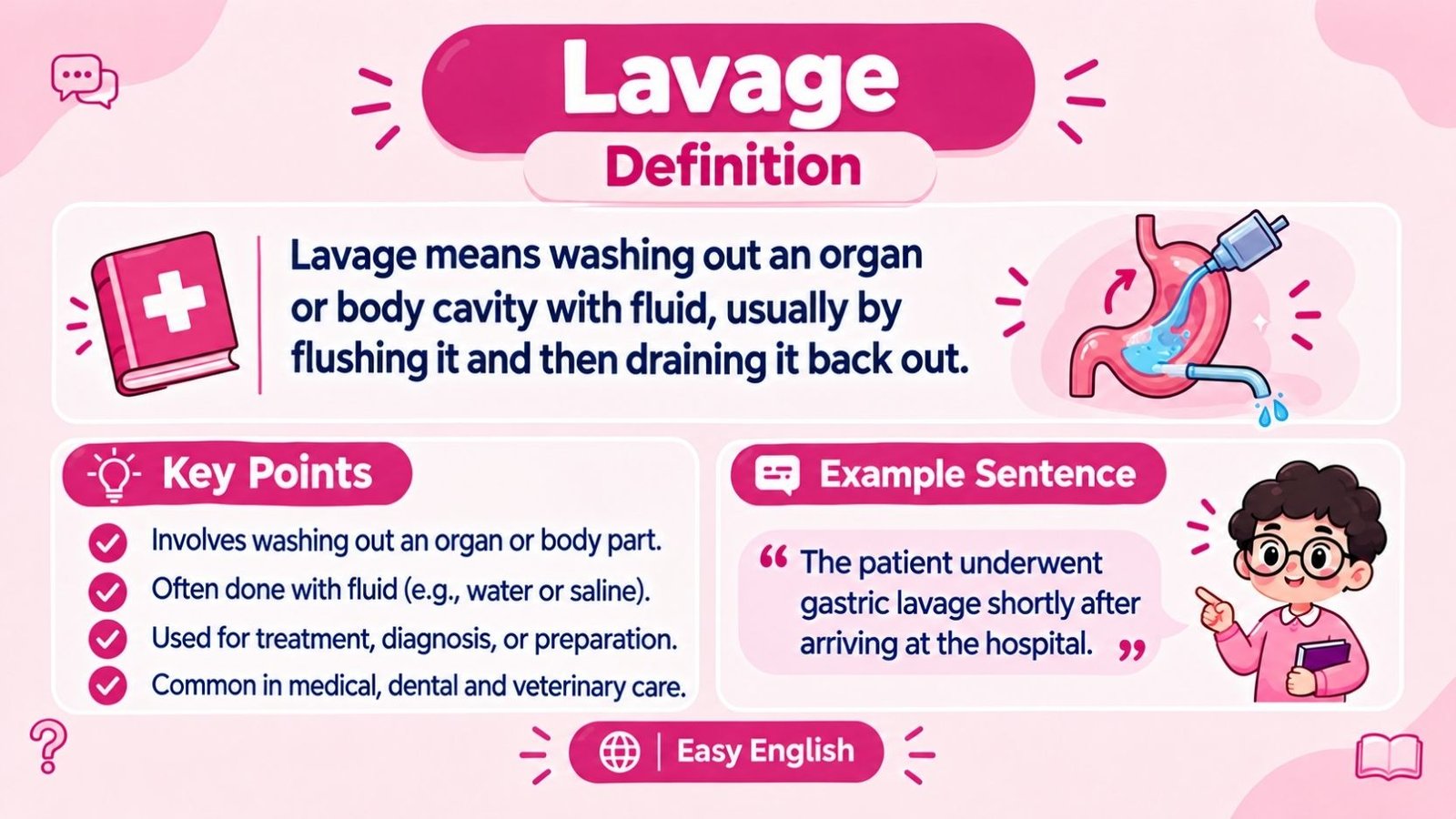
Quick Definition: Lavage (noun): the therapeutic or diagnostic washing out of an organ or body cavity, typically by flushing it with water or a saline solution.
Lavage means washing something out, and it almost always shows up in a medical or clinical setting. Formally, it refers to the act of flushing fluid into a body cavity or organ and then draining it back out, usually to clean, treat, or test that area.
You will most often see it paired with a body part, as in gastric lavage, nasal lavage, or bronchoalveolar lavage. Each phrase names the same basic action performed on a different part of the body.
At A Glance
| Detail | Information |
| Meaning | Washing out an organ, cavity, or body part with fluid |
| Word type | Noun (medical and general vocabulary) |
| Pronunciation | luh VAHZH (also heard as LAV ij) |
| Tone | Formal, clinical |
| Common context | Medicine, nursing, dentistry, veterinary care |
| Word origin | French, from laver, meaning to wash |
| Related terms | Irrigation, gavage, flushing |
Read More: Enjoined Definition
How Do You Pronounce Lavage?
There are two accepted pronunciations. In American English, most dictionaries list the standard pronunciation as luh VAHZH, with the stress on the second syllable and a soft “zh” sound at the end, similar to the “s” in the word “measure.”
British speakers usually say LAV ij instead, rhyming the last syllable with the word “ridge.” Both pronunciations refer to the exact same word, so neither one is wrong. It simply depends on which regional dictionary tradition you are following.
If you want to hear the audio version, Merriam Webster’s online dictionary entry for lavage includes a spoken pronunciation clip you can play directly from the page.
Where Does The Word Lavage Come From?
Lavage entered English from French, and its root goes back further still. The word comes from Middle French, taken from laver, meaning to wash, which itself traces back to the Latin verb lavare.
Dictionaries record its first known use in English around 1895, which lines up with a period when medical vocabulary was absorbing a lot of French clinical terminology. That history is also why the pronunciation keeps a French flavor rather than following typical English spelling rules.
Because the root laver simply means “to wash,” almost every specialized meaning of lavage still circles back to that one idea: cleaning something by flushing it with liquid.
So What Is Lavage in Simple Terms?
Strip away the medical language and lavage just means a deep, controlled rinse. Someone introduces fluid into a body part, lets it do its job, and then removes it, often along with whatever needed to be cleared out.
Think of it like flushing a clogged drain with water. The water goes in, loosens whatever is stuck, and then gets pulled or drained back out along with the debris. Lavage applies that same basic logic to the human body, under sterile, medically controlled conditions.
This is why the word shows up constantly in hospital settings but almost never in casual conversation. It describes a specific technique, not a general feeling or a slang expression.
Lavage In Medicine: The Meaning Most People Are Looking For
When people search for lavage, they are almost always asking about the medical definition. Reference dictionaries define it as the act of washing, especially the therapeutic washing out of an organ or body part. In clinical use, that washing usually serves one of three goals: treatment, diagnosis, or preparation for a procedure.
Doctors and nurses do not perform lavage on just one body part. The term gets attached to whichever organ or cavity is being flushed, which is why you see so many compound versions of the word. Below are the most searched types.
Gastric Lavage
Gastric lavage means washing out the stomach. A tube is passed through the mouth or nose down into the stomach, fluid is introduced, and the stomach contents are then suctioned back out.
News and medical reporting describe gastric lavage as a procedure that uses a tube to wash out the contents of the stomach, and it is most commonly associated with treating poisoning or a drug overdose. Outside emergency medicine, it is sometimes informally called “stomach pumping,” though that phrase is not the clinical term.
Gastric lavage is used less often today than in past decades, because activated charcoal and other treatments are frequently safer and just as effective. It is still used in select emergency cases, particularly when a patient presents very soon after ingesting a dangerous substance.
Bronchoalveolar Lavage (BAL)
Bronchoalveolar lavage, often abbreviated BAL, is a diagnostic procedure rather than a treatment. A bronchoscope is guided into the lungs, sterile saline is injected into a small section of the airway, and the fluid is then withdrawn for laboratory testing.
This kind of lavage has been described in medical reporting as a test used to investigate lung symptoms, and it commonly helps doctors check for infections, inflammation, certain cancers, or unusual cell activity in the lungs. Pulmonologists rely on BAL results heavily when a chest X ray or CT scan alone cannot explain a patient’s symptoms.
Note: Bronchoalveolar lavage and bronchial lavage are related but not always identical. Bronchoalveolar lavage samples fluid from deep in the small air sacs, while a more general bronchial lavage may focus on a larger airway.
Peritoneal Lavage
Peritoneal lavage flushes the abdominal cavity rather than a single organ. It is most associated with diagnostic peritoneal lavage, a technique once widely used after abdominal trauma to check for internal bleeding.
A small amount of fluid is introduced into the abdomen and then drawn back out for analysis. If blood or other concerning material shows up in the fluid, it can indicate internal injury. CT imaging has replaced diagnostic peritoneal lavage in many hospitals, but it is still taught and occasionally used, especially when imaging is not immediately available.
Nasal Lavage
Nasal lavage means rinsing the nasal passages, typically with a saline solution. This practice has a surprisingly long history, since ancient Greek and Roman physicians already used their own nasal lavage devices.
Modern nasal lavage ranges from simple saline sprays to full nasal irrigation using a squeeze bottle or neti pot. It is commonly recommended for chronic sinus congestion, allergies, and after certain sinus surgeries. One documented postoperative care plan reduced treatment to nasal lavage with topical steroids for a period of several weeks.
Read More: Clothe Definition
Ear Lavage
Ear lavage refers to flushing the ear canal, usually to remove excess earwax buildup. Warm water or a saline solution is gently irrigated into the canal using a syringe or specialized irrigation device, then allowed to drain out along with the loosened wax.
This is one of the more routine, low risk forms of lavage, often performed in a primary care office rather than a hospital. It is generally avoided if there is a suspected eardrum perforation or active ear infection, since fluid entering those areas could worsen the problem.
Bowel And Colonic Lavage
Bowel lavage, sometimes called colonic lavage, refers to flushing the intestines, most often as preparation for a colonoscopy or bowel surgery. Patients typically drink a prescribed solution that clears the colon rather than having fluid introduced through a tube in every case.
This differs from most other types of lavage on this list because part of the process can be done orally, at home, before ever reaching a clinical setting.
Dental Lavage
In dentistry, lavage usually means irrigating a tooth socket, root canal space, or surgical site with a sterile solution to flush out debris and reduce infection risk. It is a routine part of many oral surgery and endodontic procedures rather than a standalone treatment.
Veterinary Lavage
Veterinarians use the same basic technique on animals that human medicine uses on people. Veterinary lavage might involve flushing a wound, an animal’s stomach after ingesting a toxin, or a joint during orthopedic surgery, using essentially the same principles as human lavage procedures.
Lavage Vs Gavage: What Is The Difference?
These two words look and sound alike, and they are frequently confused, but they describe opposite actions.
| Term | Meaning | Typical Use | Key Difference |
| Lavage | Washing fluid into a body part and then removing it | Cleaning the stomach, lungs, nose, or ear; diagnostic testing | Fluid goes in, then comes back out |
| Gavage | Delivering nutrition or medicine through a tube into the stomach | Feeding infants, or patients who cannot eat by mouth | Substance goes in and stays in, for nourishment |
Lavage is washing out, while gavage means feeding through a tube. In gavage, a formula or liquid nutrition is delivered through a nasogastric or orogastric tube and is meant to remain in the stomach for digestion. Nothing is meant to be suctioned back out afterward, aside from checking placement.
The two terms sometimes appear together in phrases such as gastric gavage and lavage, which simply groups two separate stomach tube procedures, feeding and washing, under one umbrella phrase. They are not synonyms, and mixing them up in a clinical setting could describe the exact wrong action.
Lavage In French: What Does Lavage Mean In French?
Because the English word came directly from French, lavage still functions as an everyday French word with a much broader meaning than its narrow medical use in English.
In French, lavage simply means washing, in the most general sense. It is used for things English speakers would never call lavage, such as laundry or hand washing.
A few common French phrases built on the word include:
- Lavage des mains: hand washing, the everyday act of washing your hands with soap and water
- Lavage à sec: dry cleaning, a laundering method that does not use water
- Lavage de cerveau: brainwashing, a figurative expression describing psychological manipulation rather than any literal washing
Note: French speakers use lavage constantly in daily life, while English speakers almost never use it outside a clinical or scientific context. If you searched for “lavage definition français,” this broader everyday meaning is likely closer to what you were looking for than the narrow medical sense used in English.
How Is Lavage Actually Used In A Sentence?
Lavage rarely appears in casual conversation. It shows up almost exclusively in clinical notes, medical journalism, nursing textbooks, and scientific writing. Here is what that looks like in different contexts.
- In a medical chart or clinical setting:
“The patient underwent gastric lavage shortly after arrival in the emergency department.” - In health journalism:
“Doctors performed a bronchoalveolar lavage to identify the source of the persistent lung infection.” - In a nursing exam or textbook:
“Before beginning the lavage, confirm correct tube placement and monitor the patient’s vital signs.” - In everyday English, outside medicine:
Lavage almost never appears in casual speech. A patient would be far more likely to hear a doctor say “we need to flush your stomach” or “we’re going to rinse out your sinuses” than to hear the word lavage used directly with them. - In French, in everyday conversation:
“Le lavage des mains est important avant de manger,” meaning, “Hand washing is important before eating.”
Lavage In Nursing And Clinical Practice
Nursing students encounter lavage constantly, since nurses are often the ones performing or assisting with these procedures. In nursing contexts, lavage definition questions usually focus on gastric lavage and wound lavage.
Nursing responsibilities during lavage typically include confirming tube placement, monitoring the patient’s airway and vital signs, measuring fluid in and fluid out accurately, and watching for complications such as aspiration or electrolyte imbalance. Because the procedure involves introducing fluid near sensitive areas like the airway or stomach lining, careful technique matters as much as understanding the definition itself.
What Does Lavage Not Mean?
Before you use this word, it helps to know what it is not describing.
Lavage does not mean a simple rinse you would do at home without any clinical intent, such as splashing water on your face. It does not mean disinfecting a surface, which is closer to the word sanitizing or sterilizing. It also does not mean feeding someone through a tube, which is gavage, not lavage. Finally, in English, it is not a casual synonym for the word “wash,” even though that is its literal French meaning.
If you keep one distinction in mind, keep this one: lavage always implies fluid entering and then leaving a body cavity for a therapeutic or diagnostic reason, not just general cleaning.
Is Lavage A Formal Or Technical Term?
Lavage is a formal, technical term. It belongs almost entirely to medical, dental, veterinary, and scientific vocabulary. You will not typically encounter it in casual writing, social media, or everyday spoken English.
This does not mean the word is rare or obscure within its field. Among healthcare professionals, it is an extremely common, precise term. Outside that field, most people only encounter it while reading a medical article, a hospital discharge summary, or a nursing textbook.
Lavage Vs Irrigation: Is There A Real Difference?
These two words are close enough that people often treat them as interchangeable, and in many contexts, they are. Irrigation is the broader term, referring to flushing any wound, cavity, or surface with fluid. Lavage tends to describe a more involved or systematic washing of an internal organ or cavity, often with fluid introduced and then actively withdrawn or suctioned back out.
In practice, a clinician might use “wound irrigation” for a straightforward rinse of a cut, while reserving “lavage” for procedures like gastric lavage or bronchoalveolar lavage that involve deeper access and a defined withdrawal step. The overlap is real, and you will see both words used for similar procedures depending on the medical specialty and the country.
Read More: Honing Definition
Before You Use Lavage: Remember This
Lavage is not a casual word, and using it outside medical or scientific writing can sound out of place. If you are writing for a general audience, simpler phrases like “flushing,” “rinsing,” or “washing out” usually communicate the same idea more naturally.
Save lavage for clinical writing, academic contexts, or when precision genuinely matters, such as distinguishing it clearly from gavage.
Frequently Asked Questions
What does lavage mean in simple terms?
Lavage means washing out a body part or organ by introducing fluid and then removing it. It is almost always used in a medical or clinical context.
Is lavage the same as gavage?
No. Lavage means washing something out, while gavage means feeding someone through a tube. The two words are frequently confused because they sound alike.
How do you pronounce lavage correctly?
The common American pronunciation is luh VAHZH, while British speakers often say LAV ij. Both are accepted pronunciations of the same word.
What is gastric lavage used for?
Gastric lavage washes out the stomach, typically in emergency settings such as poisoning or drug overdose treatment, using a tube passed into the stomach.
What is bronchoalveolar lavage, or BAL?
Bronchoalveolar lavage is a diagnostic lung procedure. Saline is injected into a section of the airway through a bronchoscope, then withdrawn and tested for infection, inflammation, or abnormal cells.
Is nasal lavage the same as using a neti pot?
Nasal lavage covers a range of nasal rinsing methods, including neti pots, squeeze bottles, and saline sprays. All of them fall under the general term nasal lavage or nasal irrigation.
What does lavage mean in French?
In French, lavage simply means washing in the general sense, used for everyday things like hand washing and laundry, not only medical procedures.
Is lavage a formal or informal word?
Lavage is a formal, technical term used mainly in medicine, dentistry, veterinary care, and academic writing. It is rarely used in casual conversation.
What is the difference between lavage and irrigation?
Irrigation is a broader term for flushing any wound or surface with fluid. Lavage often refers more specifically to washing an internal organ or cavity, with fluid actively introduced and then withdrawn.
Why do gastric lavage and gavage sometimes appear together?
Both procedures can involve a stomach tube, so they are sometimes discussed together, as in “gastric gavage and lavage.” They still describe opposite actions: feeding versus washing out.
Last Words
Lavage means washing out an organ or body cavity, most often for a medical reason. It always follows the same basic pattern: fluid goes in, then comes back out, whether that happens in the stomach, lungs, sinuses, ear, or abdomen.
The one distinction worth remembering is that lavage washes out, while gavage feeds in, and confusing the two can genuinely change the meaning of a medical sentence.

Laiba Rahman is a writer and researcher behind Definixaa, dedicated to exploring words, meanings, terms, concepts, and everyday knowledge. Through clear and well-researched explanations, her goal is to help readers understand unfamiliar ideas quickly and discover useful information with ease.


2 Comments