
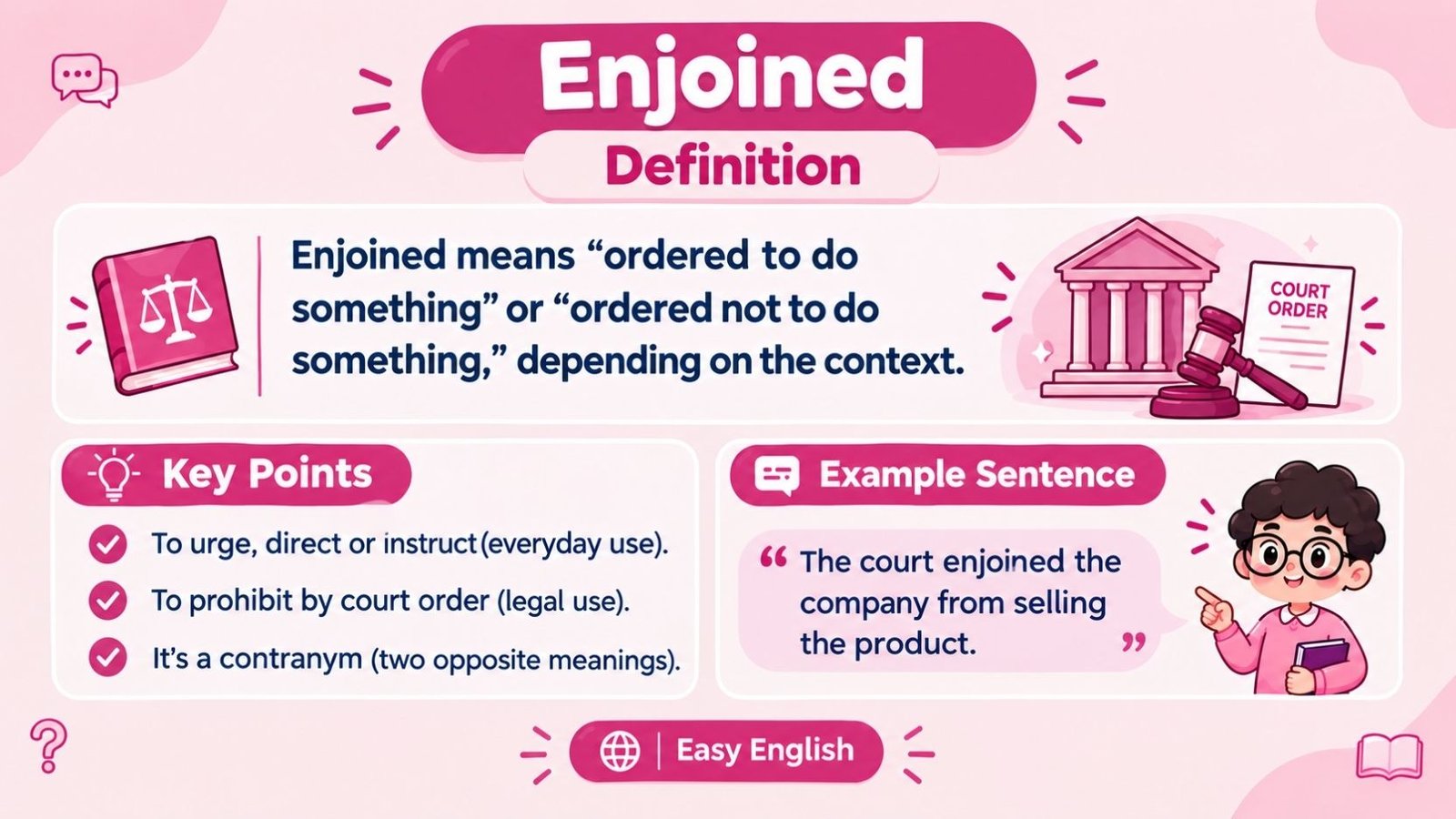
Enjoined means either “ordered to do something” or “ordered not to do something,” depending on context. It is the past tense of the verb enjoin. In everyday speech it usually means someone was urged or directed to act. In law, it almost always means a court has legally prohibited an action through an injunction.
That double meaning is not a mistake. Enjoin is one of a small group of English words, called contranyms, that can mean two nearly opposite things depending on how it is used.
At A Glance
| Detail | Information |
| Word | Enjoin (base form), Enjoined (past tense) |
| Part of speech | Verb |
| Pronunciation | en JOIN, IPA: /ɛnˈdʒɔɪn/ |
| Everyday meaning | To urge, direct, or instruct someone to do something |
| Legal meaning | To prohibit an act by court order or injunction |
| Tone | Formal |
| Common context | Legal documents, court rulings, formal writing, literature |
| Related terms | Injunction, enjoinment, prohibit, direct, command |
Read More: Honing Definition
So, What Is Enjoined in Simple Terms?
In plain language, enjoined means told to do something, or told to stop doing something, by someone with real authority.
If a teacher enjoins students to stay quiet, she is instructing them. If a court enjoins a company from selling a product, it is legally blocking that company from selling it.
The word almost never appears in casual conversation. You will meet it mostly in legal writing, news coverage of lawsuits, formal instructions, and older or literary English.
Enjoined Definition: Legal Meaning
The legal meaning is the one most people are actually looking for. In law, to enjoin means to prohibit an action through a court order called an injunction.
Enjoin is an order by a court or official authority to do or refrain from doing an act, and to enjoin is to prohibit by judicial order or to issue an injunction against someone. This is the sense used when a news report says a judge “enjoined” a company or government agency from doing something.
Note: In legal writing, “enjoined” almost always leans toward the prohibition sense, not the instruction sense. If a court enjoined a party, that party has been ordered to stop, not told to start.
Permanently Enjoined Definition
When a court issues a final ruling that a certain action can never happen again, the affected party is described as permanently enjoined. This is different from a temporary restraining order or a preliminary injunction, both of which apply only while a case is still being decided.
A party that is permanently enjoined from doing something is legally barred from that specific action going forward, usually as the final outcome of a lawsuit, unless a higher court later overturns the ruling.
Enjoined Court Definition
When people search “enjoined court definition,” they usually want to know what it means for a court to enjoin someone. It means the court has used its authority to issue a binding order, either requiring an action or, far more commonly, forbidding one, and that order can be enforced through contempt proceedings if it is ignored.
How Do You Pronounce Enjoin?
Enjoin is pronounced en JOIN, with the stress on the second syllable. In IPA, that is /ɛnˈdʒɔɪn/. The past tense, enjoined, is pronounced en JOINED, or /ɛnˈdʒɔɪnd/.
It rhymes with words like “join” and “coin” in the final syllable, which makes sense once you know its origin.
Where Does Enjoin Come From?
Enjoin has a Latin and French history behind it. It comes from Middle English enjoinen, from Old French enjoindre, from Latin iniungere, built from the prefix meaning “into” and the verb iungere, meaning “to join.”
That root, iungere, “to join,” is the same root behind words like junction, injunction, adjoin, and even yoga. The idea is that enjoin literally means to “join” a duty, obligation, or restriction onto a person.
Merriam-Webster notes an interesting family connection here as well: enjoin shares its root with the word junta, since both come from the Latin jungere, meaning “to join,” though enjoin specifically involves linking a person to an action by requiring or prohibiting it.
Enjoin Is a Contranym: Two Opposite Meanings
This is the part that confuses most readers, and it is worth explaining clearly because it is the actual reason the word feels tricky.
Enjoin belongs to a small category of English words called contranyms, words that can mean two opposite things depending on context.
Meaning 1: To order or direct someone to act.
Example: The coach enjoined the team to give full effort.
Meaning 2: To forbid or legally prohibit an action.
Example: The court enjoined the factory from dumping waste into the river.
A dictionary reference on contranyms makes this exact point about the word: enjoin can mean either to order or prescribe a course of action, or to forbid or restrain someone, and context makes clear which meaning applies.
Tip: Look at the preposition. “Enjoined to” usually signals a command to act. “Enjoined from” almost always signals a prohibition.
Merriam-Webster confirms this pattern directly: when enjoin means to direct or impose something, the word “to” typically follows, as in they enjoined us to secrecy, while when prohibition is meant, “from” is common, as in signs enjoin attendees from photographing the event.
How Is Enjoined Actually Used in Real Life?
Enjoined shows up in a few fairly distinct settings, and the meaning shifts slightly with each one.
- Legal and court settings: Almost always means prohibited by court order. This is the dominant modern usage.
- Formal or literary writing: Often means urged, instructed, or directed with authority and seriousness.
- Religious and biblical texts: Frequently means commanded or charged with a duty.
- Everyday conversation: Rare. Most people use “told,” “ordered,” or “banned” instead.
Because the legal meaning dominates modern usage, most readers encountering “enjoined” in a news article or contract should default to the prohibition sense unless the sentence clearly points the other way.
What Does Enjoined Look Like In A Sentence?
Different contexts change which meaning applies. Here are original examples across several settings.
- Legal context
The judge enjoined the company from releasing the defective product until further testing was complete. - News coverage of a lawsuit
State officials were enjoined from enforcing the new regulation while the appeal was pending. - Formal instruction
The manual enjoins technicians to disconnect the power supply before beginning any repair. - Everyday formal speech
Her parents enjoined her to call as soon as she landed. - Older or literary style
He was enjoined by his conscience to tell the truth, whatever it cost him.
Enjoin Versus Injunction: What Is the Difference?
These two words are closely related but are not the same part of speech, and mixing them up is a common source of confusion.
| Term | Meaning | Typical Use | Key Difference |
| Enjoin | The verb: to order, or to legally prohibit, an action | Used in sentences describing what a court or authority does | An action word describing the act of ordering or prohibiting |
| Injunction | The noun: the formal order itself | Used to name the legal document or ruling | The actual court order, not the act of issuing it |
In short, a court enjoins a party, and the resulting legal document is called an injunction. You enjoin someone; you do not “injunction” them.
Read More: Ren Definition
What Words Mean Something Similar to Enjoined?
Because enjoin carries two meanings, its synonyms split into two separate groups.
Synonyms for the “command” meaning:
Order, direct, instruct, charge, urge, require
Synonyms for the “prohibit” meaning:
Forbid, prohibit, bar, restrain, ban, proscribe
A usage note from Merriam-Webster places enjoin among words for issuing orders, explaining that enjoin implies giving an order or direction authoritatively and urgently, often with admonition or solicitude, as in a sign enjoining patrons to be quiet.
Enjoin Antonyms
Because enjoin can itself mean “forbid,” its antonym depends on which sense is being used.
- If enjoin means “to command,” a reasonable antonym is discourage or dissuade.
- If enjoin means “to prohibit,” the antonym is permit, allow, or authorize.
Before You Use Enjoined: Remember This
Enjoined does not always mean “banned.” In casual or literary writing, it can just as easily mean someone was strongly urged or instructed to do something. Always check the surrounding words, especially whether “to” or “from” follows the verb, before assuming which meaning applies.
Is Enjoined The Same As Enjoinment?
Not quite. Enjoin is the verb. Enjoined is its past tense and past participle. Enjoinment is a noun referring to the act or result of enjoining something, meaning the state of being legally restrained.
Legal glossaries use enjoinment to describe this restrained state directly: enjoinment can mean any legal restraint or prohibition, whether imposed by court order, a negotiated settlement, or otherwise, with “enjoined” understood accordingly.
Enjoin Enforcement Meaning
When people search “enjoin enforcement meaning,” they are usually asking about a specific legal scenario: a court ordering a government body or official to stop enforcing a particular law or rule while a legal challenge is resolved.
This happens often in constitutional and regulatory disputes. A party sues, claims a law is unlawful, and asks the court to enjoin enforcement, meaning to pause or permanently stop officials from applying that law, while the underlying legal question is decided.
What Does Enjoined Mean In The Bible?
Older Bible translations, particularly the King James Version, use enjoin in the “command” sense rather than the legal sense.
A biblical reference dictionary explains that in Scripture, the word’s usual sense is to impose something, such as a command, a charge, or a direction, appearing in passages like Esther 9:31 to mean “to command,” and in Philemon 1:8 to mean “to order” or “direct.”
One well known instance appears in Hebrews, where Moses is described as sprinkling blood on the people, calling it the blood of the testament which God had enjoined unto them. Here, enjoined simply means commanded or established as binding.
Quick takeaway: In biblical English, enjoined almost always means commanded, not prohibited. That is the opposite of how most modern legal writing uses it.
Enjoined Definition: Romeo And Juliet
Some searchers connect this word to Shakespeare, and specifically to Romeo and Juliet, but that association does not hold up well. The word does not appear as a defining or memorable term in that particular play.
Shakespeare did use the word elsewhere, however. In The Merchant of Venice, a character says he is enjoined by oath to observe certain conditions, using the classic “commanded or bound by duty” sense of the word rather than the legal prohibition sense.
If you encountered “enjoined” in a study guide or quiz tied to Shakespeare generally, it is worth double checking which specific play and line are actually being referenced, since it is not a term closely tied to Romeo and Juliet specifically.
Should You Use The Word Enjoined?
Enjoined is accurate and correct, but it is formal. In everyday writing or speech, simpler words usually communicate the same idea more naturally.
- In casual writing, prefer “told,” “ordered,” or “banned.”
- In legal, academic, or formal writing, “enjoined” is appropriate and precise.
- In fiction or literary writing, “enjoined” can add a formal or old-fashioned tone on purpose.
There is nothing incorrect or outdated about the word itself. It simply sits at the formal end of the language, so it should be reserved for contexts where that tone fits.
Enjoin In Spanish
There is no single one-word Spanish equivalent, because Spanish also needs to distinguish between the two meanings.
- For the “command” sense, Spanish typically uses ordenar or exhortar (to order, to urge).
- For the legal “prohibit” sense, Spanish typically uses prohibir mediante una orden judicial or imponer una medida cautelar (to prohibit through a court order, or to impose an injunction).
A translator or legal professional should always confirm the exact phrasing for formal or legal documents, since precise legal terminology varies by country.
Read More: Clothe Definition
Frequently Asked Questions
What does enjoined mean in simple terms?
Enjoined means someone was ordered or strongly directed to do something, or was legally forbidden from doing something. The correct meaning depends on context.
Is enjoined the same as being sued?
No. Being sued means a lawsuit was filed against someone. Being enjoined means a court has issued a specific order requiring or prohibiting an action, which often happens during or after a lawsuit.
What is the difference between enjoin and injunction?
Enjoin is the verb describing the act of ordering or prohibiting something. Injunction is the noun naming the formal court order that results from that act.
Is enjoin a formal or casual word?
Enjoin is formal. It appears mainly in legal writing, official instructions, religious texts, and literary English, rarely in everyday conversation.
Can enjoined mean both allowed and forbidden?
Enjoined can mean either commanded to act or forbidden from acting, but it never means “allowed” in a neutral sense. Context, especially the word “to” versus “from,” clarifies which meaning applies.
What does permanently enjoined mean?
Permanently enjoined means a court has issued a final order permanently prohibiting a specific action, as opposed to a temporary or preliminary restriction that only applies while a case is ongoing.
How do you pronounce enjoined?
Enjoined is pronounced en JOINED, or /ɛnˈdʒɔɪnd/, with stress on the second syllable.
What is a synonym for enjoin?
Depending on the intended meaning, synonyms include order, direct, and instruct for the command sense, or forbid, prohibit, and restrain for the legal sense.
Does enjoin always relate to court cases?
No. While the legal meaning is common in modern usage, enjoin also appears in formal, literary, and religious writing to mean commanded or urged, without any court involved.
Last Words
Enjoined means ordered to do something, or legally barred from doing something, and only context reveals which one applies. In court documents and news about lawsuits, assume the prohibition sense. In older, formal, or religious writing, assume the command sense. Either way, it is a word for authority, not casual conversation.

Laiba Rahman is a writer and researcher behind Definixaa, dedicated to exploring words, meanings, terms, concepts, and everyday knowledge. Through clear and well-researched explanations, her goal is to help readers understand unfamiliar ideas quickly and discover useful information with ease.
One Comment