
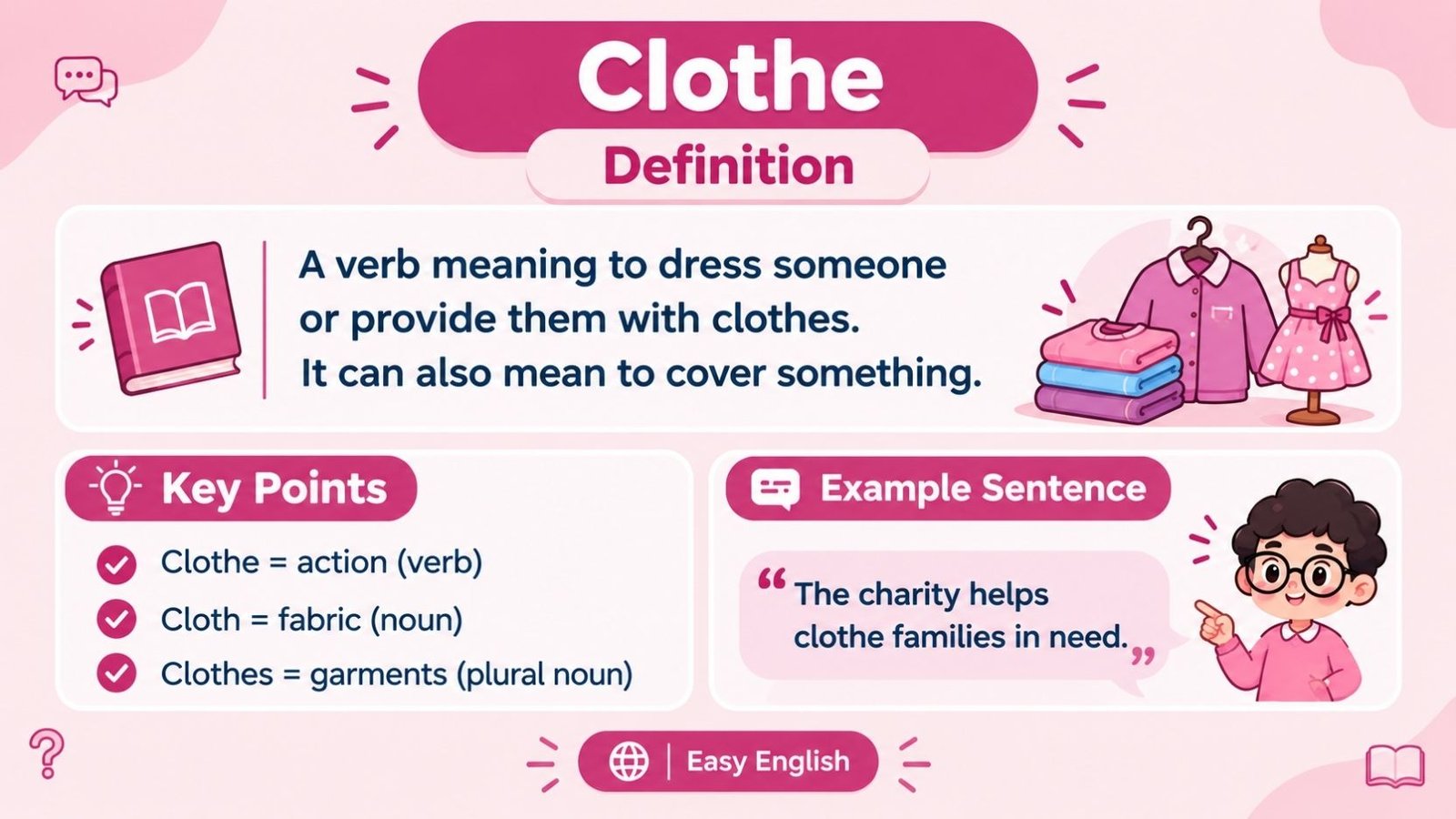
Quick definition: Clothe is a verb that means to cover a person’s body with clothing, or to provide someone with clothes. It can also be used figuratively, meaning to cover or express something as if dressing it, such as “clothe an idea in simple words.”
That is the core meaning. Everything else about this word builds on that one idea.
At A Glance
| Detail | Information |
| Word type | Verb (transitive and intransitive) |
| Pronunciation | klohth (rhymes with “clothe,” IPA: /kloʊð/) |
| Past tense | Clothed or clad |
| Tone | Formal to neutral; common in writing, less common in casual speech |
| Related words | Cloth (noun), clothes (noun), clothing (noun) |
| Common confusion | Mixed up with cloth and clothes, which are different parts of speech |
What Does Clothe Actually Mean?
According to Merriam-Webster, clothe means to cover with or as if with cloth or clothing, which is essentially the same as “dress.” Collins Dictionary describes it the same way, noting that to clothe someone means to provide them with clothes to wear.
So the word covers two closely related ideas:
- Putting garments on a person’s body.
- Supplying someone with clothes they need, such as a parent clothing a family.
Merriam-Webster also lists a figurative sense: clothe can mean to express or enhance something through carefully chosen language, as in a treaty clothed in formal phrasing. A related figurative use is to endow someone with a quality or power, such as being “clothed with authority.”
Read More: Ren Definition
In Simple Words
Think of clothe as the action version of putting clothes on someone or something.
- If you clothe a child, you dress them or buy clothes for them.
- If you clothe an idea in simple language, you are presenting that idea using plain, easy to understand words instead of complicated ones.
- If a hillside is “clothed in snow,” the snow is covering it the way a garment would cover a body.
The word almost always involves the idea of covering, providing, or wrapping something, whether that something is a person, a thought, or even a landscape.
Clothe vs Cloth vs Clothes: The Most Common Confusion
These three words look similar but belong to completely different categories. This mix-up is one of the most frequent reasons people search for a clear definition.
| Term | Part of speech | Meaning | Example |
| Clothe | Verb | To put garments on someone, or to provide them with clothes | “They worked hard to clothe and feed their children.” |
| Cloth | Noun | A piece of woven or knitted fabric, such as cotton or wool | “She wiped the counter with a soft cloth.” |
| Clothes | Noun (plural) | Garments worn on the body, collectively | “He hung his clothes in the closet.” |
A simple way to remember the difference:
- You use a cloth to clean something.
- You wear clothes on your body.
- You clothe a person when you dress them or supply their clothing.
Note: Cloth definition in English, in its most basic form, refers only to the fabric material itself, not the finished garment. A tablecloth, a dishcloth, and a piece of cotton cloth are all examples of this fabric meaning, not of the verb clothe.
Clothe Definition In The Bible
The word clothe appears often in Scripture, and it carries both a literal and a symbolic meaning. Topical Bible resources note that clothing in the Bible carries literal and metaphorical significance, reflecting themes of provision, identity, righteousness, and transformation.
Literal use: In Genesis, God is described as making garments for Adam and Eve after they realized they were naked, an early literal example of clothing someone.
Figurative or spiritual use: The word is frequently used to describe an inner transformation rather than a physical garment. For example, Colossians 3:12 encourages believers to clothe themselves with qualities such as compassion, kindness, humility, gentleness, and patience, meaning they should take on these traits the way a person puts on clothing.
The King James Bible Dictionary lists several related senses used across Scripture, including covering the body, investing someone with authority, and encompassing or surrounding something, as in being “clothed with majesty” or “clothed with honor.”
So in a biblical context, clothe rarely refers only to putting on fabric. It usually points to taking on a quality, identity, or spiritual state, much like wearing a garment on the outside reflects something on the inside.
Clothe And Cloth Definitions For Kids
For younger readers, the idea can be explained much more simply.
- Clothe (for kids): To clothe someone means to help them put clothes on, or to give them clothes to wear. A parent clothes their children by buying them shirts, pants, and shoes.
- Cloth (for kids): A cloth is a piece of soft material, like the fabric used to make a shirt or a towel. You might use a cloth to wipe up a spill.
- Clothes (for kids): Clothes are the things people wear, like shirts, pants, dresses, socks, and jackets.
A simple way to teach the difference to a child: cloth is the material, clothes are the finished items you wear, and to clothe someone means to give them those items or help them get dressed.
How Clothe Is Actually Used In Real Life
Clothe is a real, standard English word, but it is not used as often in casual conversation as its related forms, clothed and clothing.
- In everyday speech, people are more likely to say “get dressed” or “buy clothes” than “clothe myself.”
- In writing, news articles, and formal contexts, clothe appears more naturally, especially in phrases about providing for a family: “to feed and clothe their children.”
- In literature, poetry, and religious writing, clothe is used often in its figurative sense, describing ideas, emotions, or spiritual qualities being “put on” like a garment.
- The past tense forms, clothed and clad, are extremely common and appear in both everyday and formal writing.
Note: The irregular past tense clad is older and slightly more literary, often used in phrases like “clad in armor” or “clad in black.”
What Does Clothe Look Like in a Sentence?
Here are original example sentences showing different contexts.
Everyday context
“They clothe their three children on a tight monthly budget.”
Formal or news context
“The charity works to feed and clothe families affected by the flood.”
Figurative context
“She clothed her criticism in polite, careful language.”
Literary or poetic context
“The mountains were clothed in early morning mist.”
Biblical or spiritual context
“Clothe yourselves with humility and kindness.”
Where Did The Word Clothe Come From?
The word has a long history in English. Collins Dictionary traces it to Middle English clothen, from Old English clathian, which is related to cloth. The British form of the dictionary adds that it connects to the Old English clath, meaning cloth, and is related to the Old Norse klaetha.
In short, clothe developed directly from the noun cloth. The verb was formed to describe the action of covering someone with that fabric, which is why the two words still look and sound so similar today.
How Do You Pronounce Clothe?
Clothe is pronounced “klohth,” rhyming with “both” but with a soft “th” sound at the end, similar to the “th” in “breathe.” In IPA, it is written as /kloʊð/.
This is different from cloth, which has a shorter vowel sound and a harder “th,” closer to “klawth” or /klɔːθ/. Mixing up these two pronunciations is common, since the spelling is so similar.
What Words Mean Something Similar to Clothe?
Merriam-Webster’s thesaurus lists several accepted synonyms, including dress, garment, apparel, costume, gown, attire, and garb.
Close synonyms:
- Dress
- Attire
- Garb
- Array
- Robe (as a verb)
Opposite words (antonyms):
According to Merriam-Webster, common antonyms of clothe include strip, undress, disrobe, unclothe, uncover, and divest.
These opposites are useful for understanding tone: clothe leans slightly formal, and so do most of its true antonyms, like disrobe and divest, rather than casual phrases like “take off.”
Before You Use Clothe, Remember This
Clothe is a real and correct English verb, but it can sound slightly formal or old-fashioned in casual speech. Saying “I need to clothe myself” sounds unnatural compared to “I need to get dressed” or “I need to buy some clothes.”
Clothe fits best in:
- Formal or written contexts.
- Figurative expressions about ideas, qualities, or language.
- Discussions of providing for someone’s basic needs, such as “feed and clothe.”
- Biblical, literary, or poetic writing.
It fits less naturally in relaxed, spoken conversation about your own daily routine.
What Clothe Does Not Mean
Because clothe, cloth, and clothes look alike, people sometimes misuse them. A few important clarifications:
- Clothe is not a noun. You cannot say “a clothe” to mean a fabric item; the correct noun is cloth.
- Clothe does not refer to a single piece of fabric. That meaning belongs to cloth, as in a dishcloth or a piece of cloth.
- Clothe does not mean the collection of garments themselves. That meaning belongs to clothes, the plural noun for the items people wear.
If you are talking about the action of dressing someone or supplying clothing, clothe is correct. If you are talking about fabric or finished garments, you need cloth or clothes instead.
Common Cloth Related Compound Terms
Since many related searches ask about specific types of cloth, here is a quick reference table for the most common ones.
| Term | What It Means |
| Terry cloth | An absorbent, looped cotton fabric commonly used for towels and robes |
| Drop cloth | A large sheet of fabric or plastic used to protect floors and furniture, often during painting |
| Tablecloth | A piece of cloth laid over a table, often for dining or decoration |
| Lint free cloth | A cloth made from material that does not shed fibers, often used for cleaning glass, lenses, or electronics |
| Whole cloth | A phrase meaning something made entirely from one piece of fabric; figuratively, it describes a claim invented entirely, as in “made up out of whole cloth” |
| Microfiber cloth | A cloth made from extremely fine synthetic fibers, often used for cleaning because it traps dust and absorbs liquid well |
Read More: Allegedly Definition
Common Clothes Related Compound Terms
The plural noun clothes also appears in several everyday compound words.
- Clothespin: A small clip used to fasten wet clothes to a clothesline while they dry.
- Clothesline: A rope or wire stretched outdoors or indoors where clothes are hung to dry.
- Clotheshorse: A foldable rack used for drying clothes indoors; informally, it can also describe a person who loves dressing fashionably.
- Clothes hamper: A basket or container used to store dirty clothes before washing.
- Clothes hanger: A shaped frame, usually of wire, plastic, or wood, used to hang clothes in a closet.
- Clothespress: An older term for a cabinet or wardrobe used to store folded clothes, more common in historical or British English.
- Clothery: A less common term sometimes used informally to refer to a clothing business or clothes-making trade; it is not a standard dictionary entry and appears mainly in niche or regional usage.
- Clothesless: An informal, rarely used term meaning without clothes; it is understandable but not a widely recognized dictionary word.
Tip: Clothery and clothesless are not firmly established dictionary words. If precision matters, “clothing business” and “unclothed” are the clearer, more standard choices.
When Should You Use the Word Clothe?
Use clothe when you want to describe:
- The act of putting clothing on someone, especially in formal or written English.
- Providing for someone’s basic clothing needs, as in “feed and clothe.”
- A figurative covering, such as ideas, feelings, or qualities being expressed through specific language or behavior.
- Biblical, literary, or poetic writing where the symbolic sense fits naturally.
Avoid using it in casual speech about your own daily habits, where simpler alternatives like “get dressed” or “put on clothes” sound more natural.
Frequently Asked Questions
What does clothe mean in simple terms?
Clothe means to put clothes on a person or to provide them with clothing. It can also mean to cover or express something figuratively, such as clothing an idea in careful words.
Is clothe the same as clothes?
No. Clothe is a verb describing an action, while clothes is a plural noun referring to the garments themselves, such as shirts and pants.
Is clothe the same as cloth?
No. Cloth is a noun meaning a piece of fabric, while clothe is a verb meaning to dress someone or supply them with clothing.
What is the past tense of clothe?
The past tense can be either clothed or clad. Clothed is more common today, while clad is slightly more literary and often used in phrases like “clad in armor.”
Is clothe a formal word?
Yes, clothe tends to sound more formal or literary than everyday phrases like “get dressed” or “put on clothes,” though it is still standard, correct English.
What does clothe mean in the Bible?
In the Bible, clothe is used both literally, for putting on physical garments, and figuratively, for taking on qualities such as humility, righteousness, or honor, as if putting them on like clothing.
How do you explain clothe to a child?
Tell a child that to clothe someone means to help them put on clothes or to give them clothes to wear, the way a parent clothes their children with shirts and shoes.
What is a synonym for clothe?
Common synonyms include dress, attire, garb, and array. The opposite, meaning to remove clothing, includes words like undress, disrobe, and strip.
Why do people confuse clothe, cloth, and clothes?
The three words share the same root and very similar spelling, but they serve different grammatical roles: clothe is a verb, cloth is a singular fabric noun, and clothes is a plural garment noun.
Is clothe used in modern English?
Yes, though less often in casual speech. It remains common in formal writing, news reporting about aid and charity, biblical and literary texts, and figurative expressions.
Last Words
Clothe is a verb meaning to dress someone or supply them with clothing, and it can also describe covering or expressing something figuratively. It is distinct from cloth, which means fabric, and clothes, which means the garments themselves. Once you separate these three related words, the confusion around clothe tends to disappear.

Laiba Rahman is a writer and researcher behind Definixaa, dedicated to exploring words, meanings, terms, concepts, and everyday knowledge. Through clear and well-researched explanations, her goal is to help readers understand unfamiliar ideas quickly and discover useful information with ease.
One Comment