
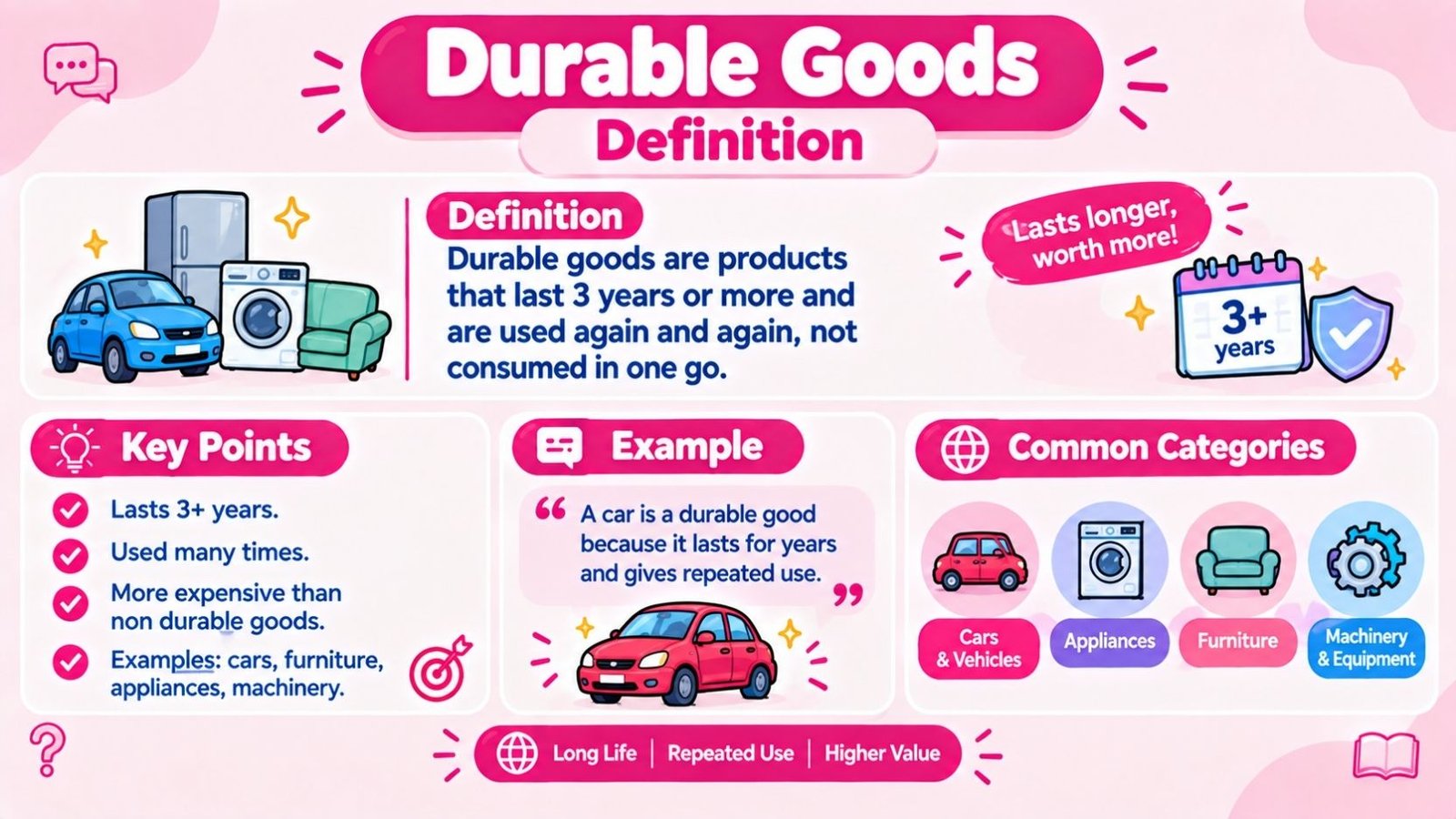
Durable goods are products built to be used repeatedly over a long period instead of being used up in one go. In economics, a good is officially classified as durable when it has an average life expectancy of three years or more, a standard used by the U.S. Bureau of Economic Analysis and the U.S. Census Bureau. The defining boundary is the product’s expected lifespan, which is set at three years, and a product is officially classified as durable if it has an average life expectancy of three years or more.
Cars, refrigerators, furniture, and machinery are all durable goods. Food, fuel, and cosmetics are not, because they get consumed or wear out quickly.
At A Glance
| Detail | Information |
| Meaning | A good that provides use repeatedly over an extended period rather than being consumed at once |
| Type | Economic and business classification term |
| Threshold | Average life expectancy of three years or more |
| Tone | Formal, technical, used in economics, accounting, and government statistics |
| Common context | Economic indicators, consumer spending reports, wholesale trade data, accounting |
| Related terms | Non durable goods, semi durable goods, capital goods, consumer goods |
Read More: Notions Definition
So, What Does Durable Goods Actually Mean?
At its simplest, a durable good is anything a person or business buys once and then keeps using for years. It is not destroyed or used up the first time someone uses it.
Think of a washing machine. You buy it, and it keeps working through hundreds of loads over several years. Compare that with a bar of soap, which disappears after a handful of uses. The washing machine is durable. The soap is not.
In economics, a durable good is a good that does not quickly wear out, or more specifically, one that yields utility over time rather than being completely consumed in one use. That single idea, value delivered over time rather than all at once, is the core of the entire concept.
The Formal Economic Definition
Government statistical agencies need a precise rule, not just a general idea, so they can sort products consistently. BEA’s fixed asset accounts define consumer durables as tangible products that can be stored or inventoried and that have an average life of at least three years.
The Census Bureau applies the same threshold when classifying wholesalers and manufacturers. Durable goods are new or used items generally with a normal life expectancy of three years or more. That three year mark is what separates a durable good from a non durable one in nearly every official U.S. data source.
Note: The three year figure is a statistical convention, not a guarantee. A cheap umbrella might fall apart in one storm, and a well-made umbrella might last a decade. Classification is based on the average or expected life of that product category, not any single item.
What Durable Goods Look Like In Practice
A durable good usually shares a few traits, even though not every example has all of them.
- It survives repeated use without being consumed.
- It typically costs more upfront than a comparable non durable item.
- It is bought infrequently, sometimes only once every several years.
- It often needs occasional maintenance or repair rather than replacement.
- It can usually be resold or has some residual value later.
None of these traits alone defines a durable good. A cheap plastic toy might be used repeatedly but wear out in a season, and would not count as durable in the statistical sense. The core test is still expected lifespan, not price or material quality.
Durable Goods Examples
Concrete examples make the category easier to recognize.
Household and consumer durable goods
- Refrigerators, washing machines, and dishwashers
- Furniture, such as sofas, beds, and dining tables
- Televisions, laptops, and other electronics
- Cars, motorcycles, and bicycles
- Power tools and major kitchen appliances
Business and industrial durable goods
- Manufacturing machinery and factory equipment
- Commercial vehicles and construction equipment
- Office furniture and computer hardware
- Medical equipment used in hospitals and clinics
Example sentence, everyday context: “We finally replaced our old dryer, so that’s one durable good we won’t need to think about for years.”
Example sentence, business context: “The company’s capital budget this quarter is mostly durable goods, including new assembly line equipment.”
Example sentence, news or financial context: “Durable goods orders rose last month, a sign that manufacturers expect stronger demand ahead.”
Read More: Soft Money Definition
Non Durable Goods Definition
Non durable goods sit on the opposite end of the same scale. Nondurable goods are items generally with a normal life expectancy of less than three years, including products such as paper and paper products, chemicals, drugs, textiles, apparel, footwear, groceries, farm products, petroleum products, alcoholic beverages, and tobacco products.
In plain terms, a non durable good is something that gets used up, eaten, or worn out quickly, usually well within a year or two.
Non durable goods examples
- Food and beverages
- Cleaning supplies and toiletries
- Fuel and gasoline
- Paper products and packaging
- Clothing that wears out quickly, such as basic apparel
- Cigarettes and tobacco products
Quick Takeaway: If you would need to buy it again within a year or two of normal use, it’s very likely a non durable good. If it could still be sitting in your house doing its job five years from now, it’s very likely durable.
Durable Goods Vs Non Durable Goods
| Term | Meaning | Typical Use | Key Difference |
| Durable Goods | Products expected to last three years or more without being used up | Cars, appliances, furniture, machinery | Provides value repeatedly over a long period |
| Non Durable Goods | Products expected to last less than three years, often consumed quickly | Food, fuel, toiletries, paper goods | Used up or worn out in a short time |
Note: Purchase frequency tracks with this difference too. Nondurable goods are products that are either consumed immediately or possess a short useful life before replacement is necessary, and because they are used up quickly, they require consumers to make successive purchases in a short cycle. Durable goods, by contrast, create a long gap between one purchase and the next.
Semi Durable Goods: The Category in Between
Not every product fits neatly into “lasts three years” or “gone in a week.” That is where semi durable goods come in.
Semi durable goods are products that last longer than typical non durables but not as long as full durable goods, often somewhere in the range of one to three years of expected use. This category shows up most often in retail analysis, household consumption surveys, and some national statistical systems outside the U.S. that use a three way split rather than a strict two way one.
Semi durable goods examples
- Basic clothing and footwear
- Bedsheets, towels, and linens
- Utensils, crockery, and low-cost kitchenware
- School bags and stationery items with moderate lifespan
- Inexpensive toys
Tip: If you see “semi durable” in a report, check which statistical system produced it. Not every country or agency uses this middle category. The U.S. Census Bureau and BEA generally classify goods as either durable or non durable, without a formal semi durable tier, while some other national accounts frameworks do include it.
Durable Goods In Business And Wholesale Trade
The durable versus non durable split is not only a consumer concept. It also structures how entire industries and government surveys are organized.
The wholesale trade sector is split into two subsectors under the North American Industry Classification System: merchant wholesalers of durable goods (NAICS 423) and merchant wholesalers of nondurable goods (NAICS 424). Wholesalers in the durable goods subsector sell items such as vehicles, machinery, furniture, and electronics to other businesses, while wholesalers in the nondurable goods subsector handle products like groceries, chemicals, apparel, and petroleum.
The Merchant Wholesalers, Nondurable Goods subsector sells nondurable goods to other businesses, generally items with a normal life expectancy of less than three years, including paper products, chemicals, drugs, textiles, apparel, footwear, groceries, farm products, petroleum products, alcoholic beverages, and tobacco products.
This is also why financial reports and economic data releases talk about “durable goods orders” and “wholesale durable goods sales” as separate figures from non durable categories. The classification determines which government survey a business falls under and how its sales get reported nationally.
Why Durable Goods Matter As An Economic Indicator
Durable goods spending is one of the more closely watched signals in macroeconomics, and there is a clear reason for that.
Durable goods are a type of consumer good typically expected to last three years or more, such as appliances, automobiles, furniture, and electronics, and because they are more expensive than non durable goods like food or clothing, they represent a significant purchase for consumers.
Because these purchases are big and optional, people tend to delay them when money feels tight. Consumers generally only feel confident enough to buy large-ticket durable items when they feel good about the economy or their personal finances, which is why durable goods orders are often among the first economic indicators to turn down when the economy begins to struggle.
That sensitivity is exactly why economists and investors track the monthly durable goods orders report. A drop in new orders can hint at weakening consumer or business confidence before it shows up elsewhere in the economy. A rise can suggest the opposite.
Durable goods form an important part of economic production, illustrated by the fact that personal expenditures on durables exceeded eight hundred billion dollars in the year 2000, when durable goods production made up roughly sixty percent of aggregate manufacturing sector output in the United States. The scale involved is one reason this single category gets its own dedicated government report rather than being folded into broader retail sales data.
How Durable Goods Are Treated in Accounting
Businesses and accountants generally treat durable goods differently from everyday supplies. A durable good used in producing a company’s products, like a piece of factory equipment, is usually recorded as a capital asset and depreciated over its useful life rather than expensed all at once. Non durable supplies, like packaging materials or office paper, are typically expensed as they are used.
This distinction matters for tax treatment, budgeting, and how a company reports its assets on a balance sheet. It is one reason the durable versus non durable line shows up not just in consumer spending reports, but throughout corporate finance and accounting practice as well.
What Durable Goods Does Not Mean
A few common mix-ups are worth clearing up.
- Durable does not mean indestructible. A durable good can still break, wear out early, or be damaged. The classification is about typical, expected lifespan, not a guarantee.
- Durable does not automatically mean expensive. Most durable goods do cost more than non durables, but price alone is not the defining test. Lifespan is.
- Durable goods are not the same as capital goods, though the two overlap. Capital goods are items businesses use to produce other goods, such as factory machinery. Many capital goods are durable, but consumer items like a home refrigerator are durable goods without being capital goods.
- The three year line is a convention, not a law of physics. Some non durable items last longer than three years in practice, and some durable-category items fail sooner. Classification is based on category-level expectations, not individual product guarantees.
Read More: Rotate Definition
When Should You Use the Term Durable Goods?
Use “durable goods” when you are talking about:
- Economic reports, consumer confidence data, or manufacturing indicators
- Business classification, accounting, or asset planning
- Product categories in retail or wholesale contexts
- Personal budgeting for big, infrequent purchases
In casual conversation, most people simply say “appliances,” “big purchases,” or name the item directly. “Durable goods” is the more formal, technical version of that same idea, and it appears far more often in economic writing, financial news, and government statistics than in everyday speech.
Frequently Asked Questions
What is the simplest definition of durable goods?
Durable goods are products that last three years or more and provide repeated use instead of being consumed in a single use, such as cars, appliances, and furniture.
What is the difference between durable and non durable goods?
Durable goods last three years or more and are used repeatedly, while non durable goods are consumed or wear out in less than three years, often within months.
What is an example of a durable good?
A refrigerator is a classic example. It is bought once, used repeatedly for years, and is not consumed in any single use.
What is an example of a non durable good?
Food is a common example. It is consumed shortly after purchase and must be bought again on a regular cycle.
What are semi durable goods?
Semi durable goods are products with a lifespan longer than typical non durables but shorter than full durable goods, often basic clothing, linens, or inexpensive household items.
Are durable goods considered an economic indicator?
Yes. Durable goods orders are tracked monthly because big, optional purchases tend to rise when consumers feel confident and fall when confidence weakens.
Is a car a durable good?
Yes. Cars are one of the most commonly cited durable goods, since they are used repeatedly for years after a single purchase.
Does durable goods classification apply to businesses too?
Yes. Wholesalers and manufacturers are grouped into durable goods and nondurable goods categories for government surveys and industry classification, separate from the consumer classification.
Why is the three year rule used specifically?
Three years is the threshold that U.S. statistical agencies, including the Bureau of Economic Analysis and the Census Bureau, use to consistently separate durable products from non durable ones across national data.
Can a durable good become a non durable good depending on use?
No. Classification is based on the typical expected lifespan of that product category, not how any one person happens to use or dispose of it.
Last Words
Durable goods are products meant to last, typically three years or more, delivering value again and again rather than being used up at once. Non durable goods sit on the other end, consumed or worn out quickly.
The distinction shapes how economists track consumer confidence, how wholesalers are classified, and how businesses account for what they buy. Knowing which side a product falls on tells you a lot about how it is bought, used, and measured in the economy.

Laiba Rahman is a writer and researcher behind Definixaa, dedicated to exploring words, meanings, terms, concepts, and everyday knowledge. Through clear and well-researched explanations, her goal is to help readers understand unfamiliar ideas quickly and discover useful information with ease.
One Comment